The Nile Valley has not yet finished revealing its secrets. In the space of a few months, a series of exceptional discoveries has upended our understanding of ancient EgyptAncient EgyptA civilisation that developed along the Nile for almost three millennia, from unification around 3100 BC to the Greco-Roman era; it bequeathed the pyramids, temples and hieroglyphic writing.→: empty royal tombs, ancient Indian graffiti, the first genome of a pyramid builder, and a five-thousand-year-old drill found in a drawer. A review of the most significant recent advances.
Thutmose II's tomb found - without the mummyMummyA body preserved from decay, naturally (cold, aridity, peat) or artificially; the frozen Pazyryk kurgans yielded natural mummies with tattooed skin.→
A joint Anglo-Egyptian archaeological mission working in the royal necropolisNecropolisA large organised burial ground, a "city of the dead", often spanning several periods.→ area has uncovered the tomb of Thutmose II, pharaohPharaohThe title of the ruler of ancient Egypt, regarded as a living god guaranteeing cosmic order (Maat), supreme head of state, army and worship.→ of the 18th Dynasty (around 1493-1479 BCE). The tomb is distinguished by its ceiling painted a deep blue strewn with golden stars, the iconographic signature of New Kingdom royal burials. Thutmose II was the husband and half-brother of the famous pharaoh-queen Hatshepsut, and one of the ancestors of Tutankhamun.
The discovery is major, yet it raises as many questions as it resolves. The burialBurialThe intentional deposition of a body, sometimes with offerings; a marker of symbolic behaviour.→ chamber is empty, with no sign of looting. Evidence suggests the royal body was moved in haste following a flood. As for the mummy identified in 1881 in the Deir el-Bahari cache and attributed to Thutmose II, it does not match the estimated age of the pharaoh at the time of his death. The mystery of the royal mummy remains unsolved.1
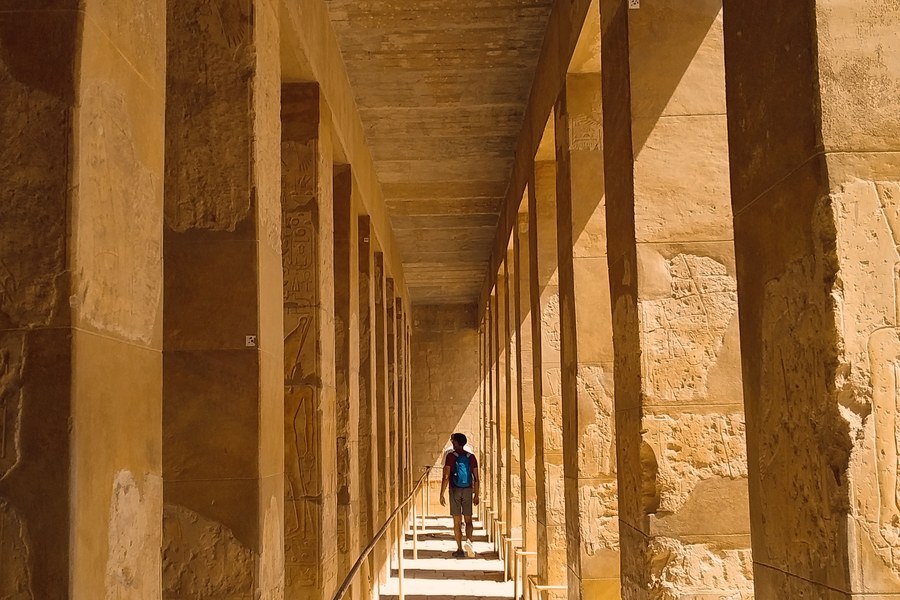
The discovery also underscores the unexplored richness of the Luxor plateau. As Egyptologist Benedicte Lhoyer, lecturer at the Ecole du Louvre, notes: "On certain sites, especially Saqqara, you are almost certain to come across remains as soon as you put a spade in the ground."
Indian tourists were already tagging royal tombs 2,000 years ago
Social media invented nothing. Researchers have just identified on the walls of six royal tombs in the Valley of the Kings some thirty graffiti written in ancient Indian languages: Tamil-Brahmi, Sanskrit and Prakrit. These inscriptions date to the period when Egypt was a Roman province, in the first centuries of the Common Era.
Among those identified, one Cikai Korran left several messages whose banality is striking: "Cikai Korran came here and saw." This traveler thus becomes the first documented tourist-tagger in history, a witness to the flourishing international trade between the Roman Empire and the Indian subcontinent via Red Sea ports.2
The first genome of an Egyptian pyramid builder
A study published in Nature reveals the first complete genome of an inhabitant of Egypt during the Old KingdomOld KingdomThe first great period of unified pharaonic Egypt (c. 2700-2200 BC, 3rd-6th Dynasties), the golden age of the great pyramids and of a strongly centralised state.→, at the time of the construction of the great pyramids. The skeleton of a man approximately 1.60 m tall, around forty years old at death and who lived some 4,600 years ago, was discovered at Nuwayrat in a funerary jar. Two perfectly preserved teeth provided the DNADNAThe molecule carrying genetic information, used to reconstruct kinship between species.→ necessary for sequencingSequencingReading the order of the bases (A, T, G, C) of a DNA molecule; high-throughput sequencing reads millions of fragments in parallel.→.
The results are surprising: the individual showed an ancestry that was 80% North African and 20% Mesopotamian, confirming the existence of early maritime migrationsMigrationsLong-distance movements of populations; a major driver of human history (the exit from Africa, the peopling of continents, Neolithic and steppe expansions).→ between the two regions via the Red Sea or the Mediterranean. Despite a life of intense manual labor - he may have been a potter - he was given a notable burial, indicating high social status. His skin tone was dark, characteristic of North African populations of the period.3
A 5,000-year-old drill found in a Cambridge drawer
Perhaps the most unexpected discovery of all. Stored in a drawer at the University of Cambridge since 1920, a "small copper awl surrounded by a leather lace" has turned out to be the oldest known rotary drill in Egypt. Microscopic analysis of its wear patterns and a fragment of leather strap preserved on the surface indicates it operated with a bow drill, a system faster and more precise than a simple manual awl.
The object is more than five thousand years old. "This small object reminds us that the Egyptians were ingenious inventors and already had remarkable tools," notes Benedicte Lhoyer. This discovery illustrates a recurring problem in archaeology: thousands of objects lie dormant in museum storerooms around the world, waiting for fresh eyes to reveal their secrets.4
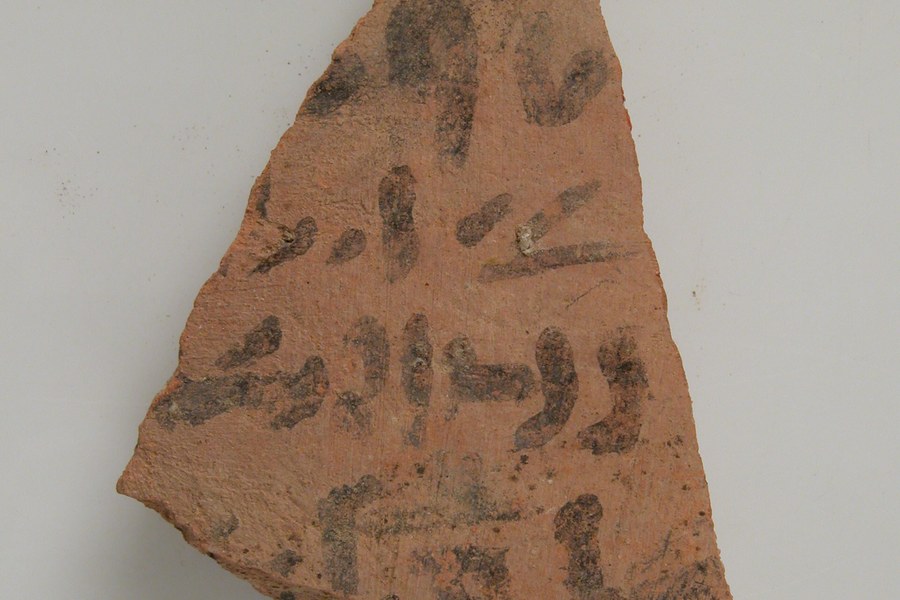
13,000 ostraca at Athribis: a thousand years of daily life
At Athribis, a joint Egyptian-German mission has unearthed some 13,000 ostraca - pottery fragments used as cheap writingWritingA system of conventional signs used to fix language or information durably; its appearance (c. 3300 BC) marks, by convention, the end of prehistory.→ supports in antiquity. Considered mere rubbish, these sherds in fact contain a wealth of documentary evidence: writing exercises, prayers, delivery vouchers, notes on animals to be sacrificed, lists of all kinds.
The collection covers a staggering period: the oldest, from the 3rd century BCE, are tax receipts in Demotic (a simplified form of hieroglyphs); the most recent are Arabic container labels dating from the 9th century CE. More than a thousand years of continuous administrative data - a treasure trove for historians of late Egypt.5
At Saqqara, the tomb of the royal physician
The necropolis of Saqqara has yielded a new treasure: the richly decorated and perfectly preserved tomb of a man named Tetinebefou. According to inscriptions engraved on the stone sarcophagussarcophagusA stone coffin, often carved, meant to hold the body of a high-ranking deceased person.→, this man who died four thousand years ago was the "dean of the palace physicians," "chief dentist" and even "specialist in venomous bites" - most likely the pharaoh's personal physician.
"The practitioners of the time had a great deal of expertise that we would call scientific - it was the Egyptians, after all, who developed the principle of auscultation," notes Benedicte Lhoyer. The burial chamber is richly decorated, but the mummy remains missing: the tomb was looted in antiquity. Only the quality of the sculpted reliefs bears witness to the exceptional rank of the deceased.6
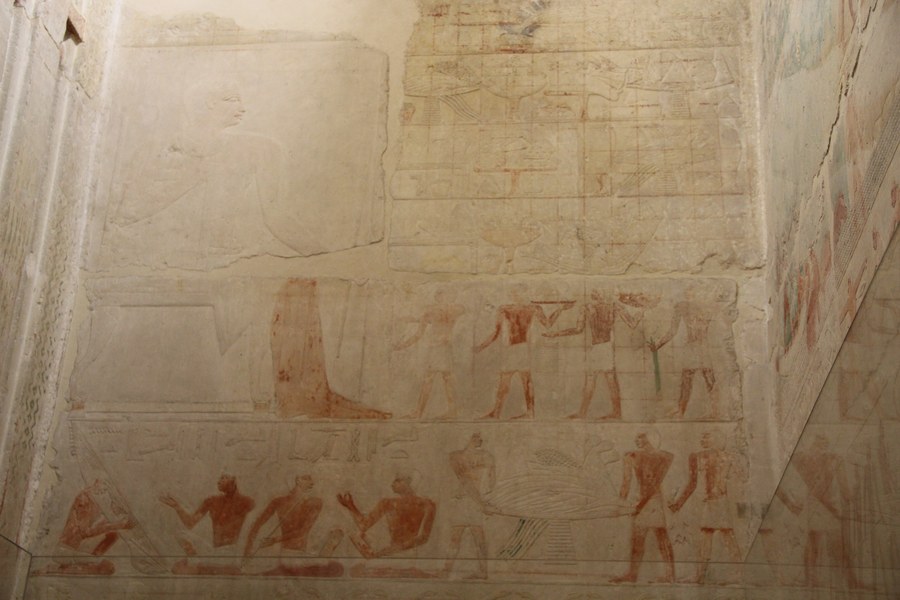
22 coffins and mummies discovered in a secret cache at Luxor
In the necropolis of Gurnah, on the west bank of Luxor, an Egyptian team has uncovered a cache containing 22 painted wooden coffins and their mummies, accompanied by rare papyri. Inscriptions carved into the wood - "singers of Amun" - indicate that these individuals were religious officiants attached to the temple of Karnak.
The arrangement of the remains suggests they were deposited in haste, likely to shield them from the recurring looting that plagued Egypt during the Third Intermediate Period (around 1070-664 BCE), a time of intense political turmoil. The discovery of intact papyri is a particularly precious scientific contribution, as these fragile documents are rarely preserved.7
These seven discoveries, diverse as they are, converge on a single conclusion: ancient Egypt has not yet revealed the full extent of its secrets. Whether it is missing mummies, pyramid builder genomes, or forgotten writing sherds, every strike of a spade - or museum drawer opened - can rewrite the history of one of the most studied civilisations in the world.
No comments yet. Be the first.