Nearly four and a half thousand years ago, on the banks of the Nile, people raised the largest stone monuments humankind has ever conceived, invented an administration capable of mobilising tens of thousands of hands, and built one of history's first centralised states. Then, within a few generations, this seemingly indestructible edifice cracked, fragmented and collapsed. The Egyptian Old KingdomOld KingdomThe first great period of unified pharaonic Egypt (c. 2700-2200 BC, 3rd-6th Dynasties), the golden age of the great pyramids and of a strongly centralised state.→, the age of the pyramids, embodies this double lesson all on its own: the grandeur of a pioneering civilisation and the fragility of every human construction in the face of time, climateClimateThe long-term average atmospheric conditions of a region; its variations (glaciations, aridifications) shaped migrations, agriculture and the collapse of prehistoric societies.→ and the internal contradictions of power.
This dossier offers an overview of that first great pharaonic civilisation. It deliberately links two moments that are too often kept apart: the rise, with its pyramids and a strikingly modern pharaonic state, and the collapse, marked by a planetary drought, the 4.2 ka event, and by the long crisis Egyptologists call the First Intermediate PeriodFirst Intermediate PeriodA phase of political fragmentation in Egypt (c. 2181-2055 BC) between the Old and Middle Kingdoms: eclipse of royal power, autonomy of nomarchs, Herakleopolis-Thebes rivalry.→. At the heart of this story stands a city: MemphisNecropolisA large organised burialBurialThe intentional deposition of a body, sometimes with offerings; a marker of symbolic behaviour.→ ground, a "city of the dead", often spanning several periods.→ and its necropolis, from the Giza plateau to the sands of Saqqara, inscribed on UNESCO's World Heritage List3. It is there, better than anywhere else, that both the power and the fall of the Old Kingdom can be read. This panorama does not claim to exhaust a subject on which entire libraries have been written; it aims rather to offer a coherent overview, linking the great stages, mechanisms and places, so that the reader can grasp at a single glance the trajectory of this pioneering civilisation.
A chronological framework: from the Thinite world to the First Intermediate Period
To understand the Old Kingdom, we must first place it. The history of ancient Egypt is not a single motionless block: it is a succession of periods of centralisation and fragmentation, which historians have organised into great eras. The Old Kingdom is the first of these phases of unity, but it belongs to a longer fabric that begins well before it, in the distant prehistoryPrehistoryThe span of human history before the invention of writingWritingA system of conventional signs used to fix language or information durably; its appearance (c. 3300 BC) marks, by convention, the end of prehistory.→, from the PalaeolithicPalaeolithicThe oldest and longest period of prehistory (c. 3.3 Ma–12,000 BC), defined by chipped stone tools and a hunter-gatherer way of life.→ to the Metal Ages, known mainly through material remains.→ of the Nile valley and in the farming societies of the African NeolithicNeolithicThe "New Stone Age": a period marked by farming, herding, settlement and pottery, from around 10,000 BC.→.
Before the Old Kingdom comes the so-called Thinite period, that of the first two dynasties (c. 3150–2700 BC). This is the founding moment: according to tradition, a ruler, often identified with Narmer or Menes, unified Upper and Lower Egypt, founding a kingdom that would stretch from the first cataract to the Delta. Hieroglyphic writing appears, the first great royal tombs are dug at AbydosAbydosA sacred site in Upper Egypt, necropolis of the earliest kings (Umm el-Qaab) and a major centre of the cult of Osiris.→ and Saqqara, and the ideology of a single king, guarantor of the country's unity, takes shape. This Thinite heritage is the direct seedbed of the Old Kingdom1.
It should be stressed that this periodisation is a construction of modern historians, partly inherited from the Egyptian Manetho, a priest of the Ptolemaic period who grouped the kings into thirty dynasties. The ancient Egyptians themselves did not think of their history in terms of "kingdoms" but of successive reigns, counted from the accession of each ruler. The dates we give remain approximate: the chronology of the Old Kingdom rests on king-lists, fragmentary annals such as the famous Palermo Stone, and astronomical correlations that are still debated. Depending on the school of thought, the Old Kingdom may begin with the Third Dynasty or be extended to the end of the Second, and its lower limits vary by several decades.
What matters, beyond the figures, is the overall logic. Pharaonic Egypt experiences three great periods of unity and prosperity, the Old, Middle and New Kingdoms, separated by "intermediate periods" of fragmentation and weakening of central power. The Old Kingdom is the first of these great syntheses; the First Intermediate Period, the first of these ruptures. To understand one without the other would be to deprive the narrative of its deepest dynamic, made of surges and setbacks.
A word, finally, on the place of the Old Kingdom in the long span of the Nile valley. Before the builder-pharaohs, millennia of Neolithic cultures had gradually domesticated plants and animals, mastered irrigation and concentrated populations along the river. The Old Kingdom is the culmination of this process: the meeting between an exceptional geography, a regular river crossing a desert, offering fertile silt every year, and a human organisation capable of methodically exploiting its resources. It was this alliance of environment and institution that made the pyramids possible; it was its rupture that precipitated the fall.
Finally comes the First Intermediate Period (c. 2200–2050 BC), often described as a time of troubles, famines and division. Central power collapses, Egypt splits into rival poles, and it will take the reunification carried out by the Theban princes, at the start of the Middle Kingdom, for the country to recover its unity. Far from being a simple "black hole", this period is also a moment of profound social and cultural recomposition, whose echo carries into classical Egyptian literature.
Memphis, capital of a world
At the centre of gravity of the Old Kingdom stands MemphisNecropolisA large organised burial ground, a "city of the dead", often spanning several periods.→. Founded, according to tradition, at the dawn of unification, at the hinge between Upper and Lower Egypt, the city held a strategic position: it commanded access to the Delta while watching over the valley. As political and administrative capital, it became the seat of the court, the centre of a nascent bureaucracy and the hearth of a royal cult that structured the whole of society. UNESCO inscribed "Memphis and its Necropolis, the Pyramid Fields from Giza to Dahshur" on the World Heritage List as early as 1979, underlining the exceptional universal value of this ensemble3.
But the grandeur of Memphis owes less to the city of the living, of which little remains in the floodplain, than to its immense city of the dead. On the desert plateau bordering the valley to the west extends a continuous necropolisNecropolisA large organised burial ground, a "city of the dead", often spanning several periods.→ several dozen kilometres long, from Giza in the north to Dahshur and Meidum in the south, by way of unmissable Saqqara. There were buried the kings, queens, viziers and high dignitaries of the Old Kingdom, in tombs whose architectural evolution tells, all by itself, the story of Egyptian power.
The Memphite city, whose oldest Egyptian name may have referred to the expression "the balance of the Two Lands", symbolised precisely that equilibrium between Upper and Lower Egypt which it was the king's mission to maintain. As the centre of the cult of the god Ptah, patron of craftsmen and builders, Memphis was also an intellectual and technical hub: it was in its workshops that some of the stone-cutting, sculpture and casting techniques that made the reputation of Egyptian art were developed. The proximity of the court, the temples and the necropolis worksites made the Memphite region a veritable laboratory of the nascent pharaonic civilisation.
For the Egyptians, the division of space was not neutral. The eastern bank of the Nile, that of the rising sun, was the domain of the living; the western bank, that of the setting sun, was associated with death and the afterlife. This is why necropolises, including that of Memphis, almost always extend to the west of the river, on the desert edge overlooking the fertile valley. The contrast is striking: on one side the green fields nourished by the flood, on the other the arid desert where the dwellings of eternity rise. This geographical opposition shapes the whole funerary thought of the Old Kingdom.
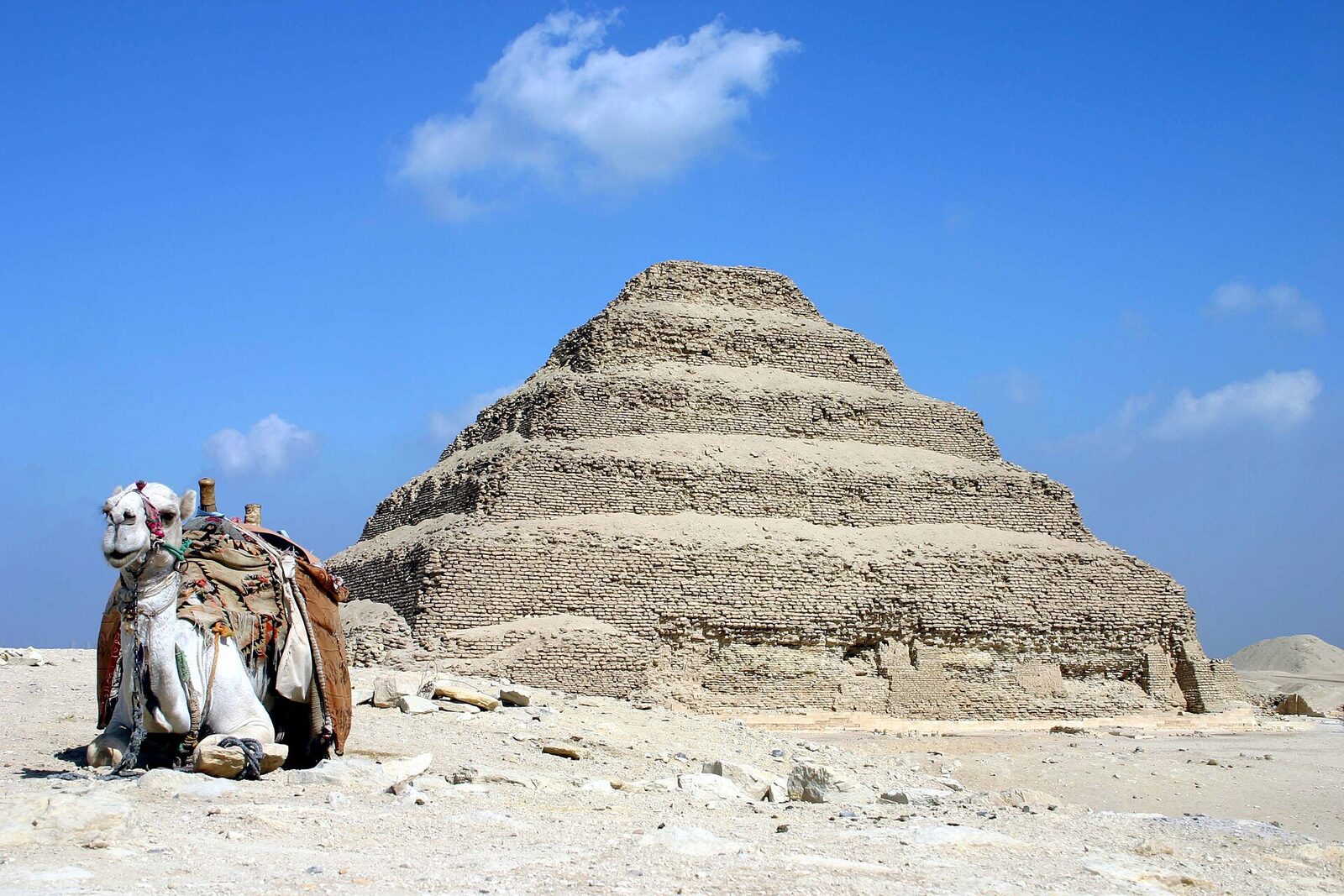
Saqqara holds a singular place in this funerary geography. It is there that the step pyramid of Djoser rises, the first dressed-stone monument of such scale, but also hundreds of mastabasMastabaAn early Egyptian flat-roofed tomb with sloping sides, the architectural ancestor of the pyramid.→, those low, flat-roofed tombs that sheltered the burials of the elite. The Memphite necropolis is therefore not a mere cemetery: it is an architectural landscape, a demonstration of power carved into limestone, and an open book for anyone who wishes to understand the society that produced it.
The age of the pyramids
If the Old Kingdom has marked the universal imagination, it is above all through its pyramids. Their history is not that of an isolated stroke of genius, but of a long experimentation. Everything begins with the mastabaMastabaAn early Egyptian flat-roofed tomb with sloping sides, the architectural ancestor of the pyramid.→, that rectangular tomb with sloping walls covering the burial chamber. Under the Third Dynasty, the architect Imhotep, so remarkable a figure that he would later be deified, had the idea of stacking several mastabas of decreasing size: thus was born the step pyramid of Djoser, the first funerary skyscraper in history.
The next step is taken under Sneferu, founder of the Fourth Dynasty, a true building genius. Three pyramids are attributed to him, including the "bent" pyramid of Dahshur, whose angle changes halfway up, evidence of an adjustment made during construction, and the "red" pyramid, the first successful smooth-sided pyramid. These trials and errors paved the way for the achievement of the following reign.
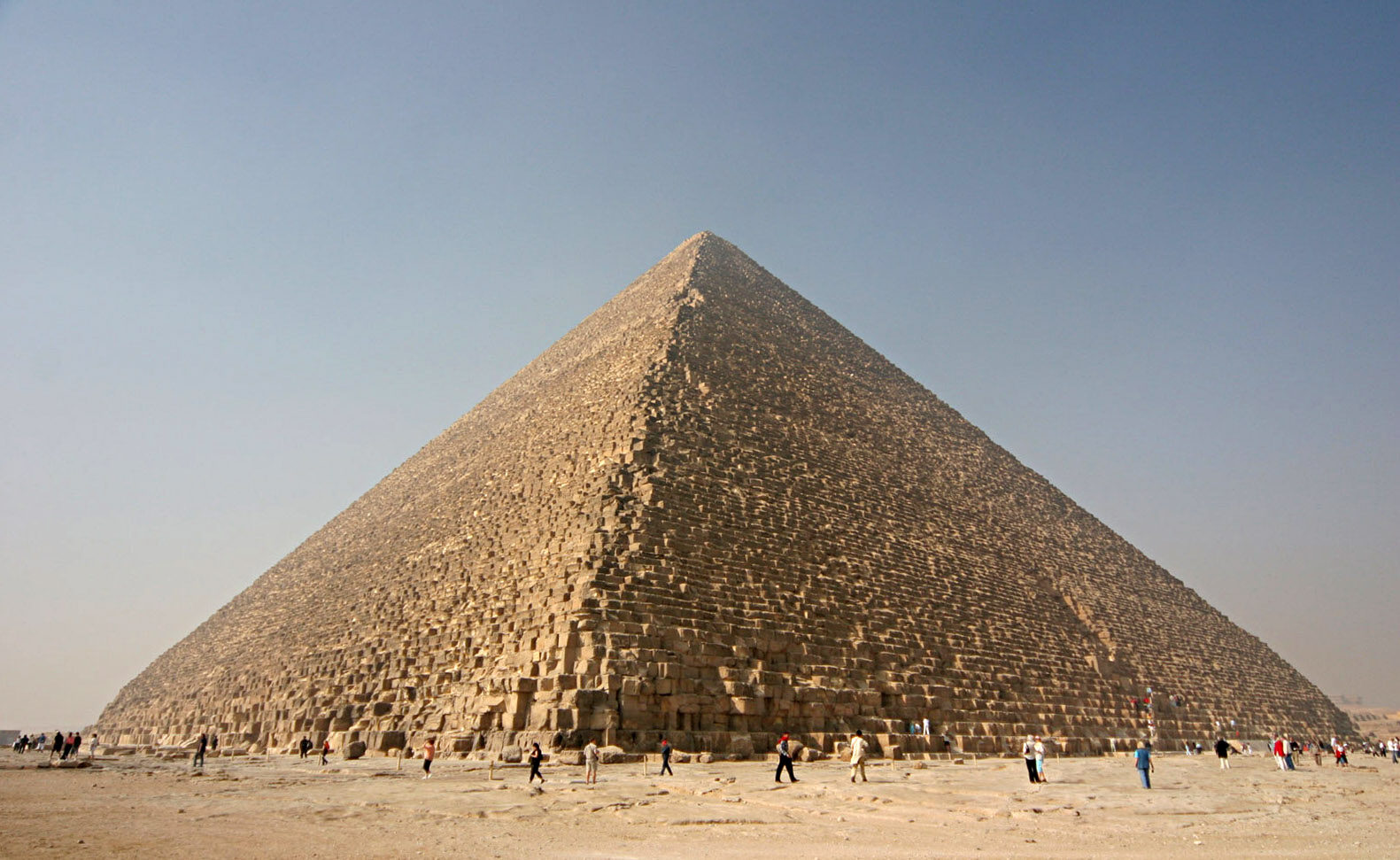
For it was Sneferu's son, Khufu (Cheops), who had the most colossal of all built on the Giza plateau: the Great Pyramid. Originally nearly 146 metres high, made of more than two million blocks weighing on average several tonnes, it is the last of the Seven Wonders of the ancient world still standing. Beside it would rise those of his son Khafre, flanked by the Great Sphinx, and his grandson Menkaure, forming the most famous ensemble on the planet.
It is worth remembering, too, that the names by which we know these rulers, Cheops, Chephren, Mycerinus, are Greek forms transmitted by later authors, while the Egyptians knew them as Khufu, Khafre and Menkaure. This small detail is itself a reminder of how much our access to the Old Kingdom passes through layers of transmission, interpretation and rediscovery accumulated over thousands of years. The civilisation we describe is always, in part, a reconstruction.
How were these monuments built? The question has fascinated since antiquity. Recent archaeological research has definitively ruled out the fanciful hypotheses: no chained slaves, no extra-human intervention. The pyramids were the work of a large, organised workforce, fed and housed near the worksites, as the excavations of the workers' villages at Giza have shown. Part of the peasantry was mobilised, in rotation, during the annual flood of the Nile, when the fields were inundated and farm work suspended. The construction of the pyramids is thus inseparable from the organisation of the pharaonic state: without a bureaucracy capable of counting, feeding and coordinating people, these mountains of stone would never have come into being2.
The organisation of these worksites testifies to remarkable logistical mastery. Stone had to be extracted from quarries, some of them distant, the granite of Aswan, hundreds of kilometres to the south, came down the Nile on barges, the blocks brought to the foot of the monument, hauled up using ramps, and adjusted with disconcerting precision. Excavations at Giza have brought to light not only the barracks and bakeries that fed the teams, but also the traces of a scrupulous administration: a papyrus discovered at Wadi al-Jarf, on the Red Sea, keeps the logbook of a team leader named Merer, charged with transporting limestone blocks intended for the casing of the Great Pyramid. It is the oldest inscribed papyrus known, and it lets us enter, day after day, into the daily life of a worksite forty-five centuries old.
The pyramids are, moreover, only the most visible part of a far vaster funerary ensemble. Each great royal pyramid was accompanied by a high temple set against its east face, linked by a processional causeway to a valley temple at the edge of the floodplain, where the boats landed. Around it were arranged satellite pyramids, boat pits, one of which, at Giza, yielded a cedar vessel reassembled piece by piece, and fields of mastabas where the king's relatives and dignitaries rested. The pyramid is therefore not an isolated object: it is the heart of a ritual complex designed to accompany the ruler in his transformation into a divine being.
One observes, across the dynasties, a revealing evolution: after the giants of Giza, the royal pyramids shrink. Those of the Fifth and Sixth Dynasties, at Abusir and Saqqara, are more modest, less well built, and many have collapsed to the point of resembling mere mounds today. This shrinking is not merely aesthetic: it reflects a shift in priorities and, perhaps, a progressive weakening of the means available to the central power. Here again, the stone tells the political history of the kingdom.
The invention of the pharaonic state
Behind the stone lies an invention even more durable than the pyramids: that of the state. The Old Kingdom is undoubtedly one of the first human societies to have set up a centralised, hierarchical and literate administration, capable of governing a territory hundreds of kilometres long. At the summit stands the pharaohPharaohThe title of the ruler of ancient Egypt, regarded as a living god guaranteeing cosmic order (Maat), supreme head of state, army and worship.→, an absolute ruler whose person concentrates political, military and religious functions.
The kingPharaohThe title of the ruler of ancient Egypt, regarded as a living god guaranteeing cosmic order (Maat), supreme head of state, army and worship.→ obviously does not govern alone. He relies on a staff of high officials, dominated by the vizierVizierThe highest official of the Egyptian state after the pharaoh (Egyptian "tjaty"): effectively a prime minister directing administration, justice, the treasury and public works in the king's name.→, a kind of prime minister who oversees justice, the Treasury, public works and the administration of the provinces. Below him unfolds a human pyramid of scribes, stewards, tax collectors and local officials. Hieroglyphic writing, and especially its cursive form, hieratic, is the indispensable tool of this machine: it makes it possible to keep accounts, draft orders, record censuses and organise the redistribution of resources.
The territory is divided into provinces, the nomes, each administered by a governor, the nomarchNomarchThe governor of a province (nome) of ancient Egypt; first appointed by the pharaoh, the nomarch became a hereditary, autonomous dignitary rivalling central power at the end of the Old Kingdom.→. At the beginning of the Old Kingdom, these officials are appointed by the king and removable; they serve the central state. But, as we shall see, this arrangement carries a risk within it: if the nomarchs manage to make their office hereditary and to take local root, they may turn into provincial lords escaping royal control. The balance of the pharaonic state thus rests on a fine thread between centralisation and delegation.
The economy of this state is largely redistributive. There is no coinage: wealth circulates in the form of grain, cattle, cloth and metals, collected as tax and stored in state granaries, then redistributed to pay officials and finance the great worksites. The ruler is, in theory, the owner of the land and the guarantor of prosperity. This command economy, closely tied to the rhythm of the Nile, is the strength of the Old Kingdom, but also its vulnerability: should the flood fail for several years in a row, the whole system totters.
Royal ideology is the cement of the entire edifice. The pharaohPharaohThe title of the ruler of ancient Egypt, regarded as a living god guaranteeing cosmic order (Maat), supreme head of state, army and worship.→ is not merely a political leader: he is presented as the son of the gods, the earthly incarnation of the falcon god Horus, then, under the influence of the solar clergy, as the "son of Ra". His function is cosmic as much as terrestrial: it is through his presence and his rituals that the sun rises, that the Nile swells, that the seasons follow one another and that chaos is held at bay. Any disorder, invasion, famine, drought, can be interpreted as a failure of the king to maintain Maat. This conception confers immense prestige on the ruler, but it also places a crushing responsibility upon him.
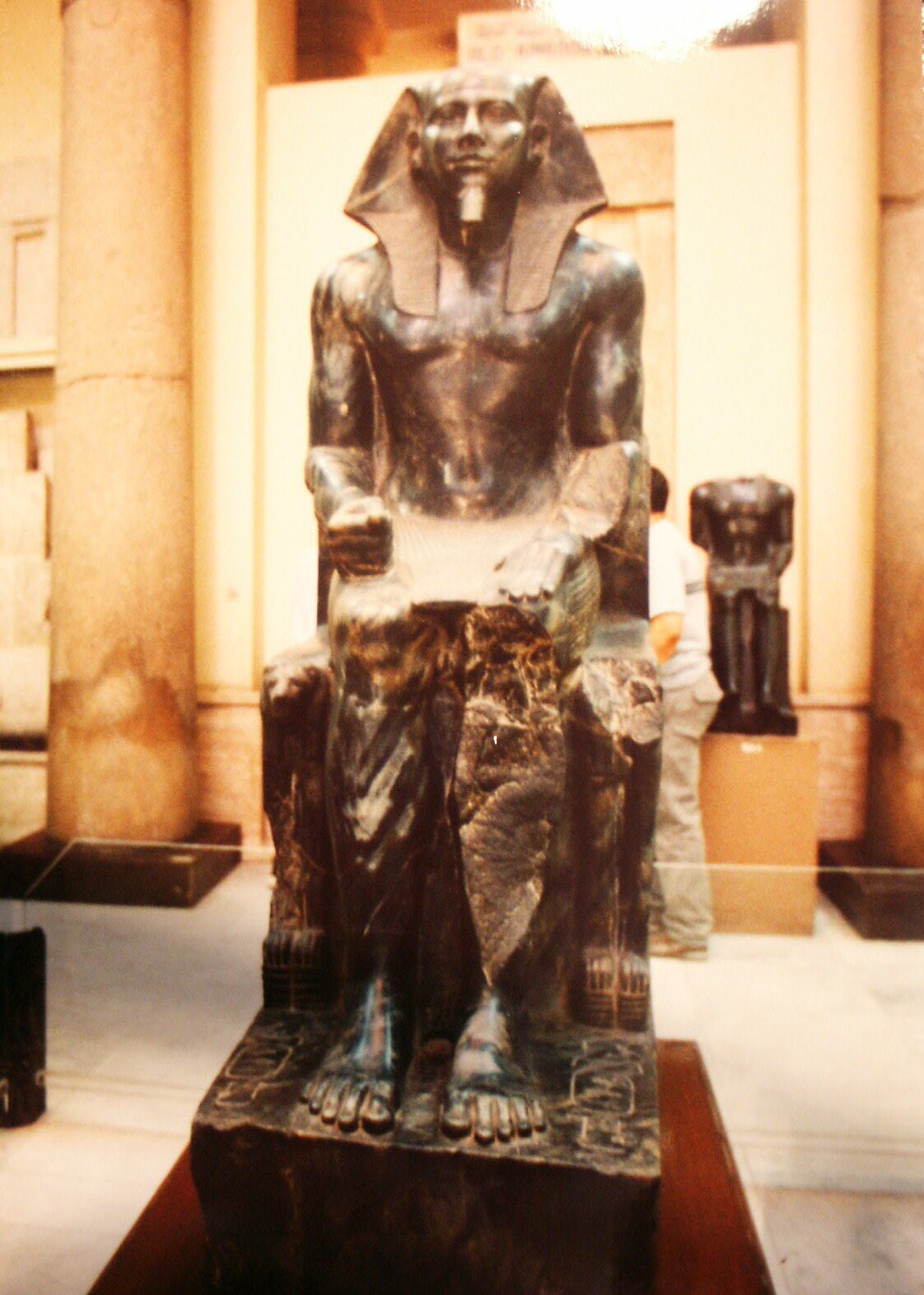
Official art puts this ideology into images. Royal statues, like that of Khafre, obey strict canons: frontality, serenity, contained strength, timelessness. The king is depicted there not as an ageing individual, but as an ideal and eternal figure. Temple reliefs show him oversized compared to his subjects and enemies, smiting chaos, making offerings to the gods. This art is not meant to please but to assert an order: it is the visual expression of the pharaonic state itself.
This administration finally rests on a literate elite whose prestige is immense. To become a scribe is to escape the harsh labour of the fields and to gain access to office. The texts of the period extol the merits of the scribal profession, the only one to offer lasting social advancement. This valuing of written knowledge, accounting and management is one of the most modern features of the Old Kingdom: it is a civilisation of the archive, where one records, classifies and preserves, and it is precisely thanks to this passion for the written word that we can today reconstruct how it worked.
Religion and the afterlife: a civilisation turned towards eternity
One cannot understand the Old Kingdom without grasping its singular relationship to death and the afterlife. All the energy deployed in building the pyramids answers a religious conviction: to ensure the deceased king an eternal survival and a successful passage into the world of the gods. The pyramid is not a mere tomb, it is a machine for resurrection, a stairway to the sky, a cosmic instrument intended to unite the dead pharaoh with the sun god Ra.
This solar dimension takes on growing importance over the course of the Old Kingdom. Under the Fifth Dynasty, the kings have built, in addition to their pyramids, solar temples dedicated to Ra, whose cult becomes central. It is also at this time, at the end of the Fifth Dynasty and then under the Sixth, that the famous Pyramid Texts appear carved in the royal burial chambers: the oldest corpus of religious texts of humanity, a set of formulas meant to guide and protect the king on his journey towards eternity.
The belief in an individual's survival after death, at first reserved for the king, gradually tends to spread towards the elite, then, later, towards broader layers of society, a process historians have called the "democratisation of the afterlife". The tombs of the dignitaries, adorned with scenes of daily life, banquets, hunts and fieldwork, attest to this hope for a prolonged life. At the heart of this worldview reigns Maat: cosmic order, justice and harmony, which the pharaohPharaohThe title of the ruler of ancient Egypt, regarded as a living god guaranteeing cosmic order (Maat), supreme head of state, army and worship.→ has the mission of maintaining against chaos.
The organisation of the funerary complex directly reflects this quest for eternity. The body of the deceased had to be preserved: it is under the Old Kingdom that the embalming techniques which would later lead to classical mummification are perfected. The dead also had to be fed: funerary priests, paid by foundations endowed with land, were charged with regularly placing offerings before the "false door" of the tomb, the symbolic threshold through which the soul of the deceased could receive the gifts of the living. Death was not a rupture, but a passage that had to be carefully prepared and maintained.
The tombs of the elite, especially the great mastabas of Saqqara and Giza, are in this respect invaluable sources. Their walls are covered with painted or sculpted scenes of extraordinary vivacity: ploughing and harvesting, cattle raising, fishing in the marshes, the making of bread and beer, craftsmen at work, musicians and dancers. These images had no decorative function but a magical one: they were meant to ensure the deceased, for eternity, the abundance and pleasures of earthly life. Paradoxically, it is therefore in monuments dedicated to death that we find the liveliest picture of Old Kingdom society.
The seeds of decline
The Old Kingdom did not collapse overnight, nor by accident. Several long-underground developments gradually undermined the foundations of the state. The first concerns the progressive decentralisation of power. As the kings rewarded their loyal followers with land, titles and tax exemptions, the royal domain dwindled and central authority diluted. The temples, endowed with vast tax-exempt estates, became autonomous economic powers.
The phenomenon with the heaviest consequences is the rise of the nomarchsNomarchThe governor of a province (nome) of ancient Egypt; first appointed by the pharaoh, the nomarch became a hereditary, autonomous dignitary rivalling central power at the end of the Old Kingdom.→. Over the generations, their office becomes hereditary: they have themselves buried no longer in the royal necropolis, near their sovereign, but in their own province, an eloquent sign of local rooting and of a loyalty that shifts from the king to the territory. Some command their own troops, maintain their own court, and end up behaving like near-independent princes.
To this is added a dynastic factor often emphasised: the exceptionally long reign of Pepi II, in the Sixth Dynasty, which according to ancient sources is said to have lasted several decades. So long a reign weakens the transmission of power, freezes hierarchies and gives provincial governors all the time they need to consolidate their autonomy. On the death of the old king, the central state, already weakened, finds itself without relays capable of reimposing its authority.
One must also reckon with the structural limits of a subsistence economy. The Old Kingdom had immobilised considerable resources in non-productive projects, pyramids, temples, funerary foundations endowed with tax-exempt land and personnel. As these foundations multiplied, a growing share of land and revenue definitively escaped the royal treasury, to the benefit of perpetual religious and private estates. The central power, by generously rewarding its followers and honouring the dead, gradually sawed off the fiscal branch on which it was seated. When the climatic shock arrived, the room for manoeuvre was already narrow.
Finally, one must not neglect the ideological dimension. The prestige of the pharaohPharaohThe title of the ruler of ancient Egypt, regarded as a living god guaranteeing cosmic order (Maat), supreme head of state, army and worship.→, founded on his ability to guarantee prosperity and order, is vulnerable to any prolonged crisis. If the king can no longer ensure the floods, ward off famine or maintain Maat, the very foundation of his legitimacy collapses. And it was precisely this challenge that an upheaval would pose, one coming not from people, but from the climate.
The collapse: the 4.2 ka climate event and the war of the nomarchs
Around 2200 BC there occurs, on the scale of the entire hemisphere, a major climatic episode that palaeoclimatologists call the "4.2 ka event" (4,200 years before present). It is a period of abrupt and prolonged aridification, perceptible from Mesopotamia to India and East AfricaAfricaThe cradle of humankind: the continent where the first hominins appeared, then Homo sapiens around 300,000 years ago, before the expansion to the rest of the world.→. This event, which in some chronologies marks the boundary of a geological subdivision of the HoloceneHoloceneThe current geological epoch, begun about 11,700 years ago at the end of the last ice age; the setting of all post-glacial history.→, coincides disturbingly with the collapse of several great Bronze AgeBronze AgeA protohistoric period following the Neolithic, defined by bronze metallurgyMetallurgyThe techniques of extracting and working metals (copper, bronze, gold); its rise in the Eneolithic and Bronze Age transformed tools, weapons and social hierarchies.→ (a copper-tin alloy) and the rise of the first cities and states; in Egypt it corresponds to the age of the first pyramids.→ civilisations.
For Egypt, whose entire life depends on the annual flood of the Nile, the consequences are dramatic. The sources of the river's water, located far to the south in the Ethiopian highlands and the Great Lakes region, are fed by the monsoon rains. A lasting weakening of these rains causes insufficient floods, year after year. The fields are no longer properly irrigated, harvests collapse, and famine sets in. Later Egyptian texts, as well as inscriptions from the First Intermediate Period, preserve the poignant memory of this distress: they speak of people reduced to eating what they would never have touched, of corpses in the streets, and of the collapse of the established order.
The climatic indicators converge. The study of the sediments of the Nile delta, of cores taken from the lakes of East Africa, of the river's deposits and even of windblown dust trapped in marine sediments, all point to a marked drying around 2200 BC. The level of the floods seems to have dropped repeatedly, while the advance of the desert ate into the cultivable margins. For a society entirely organised around flood agricultureAgricultureThe cultivation of plants and production of food by working the soil, which emerged in the Neolithic in the Near East and independently elsewhere; it radically transformed human societies.→, such a disturbance, spread over several decades, could only have devastating effects on food production and, by repercussion, on the state's revenues.
Egyptologists still debate the exact share to be attributed to the climate. Some insist on the decisive role of the drought, a veritable trigger; others stress that Egypt had already weathered poor floods without collapsing, and that it was the conjunction with a politically weakened state that proved fatal. This discussion is not merely academic: it touches on a question essential to our own era, that of knowing to what extent an environmental shock can, on its own, tip a society over, or whether it merely accelerates pre-existing fragilities.
It would nonetheless be simplistic to reduce the fall of the Old Kingdom to a single climatic cause. Recent Egyptology insists on the conjunction of factors: the drought struck a state already weakened by decentralisation and the autonomy of the nomarchsNomarchThe governor of a province (nome) of ancient Egypt; first appointed by the pharaoh, the nomarch became a hereditary, autonomous dignitary rivalling central power at the end of the Old Kingdom.→. Deprived of sufficient revenue, unable to feed its bureaucracy or finance its great worksites, the central power collapses. The provinces, now nearly autonomous, fall back on themselves; some, better situated or better administered, prosper relatively, while others sink.
Egypt then fragments into rival poles. Two centres dominate: in the north, the Herakleopolitan dynasty; in the south, the princes of Thebes, a still modest but fast-rising city. For nearly a century, these powers clash in a veritable civil war.
The two rival powers fought, made truces and clashed again over the course of generations, each claiming legitimate continuity with the great kings of the past. This protracted struggle, more than any single battle, defined the political texture of the First Intermediate Period.
On the ground, the end of the Old Kingdom was not an instantaneous cataclysm but a slow disintegration, experienced very differently from one region and social class to another. While the Memphite court lost its lustre, certain provincial nomarchs, proud of their new autonomy, had inscriptions carved in their tombs in which they boasted of having fed their populations during the years of scarcity, dug canals and maintained order where the state had failed. These autobiographies, at once testimonies and instruments of local propaganda, let us hear the voice of men who, on the scale of their territory, strove to keep upright a world that was coming apart.
At the end of this smouldering civil war, the Theban house prevailed and reunified the country, inaugurating the Middle Kingdom. The First Intermediate Period thus ends on a rebirth, but the Old Kingdom now belongs to the past.
The legacy of the Old Kingdom
What remains of this first great civilisation? Far more than ruins. The Old Kingdom bequeathed to Egypt, and beyond it to the whole of human history, a repertoire of forms and ideas of astonishing longevity. The model of the centralised pharaonic state, the ideology of the king as guarantor of cosmic order, official art with its rigorous canons, monumental funerary architecture: all this, elaborated under the Old Kingdom, would remain the reference for the Egyptians for more than two thousand years, until Greco-Roman times.
The Pyramid Texts, the first great religious texts of humanity, nourished a whole funerary tradition that would continue in the Coffin Texts of the Middle Kingdom, then in the famous Book of the Dead of the New Kingdom. The Egyptian conception of the afterlife, of the judgment of the soul and of the survival of the individual durably marked the religious imagination of the Mediterranean basin.
As for the pyramids themselves, more than forty-five centuries after their construction they remain among the most powerful symbols of human ingenuity. The Memphite necropolisNecropolisA large organised burial ground, a "city of the dead", often spanning several periods.→, from Giza to Saqqara, continues to yield spectacular discoveries to archaeologists, intact tombs, sarcophagi, mummification workshops, that constantly renew our understanding of this era. The collapse of the Old Kingdom, far from closing Egyptian history, was only one chapter of it: the Nile civilisation, after being shattered, rebuilt itself, demonstrating a resilience that is an integral part of its grandeur.
The rediscovery of the Old Kingdom is itself an adventure. For a long time, the pyramids fed fantasies and legends, from the accounts of Herodotus to the most extravagant theories. It was only with the birth of scientific Egyptology in the nineteenth century, after the deciphermentDeciphermentThe reconstruction of the meaning and value of the signs of an unknown script, often from bilingual texts, repeated proper names or statistical regularities.→ of hieroglyphs by Champollion, that these monuments began to yield their true history. The methodical excavations of the Memphite necropolis, continued to this day, have made it possible to reconstruct the succession of reigns, to understand the evolution of construction techniques, and to put names and faces to the builders of the age of the pyramids.
Even today, the Giza plateau and the site of Saqqara are among the most active archaeological sites in the world. Non-invasive technologies, muon imaging to probe the interior of the pyramids, remote sensing, 3D modelling, open up unprecedented perspectives, while excavations continue to unearth tombs, workshops and everyday objects. Each discovery is a reminder that the Old Kingdom, despite forty-five centuries of distance, has not finished surprising us, and that our image of this era remains a knowledge under construction.
But the Old Kingdom also speaks to us, across the millennia, of a deeply contemporary question: the vulnerability of complex societies in the face of climatic upheavals. The conjunction of an environmental crisis and internal political fragilities, which got the better of the most powerful state of its time, resonates strangely with our own anxieties. In this, the history of the grandeur and the fall of the Old Kingdom goes far beyond archaeological curiosity: it is a meditation on the fragility of civilisations.
Beyond Egypt, the Old Kingdom fascinates because it offers one of the oldest documented examples of a complete civilisational trajectory: birth, apogee, decline. Where so many ancient societies have left us only fragments, the Egypt of the age of the pyramids can be read in its monuments, its administrative texts, its tombs and its landscapes. It holds out to us a kind of mirror, distant but recognisable, in which are reflected the ambitions, achievements and limits of every large-scale human enterprise.
Further reading
To explore some of the aspects addressed in this dossier, we offer these resources from our editorial team, devoted in particular to the fall of the Old Kingdom and to the archaeology of the Memphite necropolis:
- Documentary, Egypt, the fall of the Old Kingdom (1/2): the end of a kingdom
- Documentary, Egypt, the fall of the Old Kingdom (2/2): climate change and civil war
- Documentary, The mystery of the vizier's tomb
Conclusion
The Egyptian Old Kingdom was indeed a first: the first great civilisation to raise mountains of stone, the first to endow itself with so vast and organised a state, the first to set down in writing a religious thought on the survival of the soul. For five centuries, under the leadership of pharaohsPharaohThe title of the ruler of ancient Egypt, regarded as a living god guaranteeing cosmic order (Maat), supreme head of state, army and worship.→ who became legendary, Egypt invented a way of inhabiting the world and confronting death that would durably mark humanity.
Its fall does not erase this grandeur; it illuminates it. By linking the rise and the collapse, by placing side by side the Great Pyramid and the famines of the First Intermediate Period, we grasp better what this civilisation was: a brilliant success, but built on a fragile balance between the power of people and the generosity of the river. When the climate withdrew and the nomarchsNomarchThe governor of a province (nome) of ancient Egypt; first appointed by the pharaoh, the nomarch became a hereditary, autonomous dignitary rivalling central power at the end of the Old Kingdom.→ emancipated themselves, the edifice gave way. From MemphisNecropolisA large organised burial ground, a "city of the dead", often spanning several periods.→ and its necropolis there still reach us, intact, the two faces of this history: the splendour and the ruin, inseparable, of a world that was, in its time, the most advanced on Earth.
La structure de vos articles est un modèle : accroche, développement, sources. Simple et efficace.
La question posée en intro est exactement celle qui divise la communauté en ce moment. Bon angle.
D'un point de vue archéologique, l'Ancien Empire est une période remarquablement bien documentée grâce à la qualité de conservation des monuments et des inscriptions. Les nouvelles fouilles menées à Abu Sir et Dahchour par des missions internationales continuent d'apporter des precisions importantes. C'est une des périodes les mieux connues de toute l'histoire ancienne.
L'Ancien Empire égyptien est la période de ma plus grande passion : les pyramides de Gizeh, les mastabas de Saqqarah, les textes des pyramides de la V ème et VI ème dynasties. Ce hub est une excellente entrée pour explorer l'ensemble du sujet de manière structurée. Les articles associés couvrent bien les différents aspects de cette période fascinante.