For more than a century, a handful of inscriptions carved on clay cones, stone tables and silver vessels resisted every attempt to read them. Set out in fine, angular signs, these marks came from south-western Iran, from the heart of the kingdom of ElamElamAn ancient civilisation of south-western Iran, centred on Susa and Anshan, neighbour and rival of Mesopotamia from the 3rd to the 1st millennium BC.→, a civilisation contemporary with the great cities of Mesopotamia. Scholars had given them a name, Linear ElamiteLinear ElamiteA script of Elam (Iran), used around 2300 BC, partly syllabic, long undeciphered and cracked in the 2010s-2020s thanks to repetitive royal inscriptions.→, but they could not make them speak. In 2020, the French archaeologist François Desset, affiliated with the CNRS ARCHÉORIENT laboratory and the University of Tehran, announced, together with an international team, that he had reconstructed how to read it. The result, published in 2022 in a specialist journal, proposes to decipher one of the oldest scripts in the world, some 4,400 years old [1].
The matter goes well beyond mere philological curiosity. If the team's conclusions hold, Linear Elamite would become the oldest known purely phonetic script, and above all the demonstration that writingWritingA system of conventional signs used to fix language or information durably; its appearance (c. 3300 BC) marks, by convention, the end of prehistory.→ was not invented only once, in a single Mesopotamian cradle, before spreading everywhere. In Iran, a graphic tradition may have evolved in parallel, without descending from cuneiform. What this deciphermentDeciphermentThe reconstruction of the meaning and value of the signs of an unknown script, often from bilingual texts, repeated proper names or statistical regularities.→ puts on the table is a revision of the story of the late prehistoryPrehistoryThe span of human history before the invention of writing, from the PalaeolithicPalaeolithicThe oldest and longest period of prehistory (c. 3.3 Ma–12,000 BC), defined by chipped stone tools and a hunter-gatherer way of life.→ to the Metal Ages, known mainly through material remains.→ and protohistoryProtohistoryThe transitional period between prehistory and history, covering societies without their own writing but known through external texts.→ of the Near EastNear EastA region of western Asia (LevantLevantA region of the eastern Mediterranean Near East (Israel, Lebanon, Syria, Jordan), a major crossroads of the first human migrations out of Africa.→, Mesopotamia, Anatolia, Iran), cradle of the Neolithic revolutionNeolithic revolutionThe shift from hunter-gatherer societies to farming and settled life (c. 10,000 BCE in the Near East), giving rise to villages and then cities.→, agricultureAgricultureThe cultivation of plants and production of food by working the soil, which emerged in the Neolithic in the Near East and independently elsewhere; it radically transformed human societies.→, the first cities and writing.→ [2]. It remains to be seen, with due caution, what is established and what is still debated, for not all researchers share the same enthusiasm.
The very word decipherment deserves to be handled carefully. To decipher a script does not mean merely recognising a few isolated signs, but reconstructing the system that links those signs to a language, to the point of being able to read previously unknown texts. It is this ambition, applied to Linear Elamite, that the work of François Desset and his five co-authors carries, published in 2022 under the title "The Decipherment of Linear Elamite Writing". The authors claim an almost complete reading, while acknowledging that a handful of signs remain without a secure value [3].
For the non-specialist reader, the interest of this story also lies in what it reveals about the craft of the archaeologist and the philologist. It brings together tablets dug up more than a century ago, precious vessels long hidden in safes, forgotten names of kings, vanished deities and reasoning that borders on detective logic. It reminds us that, for the earliest periods, writing is our only direct access to the words of the people of the past, and that an unread script is like a closed door onto centuries of thought. To close it, or to nudge it open, changes the way we tellTellAn artificial mound formed by the accumulation of successive layers of settlement remains at the same spot, typical of the Near East. Each destruction-rebuilding event adds a stratum.→ the origins of civilisation.
What is Linear Elamite?
Linear Elamite is a writing system attested by a very small number of documents, only about forty texts, often short, known to this day. It served to note the Elamite language, a language isolate with no established kinship to any other living or dead language. The signs, traced in lines, hence the term "linear", number around a hundred glyphs, some being only graphic variants of the same character. This relative economy of the repertoire is a strong clue, it suggests a phonetic system rather than a script mixing symbols for sounds with symbols for whole words [2].
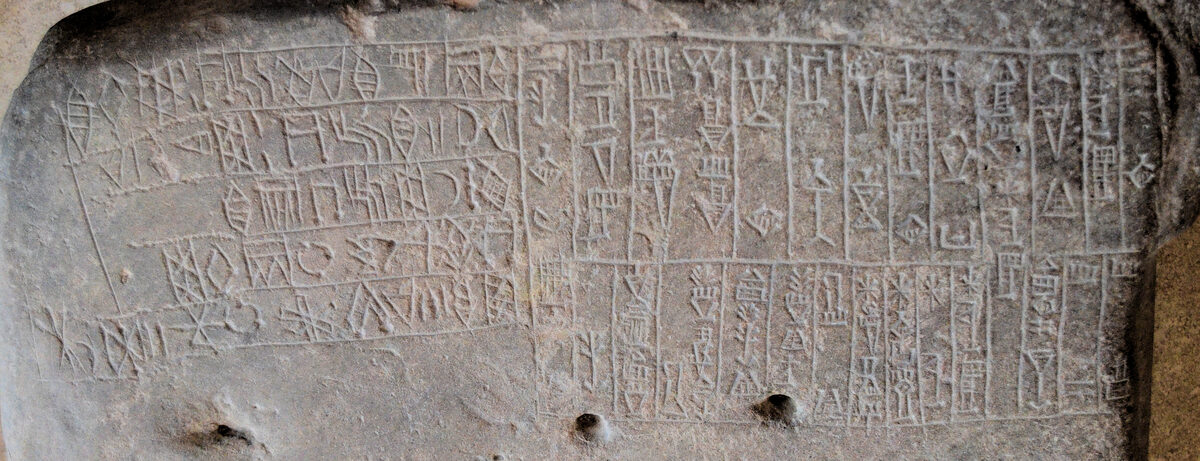
According to the analysis of François Desset and his colleagues, Linear Elamite would be an alpha-syllabary, that is, a system in which each sign notes a consonant accompanied by a vowel, with means to specify that vowel. On this hypothesis, it would be the oldest script entirely based on the sounds of the language, whereas Mesopotamian cuneiformCuneiformThe oldest known writing, born at Uruk; its signs, impressed into clay with a reed stylus, are wedge-shaped (from Latin cuneus).→ and Egyptian hieroglyphsHieroglyphA sign of the sacred Egyptian script, at once figurative and phonetic, carved or painted on monuments and in tombs.→ combined, at the same period, phonograms, which note sounds, and logograms, which note whole words. A purely phonetic script requires fewer signs to memorise, which could, in theory, have favoured a somewhat wider literacy than elsewhere [2].
It is important to distinguish two notions that are often confused, language and writing. The Elamite language is an oral phenomenon, a set of sounds and words. The Linear Elamite script is only one of the ways to note it on a support. The same Elamite language was in fact written later using cuneiform, borrowed from Mesopotamia. This situation, in which a single language is noted by two different graphic systems, has a name, digraphia. The case is not unique in history, ancient Greek was itself written first with Linear B, deciphered in 1952, then with the Greek alphabet, from the eighth century BC [2].
This comparison with Linear B is not accidental. In both cases, it is an ancient, forgotten script, rediscovered by archaeology, then reconstructed by reasoning. And in both cases, prior knowledge of the language, from other sources, made the decipherment possible. For Elamite, a considerable mass of vocabulary has indeed long been known, thanks to the trilingual inscriptions of the Achaemenid Empire, in particular the famous Behistun inscription, where Elamite appears alongside Old Persian and Akkadian. To decipher Linear Elamite therefore amounted, essentially, to discovering the value of some hundred signs, the language being already known in its broad outlines [2].
The supports are varied, clay, stone, metal, and the inscriptions do not all read in the same direction, some from right to left, others from left to right. This fragmentary corpus is dispersed, between the Louvre Museum in Paris, Iranian museums in Tehran or Jiroft, and private collections around the world. This dispersal, as we shall see, played a decisive, and at times problematic, part in the history of the decipherment.
The kingdom of Elam and the city of Susa
Elam designates at once a region, a group of kingdoms and a civilisation that unfolded across present-day south-western Iran, from the plains of Susiana, around the city of Susa, to the highlands of Fars and the regions of Kerman. Its inhabitants seem to have called themselves by a name transcribed Hatamti, of which "Elam" is the form received through Mesopotamian intermediaries. A neighbour and often a rival of the cities of Sumer and Akkad, this civilisation was among the great powers of the ancient Near East for nearly two millennia [2].
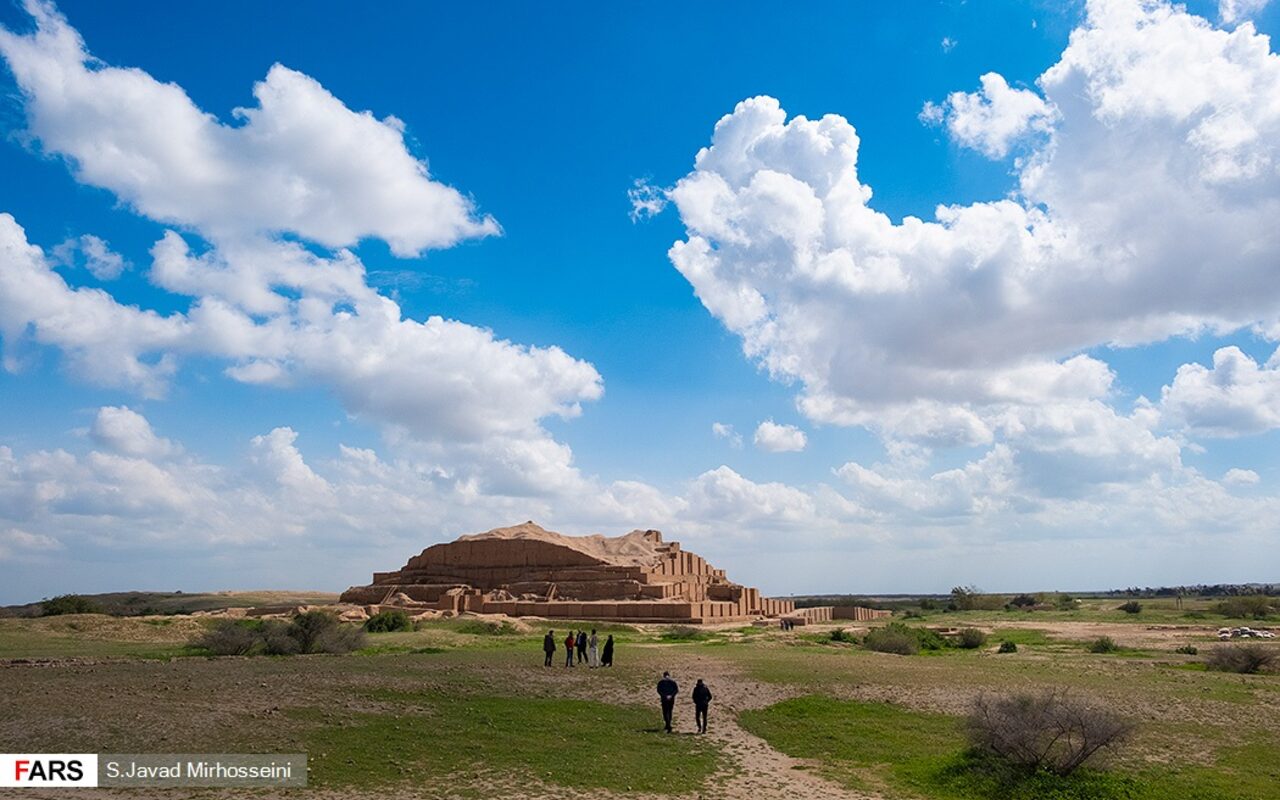
Susa is the key site of this story. Occupied from the end of the fifth millennium BC, it became a major capital, a crossroads between the world of the Mesopotamian plains and that of the Iranian mountains. It was there, during the excavations led by the French archaeological mission from 1897, that the first documents in Linear Elamite were brought to light, discovered in 1903. Susa yielded monumental inscriptions, engraved on large stone sculptures, votive tables and monumental staircase steps, some of which combine Linear Elamite with Akkadian cuneiform [2].
On the chronological scale, the Elam of the Bronze AgeBronze AgeA protohistoric period following the NeolithicNeolithicThe "New Stone Age": a period marked by farming, herding, settlement and pottery, from around 10,000 BC.→, defined by bronze metallurgyMetallurgyThe techniques of extracting and working metals (copper, bronze, gold); its rise in the Eneolithic and Bronze Age transformed tools, weapons and social hierarchies.→ (a copper-tin alloy) and the rise of the first cities and states; in Egypt it corresponds to the age of the first pyramids.→ is contemporary with the dynasties of Akkad and Ur in Mesopotamia. King Puzur-Inshushinak, whose name recurs on most of the monumental inscriptions, ruled at Susa around 2100 BC, at a time when the city was asserting its autonomy in the face of its powerful neighbours. A little later, the so-called Sukkalmah dynasty, around 1900 to 1500 BC, produced the silver vessels that would become the key to the decipherment. It is therefore between roughly 2300 and 1850 that the use of this script is concentrated [3].
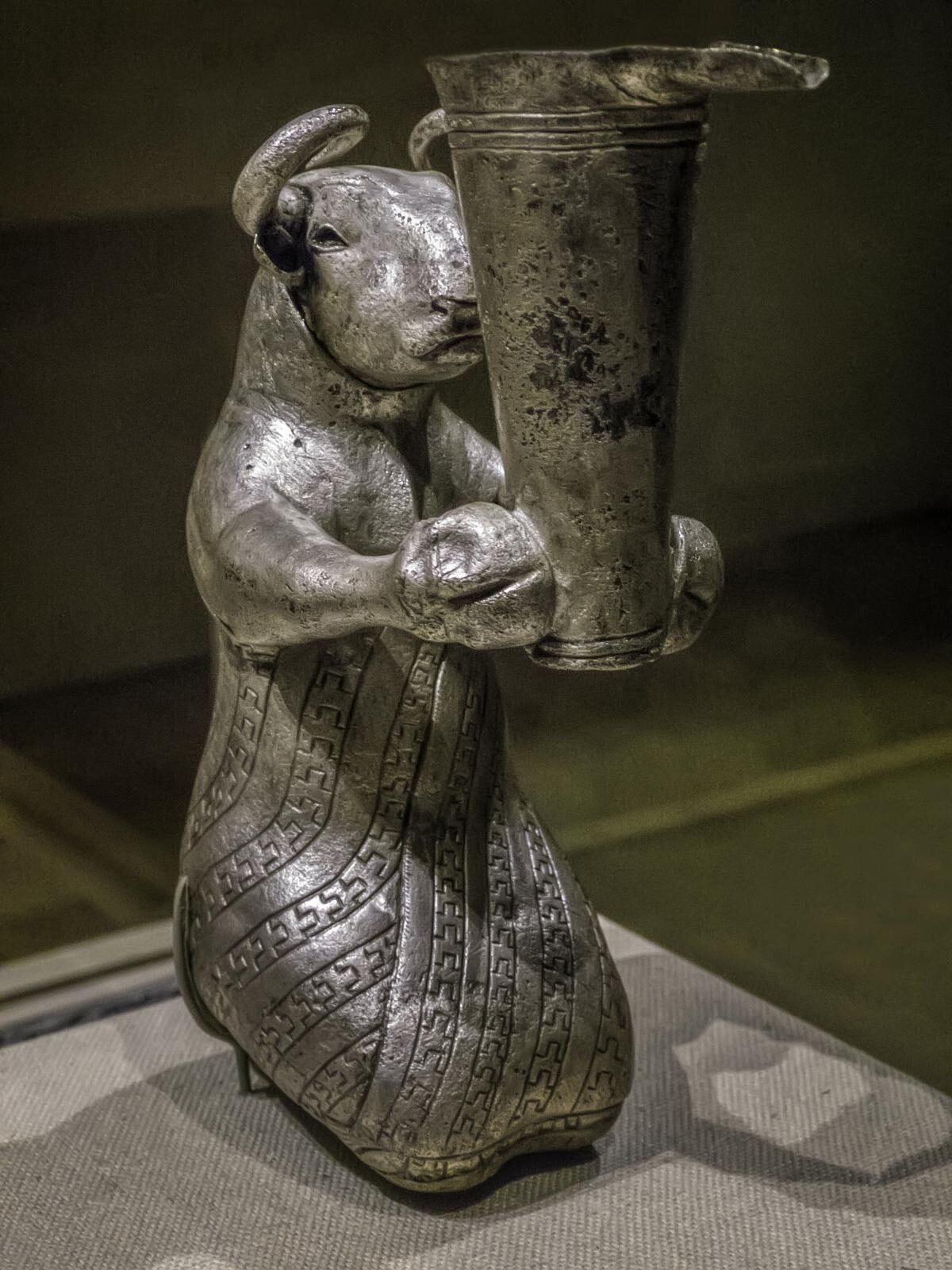
The Elamite civilisation cannot be reduced to its scripts. It produced a remarkable material culture, a monumental architecture of which the ziggurat of Chogha Zanbil, built later, around the thirteenth century BC, remains the most spectacular symbol, and a refined metalworkGoldsmithingThe art of working precious metals (gold, silver) into jewellery, vessels and ornaments; the Maikop kurgans are among the earliest evidence of elite goldsmithing.→, notably a silverwork of great delicacy. It is precisely on objects of precious metal, cups and vessels, that some of the most important inscriptions for the decipherment are found. Far from being marginal, writing here belongs to a context of power, religion and prestige, it serves kings who commemorate their deeds and honour their gods [3].
Specialists today divide the Linear Elamite corpus into three broad geographical groups, corresponding to distinct areas. A western group, that of the lowlands, around Susa, with inscriptions on stone and clay. A central group, that of the highlands of Fars, made up essentially of inscriptions on silver vessels. And an eastern group, rarer, formed of short inscriptions from south-eastern Iran. This distribution suggests that the script, far from being confined to Susa alone, circulated over a vast territory, from the plains of Susiana to the borders of Kerman [2].
From Proto-Elamite to Linear Elamite
Before Linear Elamite, Iran had already known a script, nearly a thousand years older, which specialists call Proto-ElamiteProto-ElamiteThe oldest writing of Iran (c. 3300 BC), still largely undeciphered, contemporary with Mesopotamian proto-cuneiform but distinct from it.→. Attested around 3300 BC, this system of signs is used on thousands of clay tablets, most of them accounting and administrative documents. It remains, to this day, very largely undeciphered, and we do not even know which language it noted [2].
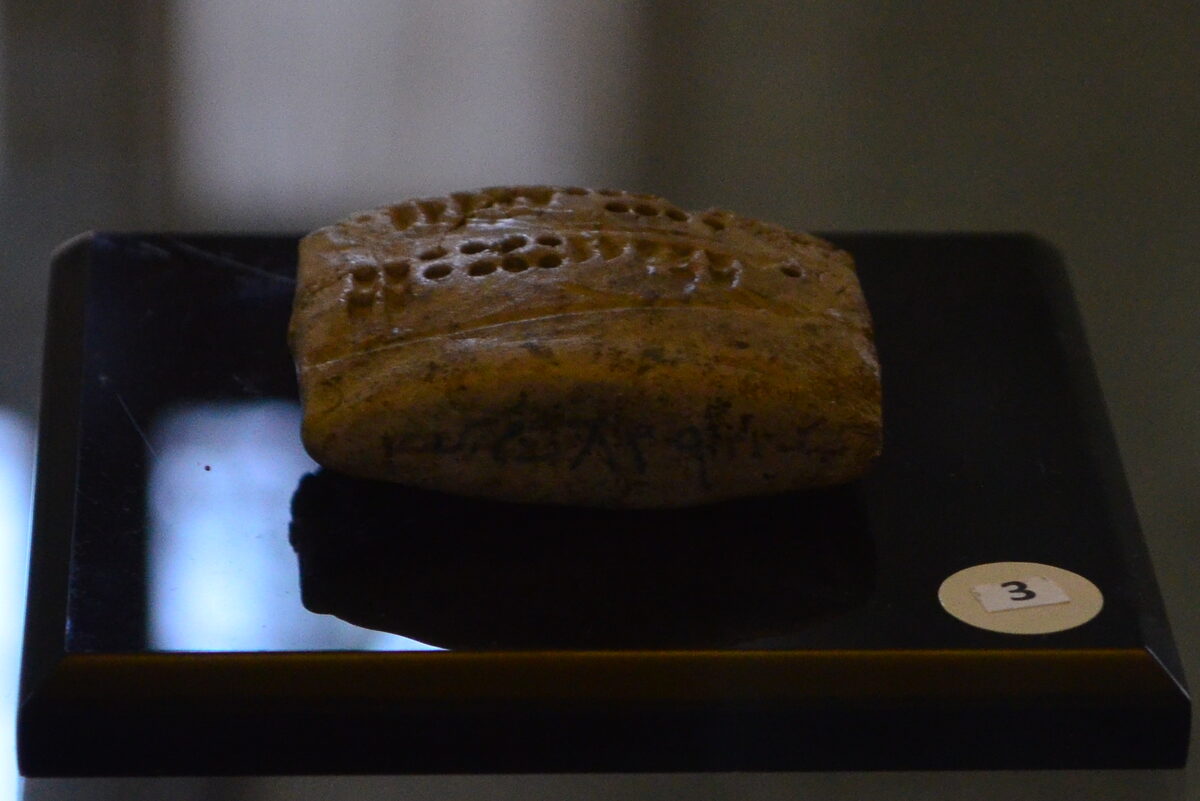
The question of the link between these two scripts, the older Proto-Elamite and the more recent Linear Elamite, is old and disputed. A long-favoured hypothesis saw Proto-Elamite as a system derived, in one way or another, from the Mesopotamian invention, and regarded Linear Elamite as independent of Proto-Elamite. Another reading, defended by François Desset and his team, proposes on the contrary that Linear Elamite is the outcome of a continuous evolution of Proto-Elamite, the two forming only one and the same writing system grasped at two different stages of its history [3].
This supposed continuity is not a mere matter of scholarly schools. If it holds, it would offer an unexpected way in to Proto-Elamite itself, by allowing one to work back, sign after sign, from a now readable script to a script more than half a millennium older. Formal resemblances between certain Proto-Elamite signs and certain Linear Elamite signs have been noted in support of this idea. But, caution obliges, these resemblances could also be explained otherwise, by a late imitation of old rediscovered tablets, a phenomenon called schismogenesis, to which we shall return.
Proto-Elamite deserves attention, for it is one of the great mysteries in the history of writing. Contemporary, or nearly so, with the Proto-Cuneiform of Mesopotamia, it appears at a pivotal moment, that of the rise of the first great urban settlements and of the need to manage flows of goods, livestock, cereals and labour. Its tablets, found at Susa but also on distant sites such as Tepe Yahya in Kerman, are covered with numbers and signs that do seem to note quantities and categories of merchandise. But, for lack of a bilingual and for lack of identifying the underlying language, it still resists attempts at reading [2].
Making Linear Elamite readable would change the situation, provided the filiation between the two scripts is confirmed. One would then have, for the first time, an anchoring point, a known script to which to attach an older unknown script. It is this prospect that makes the stakes so important in the eyes of researchers, well beyond the Linear Elamite corpus alone. The decipherment of one script can, in this way, call forth another, like the links of a single chain.
A script that long remained silent
Discovered in 1903, the Linear Elamite script remained unread for more than a century. Not for want of trying. From the beginning of the twentieth century, scholars such as Ferdinand Bork, in 1905 and then 1924, and Carl Frank, in 1912, tried to pierce the mystery. They had one asset, the existence of partly bilingual inscriptions, where a single monument bore both a text in Linear Elamite and a text in cuneiform noting Akkadian, a well-known language [2].
The method looked straightforward. On the famous "Table au Lion", kept in the Louvre, two words with similar endings appeared in the Akkadian part, the names Inshushinak, a god, and Puzur-Inshushinak, the king. Spotting the equivalent groups of signs in the Linear Elamite part made it possible to assign a phonetic value to about ten signs. It was a real success, but a success that stopped short. The Linear Elamite and cuneiform versions were not faithful translations of one another, but only texts of similar meaning, so that beyond the proper names, no progress could be made [3].
Later, in the 1960s, researchers such as Walther Hinz and Piero Meriggi took up the file again and proposed new readings, without carrying general conviction. The main obstacle lay in the nature of the corpus, too thin, with texts too short, and in the poor knowledge of the oldest form of the Elamite language, the very one that Linear Elamite was supposed to transcribe. The script remained, for the most part, elusive.
This long failure is explained in part by structural reasons. A successful decipherment generally rests on three conditions, a sufficiently rich corpus, knowledge of the language noted, and preferably a reliable bilingual document, in the manner of the Rosetta Stone for Egyptian hieroglyphs. Yet Linear Elamite combined the handicaps, a minuscule corpus, very short texts, imperfect bilinguals that were not true translations, and a lacunar knowledge of the ancient form of the Elamite language. Each of these difficulties, taken alone, would already have been a serious obstacle, their accumulation made the task almost hopeless [3].
One must also gauge that the stakes were not only technical. Compared with Mesopotamian cuneiform or Egyptian hieroglyphs, whose corpora number in the tens of thousands of texts and which mobilised generations of scholars, Linear Elamite remained an object for specialists, a peripheral script, without the critical mass of documents that, elsewhere, had allowed the great decipherments of the nineteenth and twentieth centuries. It took a researcher to devote himself to it almost exclusively, and an unexpected batch of documents to appear, for the situation to unlock.
One can measure the ground covered by comparing it with a few great decipherments of history. Old Persian cuneiform was cracked at the start of the nineteenth century thanks to the names of the Achaemenid kings, repeated in stereotyped formulas, rather like the royal names of the Elamite vessels. Egyptian hieroglyphs fell thanks to Champollion and the Rosetta Stone, an exceptional bilingual. Mycenaean Linear B was solved in 1952 by Michael Ventris, who guessed that it noted an ancient form of Greek. Each time, the combination of a decisive clue and a bold piece of reasoning tipped a mute script into the realm of the readable [2].
François Desset and fifteen years of investigation
It was into this file, reputed impassable, that François Desset engaged in the mid-2000s. An archaeologist specialising in ancient Iran, he devoted more than fifteen years to the study of these signs, between France and Tehran, patiently gathering a corpus, photographing it, comparing it, confronting it with the scant documentation available on the ancient Elamite language [1].
The breakthrough came from a set of documents that had long remained outside the reach of research. From 2015, François Desset was able to study a series of inscriptions engraved on silver vessels kept in private collections, notably the Mahboubian collection, and until then judged of doubtful authenticity. These vessels, published in 2018, bore stereotyped ritual inscriptions, repeating very similar formulas from one object to another. This regularity was precisely what had been missing, comparable, standardised material in which to spot constants [2].
The researcher's approach recalls that of the great decipherers of the past, such as Georg Friedrich Grotefend who, at the start of the nineteenth century, had attacked Old Persian by guessing that certain repeated sequences were names of kings. François Desset made the hypothesis, later verified, that the inscriptions on these vessels had known equivalents in cuneiform on other objects of the same type and period. Starting from this hypothesis, it became possible to identify proper names and, step by step, to test the value of new signs [3].
The recourse to private collections and to objects without known archaeological provenance is not trivial. It places the researcher before a dilemma, widely debated in the discipline. On the one hand, these objects bear irreplaceable inscriptions, without which the decipherment would probably not have been possible. On the other, their lack of an excavation context and their circulation on the art market raise questions of authenticity and ethics. François Desset and his team had, first of all, to convince themselves that these vessels were not forgeries, relying in particular on the internal coherence of the inscriptions and on their agreement with data known from elsewhere [2].
The approach also relied on international collaboration. Around François Desset, the 2022 article brings together several specialists, Kambiz Tabibzadeh, Matthieu Kervran, Gian Pietro Basello and Gianni Marchesi, with complementary skills in archaeology, linguistics and Assyriology. The decipherment of an ancient script is never the work of one person alone, it requires crossing knowledge of the material supports, of the language and of neighbouring scripts. This collective dimension is also what gives weight to the proposal, while offering, in return, several points of discussion to critics.
The "gunagi" vessels, key to the decipherment
At the centre of the investigation are the so-called "gunagi" vessels, silver beakers and cups engraved with royal inscriptions. The word itself designates, in the texts, this kind of precious vessel. Nine of these vessels, designated in the publications by letters, yielded decisive inscriptions. Their repetitive wording, a sovereign declaring that he had had the object made and dedicated it to a deity, offered a regular framework in which the variables were precisely the names of the kings and the gods [3].
The foothold was the name of king Shilhaha, one of the first sovereigns of the Sukkalmah dynasty. Its spelling presented a precious peculiarity, the doubling of the last syllable, ha-ha, which was rendered by the repetition of the same sign. This graphic signature served as a pivot. Once this name was recognised, together with that of Ebarat, another king of the same dynasty, and that of the great god Napirisha, several additional signs received a secure phonetic value [2].
From there, the team related nine cuneiform inscriptions to those on the vessels. Two of them contained a large number of proper names, titles and formulas that were also found in Linear Elamite. By systematically cross-checking these data with the Elamite vocabulary already known from elsewhere, notably thanks to the trilingual inscriptions of the Achaemenid period in which Elamite is noted in cuneiform, the researchers brought to 72 the number of signs whose phonetic value was established. These 72 signs would represent about 96 percent of the occurrences recorded across all known inscriptions. There remain a few dozen rare characters, sometimes attested only once, whose value stays uncertain [3].
The logic of the decipherment deserves to be described a little more precisely, for it sheds light on the robustness, but also the limits, of the result. The reasoning proceeds in concentric circles. One starts from a core of secure signs, those of the proper names identified thanks to the bilinguals and the repeated sequences. One then uses these values to read other words, some of which are expected from the context, a royal title, a dedication formula, a divine name. Each successful reading confirms, or refutes, the initial values, and allows new ones to be added. Circle by circle, the system closes upon itself, and its overall coherence becomes an argument in favour of its validity [3].
This method has a strength and a weakness. Its strength is that the overall coherence of a decipherment, the ability to read plausibly texts that did not serve to establish it, is a demanding test, hard to satisfy by chance. Its weakness is that the reasoning involves a measure of expectation, one looks for formulas assumed to be present, which exposes one to the risk of finding what one expected to see. It is precisely on this point that some of the reservations of the most cautious researchers focus, calling for the full publication, text by text, of the proposed readings [2].
What the inscriptions say: kings and gods
Once the reading is restored, what do these texts tell? The bulk of the corpus belongs to the votive and commemorative formula. In it, kings declare that they had an object made, a vessel, a statue, a monument, and dedicated it to a deity, often to obtain its protection or favour. One reads names of sovereigns, Puzur-Inshushinak at Susa, Shilhaha and Ebarat for the Sukkalmah dynasty, as well as names of deities, such as Inshushinak, the tutelary god of Susa, or Napirisha, one of the great figures of the Elamite pantheon [3].
A telling example is that of a silver vessel found near Marvdasht, in Fars, whose inscription might read as follows, in the restitution proposed by the team, a dedication to a divine lady by a person named Shuwar-asu, who declares that he made this silver vase and consecrated it, with goodwill, in a temple destined to bear his name. Beyond the anecdote, each text of this kind yields vocabulary, formulas and turns of phrase that document the oldest state of the Elamite language [2].
This is perhaps the most concrete gain of the decipherment. For the period from about 2250 to 1500 BC, the Elamite language was documented in cuneiform by fewer than ten attestations. By making the some forty Linear Elamite texts readable, the decipherment quintuples, according to the authors, the number of documents informing the earliest stages of this language. Moreover, since Linear Elamite was designed specifically to note Elamite, it reflects its phonology more faithfully than cuneiform, borrowed from a foreign language [3].
The texts also yield valuable indications on the organisation of power and religion in Elam. The royal titles, the mentions of dynasties, the hierarchies among deities sketch, in outline, a society in which the king plays a central role of intermediary between men and gods, and in which the giving of precious objects to sanctuaries is a political act as much as a religious one. A tablet kept in the Louvre also seems to attest that the syllabic character of the script was already formalised, ordered, by those who used it, as if the scribes had a kind of reference list of signs [2].
One must, however, remain measured about the richness of the content. Most of the known texts are short and repetitive, they are dedications, formulas, not narratives, laws or correspondence. We are far from the variety of the Mesopotamian archives. Linear Elamite illuminates above all the language and a few royal figures, it does not, on its own, tell the eventful history of Elam. It is a real contribution, but one that must be appreciated on its proper scale, that of a fragmentary corpus.
The great lesson: two parallel scripts
Beyond the kings and the gods, the broadest reach of this work touches the very history of the invention of writing. For a long time, one narrative dominated, that of a single invention, occurring at Uruk in Mesopotamia around 3300 BC, with Proto-Cuneiform, from which all the other scripts of the Near East supposedly derived by diffusion. In this scheme, Iran would have done no more than receive, in one form or another, an idea born elsewhere [1].
Yet the analysis of François Desset and his colleagues leads to another picture. According to them, Mesopotamian Proto-Cuneiform and Iranian Proto-Elamite evolved in parallel, from a common stock of simple signs and counting systems tied to the clay tokens and numerical tablets that, from the fourth millennium onwards, served to manage goods throughout the Near East. Neither of these two scripts would therefore descend from its neighbour, they would be sisters rather than mother and daughter [3].
If this reading prevails, it calls into question the idea of a single cradle of writing. It suggests that, within one and the same cultural area, two neighbouring societies were able to cross, at roughly the same time and independently, the decisive threshold that leads from counting systems to the writing of languages. Writing would cease to be an isolated flash of genius and become a process, engaged in several centres at once. This is a notable inflection for the history of the beginnings of urban civilisation and administration.
This idea fits into a broader movement in recent research, which tends to relativise the diffusionist model, that of a single invention radiating from one centre. It is known, moreover, that writing was invented independently at several points on the globe, in China and Mesoamerica notably, at much later dates. That two graphic systems could have arisen side by side in the Near East, at the same period and from the same background of accounting practices, accords with this more plural view of the origins of writing [1].
The difference in the fate of the two scripts is all the more striking. Mesopotamian cuneiform enjoyed immense success, it was adapted to very diverse languages, Akkadian, Hittite, Elamite itself, and it endured for three millennia. The Iranian script, Proto-Elamite then Linear Elamite, remained on the contrary confined to a restricted use, before disappearing. Understanding why an invention as powerful as writing took hold here and died out there, in two neighbouring and comparable societies, is one of the questions this decipherment helps to reformulate [3].
Debates and caution: a contested decipherment
It must be said clearly, this decipherment, however appealing, is not unanimously accepted. Part of the scholarly community welcomed it with interest, seeing in it a major advance, while other researchers remain reserved, in particular until detailed translations, text by text, line by line, have been fully published and discussed [2].
Several points feed the caution. First, the phonetic nature of the script, presented as an almost pure alpha-syllabary, is contested. The linguist Michael Mäder holds, on the basis of statistical analyses, that a notable share of the signs, perhaps close to a third, would in reality be logograms noting whole words, and not simple syllables. Next, the authenticity of certain objects poses a problem. Several major pieces come from private collections or clandestine excavations, without archaeological context, and some inscriptions have been suspected of being forgeries, which weakens the edifice if these documents were to be removed from the corpus [2].
The question of filiation with Proto-Elamite is likewise far from settled. The specialist Jacob Dahl, who works precisely on Proto-Elamite, proposes another explanation for the resemblances between the two scripts. According to him, the Elamite scribes, confronted with Mesopotamian cultural pressure, would have deliberately imitated old Proto-Elamite tablets to endow themselves with an archaising-looking script and set themselves apart from their neighbours, a process of cultural differentiation called schismogenesis. In that case, the formal kinship would not prove a direct descent. The debate, as we can see, remains open, and the corpus, very restricted, leaves ample room for interpretation [3].
This caution is not a reservation of convenience, it stems from the very nature of the object. On a corpus of about forty short texts, each document weighs heavily, and the removal of a few suspect pieces can significantly alter the statistics and the reasoning. Conversely, the discovery of new texts in regular excavation, in a dated and documented archaeological context, would bring a far more solid confirmation than objects from the art market. It is on this side that the future of the file is played out, in the soil of Iran rather than in the display cases of collectors [2].
Finally, one must distinguish what commands consensus from what remains contested. That certain signs of Linear Elamite have a now well-established phonetic value, notably those of the proper names, is scarcely disputed, these readings go back in part to the beginning of the twentieth century. What divides is the scope of the decipherment, the idea of an almost complete reading, the purely phonetic nature of the script, and the thesis of its direct filiation with Proto-Elamite. On these three points, the last word has not been said, and science advances, as often, by successive proposals submitted to discussion. It is this dynamic, more than certainty, that characterises the current state of knowledge [3].
Conclusion
The proposed decipherment of Linear Elamite is one of the most stimulating episodes in the recent archaeology of the Near East. It is the fruit of long, patient work, of a tested method, that of repeated royal names, and of a happy concurrence of circumstances, the late arrival in research of the "gunagi" silver vessels with their stereotyped formulas. It gives a voice back to a script that was long silent and considerably enriches our knowledge of the language and civilisation of Elam.
Its theoretical reach, the idea of two scripts born in parallel on either side of the Iranian-Mesopotamian frontier, invites us to rethink the too-simple narrative of a single invention. But the story is not closed. The reservations expressed by several specialists, on the exact nature of the script, on the authenticity of certain pieces, on the link with Proto-Elamite, remind us that a decipherment is validated over time, as new texts come out of the ground and translations are submitted to criticism. The next, most promising step would be for this reading to open at last the way towards Proto-Elamite, that still silent script which, in Iran, precedes Linear Elamite by more than a thousand years. Were that the case, a whole swathe of the dawn of writing could, in its turn, begin to speak.
There remains, finally, a human dimension to this kind of undertaking, that of transmission. To make Linear Elamite readable and reproducible in the digital age, a typographic project was carried out, resulting in a font, named Hatamti, rich with several hundred glyphs. Such a tool, far from anecdotal, allows researchers the world over to cite, compare and study these signs without having to draw them by hand, and it inscribes a script that vanished nearly four millennia ago into the repertoires of contemporary computing. It is a discreet but concrete way of keeping alive a heritage that long remained undecipherable [2].
The story of Linear Elamite thus stands at the crossroads of several disciplines and of a long historiography. It is at once a triumph of philological patience, a reminder of how fragile our access to the ancient past can be, and an invitation to keep an open, critical mind. Whether or not the decipherment is confirmed in every detail, it has already achieved something rare, it has brought a forgotten writing system back into the conversation, forcing scholars to look again at the earliest chapters of the human adventure of writing, and at the many hands that, across the Near East, first turned marks into meaning [1].
Le côté gestion de ressources et déplacements de la préhistoire m'intéresse particulièrement.