For decades, the prehistoryPrehistoryThe span of human history before the invention of writing, from the Palaeolithic to the Metal Ages, known mainly through material remains.→ of our species was written almost exclusively from bones and stones. Skulls, jaws, fragments of pelvis, flakes of flintFlintA hard, brittle siliceous rock, knapped by prehistoric people to produce blades, points and sharp tools.→: this was the ordinary material of the story of our origins. Yet there exists another archive, more intimate still, more fleeting, and long neglected. These are the traces our ancestors left as they walked, crouched, or trailed their fingertips through the wet sand of a vanished beach. In 2023, a South African team led by Dr Charles Helm, of Nelson Mandela University, brought this archive into history in the most spectacular way imaginable. In the journal Ichnos, the international journal of trace fossils, he and his colleagues dated a cluster of seven homininHomininMember of the subtribe Hominina, comprising the human lineage (Homo, Australopithecus, Paranthropus…) but excluding orangutans and gibbons. The term progressively replaces "hominid" in its narrow sense.→ ichnosites on South AfricaAfricaThe cradle of humankind: the continent where the first hominins appeared, then Homo sapiens around 300,000 years ago, before the expansion to the rest of the world.→'s Cape south coast. The oldest dates back about 153,000 years. It is, to date, the oldest footprint ever attributed to Homo sapiensHomo sapiensThe present-day human species, which emerged in Africa around 300,000 years ago, the only surviving human lineage after the extinction of NeanderthalsNeanderthalsA fossil humanity of Eurasia, robust and cold-adapted, extinct around 40,000 years before present.→ and Denisovans.→.
The news travelled around the world. It pushes back the previous record by about 30,000 years and shifts the centre of gravity of a major scientific debate. For this footprint is not isolated: it belongs to a genuine cluster of sites documenting the presence of the first anatomically modern humans on a specific coastline, at a pivotal moment in our evolution. The traces span 71,000 to 153,000 years, precisely the window during which southern Africa saw the emergence of some of the behaviours we now consider distinctly human: sophisticated tools, personal ornaments, art, and the methodical harvesting of marine resources. The Cape south coast is not an incidental backdrop to this story. It may well be one of its cradles (#s2).
To grasp the significance of this discovery, one must be willing to change perspective. It is no longer a matter of digging to unearth bones, but of reading the ground itself as a manuscript. A footprint is not an object one collects: it is a frozen instant, the memory of a gesture more than a hundred millennia old. This article tells how a handful of researchers, tirelessly walking sandstone cliffs battered by the Indian Ocean, learned to decipher these instants, to date them, and to draw from them a living portrait of our most distant modern relatives.
The Cape south coast, laboratory of ichnology
The Cape south coast, in South Africa, stretches eastward from Cape Town along a spectacular shoreline where the ocean crashes against cliffs of hardened ancient sand. It is here, among the seaside towns of Still Bay, Mossel Bay, Wilderness and Knysna, that over the past twenty years one of the most original scientific adventures in African prehistory has unfolded. This region has become, without exaggeration, the world's laboratory of hominin ichnologyTrace fossilFossilised trace of a living organism's activity (footprint, burrow, track), as opposed to body fossils such as bones. Ichnology is the science that studies these traces.→, the study of the fossil traces left by humans and their close relatives.
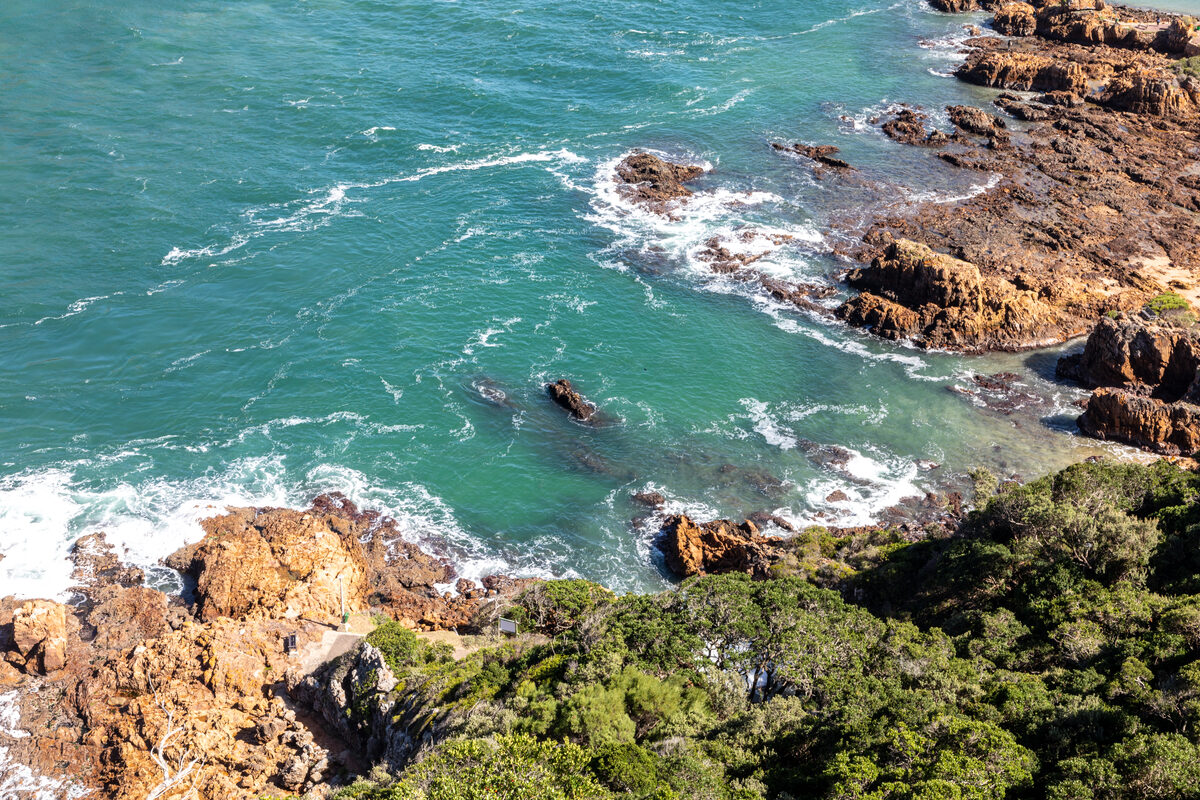
A little over twenty years ago, at the turn of the millennium, the situation was quite different. Traces left by our ancestors older than about 50,000 years were regarded as exceedingly rare. Across the whole of Africa, only four sites had then been reported. Two were in East Africa: Laetoli, in Tanzania, famous for its australopithecineAustralopithecineA genus of bipedal hominins from Africa (c. 4.2–1.9 Ma) with a brain still close to that of great apes (400–550 cm³) but walking upright. Lucy (<em>Au. afarensis</em>) is the most famous specimen.→ footprints 3.66 million years old, and Koobi Fora, in Kenya. The other two were South African: Nahoon and Langebaan. The Nahoon site, described as early as 1966, was in fact the very first hominin tracksite ever published in the world (#s2).
Within two decades, this landscape was transformed. People were not looking hard enough, or were not looking in the right places. Today the African tally of dated hominin ichnosites older than 50,000 years stands at fourteen. They can conveniently be divided into two clusters: an East African cluster of five sites, and a South African cluster from the Cape coast of nine sites. To these are added around ten others elsewhere in the world, notably in the United Kingdom and on the Arabian Peninsula. The Cape coast alone therefore concentrates a considerable share of everything humanity knows of its own ancient footprints (#s2).
One might reasonably struggle to appreciate how abrupt this reversal was. In a single generation of researchers, the Cape south coast went from local curiosity to global reference. Publications multiplied, as did international collaborations, and a genuine scientific community took shape around this shoreline. Where once people saw only holiday beaches, they now read an open book of the PleistocenePleistoceneThe geological epoch of the great ice ages (c. 2.6 Ma–11,700 BP), spanning most of human prehistory.→. This shift of perspective illustrates a broader lesson of archaeology: very often, it is not the remains that are lacking, but the eyes able to recognise them. The traces had been there for millennia; it took a team learning to see them.
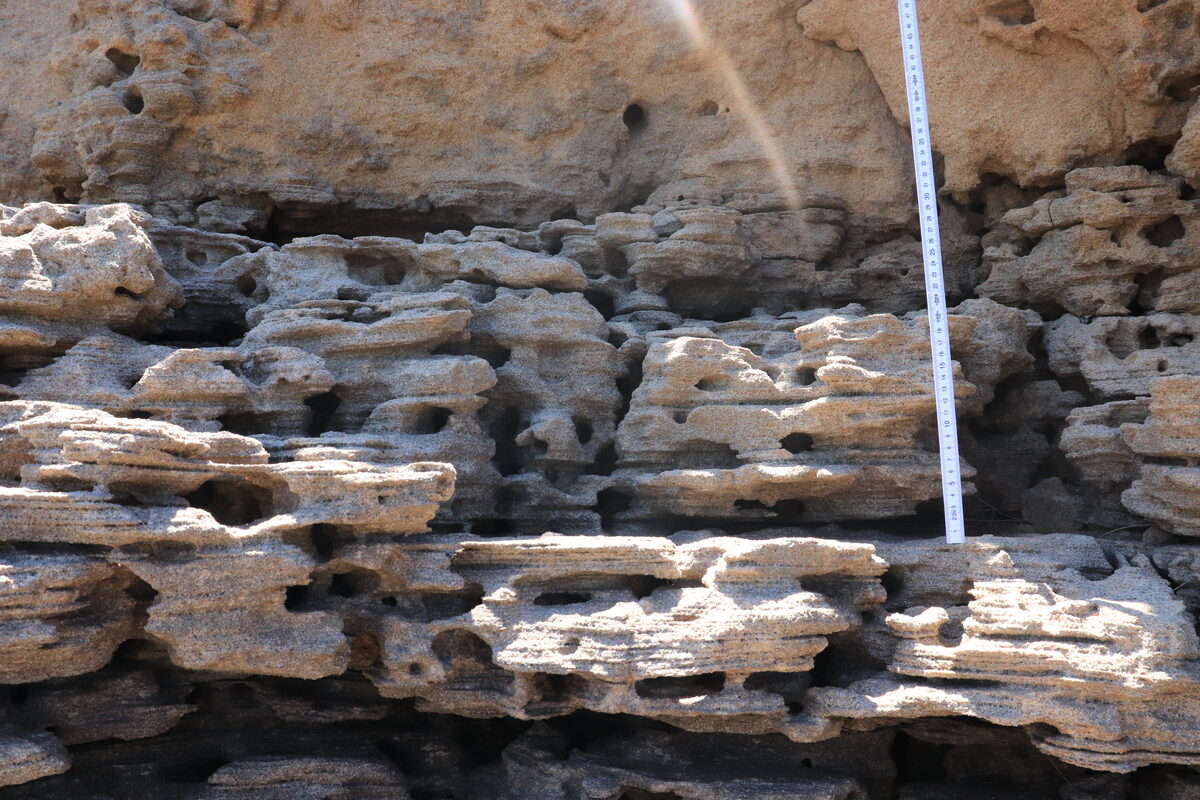
Why this region and not another? The answer lies in a remarkable convergence of geology and human effort. First, the geology: the coastline is lined with aeolianitesAeolianiteRock formed by the cementation of ancient coastal sand dunes. On South Africa's Cape south coast, these dune sandstones preserve the footprints of Homo sapiens.→, rocks formed by the cementation of ancient coastal dunes. When a dune stabilises and its sand grains weld together under the action of calcium carbonate, it turns into a soft stone that can preserve, engraved on its surface, the faintest impressions left before burialBurialThe intentional deposition of a body, sometimes with offerings; a marker of symbolic behaviour.→. Then, the human factor: a small community of researchers, often volunteers, patiently learned to spot these surfaces, to distinguish them from the natural play of erosion, and to understand what they told. On the Cape south coast, relatively few skeletal hominin remains have been found. Traces therefore become a precious way to complement and enrich our understanding of Africa's ancient inhabitants (#s2).
The discovery and Charles Helm's team
At the heart of this endeavour stands Dr Charles Helm, a researcher affiliated with the African Centre for Coastal Palaeoscience at Nelson Mandela University in Gqeberha (formerly Port Elizabeth). Trained as a physician, Helm has over the years become one of the leading figures in world ichnology, not from a university office but with his feet in the sand, walking kilometres of coast at low tide, his eye sharpened to spot on a sandstone wall the ghostly silhouette of a human footstep a hundred millennia old.
The team he coordinates has worked since the early 2000s on a methodical inventory of the coastline. Its originality lies in a multidisciplinary approach: geologists, dating specialists, wildlife biologists and traditional trackers collaborate to interpret what the rock has retained. Remarkably, the team enlisted San trackers, heirs to an ancient tracking knowledge, capable of reading in a footprint information a Western eye would miss: the direction of travel, the speed, sometimes even the physical state of the person who left the trace. This encounter between modern science and vernacular knowledge is one of the signatures of the South African school of ichnology.
The paper published in Ichnos is the culmination of five years of intensive fieldwork. Over that period, the team identified and dated seven new hominin tracksites, which join the South African cluster and bring it to nine sites. Each of these discoveries is the fruit of demanding fieldwork carried out under pressure, for the coast is alive: every storm, every spring tide can reveal a new surface and destroy another. To document a trace is often to save it at the last moment before the ocean erases it forever (#s2).
International media coverage rightly stressed the personality of the team leader and the almost artisanal character of his approach. Where laboratory archaeology mobilises heavy resources, Cape ichnology rests first on patience, on walking, on the repeated observation of the same stretch of coast season after season. It is this perseverance that eventually yielded the oldest trace ever attributed to our species (#s1).
The method deserves detailing, for it breaks with the classic image of the archaeologist bent over a trowel. Here, most of the work happens at low tide, in the raking light of morning or evening, when the reliefs of the rock stand out most clearly. A footprint on a sandstone wall does not leap to the eye: it is guessed at through a play of shadows, a slight depression, a suspicious regularity in the surface. To spot a trackway requires having internalised the shape of a human step to the point of recognising it even when half erased. It is knowledge built over years in the field, and it explains why so few teams in the world reach this level of productivity.
The dimension of this collaboration is also remarkable on the human level. By associating trackers from communities whose ancestors may have trodden these very shores, the team weaves an unexpected link between the most distant past and the present. Tracking knowledge, transmitted orally from generation to generation, proves a scientific tool of the first order. This meeting of analytical methods and vernacular knowledge is no mere ornament: it directly contributed to the interpretation of several sites, and it embodies a more open, more respectful way of doing prehistory.
Seven ichnosites, from 71,000 to 153,000 years
The core of the study published in Ichnos lies in a series of dates. The team submitted seven hominin tracksites to rigorous dating, and the result outlines a remarkably coherent chronological range: from 71,000 to 153,000 years. In other words, each of these sites falls within a period running from the late Middle PleistoceneMiddle PleistoceneGeological subperiod (about 770,000 to 126,000 years ago) marked by growing behavioural complexity among hominins.→ to the Upper Pleistocene, at the very heart of what prehistorians call the African Middle Stone AgeMiddle Stone AgeA long phase of African prehistory (c. 300,000 to 40,000 years ago), the African equivalent of the Middle Palaeolithic, marked by the rise of symbolic behaviour.→ (#s2).
The most recent of the seven sites dates back about 71,000 years. This lower bound is anything but trivial: it corresponds to a particularly rich phase of the Middle Stone Age, the one in which southern Africa saw the flowering of stone industries of unprecedented sophistication. The oldest reaches 153,000 years and is the highlight of the study. Between these two extremes, the other sites spread along a chronology that faithfully echoes what was already known of the region's geological deposits. The two long-dated South African sites, Nahoon and Langebaan, yielded ages of about 124,000 and 117,000 years respectively. The new dates therefore slot into an already known framework while extending it further into the past (#s2).
This coherence is not a technical detail. It means that the Cape south coast was frequented by human groups not occasionally but recurrently, over tens of thousands of years. Each site is a snapshot, but together they compose a film: that of a lasting human presence, adapted to a rich and shifting coastal environment. The footprints do not merely tellTellAn artificial mound formed by the accumulation of successive layers of settlement remains at the same spot, typical of the Near East. Each destruction-rebuilding event adds a stratum.→ us that an individual passed by on a given day; they attest that an entire population made this shore its territory, generation after generation.
One must also weigh what it means simply to date seven sites at once. Each trace fossil is a fragile object, often partly eroded, sometimes reduced to a few isolated impressions on a slab exposed to sea spray. Assembling seven reliable dates requires a colossal effort of sampling, analysis and cross-checking. This is why the study stands as a landmark: it does not merely announce a record, it builds a solid chronological reference for a whole swathe of African prehistory (#s3).
It is worth clarifying exactly what the word cluster covers in the researchers' vocabulary. It refers not to mere geographical proximity but to a coherent set of sites sharing the same geological context, the same chronological window and the same human signature. The South African cluster of the Cape coast thus forms a scientific entity in its own right, which can be compared with the East African cluster to bring out their differences. This comparative approach is fruitful: it allows each discovery to be placed within a broader framework and avoids the trap of over-interpreting an isolated site.
The 153,000-year-old trace, in the Garden Route National Park
The centrepiece of the study lies west of the coastal town of Knysna, within the bounds of the Garden Route National Park. It is there, on an aeolianite surface, that the footprint dated to about 153,000 years was identified. It thereby becomes the oldest footprint ever attributed to Homo sapiens, our own species (#s2).
The figure deserves pausing over. Until this publication, the oldest footprints attributed to our species stood around 120,000 years. The Garden Route National Park trace pushes that limit back by about 30,000 years in a single leap. To give a sense of the gap, thirty millennia represent an interval longer than the entire span separating us from the painted caves of Lascaux or Chauvet. Such is the scale of the chronological setback this single footprint imposes on the world record (#s1).
What strikes one is the contrast between the modesty of the object and the immensity of what it signifies. A footprint is nothing more than a hollow in an ancient dune. It weighs nothing, cannot be transported, will join no museum display case. And yet it carries information no bone can give: the certainty that a living, breathing human being stood there, at that precise spot, 153,000 years ago, and pressed a bare foot into the wet sand before continuing on. It is a direct, almost physical contact with an individual from the deepest past.
The contrast with the East African sites in fact illuminates the whole specificity of the Cape. At Laetoli, in Tanzania, the footprints 3.66 million years old were not left by modern humans but by australopithecines; at Koobi Fora, by more ancient representatives of the genus Homo. The East African traces, often deeply buried, had to be exposed through long and painstaking excavation. The Cape traces, by contrast, all belong to our species and most often appear in the open air, ready to be read but also exposed to rapid disappearance. Two ichnological worlds thus coexist on the same continent: one plunges toward the deep roots of the human lineage, the other lights up the precise moment when Homo sapiens was taking possession of its shores.
The location, too, makes sense. The Garden Route National Park today protects a shoreline of great beauty, a mosaic of forests, lagoons and cliffs. 153,000 years ago the landscape was different, the sea level lower, the coast at times further away. But the ecological richness of the shore was already there: shellfish beds, fish-filled estuaries, freshwater points. It was this abundance that drew the first modern humans and held them in place long enough for them to leave, generation after generation, the lasting mark of their steps (#s2).
It is worth measuring what a single footprint of this age represents in terms of preservation. For a trace to survive 153,000 years, an improbable chain of events had to align: the sand had to be damp enough to take the imprint, then dry and firm enough for it not to collapse, then buried quickly by fresh wind-blown sand, then cemented over millennia, and finally re-exposed today at just the right moment for a human eye to notice it before the ocean claimed it. Each surviving footprint is thus a statistical miracle, the improbable outcome of a lottery played out over more than a hundred millennia. That the Cape coast has yielded not one but a whole cluster of such miracles is what makes it so exceptional.
How to date a footprint: OSL and aeolianites
Dating a footprint may seem an impossible challenge. A trace is not a bone that can be submitted to radiocarbon; nor is it a volcanic crystal one would date by classic radiometric methods. It is a simple hollow in a sedimentary rock. The solution adopted by Charles Helm's team rests on an elegant method: optically stimulated luminescence, or OSLLuminescence (OSL)Optically stimulated luminescence datingLuminescence datingA method dating the last heating or light exposure of sediments and minerals by measuring energy trapped in the crystal.→: measures the last exposure of sediment grains to light.→ (#s2).
The principle is as follows. A grain of quartz sand, as long as it is exposed to sunlight, has its internal clock reset to zero. But once buried, sheltered from solar radiation, it begins to accumulate energy, trapped in its crystal defects under the effect of the soil's natural radioactivity. In the laboratory, this energy can be released by shining light on the grain and measuring the light it emits: the longer the burial, the more intense the signal. OSL therefore indicates not the age of the grain itself but the time elapsed since its last exposure to the sun, that is, since its burial (#s2).
Now, in the case of the Cape footprints, this moment of burial coincides almost exactly with the creation of the trace. The scenario is always the same: a human walks on wet sand and imprints a foot; shortly after, wind-blown sand covers the footprint and seals it, away from the light. The OSL clock then starts at the precise moment the trace vanishes beneath the dune. To date the sand covering the footprint is therefore to date the footprint itself, to within a few years. The correspondence between the geological event and the human event is here almost perfect (#s2).
The Cape south coast proves, moreover, an ideal terrain for this method. On the one hand, its sediments are rich in quartz grains, which produce abundant and easily measured luminescence. On the other, generous sunshine, wide beaches and the constant transport of sand by the wind guarantee that any earlier light signal has been fully erased before the decisive burial. These conditions translate into robust age estimates. It is this same technique that had already underpinned the dating of most earlier finds in the region, which strengthens confidence in the new results (#s2).
Yet aeolianites impose their own limits. Unlike the East African surfaces, painstakingly excavated and generally well preserved, the Cape traces are most often exposed in the open air as soon as they are discovered. Dune sand, relatively coarse, retains fine detail less well than a river silt. One therefore sacrifices some interpretive finesse but gains the possibility of directly dating the deposit. This trade-off, embraced by the team, lies at the heart of the approach: a somewhat crude but firmly dated trace is worth more than a magnificent footprint of unknown age (#s2).
There is also a philosophical dimension to this method worth dwelling on. OSL does not date the object we care about, the footprint, but its negative, the sand that filled it in. The scientist reads the trace not directly but through the veil of what covered it. There is something fitting in this: the human gesture itself leaves no datable material, only an absence, a hollow, and it is the world's response to that absence, the sand rushing in to fill it, that carries the memory of the date. To date a footprint is, in a sense, to date the moment the world moved to erase it.
What the footprints reveal: gait, size, behaviour
A fossil footprint is not merely a marker of presence. Correctly read, it becomes a source of biological and behavioural information of unsuspected richness. This is what gives ichnology all its value: where an isolated bone informs us about anatomy, a trace informs us about movement, gesture, life in action.
The size of a footprint first gives an estimate of foot length, and by extension of the stature and sometimes the age of the one who left it. A small footprint betrays a child; a trackway alternating adult and child steps suggests movement in a family group. The spacing between successive steps, the length of the stride, inform us about the pace: leisurely walk, hurried step, run. The depth and distribution of pressure under the arch of the foot may even indicate whether the individual carried a load, or walked on more or less yielding ground. Each parameter is a window onto a precise instant of daily life.
On the Cape coast, these readings are made possible by collaboration with experienced trackers, whose gaze hunts down the clues that science then measures. A trace is then no longer a mere hollow in the stone but the condensed narrative of a journey: where the walker came from, where they were going, at what speed, alone or accompanied. It is a palaeontology of gesture, an archaeology of movement, restoring something of the bodily presence of the shore's ancient inhabitants.
One must, however, remain cautious. Dune sand, coarser than a fine sediment, does not always preserve the most subtle details, and exposure to the elements rapidly degrades surfaces. Many traces are partial, eroded, hard to interpret in detail. The team stresses this limit: a cautious reading is preferable to an over-confident reconstruction. But even a crude footprint, provided it is dated with certainty, brings vital information: it proves that a modern human stood there, on that date, in that landscape. And this proof alone is worth its weight in gold for understanding the peopling of southern Africa (#s2).
The significance of this collaboration goes beyond ichnology alone. It reminds us that prehistory is not only a matter of laboratories and instruments, but also of crossed perspectives. The tracker reads in a footprint what the geologist will date, what the biologist will assign to a species, what the prehistorian will inscribe in an overall narrative. None of these readings suffices on its own; it is their superposition that makes sense. In this, Cape ichnology offers a model of genuinely integrated research, in which the most diverse skills converge on the same object, humble in appearance: a hollow in the sand.
Ammoglyphs and other human traces
Footprints are not the only marks humans left in the sand of the ancient dunes. Researchers on the Cape coast coined a specific term for a category of more enigmatic traces: ammoglyphsAmmoglyphPattern or trace left intentionally or not by humans in sand (drawings, alignments, marks), preserved after the dune cemented. Term coined by researchers on the Cape coast.→. The word, built from the Greek ammos (sand) and glyphê (carving), designates all the patterns, drawings and marks left intentionally or not by humans in the sand, then preserved after the dune cemented.
Where a footprint results from a step, an ammoglyph may result from a quite different gesture: a finger dragged through the sand, an object set down then removed, a pattern traced deliberately, or the imprint of a tool. Some of these patterns bear directly on the question of symbolic thought. If a human being took the trouble, more than a hundred thousand years ago, to trace a shape in the sand not for a practical purpose but to represent something, then we are touching the very roots of art and abstraction. Of course, interpretation is delicate: distinguishing an intentional pattern from a natural or animal accident demands extreme rigour. This is precisely one of the most stimulating fields of Cape ichnology.
This approach considerably broadens the very definition of a trace. In ichnology, an ichnosite is not limited to footprints: it encompasses all traces, including these patterns and carvings in the sand. This is why researchers speak of hominin ichnosites rather than simple footprint sites. The Cape coastline then becomes an immense sheet of sand on which our ancestors left, unknowingly, a multitude of signals: their steps, but also the traces of their hands, their tools, perhaps their games (#s2).
This ensemble composes a picture of rare density. Alongside the human footprints, the coast also preserves the traces of a vanished fauna, those of elephants, large bovids and birds, which shared the shore with the first modern humans. By cross-referencing these different ichnological archives, researchers reconstruct a whole Pleistocene ecosystem, with its actors, its interactions, its landscapes. The 153,000-year-old footprint then ceases to be an isolated curiosity and becomes the thread of a far vaster environmental story.
These carvings in sand also invite a comparison with the better-known record of cave art. Where painted caves such as Blombos preserved deliberate engravings on durable stone, the ammoglyphs of the Cape capture something more spontaneous and fleeting: the trace of a hand or a stick in loose sand, an act that would normally vanish within hours. That such ephemeral gestures could be frozen and read a hundred thousand years later is one of the most astonishing gifts of the aeolianites, and it hints at layers of ancient behaviour that conventional archaeology can rarely reach.
Why the South African Middle Stone Age is crucial
The range of 71,000 to 153,000 years places these footprints at the very heart of the Middle Stone Age, the long period during which Homo sapiens acquired, in Africa, most of its cognitive and technical toolkit. To understand the importance of this phase is to understand why the Cape discovery goes far beyond a mere chronological record (#s2).
It is indeed in southern Africa, and notably on this south coast, that some of the oldest evidence of modern behaviours is concentrated. Not far from the footprint sites, Blombos cave yielded blocks of ochreOchreA red or yellow mineral pigment (iron oxides), used from prehistory for adornment, funerary rites and art.→ engraved with geometric patterns more than 70,000 years old, considered among the oldest known manifestations of abstract art, as well as shell beads attesting the use of ornament. The region also gave its name to the Still BayStill BayA southern African Middle Stone Age culture (c. 75,000–72,000 years ago), characterised by bifacially worked silcrete points and rich symbolism (engraved ochres, beads). Attested at Blombos Cave.→ industry, characterised by fine stone points worked with remarkable care and mastery. Elaborate tools, pigments, body ornaments, methodical harvesting of shellfish: all these clues converge toward one conclusion (#s2).
The new dates corroborate this reading. By attesting a recurrent human presence on the coast between 71,000 and 153,000 years ago, they add to the body of evidence that makes the Cape south coast one of the regions where the first anatomically modern humans survived, evolved and thrived, before dispersing out of AfricaOut of AfricaThe dispersals of Homo sapiens out of Africa, including a major expansion c. 70,000 to 60,000 years ago and earlier exits.→ to the other continents. The footprints say not merely that humans were there: they say that modern humans, fully capable of advanced symbolic and technical behaviours, made this shore a lasting home (#s2).
This convergence between the archive of objects and the archive of traces is precious. Tools and ornaments tell us what these humans made and thought; footprints tell us where they walked, how they moved, and with whom. By superimposing these two views, one approaches a complete portrait: that of a population of Homo sapiens settled on a generous coastline, technically inventive, socially organised, and already carrying that symbolic spark which would accompany our species to the ends of the earth.
There is here a stake that touches the very narrative of our origins. For a long time, people sought a single cradle of modern humanity. Current data instead paints a richer picture, in which several regions of Africa each contributed, in their own way, to the emergence of Homo sapiens. In this mosaic, the Cape south coast holds a place of choice, and the footprints of Charles Helm and his team bring a striking confirmation of it (#s3).
A word, finally, on the heritage significance of these sites for South Africa itself. Far from being an abstraction reserved for specialists, this story touches the identity of a country that ranks among the world's richest regions in remains of human evolution. The Cape footprints extend a long series of major discoveries, from Sterkfontein in the Cradle of Humankind to the painted caves and knappingknappingThe set of operations for fracturing a stone block to extract flakes or blades.→ workshops of the coast. They remind us that southern Africa is not a periphery of world prehistory but one of its essential heartlands, a place where a decisive part of our species' adventure was played out.
Fragility and conservation of the coastline
There is a cruel paradox at the heart of Cape ichnology. The very conditions that allowed these traces to be preserved, their exposure in the open air within soft rocks, are also those that doom them. A 153,000-year-old footprint outcropping today on a wave-battered cliff may disappear tomorrow, erased by a single storm. The race against time is permanent (#s2).
Aeolianites are fragile rocks. Dune sandstone yields easily under the combined action of ocean, wind and salt spray. A surface revealed by erosion may be visible for only a few months, sometimes a few weeks, before being carried away forever. This is why the team's work often consists of documenting under pressure: photographing, measuring, casting, dating, before the sea reclaims its due. Each recorded site is a victory wrested from erosion.
This fragility calls for adapted methods. Rather than excavating, as one would in East Africa, researchers favour rapid, non-destructive recording: photogrammetry, field surveys, targeted sampling for dating. The aim is not to preserve the rock, often impossible to move, but to preserve the information it carries, in the form of digital models and data, before its inevitable destruction. The physical trace will perish, but its scientific memory will be saved.
This particular temporality also changes our relationship to discoveries. In classic archaeology, an excavated site remains, at least in part, accessible for future study. On the Cape coast, each survey may be the last. The data recorded today becomes the sole testimony of a trace no one will ever see again. This responsibility weighs on the researchers' shoulders and lends their work a singular gravity: they do not merely describe the past, they save its last fragments before they return to nothingness. Here, the hourglass runs both ways.
Finally, there is the question of protecting the coastline itself. Some of the sites lie within protected areas, such as the Garden Route National Park, which limits human-caused damage. But no protection can stop the ocean. Conservation here is less about fencing off a site than about permanent vigilance: monitoring the coast, returning again and again to the same sectors, seizing each new outcrop before it fades. It is a heritage ephemeral by nature, whose safeguarding rests entirely on the constancy of the researchers.
Conclusion: reading the ground as a manuscript
The discovery published in Ichnos by Charles Helm and his team will remain a landmark of African prehistory. By dating seven hominin ichnosites from 71,000 to 153,000 years, and by identifying the oldest footprint ever attributed to Homo sapiens, it pushes back by about 30,000 years a record long considered stable. But to reduce this study to a figure would be to miss the essential (#s1).
What this work demonstrates is the value of a long-neglected archive. Footprints, ammoglyphs, all these fleeting traces preserved in the hardened sand of ancient dunes, open a unique window onto the daily life of our ancestors. Where bones tell of anatomy and stones tell of technique, traces tell of gesture, of movement, of living presence. They restore something no other fossil can offer: the instant when a human being pressed a bare foot into the sand of a shore, more than a hundred and fifty millennia ago.
Cape coast ichnology thus teaches us to read the ground itself as a manuscript, each footprint forming a letter, each trackway a sentence, each site a paragraph of an immense and fragmentary text. This text is far from fully deciphered. The team knows it well: other ichnosites await discovery, not only on the Cape south coast but also in older deposits, ranging in age from 400,000 years to more than two million years. The research is only beginning.
A decade from now, the list of hominin tracksites will no doubt be far longer than today, and our understanding of the landscapes our distant ancestors occupied far finer. The Cape shore, with its patient ocean that gives and takes back, will keep yielding, storm after storm, the erased steps of those who came before us. And with every footprint recovered, a little of our own history, that of humanity on the move, rises again from the sand (#s2).
Les images de cet article m'inspirent vraiment. L'iconographie préhistorique est une mine.
Ce site est exactement ce que je cherchais pour partager la culture historique en famille.