A field, cliffs and a treasure from across the Channel
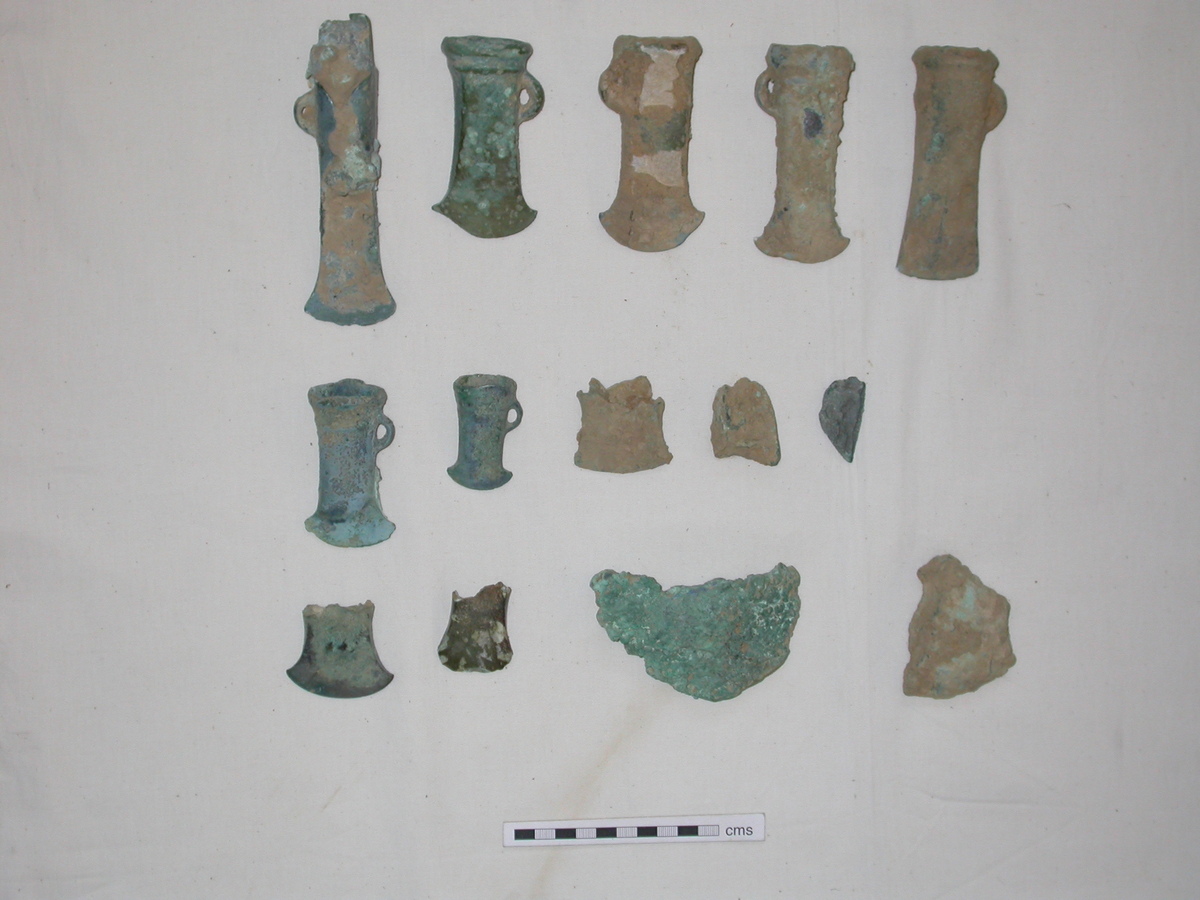
At Escalles, a small commune in the Pas-de-Calais region set against the chalk cliffs of Cap Blanc-Nez, an ordinary farm field has yielded one of the most stimulating cases in the prehistoryPrehistoryThe span of human history before the invention of writing, from the Palaeolithic to the Metal Ages, known mainly through material remains.→ of the coastline. Beneath the ploughed soil lay, for roughly four thousand years, fifty-seven bronze axes of British origin, carefully buried during the âge du bronzeBronze AgeBronze AgePeriod of late prehistory marked by bronze metallurgy and the rise of maritime trade, beginning in the Near East around 3300 BCE.→A protohistoric period following the NeolithicNeolithicThe "New Stone Age": a period marked by farming, herding, settlement and pottery, from around 10,000 BC.→, defined by bronze metallurgy (a copper-tin alloy) and the rise of the first cities and states; in Egypt it corresponds to the age of the first pyramids.→. The fact is surprising: these objects, cast on the other side of the Channel, should in theory never have ended up on this shore of the strait. Their presence, far from being an isolated anomaly, actually sheds light on the intensity of the exchanges that linked the two sides of the sea arm four millennia ago3.
Since 2026, forty of these axes have become the property of the French State, a decision confirmed by the Regional Directorate of Cultural Affairs of Hauts-de-France. This status is no administrative formality: it opens the way to a thorough, structured and lasting scientific study, meant to reveal why and how such an assemblage came together at this precise spot. The Escalles case is therefore not merely a fine field discovery. It has become a research object in its own right, at the crossroads of field archaeology, ancient métallurgieMetallurgyThe techniques of extracting and working metals (copper, bronze, gold); its rise in the EneolithicEneolithicThe "Stone-and-Copper Age": a transition between the Neolithic and the Bronze Age (c. 5000–3000 BC in south-eastern Europe), marked by the first copper objects, large farming settlements and, in places, the rise of fortified sites. Broadly synonymous with Chalcolithic.→ and Bronze Age transformed tools, weapons and social hierarchies.→ and the history of European exchange networks.
Fifty-seven axes from across the Channel
At the heart of the case are these fifty-seven bronze axes, whose typology and composition point unambiguously to insular production, that is, manufactured in Britain or Ireland. Bronze Age axes are not merely woodcutters' tools: depending on the period and region, they served as implements, prestige goods, metal reserves, and sometimes symbolic objects. The hafted models known as palstaves, characteristic of part of the second millennium before our era, are among the most widespread and most travelled forms of this bronze economy4.
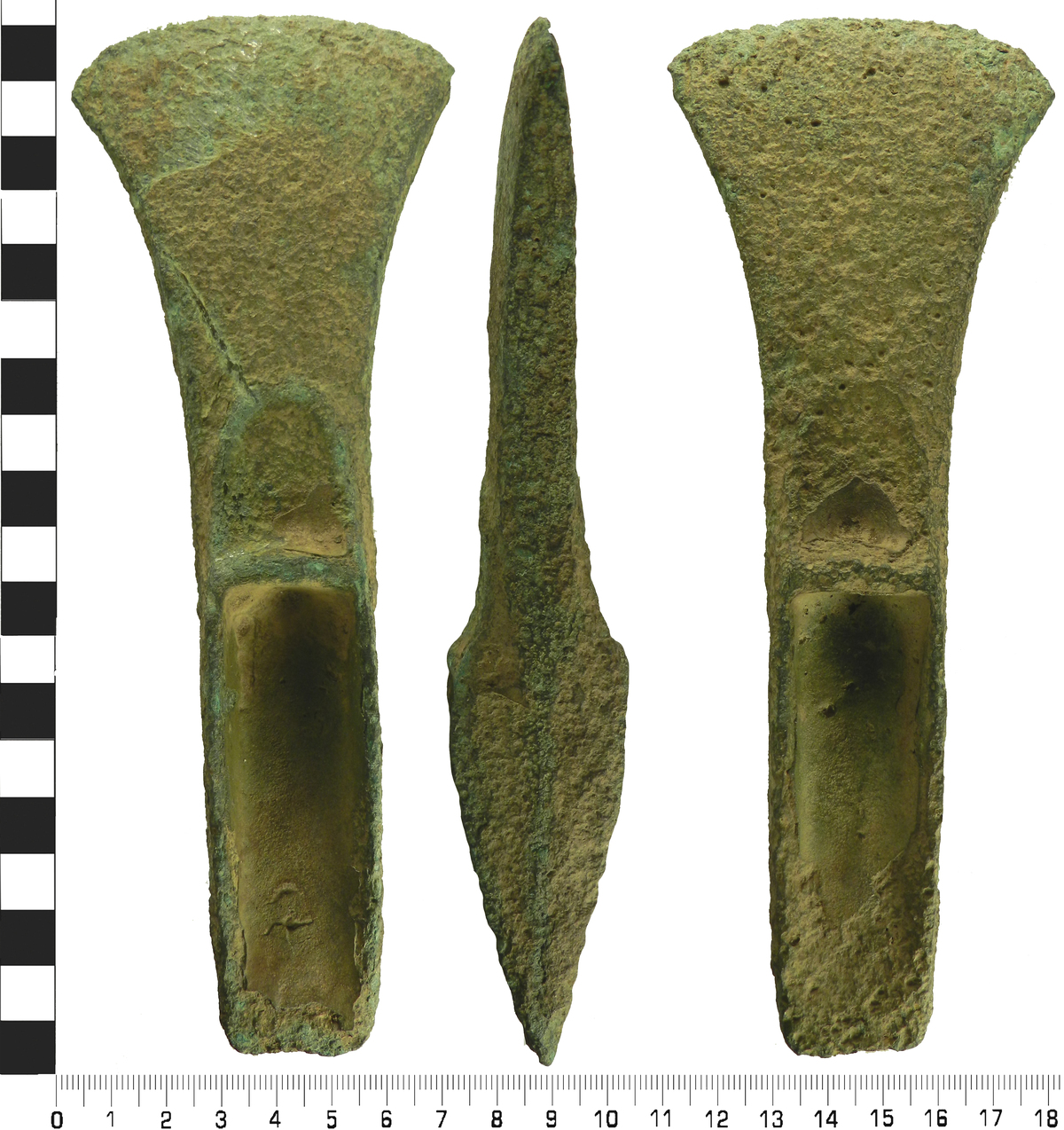
That dozens of these pieces, cast across the Channel, crossed the strait to be finally gathered and then buried in a field at Escalles is anything but trivial. Bronze is an alloy of copper and tin, two metals that do not surface everywhere: their circulation required long supply chains, intermediaries and shared know-how. Recovering a coherent lot of British objects on the continent means putting a finger on a concrete link in these circuits. Each axe is at once an artefact and a clue, the material trace of a movement of raw materials and finished goods that crossed the sea in both directions.
Cap Blanc-Nez, a crossroads of the strait
Geography partly explains why Escalles holds such a particular place. Cap Blanc-Nez marks, together with neighbouring Cap Gris-Nez, the point where the continent comes closest to the English coast. There the Strait of Dover measures barely thirty kilometres, a distance that Bronze Age vessels could cover by seizing favourable weather windows. Far from being a boundary, the sea was here a route of circulation, a space frequented by communities that knew how to read currents, winds and tides.
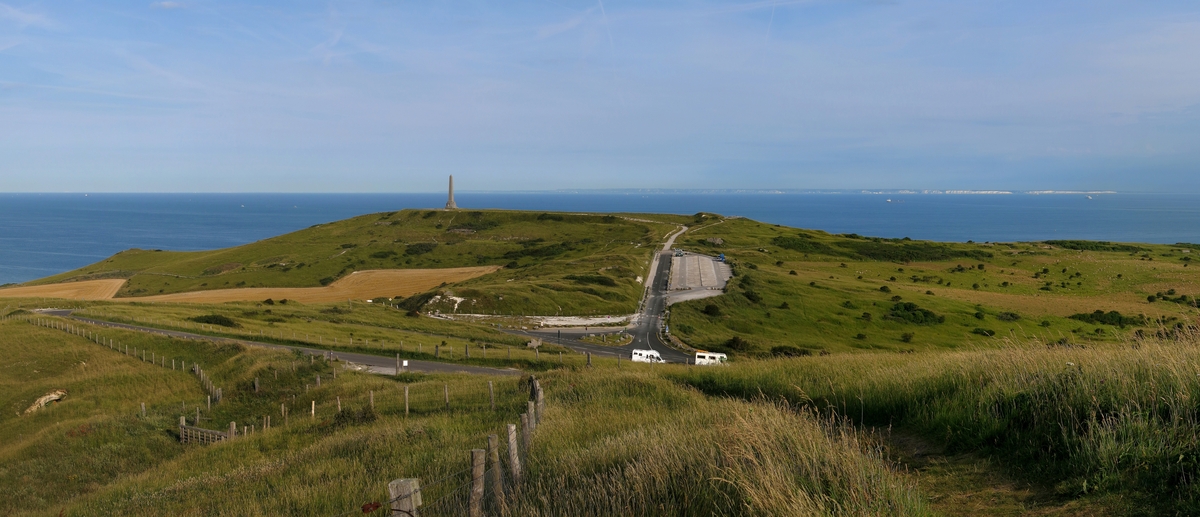
This coastline was therefore not a margin but an interface. The white cliffs, visible from far off in clear weather, formed a natural navigation landmark, a seamark that can be spotted from the opposite shore. Such a location favoured landings, points of contact and places of exchange where goods, people and information crossed paths. Set in this framework, the Escalles deposit stops being a local curiosity and becomes the witness of a spatial organisation: that of a territory turned towards the sea, whose wealth came not only from its land but from its position on the edge of one of the most strategic maritime passages of protohistoric Europe.
Networks on a European scale
The Escalles case only makes full sense on a continental scale. Research conducted on the Pas-de-Calais coast shows that the region took part in vast exchange networks during the early and middle Bronze Age2. These networks were not confined to the shores of the Channel: they stretched over thousands of kilometres, connecting areas with complementary resources. From the Baltic came amber, a fossil resin prized for adornment and prestige. From Ireland and Britain circulated bronze and finished objects. Between these poles, the continent served as a relay, a zone of transit and transformation.
In this geography of flows, the strait region occupied a crossroads position. Raw materials and valuable goods did not move at random: they followed structured itineraries, passed through privileged crossing points, and stopped at places where there existed actors able to organise their redistribution. Escalles, at the hinge between the insular world and the continent, between the amber routes coming from the north and east and the bronze routes coming from the west, lay precisely on one of these lines of force. The deposit of British axes is no accident: it materialises this coastline's belonging to an exchange system that embraced much of Europe.
The hypothesis of a chiefdom
How could such a volume of goods from elsewhere become concentrated at a single point of the territory? For researchers, a hierarchical social organisation is needed to explain the mastery of long-distance flows of raw materials. Hence the hypothesis of a local chefferieChiefdomA hierarchical social organization led by a chief, controlling redistribution and exchange, without a formed state.→, that is, a power able to control, capture and redistribute the resources moving through the strait. Controlling passage, accumulating metal, organising distant exchanges: these functions imply individuals or groups endowed with authority, alliances and means going beyond the frame of a single village.
This reading must nonetheless be handled with caution. The chiefdom remains a working hypothesis, a coherent way of interpreting the clues, not a demonstrated fact. What is firmly established are the deposit itself, the British origin of the axes, their dating to around four thousand years ago, and the site's insertion into vast exchange networks. Moving from these facts to a precise social model belongs to interpretation, and it is precisely the role of research to test, refine or revise such a proposal. The distinction between what is observed and what is inferred is essential here: it protects the reasoning from hasty conclusions and keeps the space of scientific debate open.
Why bury a bronze treasure?
There remains the most intriguing question: why bury such an assemblage? dépôt (cache)HoardA set of deliberately buried objects: a metal reserve, hoarding or offering; common in the Bronze Age.→s of axes and metal objects are a well-known phenomenon of the European Bronze Age, but their motivations remain debated. Several explanations coexist, without necessarily excluding one another. Some deposits seem to have an economic function: they constitute metal reserves, set aside with a view to later recovery, the raw material having a value of its own. Others belong to a symbolic or ritual dimension: the objects are then offered, deliberately withdrawn from circulation, laid down in a gesture that escapes purely utilitarian logic.
In the Bronze Age, metal is not only a material, it is also a form of value. Before the appearance of struck coinage, standardised objects such as axes or ingots could serve as standards, means of payment or reserves: this is sometimes described as a pre-monetary economy, in which hoarding bronze amounted to accumulating wealth. From this perspective, burying fifty-seven axes may amount to securing a capital, displaying a status, or honouring a social or religious obligation. The research carried out at Escalles aims precisely to clarify, as far as possible, which of these readings best accounts for this singular deposit, by cross-referencing the composition of the metal, the context of discovery and regional comparisons.
Forty axes for science
The recent turning point of the case lies in the status acquired by part of the lot. Since 2026, forty axes have been the property of the State, as confirmed by the Regional Directorate of Cultural Affairs of Hauts-de-France. This classification guarantees the preservation of the assemblage and the launch of a complete scientific study, safe from dispersal. The objects thus become a stable, documented corpus, accessible to laboratory analyses and comparisons, which is an indispensable condition for drawing from the finds all they can teach.
The investigation is part of a collective research project devoted to Escalles, bringing together the Pas-de-Calais Department, the National Institute for Preventive Archaeological Research, universities, the National Centre for Scientific Research, the Ministry of Culture and British researchers1. This cooperation, notably across the Channel, is no detail: it reflects the very nature of the subject. Since the axes come from the British Isles and the site tells of exchanges between the two shores, it was logical that the research should associate teams from both countries. Studying the ancient circulation of goods today requires, in turn, that skills and data should circulate.
What the Escalles deposit teaches us
At the end of this journey, the Escalles field appears as a window opening onto a connected world, long before writingWritingA system of conventional signs used to fix language or information durably; its appearance (c. 3300 BC) marks, by convention, the end of prehistory.→ and states. Axes cast across the Channel, crossing a strait of thirty kilometres, gathered and buried at the foot of cliffs serving as a landmark for navigators: each element draws the same picture, that of a coastline embedded in exchange networks on a European scale, through which flowed Baltic amber and insular bronze. The site reminds us that the Channel has not always been a border, and that four thousand years ago it was a space of intense contacts.
It also calls for rigour. The firmly established facts are the deposit, the British origin of the objects, their dating and the territory's insertion into vast exchanges. The idea of a chiefdom controlling these flows remains an attractive but unconfirmed hypothesis. This is the whole point of the ongoing research: to move patiently from the found object to reconstructed history, without skipping steps. Beneath a Pas-de-Calais field, fifty-seven bronze axes will thus have reopened an entire chapter of the strait's prehistory, and this time the last word will belong to the laboratory.
J'ai commandé plusieurs livres après avoir lu vos dossiers. Vous m'avez donné envie d'aller plus loin.