Before Rome, there were the Etruscans. Between the ninth and the first century BCE, this remarkable people dominated a large part of the Italian peninsula, controlled maritime trade across the western Mediterranean, built prosperous city-states, and developed an artistic and religious civilisation of extraordinary richness. Yet the Etruscans remain one of the least known of the great ancient civilisations, partly because their language is still largely undeciphered and most of our sources about them are indirect, filtered through Greek or Roman eyes.
The Greeks called them Tyrsenoi or Tyrsenoi, the Romans Tusci or Etrusci. They called themselves Rasna. At their height, between the seventh and fifth centuries BCE, the Etruscans were the undisputed masters of what we now call Tuscany, parts of Umbria, northern Latium, and the Po plain. Their cultural influence radiated as far as southern Gaul, Corsica, and the Iberian Peninsula. To understand the Etruscans is to understand the foundations on which Rome built its own greatness.
Origins: An Indigenous People or Immigrants from the East?
The question of Etruscan origins has fascinated and divided historians and philosophers since antiquity. Herodotus claimed they came from Lydia in Anatolia, fleeing a great famine. Dionysius of Halicarnassus, on the contrary, argued they were an indigenous people, sprung spontaneously from Italian soil. Livy proposed a third view, making them descend from the Alps.1
Modern paleoanthropology, and above all genomics, have provided a nuanced answer to this age-old debate. A study published in 2023 in Science Advances, analysing ancient genomes from 82 Etruscan individuals and contemporary Italian populations, confirmed that the Etruscans were genetically very close to other Italic and European populations of the period, with no significant input from a recent eastern migration.2 Their cultural and linguistic distinctiveness therefore did not result from a mass immigration from the Near EastNear EastA region of western Asia (Levant, Mesopotamia, Anatolia, Iran), cradle of the Neolithic revolution, agriculture, the first cities and writing.→, but from a local evolution from Bronze AgeBronze AgeA protohistoric period following the Neolithic, defined by bronze metallurgy (a copper-tin alloy) and the rise of the first cities and states; in Egypt it corresponds to the age of the first pyramids.→ Italian populations.
The origins of Etruscan civilisation proper trace back to the Villanovan culture (ninth to eighth centuries BCE), an Iron AgeIron AgeThe last period of protohistory (from c. 1200 BC in Europe and the Near East), marked by iron metallurgy and the first kingdoms.→ culture characterised by cremating the dead in biconic urns. This people of the Tuscany-Latium region lived in villages of huts, practised agricultureAgricultureThe cultivation of plants and production of food by working the soil, which emerged in the Neolithic in the Near East and independently elsewhere; it radically transformed human societies.→, animal husbandry, and above all metallurgyMetallurgyThe techniques of extracting and working metals (copper, bronze, gold); its rise in the Eneolithic and Bronze Age transformed tools, weapons and social hierarchies.→. The presence of rich iron ore deposits on the island of Elba and in the Populonia region would play a decisive role in the development of Etruscan civilisation, making it an indispensable commercial actor in the Mediterranean.
Etruscan Society: City-States, Aristocracy, and the Role of Women
The Etruscans never constituted a unified state or even a federation in any political sense. Their world was organised into a dozen major independent city-states, among them Veii, Cerveteri (Caere), Tarquinia, Vulci, Vetulonia, Populonia, Volterra, Arezzo, Chiusi, Orvieto, Perugia, and Fiesole. These cities met occasionally within a religious league, the League of Twelve, whose federal sanctuary was the fanum Voltumnae, probably located near Bolsena, but they shared no common political institutions. Each city conducted its own foreign policy, concluded its own alliances, and sometimes fought its neighbours.3
ArchaicArchaicRefers to an ancient, now-extinct human population or form (Neanderthals, Denisovans, ghost lineages), as opposed to anatomically modern humans.→ Etruscan society, between the ninth and seventh centuries BCE, was organised in villages with little pronounced social stratification. Then, under the effect of commercial prosperity, an urban aristocracy gradually emerged whose lifestyle drew heavily on Greek practices. Until the fifth century BCE, power was exercised by kings (lucumon); they were subsequently replaced by annual magistrates, the zilath, who performed both civil and religious functions.
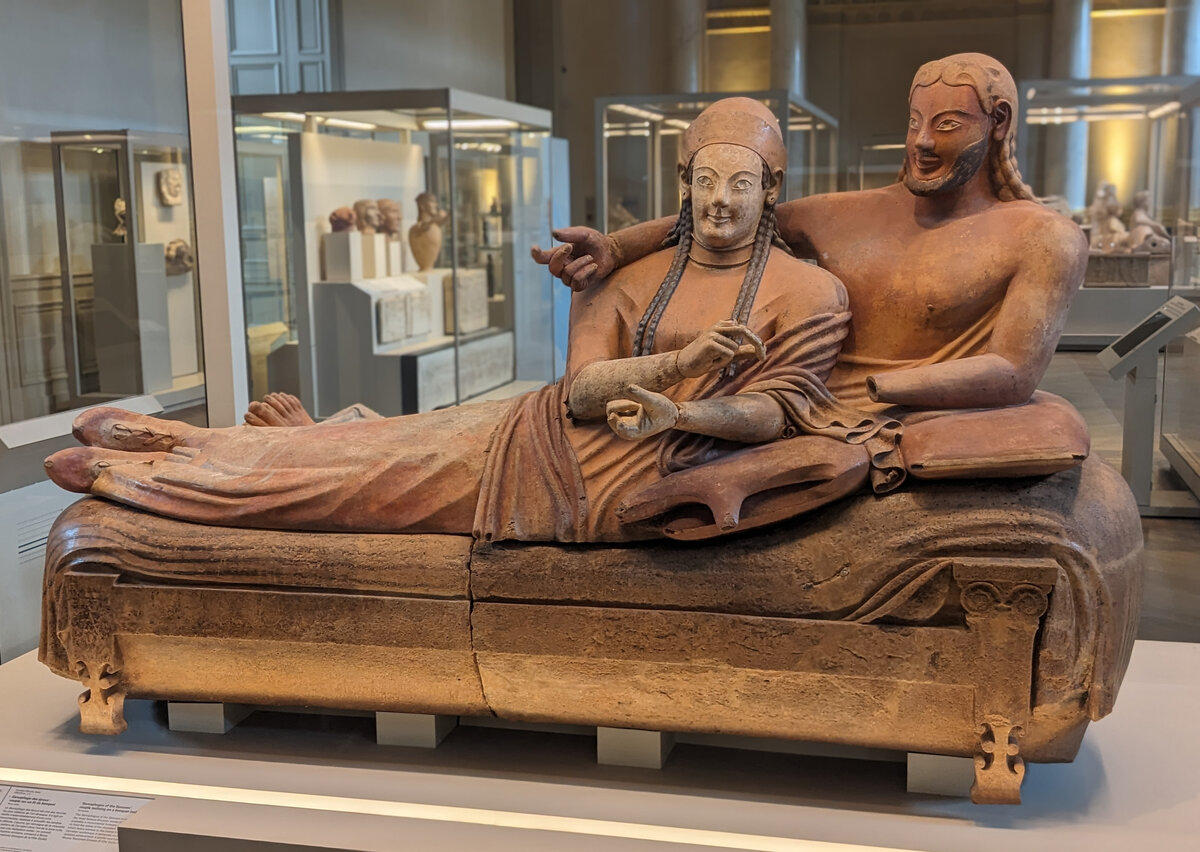
One of the most striking characteristics of Etruscan society, and the one that most shocked Greek and Roman observers, was the place accorded to women. While in Greece and Rome women were relegated to the domestic sphere and excluded from male banquets, Etruscan women fully participated in public life and aristocratic feasting. Funerary frescoes from Tarquinia show them reclining alongside their husbands, playing the cithara, attending athletic games. They held rights to property and education, and their name was passed on to their children alongside the father's, a practice unique in the ancient world.4 This emancipation earned them the label of "debauched" from certain Greek historians such as Theopompus, which tells us more about the misogynistic gaze of those observers than about the reality of Etruscan society.
The Etruscan Language: A Linguistic Isolate Still Shrouded in Mystery
The Etruscan language is one of the great mysteries of ancient linguistics. It belongs to no known language family: not the Indo-European languages (Latin, Greek, Italic languages) nor the Semitic languages. It is described as an isolated language or a pre-Indo-European language. This does not mean it is undecipherable: the Etruscan alphabet is well understood, as it derives directly from the western Greek alphabet (probably introduced via the Greek colonies of Cumae and Pithecussai in the eighth century BCE). The basic grammar and syntax are also known. But the vocabulary remains very limited, for lack of a sufficient number of substantial inscriptions.5
Around 13,000 Etruscan inscriptions are known, but the vast majority are very short: epitaphs, votive dedications, inscriptions on objects. Lengthy texts are extremely rare. The most important Etruscan textual document is the Liber Linteus Zagreb, a manuscript written on linen, discovered in Egypt and used as mummyMummyA body preserved from decay, naturally (cold, aridity, peat) or artificially; the frozen Pazyryk kurgans yielded natural mummies with tattooed skin.→ wrappings. This ritual text, dated to the first century BCE, contains around 1,200 legible words. The Ljubljana Tablet, the Lead of Magliano, and a few other texts complete this insufficient corpus. The existence of only one substantial bilingual inscription, the Pesaro stele (Etruscan-Umbrian), allows a few correspondences but does not suffice for a complete translation.6
The only other known relative of Etruscan is Lemnian, a language attested by a few inscriptions discovered on the island of Lemnos in the Aegean Sea, dated to the sixth and fifth centuries BCE. This kinship may testify to a diaspora of speakers of a common ancestral language around the Mediterranean shores at a remote period, without however confirming a historical migration from the Aegean to Italy.
Religion and Divination: The Disciplina Etrusca
The Etruscans had the reputation, throughout the ancient world, of being the most religious people of their era. This piety was expressed through a body of doctrines and ceremonial practices gathered under the name of the Disciplina Etrusca: a corpus of sacred texts organising relations between humans and gods, the liturgy of sacrifices, and the interpretation of portents and divine signs.7
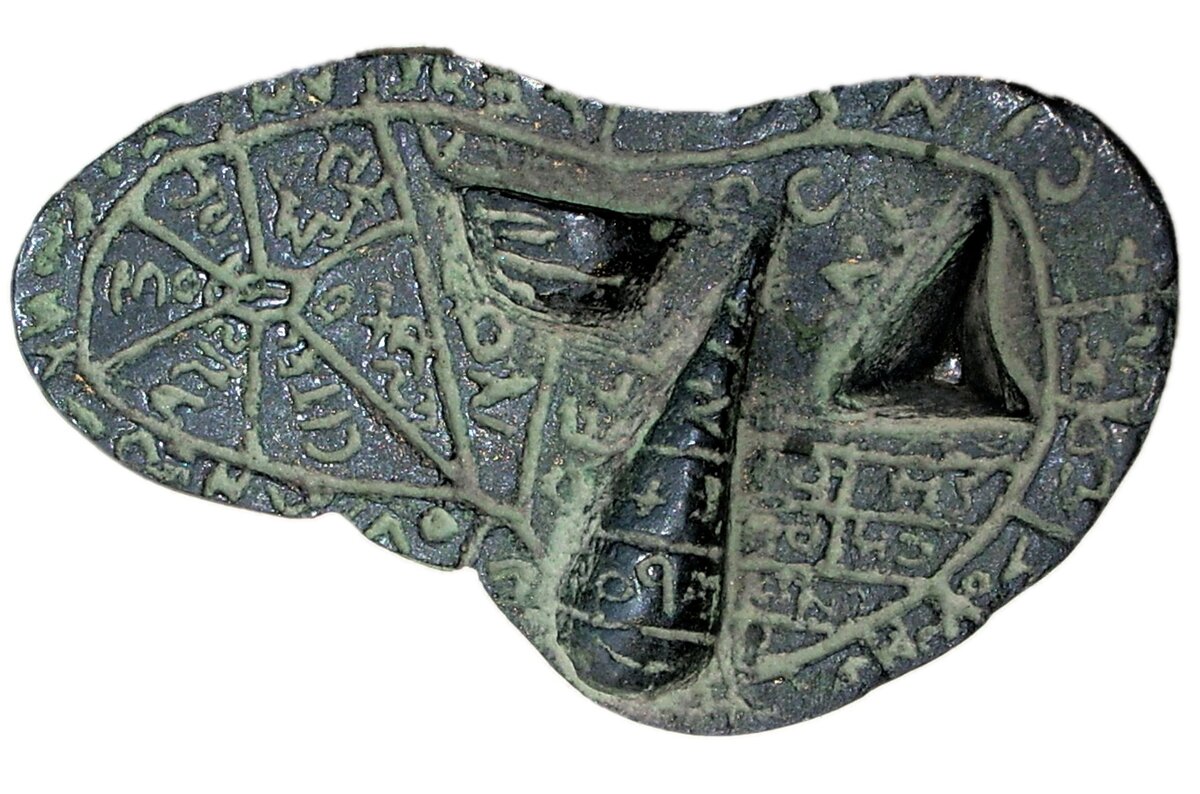
Etruscan divination encompassed three major domains. Haruspicy involved reading the entrails of sacrificed animals, particularly the liver, lungs, and gall bladder, to discern the divine will. The Piacenza Liver, a bronze model divided into sixteen sections each corresponding to a deity, is the most celebrated teaching tool of this practice. Fulguration was the interpretation of lightning: the Etruscans had classified different types of lightning according to their source and predicted consequences, distinguishing eleven gods capable of hurling thunderbolts. Ornithomancy, finally, involved observing the flight and song of birds, a practice that would pass directly to the Roman augurs.8
The Etruscan pantheon was structured around a supreme triad: Tinia (equivalent to the Greek Zeus and the Roman Jupiter), Uni (Hera/Juno), and Menrva (Athena/Minerva). This Capitoline triad was adopted by Rome and constituted the heart of archaic Roman religion. Other important deities included Charun (the guide of the dead, different from the Greek Charon in his violence: armed with a hammer), Tuchulcha and Vanth, psychopomp demons depicted in tomb frescoes as an alarming escort for the dead toward the afterlife. Sethians, Laran (god of war), Nethuns (Neptune), and Voltumna, the federal god of the Etruscans, completed this syncretic pantheon which constantly enriched itself through contact with Greek and Oriental religions.
Necropolises and Funerary Art
If Etruscan culture is largely known to us today, it is in great part thanks to its necropolises. The Etruscans devoted exceptional attention to death and the journey to the afterlife. Wealthy aristocrats had immense underground tombs excavated, the ipogei, sometimes organised in vast necropolises resembling true cities of the dead.
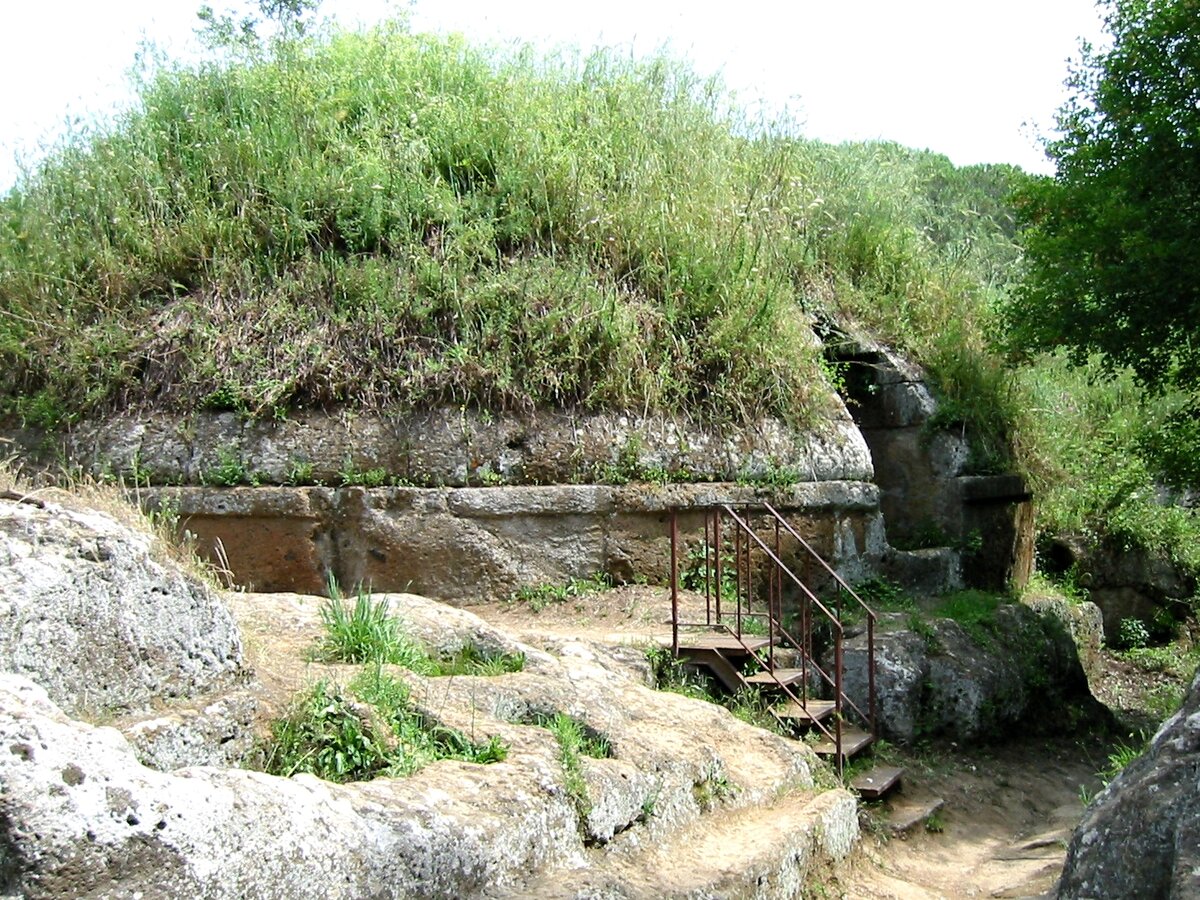
The Banditaccia necropolis, near Cerveteri, is one of the largest and best preserved in the Etruscan world. It contains several thousand tombs organised according to a genuine urban plan, with avenues lined with monumental tumuli covered with earth and vegetation. The interior chambers faithfully reproduce the interior of Etruscan homes: sculpted columns, lateral niches for the deceased, funerary furnishings placed as in an inhabited house. Together with the rock-cut necropolis of Tarquinia, Banditaccia has been inscribed as a UNESCO World Heritage Site since 2004.9
The frescoes of Tarquinia constitute one of the most important ensembles of ancient mural painting in Europe. In these rock-cut tombs carved into volcanic tufa, Etruscan artists depicted with extraordinary vitality and freedom scenes of banquets, athletic games, hunting, fishing, music, and dance. These frescoes, dated between the seventh and second centuries BCE, are well documented: the Tomb of the Leopards (c. 470 BCE) shows an animated banquet with female musicians and dancers; the Tomb of Hunting and Fishing (c. 520 BCE) is one of the oldest landscape paintings in the ancient West.
The Sarcophagus of the Spouses, now in the Louvre Museum, is the most celebrated Etruscan funerary work. This polychrome terracottaTerracottaClay shaped and then hardened by firing; the material of pottery, bricks and figurines, ubiquitous since the Neolithic.→ sarcophagus (c. 520 BCE), discovered at Cerveteri in 1861, represents a couple reclining on a banquet couch, serene and intimate. The woman rests a hand on her husband's shoulder in a gesture of tenderness rare in ancient art. These two life-size figures express with striking humanity the Etruscan conception of the afterlife: not a dark, penitential dwelling as in many other ancient religions, but a continuation of earthly life at its finest.
Etruscan Art: Bronzes, Ceramics, and Frescoes
Etruscan craftspeople excelled in several domains that profoundly influenced the Roman world and, through it, the entire West. Toreutics, the art of working metals, was one of their strongest suits. Etruscan bronze-smiths produced large divine statues, decorated weapons and armour, military chariots, and rich banqueting objects. Their reputation was such that Etruscan bronzes have been recovered as far as Scandinavia and southern Russia, testifying to a far-reaching commercial network.
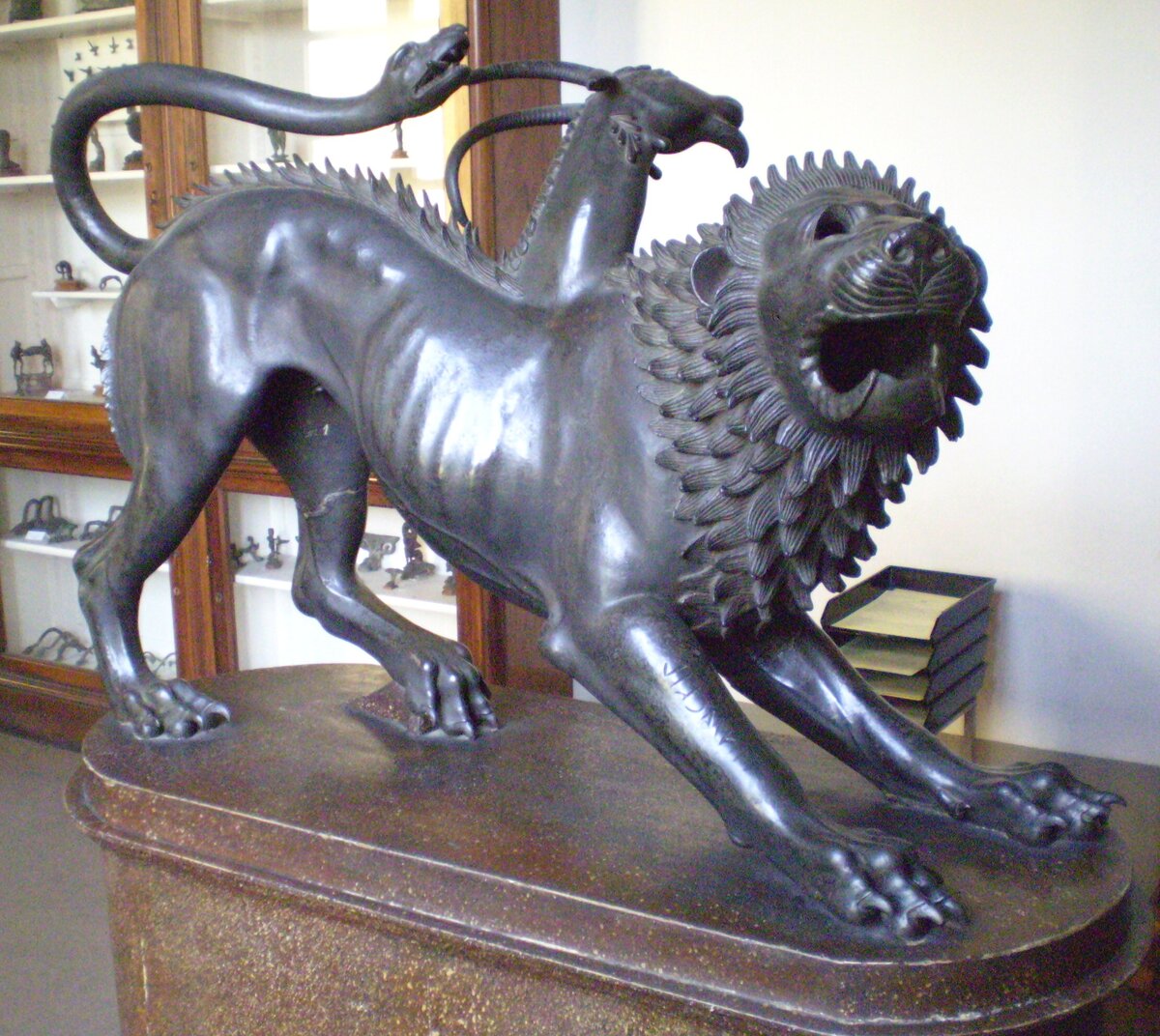
The Chimera of Arezzo, discovered in 1553 during construction works, is the absolute masterpiece of Etruscan bronze-working. This mythological creature (a lion with a goat's head on its back and a serpent's tail) testifies to prodigious technical mastery and a taste for movement and expressivity that foreshadows much classical sculpture. Dated to the fifth or fourth century BCE, it was immediately recognised as exceptional by Cosimo de' Medici, who had it placed in his collection of antiquities.10
Etruscan ceramics are equally remarkable. Bucchero, produced from the seventh century BCE onward, is a glossy black pottery obtained through reduction firing, imitating the appearance of metal vessels. Its surface could be decorated with geometric motifs, animal figures, or mythological scenes in relief. Exported throughout the Mediterranean basin, this pottery is one of the most reliable markers of Etruscan presence in archaeological sites across western Europe. The Caeretan hydrias, a major production of workshops based in Cerveteri between 530 and 500 BCE, demonstrate perfect mastery of black-figure painting technique, directly inspired by Attic methods.
Masters of the Sea and Commerce
Etruscan prosperity rested largely on control of mineral resources and mastery of maritime trade. The metallurgical wealth of Etruria, particularly the iron ore deposits of the island of Elba and the Populonia region and the copper and tin mines of the Tuscan zone, made this people one of the principal metal suppliers of the western Mediterranean. Populonia, the only Etruscan city located directly on the coast, was a major centre of iron metallurgy, as evidenced by the immense slag heaps recovered at its site.11
From the eighth century BCE onward, the Etruscans maintained close commercial relations with the PhoeniciansPhoeniciansA people of sailors and traders from the Levant (modern Lebanon) who founded trading posts across the western Mediterranean from the start of the first millennium BC.→ and the Greeks. The latter, established in their colonies at Cumae, Neapolis, and Massalia, were both partners and competitors. The Etruscans readily adopted cultural and technological innovations coming from the East or from Greece, while reinterpreting them in their own way. The rite of the reclining banquet (symposion), wine amphoras, alphabetic writingWritingA system of conventional signs used to fix language or information durably; its appearance (c. 3300 BC) marks, by convention, the end of prehistory.→ techniques: all Greek contributions that the Etruscans assimilated and in turn transmitted to the Latin and Gaulish peoples with whom they traded.
At sea, Etruscan ships controlled the Tyrrhenian Sea for several centuries, which the Greeks called "the Etruscan Sea". The Battle of Alalia (c. 535 BCE), fought off Corsica between an Etrusco-Carthaginian fleet and the Phocaeans of Massalia, ended in an Etruscan victory that confirmed their maritime dominance for another century. It was only after the naval defeat at Cumae in 474 BCE, inflicted by the Syracusan fleet, that Etruscan sea power began to decline.
Decline and Romanisation
The decline of Etruscan civilisation was gradual, spanning several centuries, and resulted from a convergence of military, political, and demographic factors. From the fifth century BCE, the GaulsGaulsCeltic peoples settled in Gaul (France, Belgium and neighbouring regions) during the second Iron Age, before their integration into the Roman Empire.→ infiltrated the Po plain and ended Etruscan dominance over Cisalpine Gaul. To the south, the Samnites and Latins reconquered Campania. The defeat of Veii by Rome in 396 BCE, after a ten-year siege, marked a decisive stage: this was the first great Etruscan city to fall into Roman hands.12
Throughout the fourth and third centuries BCE, the Etruscan cities fell one by one. Some, like Caere, rallied to Rome by treaty and retained limited autonomy as allies. Others resisted and were conquered by force, like Vulci in 280 BCE. The Etruscans suffered a fundamental handicap: the absence of political unity prevented them from coordinating an effective defence against the Roman war machine. The League of Twelve Cities, purely religious in nature, could not transform itself into a military coalition at the decisive moment.
Romanisation accelerated from the third century BCE with the founding of Roman colonies on Etruscan territory, the distribution of land to Roman citizens, and the progressive grant of Roman citizenship to Etruscan elites. The law of 90 BCE (lex Iulia de civitate) that granted Roman citizenship to all Italian allies juridically completed the fusion of the Etruscans into the Roman world. The Etruscan language died shortly thereafter, supplanted by Latin: the last Etruscan inscriptions date to the first century BCE or the early centuries CE.
The Etruscan Legacy in Rome and in Our World
To say that Rome owes a great deal to the Etruscans is not an exaggeration. Three of the seven legendary kings of Rome, Tarquinius Priscus, Servius Tullius, and Tarquinius Superbus, were of Etruscan origin or had close ties to Etruria. Under their reigns, Rome underwent accelerated urbanisation: drainage of marshes (Cloaca Maxima), construction of the first Capitoline temple (dedicated to the Tinia-Uni-Menrva triad, i.e. Jupiter-Juno-Minerva), organisation of the Circus Games. The Roman toga, the distinctive garment of the Roman citizen, derives from the Etruscan tebenna. The fasces of the lictors, symbols of Roman executive power, are an Etruscan innovation. The triumphal arch, the barrel vault, drainage and irrigation techniques: all foundational Etruscan contributions.13
Etruscan haruspices continued to offer their services to Rome long after Romanisation, and their art of divination remained in use until the end of the Roman Empire. Caesar consulted haruspices on the eve of the Ides of March. The Roman Capitoline triad derives directly from the Etruscan pantheon. And gladiators themselves are probably an Etruscan invention, connected to the funerary games organised in honour of distinguished dead.
Beyond Rome, the Etruscan legacy touches domains as varied as the Latin alphabet itself: the Romans did not learn to write directly from the Greeks, but through the intermediary of the Etruscans, who had adapted Greek writing in the eighth century BCE. It is therefore through this Etruscan relay that the Latin alphabet reached us, and with it all modern Western scripts. The Etruscans, this "mysterious" people so often reduced to silence by their undeciphered language, thus contributed to forging the linguistic foundations of our civilisation.
No comments yet. Be the first.