A poison that evaporates from the record
Hunting poison is one of humanity's most effective innovations, and one of the hardest to prove. Applied to an arrow tip, it is almost always an organic coating, often plant-based, sometimes mixed with animal venom or larvae. These substances degrade quickly, dissolve into the sediment and leave no mark visible to the naked eye on stone or bone. For decades, the archaeology of Upper PalaeolithicPalaeolithicThe oldest and longest period of prehistory (c. 3.3 Ma–12,000 BC), defined by chipped stone tools and a hunter-gatherer way of life.→Upper PalaeolithicThe final phase of the Palaeolithic (c. 45,000 to 10,000 years ago), marked by Homo sapiensHomo sapiensThe present-day human species, which emerged in Africa around 300,000 years ago, the only surviving human lineage after the extinction of Neanderthals and Denisovans.→ in Europe, art, ornaments and a succession of cultures (AurignacianAurignacianThe earliest culture of the European Upper Palaeolithic (c. 43,000–33,000 BC), tied to the arrival of Homo sapiens and the first artworks.→, GravettianGravettianAn Upper Palaeolithic culture (c. 33,000–21,000 BC) spanning from the Atlantic to Siberia, famous for its ivory female figurines ("Venuses") and, at Dolní Věstonice, the oldest fired ceramics.→, SolutreanSolutreanA European Upper Palaeolithic culture (c. 22,000–17,000 BC), remarkable for its leaf-shaped lithic points worked with flat retouch. Contemporary with the second art phase of Cosquer Cave.→, MagdalenianMagdalenianThe last great Upper Palaeolithic culture (c. 17,000–12,000 BC), the peak of cave art (Lascaux).→).→ weapons focused on worked stone, on shapes and fractures, and was simply not equipped to spot an invisible residue.1
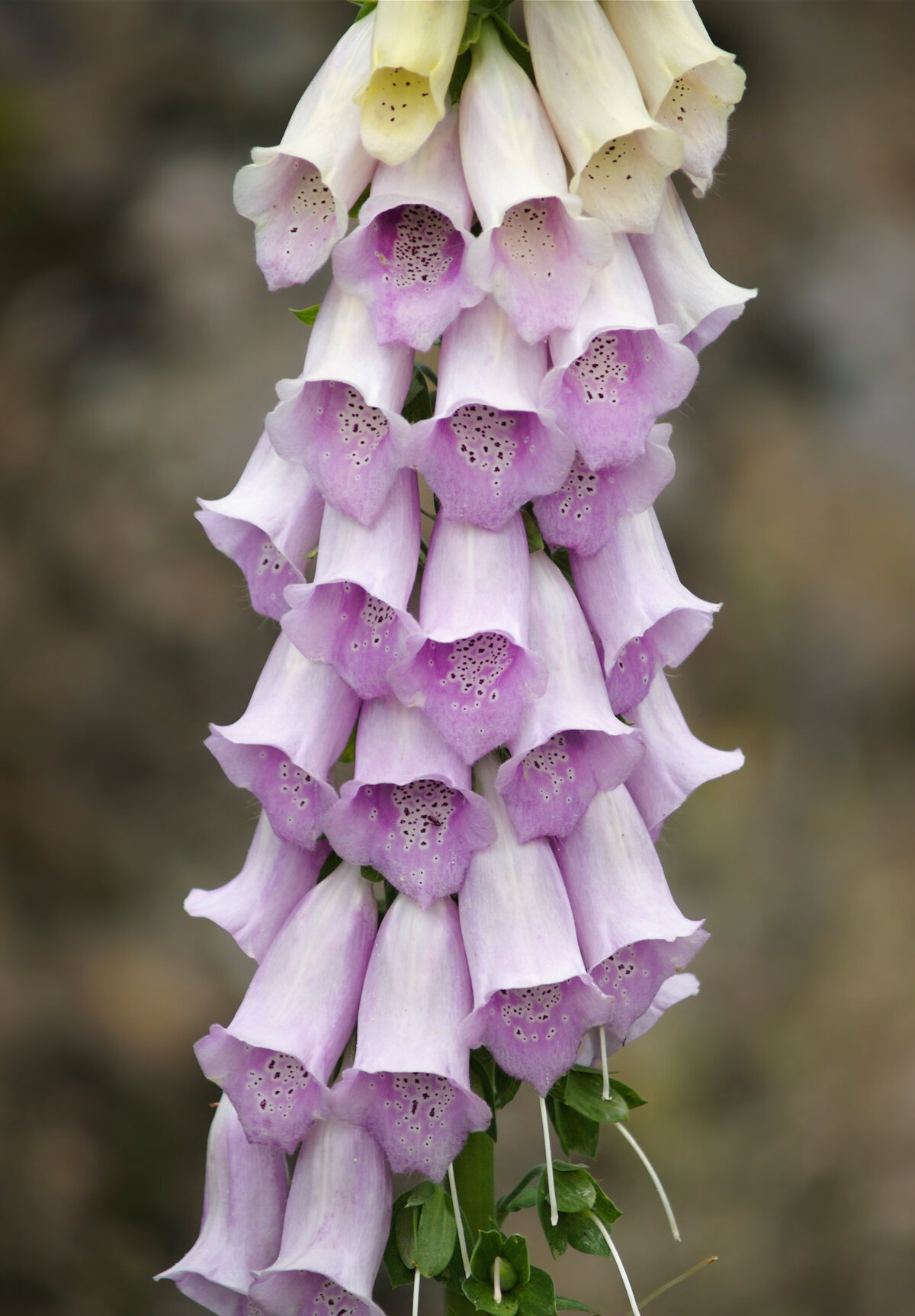
That changed with the arrival of biomolecular methods. By analysing micro-residues with gas chromatography coupled to mass spectrometryMass spectrometryA technique that measures the mass of molecular fragments very precisely in order to reconstruct their composition, here the sequence of proteins.→, researchers can now identify precise molecules where flintFlintA hard, brittle siliceous rock, knapped by prehistoric people to produce blades, points and sharp tools.→-focused approaches saw nothing. This is how cardiac glycosidesCardiac glycosidesPlant toxins (digitoxin, strophanthidin) that disrupt heart rhythm, identified as hunting poisons on points from southern AfricaAfricaThe cradle of humankind: the continent where the first hominins appeared, then Homo sapiens around 300,000 years ago, before the expansion to the rest of the world.→.→, toxins that disrupt the heart's rhythm, were detected on points from southern Africa. Poison, long suspected but never proven, became legible at last. These analyses do, however, demand exceptional preservation and remain rare: most of the prehistoric record stays silent on the matter. They also carry their own pitfalls, since a residue can be contaminated, misidentified or left by a process that has nothing to do with hunting, so each positive result has to be weighed against its context rather than taken at face value.
This bias is far from trivial. Poison radically changes the balance of power between a hunter and prey. Without it, bringing down a large herbivore demands a heavy weapon, striking force and a considerable risk at close quarters. With it, a scratch becomes lethal, game far larger than the hunter can be taken with a light projectile, and the immediate danger recedes. Recognising poison in the prehistoric record is therefore not a mere technical footnote: it means re-weighing the place of cunning, chemistry and ecological knowledge in the economy of early hunting.
That is the whole point of the paper by Felix Riede, of Aarhus University, and Marlize Lombard, of the University of Johannesburg, published in 2024 in the Journal of Archaeological Science: Reports. In the absence of residues, can the shape of the armatures themselves be made to talk? A point designed to kill by deep penetration does not share the geometry of a point whose only job is to nick the skin so the poison reaches the blood. The aim is to look, in the statistics of the dimensions, for the indirect signature of a poisoned weapon.2
The direct evidence from southern Africa
Before turning to Europe, it is worth stressing that southern Africa provides the firmest empirical ground. There, the combination of favourable preservation and chemical analysis turned a hypothesis into a fact. Across a range of bone and stone points, toxic residues have been documented within a window ranging, depending on the site, from roughly 24,000 to 37,000 years ago. The oldest clearly identified poison molecule in the region comes from a wooden spatula at Border Cave, dated to about 24,000 years, bearing traces of ricinoleic acid, a by-product of ricin from the castor-bean plant.3
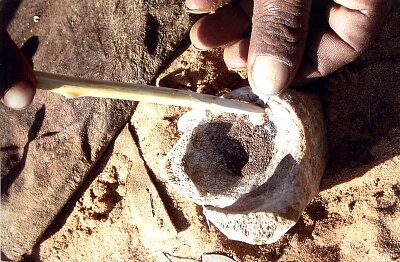
Closer to us in time, but decisive for the method, a roughly 7,000-year-old bovid femur from Kruger Cave, South Africa, held three bone arrowheads and probably served as a quiver. The residue lodged in its marrow cavity contained digitoxin and strophanthidin, two cardiac glycosides. Because those molecules do not co-occur in a single plant, the authors read it as the oldest demonstrated composite poison recipe, a mixture that was thought out and dosed.4 This African record matters because it anchors the debate in physical proof rather than inference alone.
It also rests on a living ethnographic present. The San hunters of southern Africa still coat their small armaturesArmatureThe cutting or piercing element (stone, bone) fixed to the tip of an arrow, javelin or spear.→ with plant poisons and beetle-larva secretions. For them, the arrow does not kill by impact: it deposits the toxin, and death comes at a distance, sometimes after a long tracking. This model directly inspires the reading that Riede and Lombard propose for the far more residue-poor European material.
The African file keeps growing, too. Recent work has reported toxic plant alkaloids on quartz microliths from a South African rock shelterRock shelterA shallow cavity at the foot of a cliff or under a rocky overhang, offering natural shelter; a favoured site of prehistoric habitation and rock art.→, pushing the boundary back toward roughly 60,000 years, well beyond the classic window. The chemistry used by San hunters is itself remarkably subtle: alongside plants, they exploit the larvae of beetles of the genus Diamphidia, whose secretions hold a potent toxin. That detail matters to the archaeologist, because it shows a hunting poison can combine several sources, plant and animal, and sometimes needs hours to act. It also warns against an over-simple reading: the absence of a toxic plant at a site does not mean the absence of poison, since the raw material may have been carried from afar, exactly as Kruger Cave demonstrates.
Grotte Mandrin, the bow that slides back 40,000 years
Europe must now be placed in this story. Direct, uncontested organic proof of the bow comes late there: at Stellmoor, in northern Germany, dozens of wooden arrow shafts dated to about 14,700 years are the oldest material testimony of archery in the world. Before that date, the record pointed mainly to thrusting spears and javelins, cast by hand or with a spear-thrower.5
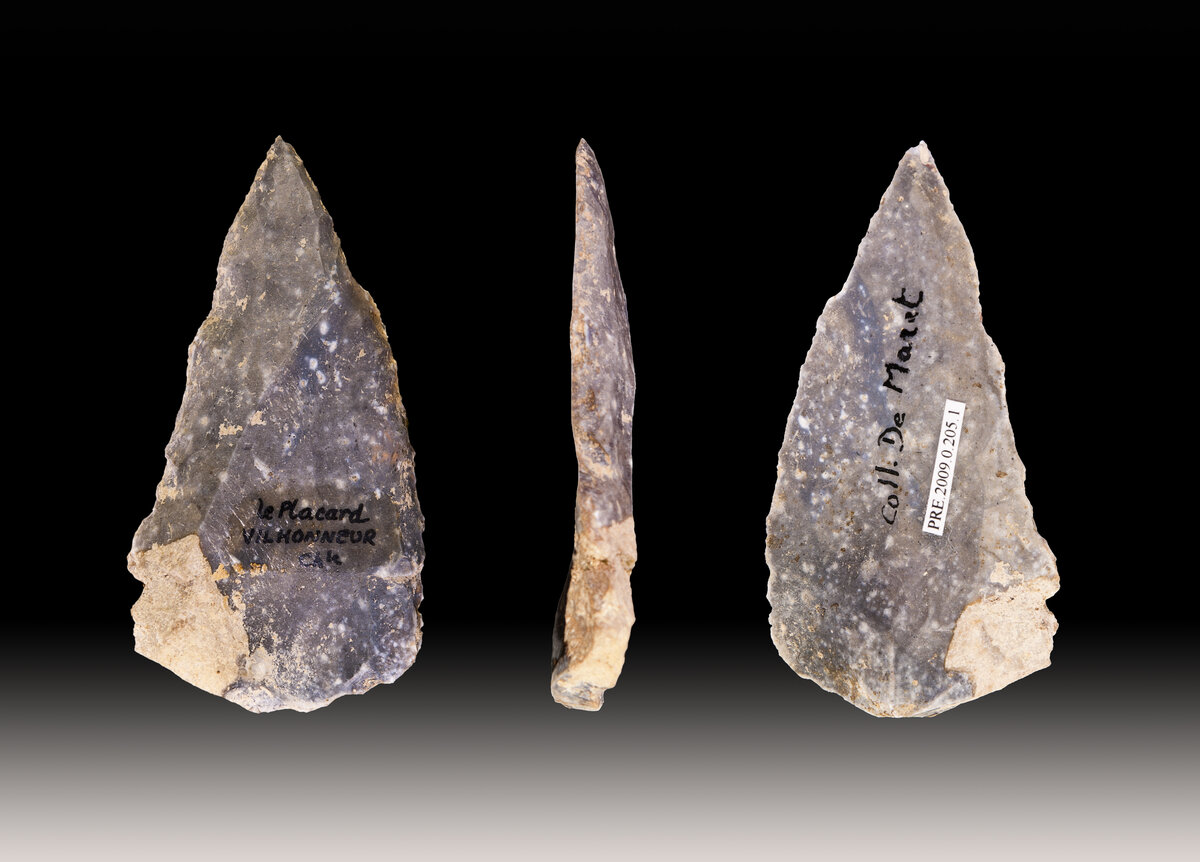
It is this ceiling that Grotte MandrinGrotte MandrinPrehistoric site at Malataverne (Drome, France) whose layer E, around 54,000 years ago, yielded the oldest possible traces of bow and arrow in Europe.→, at Malataverne in the Drome, shattered. In the site's layer E, attributed to Homo sapiens some 54,000 years ago, Laure Metz, Ludovic Slimak and their colleagues studied minuscule flint points, some smaller than a coin. About 30 percent of them weigh barely a few grams. Too small and too light, the authors argue, to be launched by any means other than a bow: replicas fired into carcasses produced fractures comparable to those on the originals, the mark of a fast propulsion.6
Here the two files meet. The cross-sectional values measured on some of the Mandrin nanopoints are not statistically distinguishable from those of the poisoned arrowheads of southern Africa. In other words, the geometry allows the idea that the bow, and perhaps already the poisoned arrow, reaches back toward 54,000 years. One must be clear about the status of that claim: at Mandrin, no poison residue has been recovered. The poison link is a hypothesis inferred from shape, not a chemical proof, whereas the African glycosides are direct evidence.
The Mandrin context nonetheless strengthens the reach of the hypothesis. Layer E documents an early, brief incursion of Homo sapiens into western Europe, in a land then held by NeanderthalsNeanderthalsA fossil humanity of Eurasia, robust and cold-adapted, extinct around 40,000 years before present.→, for whom no evidence of the bow exists to date, even though they handled the thrusting spear skilfully. If these first sapiens already had the bow, and perhaps poison, they arrived with a considerable technical edge. Caution still requires separating two claims of very unequal weight: archery at Mandrin, supported by ballistic experiment and the size of the points, and poison, which remains an extrapolation from geometry alone. To blend the two would be to lend the stone a certainty it does not carry.
The TCSA method, reading intent in the stone
The tool at the heart of the demonstration carries a technical name: the tip cross-sectional area (TCSA)Tip cross-sectional area (TCSA)A measure of a point's section (width times thickness, divided by two) that estimates its penetration capacity and separates heavy weapons from light tips.→. It is calculated simply, by multiplying maximum width by maximum thickness and dividing by two. This value is ballistically meaningful: it tells how much material the tip must push aside to penetrate. A large section implies a heavy projectile, launched with force, built to drive in deep. A very small section, by contrast, marks a tip that need not force its way through.2
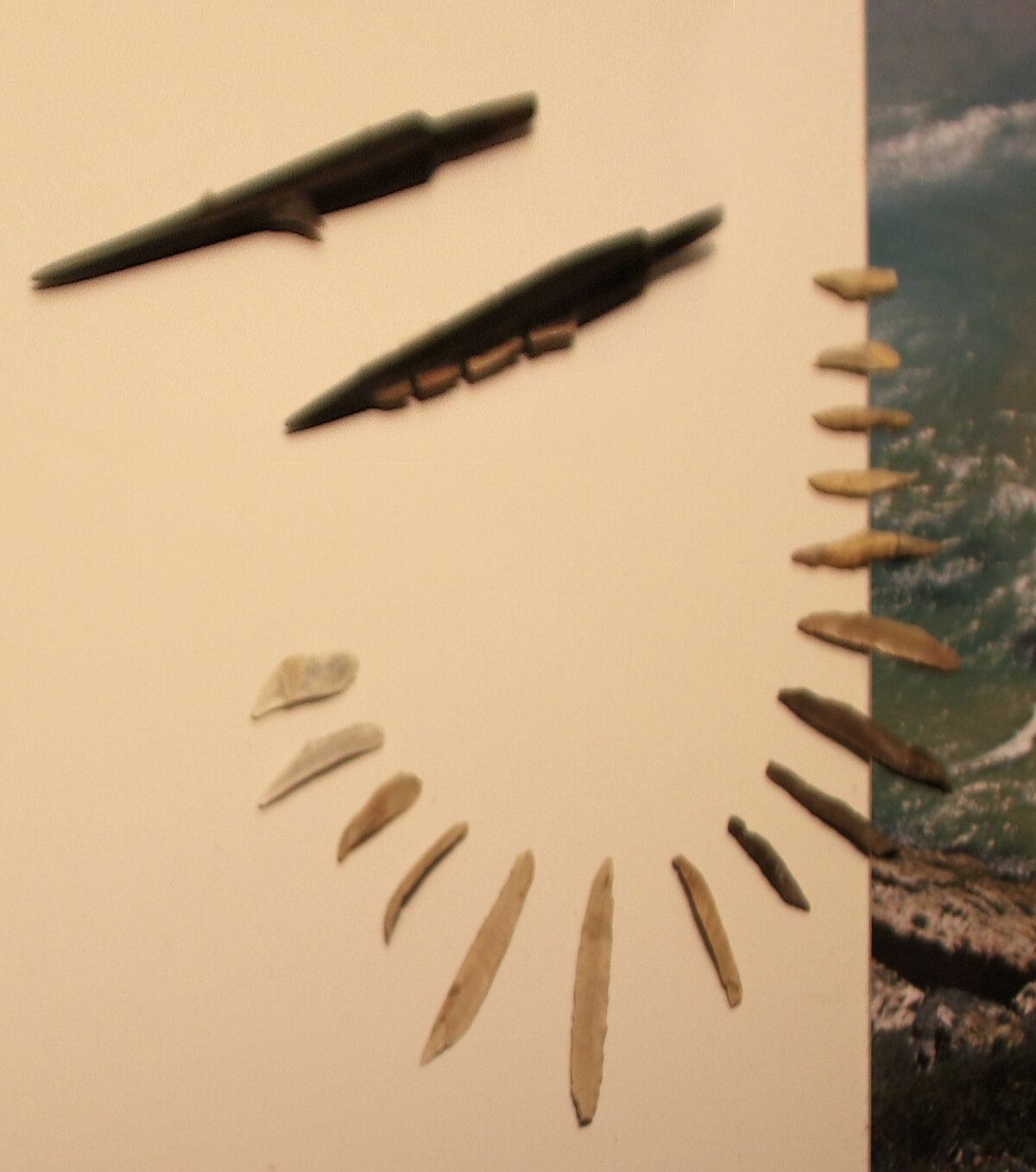
For a poisoned arrow, deep penetration is pointless, even counterproductive. A simple cut is enough to deposit the toxin into the bloodstream; the rest is a matter of pharmacology, not kinetic force. Riede and Lombard therefore calculated the TCSA of a large sample of northern European points, shouldered, backed and tanged, to track how weapon systems changed. Their conclusion is threefold: the bow was most likely present from the earliest phases of occupation in the region; several weapon systems then coexisted; and the smallest microlithsMicrolithA very small chipped-stone tool (a few millimetres to 2-3 cm), often mounted in series on a shaft; emblematic of the MesolithicMesolithicThe period between the Palaeolithic and the Neolithic (c. 10,000–6,000 BC in Europe), still based on hunting and gathering.→.→ align closely with the values of the poisoned arrows documented by ethnography.
In practice, a notable share of some assemblages, on the order of a quarter of the pieces, about 26 percent, falls within the low-penetration profile compatible with poison. Armatures with a section below 20 mm2 appear in this way in the Ahrensburgian and at the site of Eskebjerg, in Denmark. Caution remains in order: TCSA cannot say how a given object was actually used, and a slender point may have other functions. It is a bundle of probabilities, not a verdict, and the authors themselves stress the point.
The strength of TCSA lies in how it meshes with experiment. By firing replicas and measuring wound depth, researchers have shown that the penetration threshold does depend on the section, and that the smallest points deliver only a shallow wound. For a conventional weapon, that is a flaw: the prey can flee, wounded but alive. For a poisoned weapon, it is precisely the intended function, because the toxin does the work that force does not. The convergence between the values of the European microliths, the San poisoned points and the Mandrin nanopoints is therefore no accident: it describes one and the same ballistic logic, that of a projectile that wounds little but poisons much.
Aconite and foxglove, a lethal herbarium
Beyond the points, a body of knowledge takes shape. Poisoning an arrow requires identifying the right plants, extracting the active principle, concentrating it and dosing it to kill the game without spoiling the meat. None of that is trivial. To guide future research, Riede and Lombard draw up a list of about 58 candidate European plants, with their present-day distribution, so that residues may one day be tested where they might survive.1
Among those candidates, two names recur. First aconiteAconiteA toxic plant of the genus Aconitum, whose alkaloid aconitine is among the most violent plant poisons, used as an arrow poison in several cultures.→, whose aconitine is one of the most ferocious plant alkaloids known, and whose use as an arrow poison is attested in other parts of the world. Then foxglove, a source of cardiac glycosides comparable to those identified in southern Africa. Their mere presence in the European flora proves nothing, but it makes the hypothesis plausible: the raw materials were available, within reach of hunters already finely attuned to their environment.
What stands out is the chain of skills an effective arrow implies. One must know which part of a plant concentrates the toxin, in which season, how to prepare it without poisoning oneself, how to fix it to a tiny armature and how to match the dose to the size of the game. This is an inherited body of knowledge, memorised and refined over generations, on a par with flint-knappingknappingThe set of operations for fracturing a stone block to extract flakes or blades.→ or the reading of tracks. The black residues seen on Egyptian arrowheads of about 2000 BCE, suspected of having carried a coating, show that this technology crossed the millennia in varied forms, long before it was ever set down in writingWritingA system of conventional signs used to fix language or information durably; its appearance (c. 3300 BC) marks, by convention, the end of prehistory.→.
The picture that emerges is trans-regional and cross-cultural. Arrow poison is neither an African curiosity nor a late European invention: it links today's San hunters, the microliths of the Ahrensburgian, the nanopoints of Mandrin and even the black residues spotted on Egyptian arrowheads of about 2000 BCE. Should the trail be confirmed, it would make poison one of the oldest forms of applied chemistry, a quiet but crucial chapter in human intelligence. For now, the European case remains a solid hypothesis grounded in geometry, which only future biomolecular analysis can turn into certainty. Until a tip from Mandrin or an Ahrensburgian microlith yields its own trace of a toxin, the tiny points keep their secret, and the honest answer is that we strongly suspect, but cannot yet prove, the use of poison that far back in Europe.
No comments yet. Be the first.