The archaeological sites of Peru's northern coast have never stopped yielding major discoveries. From Caral to Huaca de la Luna, from Chavin de Huantar to the pyramids of the Moche culture, this region harbours the remains of some of the most complex and ancient civilisations on the American continent. In July 2025, a new find joined this long tradition: the uncovering of a polychrome mural of such scope and singularity that it immediately generated enthusiasm among archaeologists. At the Huaca Yolanda site, in the Chao Valley of the La Libertad region, a wall painting measuring more than five metres in length and two metres in height had been waiting three to four millennia to be discovered.
The Chao Valley and the Formative Period
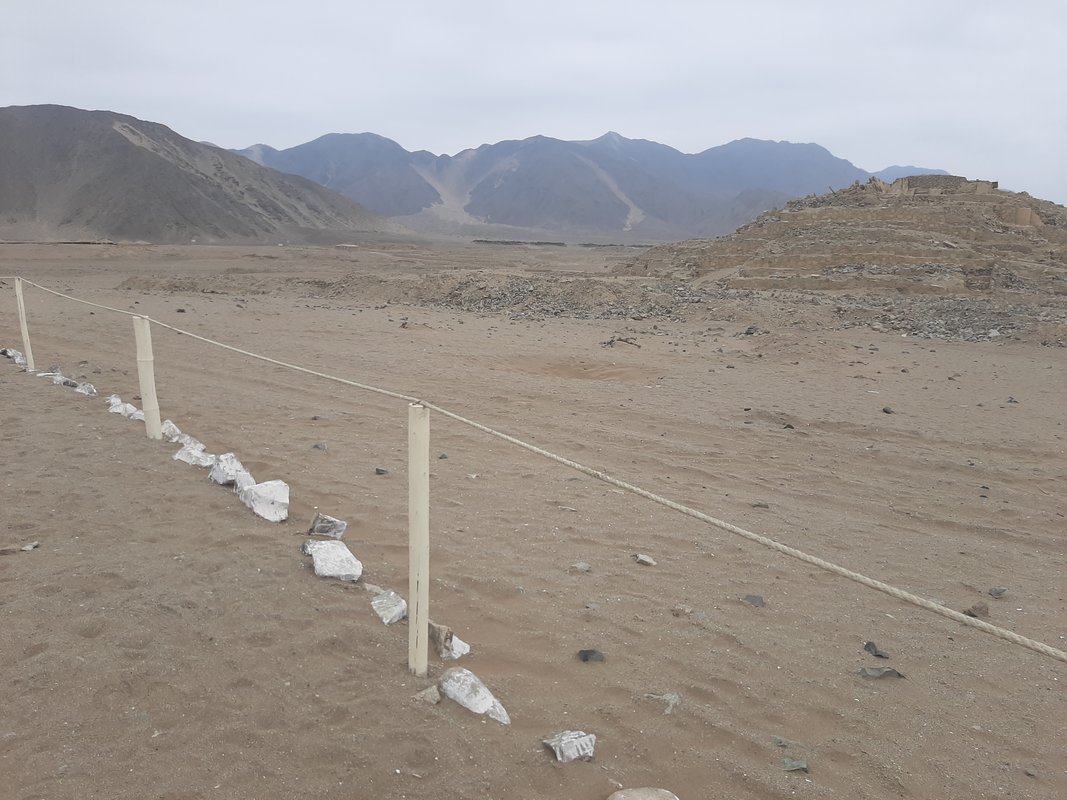
The Chao Valley is one of those micro-regions of Peru's northern coast whose archaeological richness is inversely proportional to its international fame. Just a few dozen kilometres from major cities such as Trujillo, it nevertheless houses sites of considerable importance for understanding Andean prehistoryPrehistoryThe span of human history before the invention of writing, from the Palaeolithic to the Metal Ages, known mainly through material remains.→. Huaca Yolanda is one such site: a huaca, the Quechua term for a sacred place or object, corresponding here to a pre-Columbian architectural structure -- most likely an ancient temple or ceremonial complex.
The discovery was made during excavations carried out between July and September 2025 by a team from the Pontificia Universidad Catolica del Peru (PUCP), led by archaeologist Ana Cecilia Mauricio. The mural adorned the walls of an atrium of a temple from the Formative Period, a crucial phase in Andean pre-Columbian history spanning approximately 3000 to 200 BCE. It was during this period that the first complex ceremonial structures, social hierarchies, long-distance exchange networks, and major iconographic systems were established -- all of which would form the substratum of later Andean civilisations.
The dating of the Huaca Yolanda mural currently rests on stylistic and contextual analysis rather than direct radiometric dating of the pigments. The research team estimates, based on the style of the motifs and the architectural characteristics of the temple, that the work dates back to between 3,000 and 4,000 years -- that is, between 2000 and 1000 BCE, at the heart of the Formative Period. Complementary radiocarbon analyses on organic materials associated with the construction will allow this chronological range to be narrowed down.
A Mural Unlike Any Other in the Region
What immediately sets the Huaca Yolanda mural apart from other known pre-Columbian wall paintings in the region is the combination of its dimensions, its polychromy, and above all its iconography. Measuring more than five metres in length and two metres in height, it constitutes one of the largest Formative Period wall murals discovered to date on Peru's northern coast.
But it is its iconographic repertoire that has truly struck specialists. On a polychrome background -- several distinct colours have been identified: ochres, reds, whites, and blacks -- one can make out representations of stars, plants, fishing nets, and beings resembling fish. A particularly unusual visual ensemble for the region. "This mural from Huaca Yolanda is unique: nothing like it had ever been recorded in the region," stated Ana Cecilia Mauricio in the PUCP press release.
The painting technique used is also remarkable. This is not simply paint applied to stone or earth, but a genuine polychrome frescoFrescoA term used by extension for large painted compositions on the walls of decorated caves, although the technique differs from the classical mural fresco.→ involving the preparation of a base plaster and the application of multiple layers of pigment. This level of technical mastery implies an established painting tradition and specialised craftsmen -- both additional indicators of the degree of social organisation that characterised the builders of this temple.
A Site Under Direct Threat
The enthusiasm generated by the discovery is, however, tempered by a serious concern: the Huaca Yolanda site is threatened by the agricultural expansion that characterises much of Peru's northern coast. Heavy machinery used for land preparation is already damaging parts of the site, and Ana Cecilia Mauricio has issued an urgent call to Peruvian authorities for protective measures to be put in place rapidly.
This situation is unfortunately not exceptional in Peru, where dozens of major archaeological sites are damaged or destroyed every year by urbanisation, intensive agricultureAgricultureThe cultivation of plants and production of food by working the soil, which emerged in the Neolithic in the Near East and independently elsewhere; it radically transformed human societies.→, and clandestine looting. The discovery of the Huaca Yolanda mural comes at just the right moment to remind us of the fragility of this heritage: it was only uncovered because excavations continued after the official end of the campaign, and it could have remained buried -- or been destroyed -- without anyone ever knowing what the earth concealed.
No comments yet. Be the first.