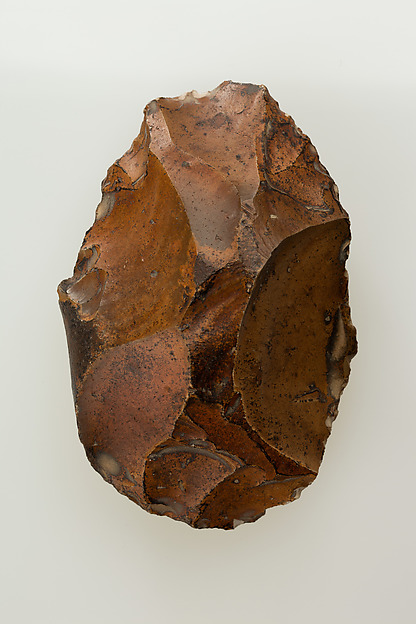
A cave carved into the flanks of the Carmel mountain range, a few kilometres south of Haifa, has yielded what archaeologists are already calling a "time capsule": an intact assemblage of remains dating back 400,000 to 250,000 years, sealed beneath enormous limestone blocks for hundreds of thousands of years. Excavated over the past six months by the Israel Antiquities Authority (IAA) and the University of Haifa, the Fureidis site sheds new light on a still poorly understood period of Levantine prehistoryPrehistoryThe span of human history before the invention of writing, from the Palaeolithic to the Metal Ages, known mainly through material remains.→ , just before NeanderthalsNeanderthalsA fossil humanity of Eurasia, robust and cold-adapted, extinct around 40,000 years before present.→ and modern humans came to share the region.
"This is probably the last culture of a very long continuum," explains Dr. Kobi Vardi, Head of the IAA's Prehistory Department and co-director of the excavation, adding: "Between 250,000 and 50,000 years ago, Homo sapiensHomo sapiensThe present-day human species, which emerged in Africa around 300,000 years ago, the only surviving human lineage after the extinction of Neanderthals and Denisovans.→ and the Neanderthals had created a completely different culture; so we are right at the heart of this transition period."
A Time Capsule at the Foot of the Carmel
The discovery came about by chance. Identified decades ago by researchers mapping prehistoric sites in the Carmel region, the deposit had initially been attributed to the Middle PalaeolithicMiddle PalaeolithicA Palaeolithic period (c. 300,000 to 40,000 years ago) associated mainly with Neanderthals and early Homo sapiens, marked by Levallois tools.→ (250,000, 50,000 BP). It was during preventive excavations ahead of the construction of a new access road to Fureidis , funded by Ayalon Highways under Israeli law requiring developers to finance salvage archaeology , that the team realised its dating error.
The cave's roof collapsed hundreds of thousands of years ago, burying the site under enormous limestone blocks, earth and dense vegetation. This geological accident proved providential: it isolated the cave's contents from later disturbance, preserving the remains in exceptional condition. "This is only the beginning," says Vardi, who plans to continue excavations once the road is built over the site via a bridge specially designed to protect it.
The Acheulo-Yabrudian Culture: A Missing Link
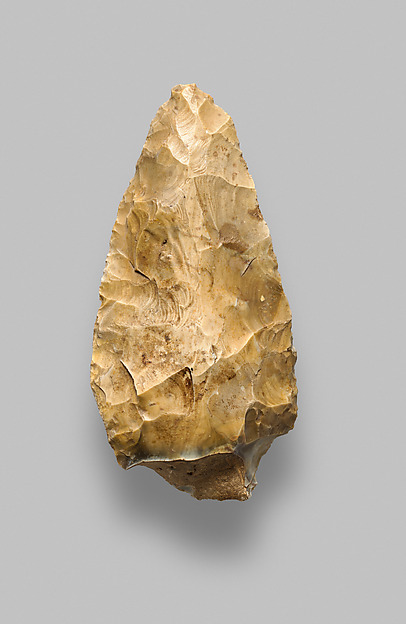
Specialists designate the period represented at Fureidis as the Acheulo-Yabrudian culture , a hybrid name that reveals the transitional nature of this episode. It combines the bifaces characteristic of the long Acheulean tradition (spanning nearly a million years) with more elaborate tool types, particularly Yabrudian scrapers, which foreshadow Middle Palaeolithic industries. Across the entire Near East, this culture is represented at only about ten sites , two in Syria, one in Lebanon, six in Israel , and Fureidis is the only site in the Carmel massif to have yielded intact Acheulo-Yabrudian remains.
"This is very important, because sites dating to this phase are extremely rare," Vardi stresses. The rarity is partly explained by preservation conditions: Middle Pleistocene sediments are often overlain by later layers that contaminate or destroy them. At Fureidis, the early roof collapse protected the oldest deposits from precisely such disturbance , except in a small part of the cave.
Flint Tools and PleistocenePleistoceneThe geological epoch of the great ice ages (c. 2.6 Ma–11,700 BP), spanning most of human prehistory.→ Fauna Bones
The excavation has uncovered around one hundred lateral scrapers, the most characteristic tool of the Acheulo-Yabrudian culture. Knapped on a flint flake, the lateral scraper provides a convex cutting edge ideal for processing meat or working hides. The archaeologists also found small, finely worked bifaces. "These hominins were able to extract flint directly from rock outcrops, which testifies to already elaborate technical organisation," Vardi notes.
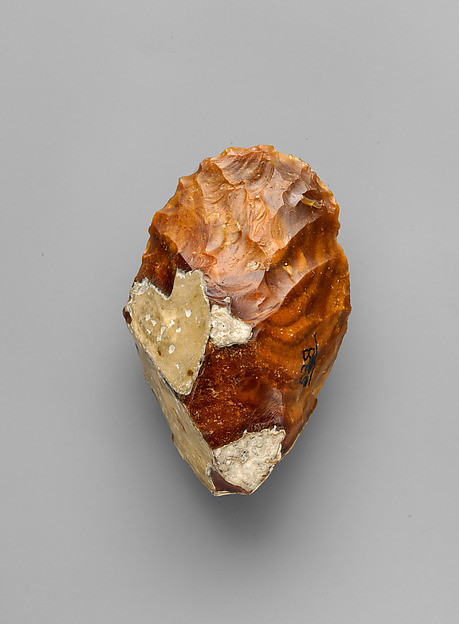
Alongside the tools, animal bones constitute the site's other major find. The archaeologists identified remains of deer, gazelles, prehistoric horses and wild cattle, all bearing cut marks and evidence of human exploitation. "It is very rare to find bones 300,000 years old in such a state of preservation," Vardi emphasises. A well-preserved deer tooth was also recovered.
At this stage, no evidence of a hearth has been found in the cave , no ash, no burned stones, no charred bones. The question of fire control by these hominins therefore remains open for this particular site. However, the researchers have identified sediment indicators suggesting that a water spring once flowed nearby, which would explain the site's attractiveness to a group of hunter-gatherersHunter-gatherersA way of life based on hunting, fishing and gathering wild resources, without farming or herding; it dominated almost the whole of human history.→.
Who Were These Hominins?
"The gradual changes that appeared during this period in human anatomy, technology and society foreshadowed the complex characteristics and behaviours that subsequently developed and that define both Neanderthals and modern humans."
, Prof. Ron Shimelmitz, University of Haifa, co-director of the Fureidis excavation
No human bones have yet been unearthed at Fureidis , unsurprising, as human remains are always underrepresented relative to tools in PalaeolithicPalaeolithicThe oldest and longest period of prehistory (c. 3.3 Ma–12,000 BC), defined by chipped stone tools and a hunter-gatherer way of life.→ deposits. For the Acheulo-Yabrudian period in the LevantLevantA region of the eastern Mediterranean Near East (Israel, Lebanon, Syria, Jordan), a major crossroads of the first human migrations out of Africa.→, the rare known fossils , notably those from Zuttiyeh Cave, a few dozen kilometres to the north , belong to morphologically intermediate hominins that specialists sometimes designate as Homo heidelbergensisHomo heidelbergensisMiddle Pleistocene human species, often seen as the common ancestor of Neanderthals and our own species.→ or archaicArchaicRefers to an ancient, now-extinct human population or form (Neanderthals, Denisovans, ghost lineages), as opposed to anatomically modern humans.→ humans.
These groups lived in larger communities than before, hunted both small and large game, and mastered in situ flint extraction , all traits that anticipate the cognitive and social behaviours of the populations that would succeed them in the region. "Between 250,000 and 50,000 years ago, Homo sapiens and the Neanderthals had created a completely different culture; so we are right at the heart of this transition period," Vardi sums up.
The Cave Saved by a Bridge
Faced with the site's scientific importance, an ingenious solution was found to reconcile archaeology and road construction: the new road will span the cave via a bridge, leaving it intact and accessible to researchers. This type of device, common in countries with high archaeological density, illustrates how Israeli heritage legislation can sometimes turn a constraint into an opportunity.
For the IAA and University of Haifa team, future excavations promise to be equally fruitful. The discovery of human bones , which researchers hope for , would make it possible to more precisely identify the populations who occupied the Carmel at this pivotal period, and perhaps better understand the long evolutionary chain that led, some 200,000 years later, to the emergence of Homo sapiens and Neanderthals in the region.
Ce site est clairement ma référence pour trouver des contenus exploitables en classe.
Je prépare une sortie avec l'association des retraités. Votre dossier sera notre guide de lecture.
L'Acheuléen est une technologie lithique remarquable par sa stabilité : le biface a peu changé sur plus d'un million d'années et sur trois continents. La grotte de Fureidis s'inscrit dans ce continuum technologique qui témoigne soit d'une forte contrainte fonctionnelle, soit d'une capacité d'imitation intergénérationnelle très efficace. Ces deux hypothèses ne sont d'ailleurs pas exclusives.
La grotte de Fureidis en Israel est un site important pour comprendre la présence humaine dans le Levant pendant l'Acheuléen. La découverte de bifaces associés à des faunes disparues dans ce contexte karstique apporte des précisions précieuses sur les comportements des Homo erectus ou pre-sapiens dans cette région. Le Levant est un carrefour biogéographique essentiel pour les migrations humaines hors d'Afrique.