It was a power line construction project that handed archaeologists from the State Office for Heritage Management and Archaeology of Saxony-Anhalt (LDA) a macabre discovery. Near the village of Gerstewitz, in central Germany, a preventive excavation on 15 June 2026 uncovered the skeleton of a man approximately 25 years old, buried in a firing pit (or NeolithicNeolithicThe "New Stone Age": a period marked by farming, herding, settlement and pottery, from around 10,000 BC.→ kiln) nearly 5,000 years old. Deep skull injuries and the total absence of grave goods point researchers towards a disturbing hypothesis: human sacrifice.
The Corded Ware culture: codified funerary rites
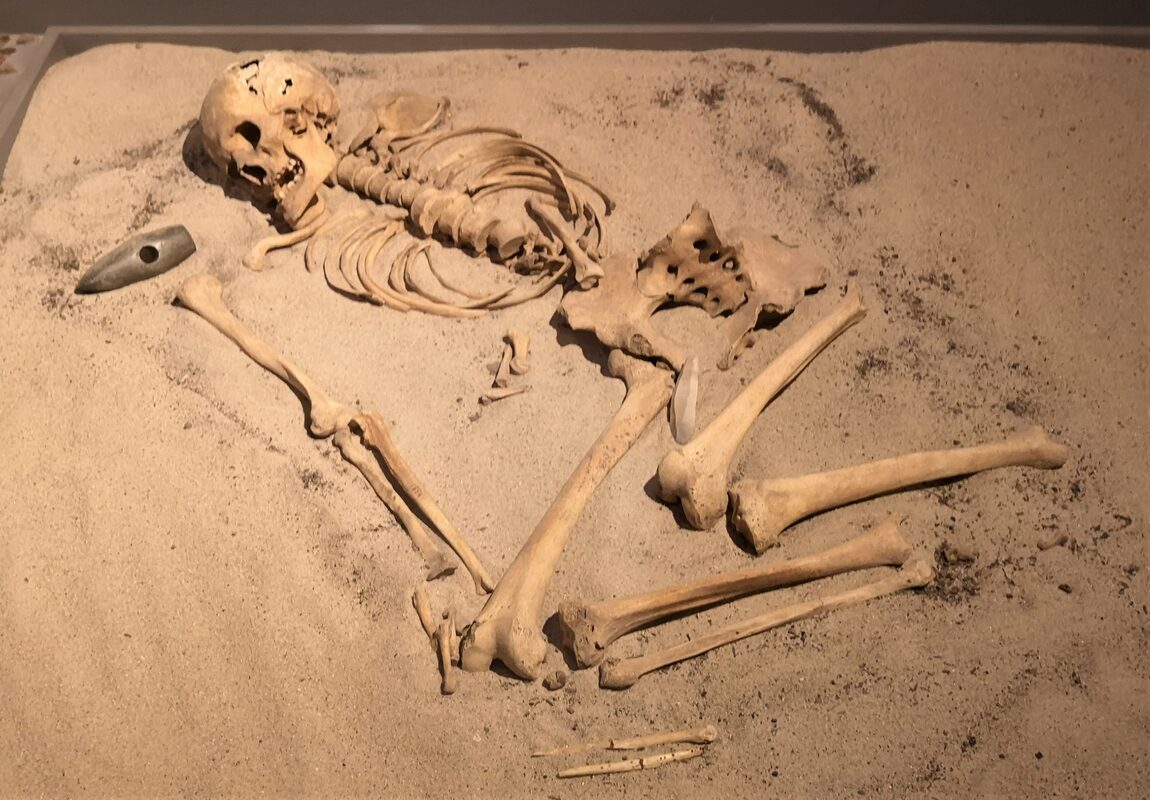
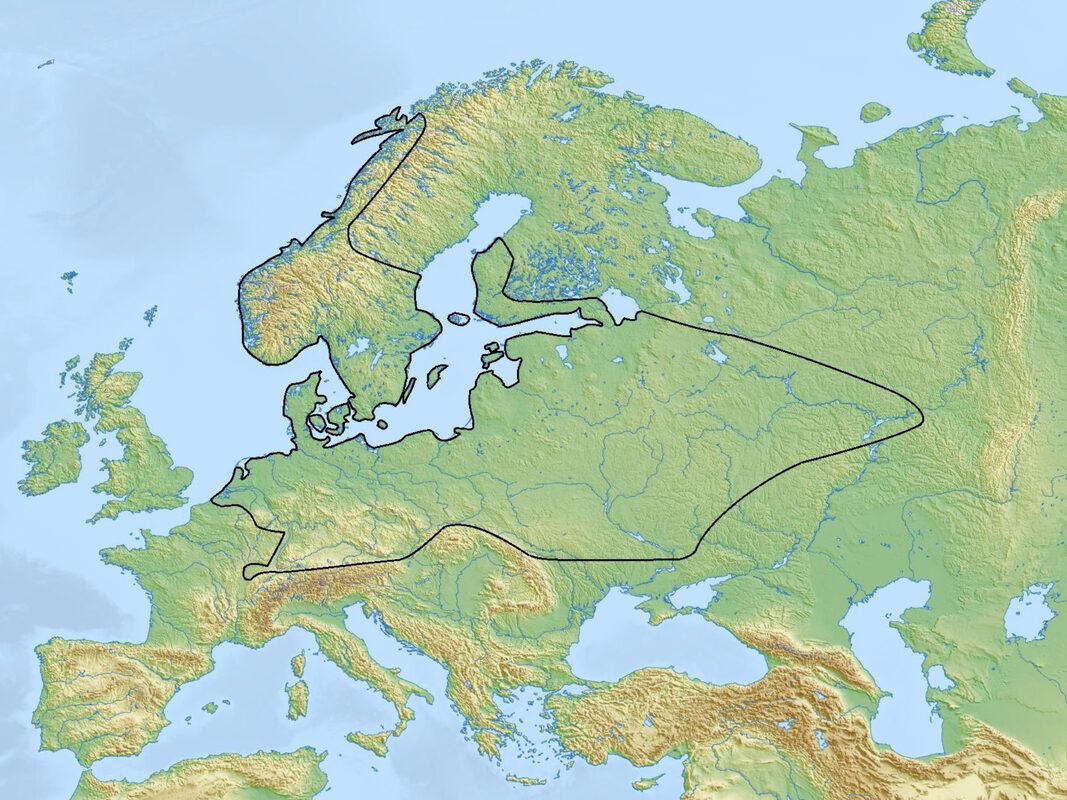
The Gerstewitz skeleton belongs to the Corded Ware culture (German: Schnurkeramik), a major cultural entity of the Late Neolithic and Copper Age that spread across Northern Europe between roughly 2,900 and 2,050 BCE. The name comes from the cord-like impressions made on fresh clay before firing.
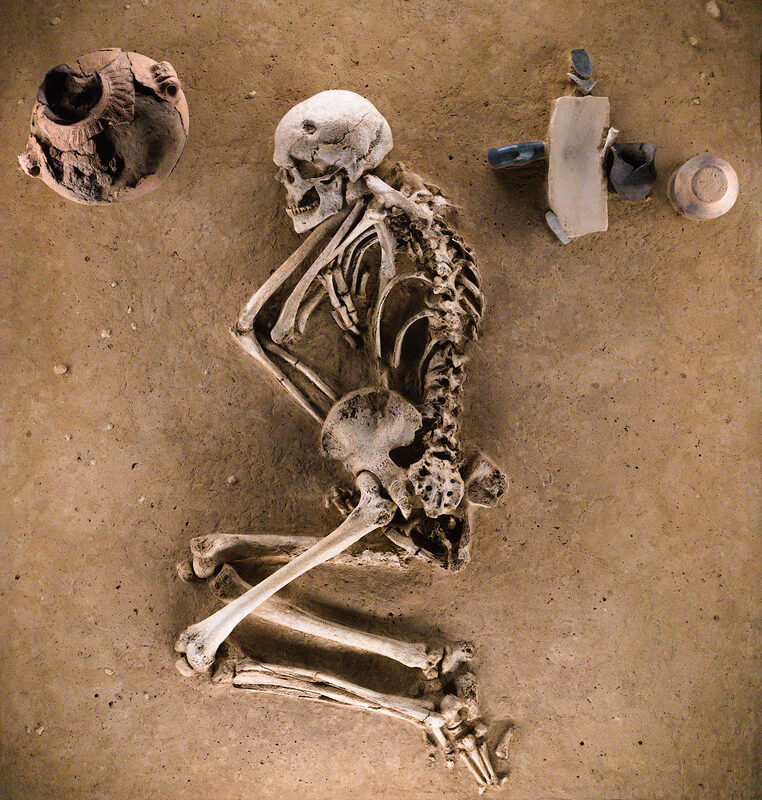
The funerary practices of this culture are remarkably standardised. Men were buried on their right side, women on their left, both in a crouched position, oriented toward the south. These invariable rites allow archaeologists to instantly identify a Corded Ware burial , and to spot any deviation from the pattern.
At Gerstewitz, the skeleton's position matches the usual rite: a man lying on his right side, facing south. But the burial itself is abnormal: instead of a pit under a small mound, the body was placed in a Neolithic kiln, a cavity originally used to fire clay or cook food.
A fractured skull, a violent death
Preliminary examination of the skeleton revealed deep lesions on the skull, consistent with a violent death. Archaeologists are considering three scenarios:
- Murder: the man was killed and thrown into the abandoned kiln.
- Death in combat: Copper Age societies knew armed conflict, and skull injuries are common among warriors of this period.
- Human sacrifice: the hypothesis researchers consider most consistent with the archaeological context.
What tips the balance toward sacrifice is the total absence of artefacts , no weapons, no ceramics, no ornaments , in the pit, whereas conventional Corded Ware burials are typically accompanied by characteristic grave goods. "In structures linked to the Corded Ware culture, there are many examples of cattle and dog bones, indicating these animals served as sacrificial offerings to unknown deities," says archaeologist Oliver Dietrich of LDA Saxony-Anhalt. "Future laboratory analysis should tellTellAn artificial mound formed by the accumulation of successive layers of settlement remains at the same spot, typical of the Near East. Each destruction-rebuilding event adds a stratum.→ us more about the deceased and the context of his death."
Gerstewitz: a site of serial sacrifices?
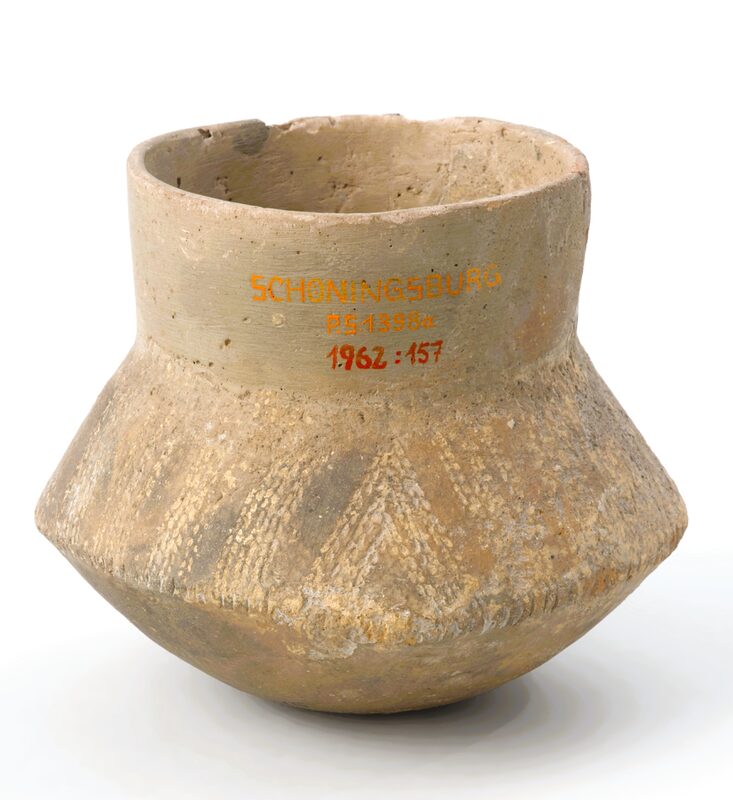
The 2026 discovery is not isolated. The previous year, the same team had unearthed at Gerstewitz 12 pits ringed by a moat-like ditch. Inside, sealed under the rubble of burnt houses, lay numerous dog bones, human skulls and intact ceramic pots , all attributed to the Salzmünde culture (3,400, 3,050 BC), which predates the Corded Ware people. Another human skeleton had also been found in a converted oven pit during those earlier excavations.
These successive discoveries make Gerstewitz one of the most remarkable ritual sites of the European Neolithic. The region bears more than 6,000 years of continuous human occupation, and excavations tied to the power line project are expected to continue until at least 2027.
What Neolithic kilns tell us
Neolithic kilns , simple pits dug into the ground and fuelled with wood or charcoal , were mainly used to fire pottery and cook food. Their reuse for ritual or funerary purposes is documented but rare. The presence of a human body in such a structure, with no other grave goods, suggests a deliberately symbolic intention: the kiln as a place of transformation, a threshold between the world of the living and the spirit world.
DNADNAThe molecule carrying genetic information, used to reconstruct kinship between species.→ and isotopic analyses of the skeleton are planned to determine the individual's geographic origin, diet and, perhaps, the precise circumstances of his death. These findings could provide decisive answers about the nature of the ritual practised at Gerstewitz 5,000 years ago.
Sources: LDA Saxony-Anhalt (press release, 15 June 2026, idw-online.de); Kristina Killgrove, Live Science, 16 June 2026.
Ce site est dans ma veille depuis longtemps. Les résumés d'études sont clairs et bien contextualisés.
La découverte de ce four en Saxe-Anhalt s'inscrit dans un contexte régional riche pour la période du Néolithique moyen. Les analyses de résidus carbonisés permettent aujourd'hui de reconstituer les menus des populations néolithiques avec une précision remarquable. Il serait intéressant de croiser ces données avec les analyses polliniques de la région pour reconstituer l'environnement de ces communautés.
Ce four néolithique de Gerstewitz est un très bel exemple concret pour illustrer à mes élèves l'économie de subsistance du Néolithique. La cuisson des aliments dans des structures aménagées témoigne d'une organisation domestique et d'un savoir-faire technique transmis de génération en génération. C'est un patrimoine immatériel autant que matériel.