Beneath the Giza plateau, sand and limestone no longer surrender their secrets to the pickaxe alone. For about a decade, international teams have aimed at the ground and at the pyramids a battery of instruments able to probe matter without touching it. The results boil down to a handful of recurring words in the press releases: void, anomaly, unknown structure. These terms fuel a legitimate fascination, but they also call for caution, because an anomaly detected by a sensor is not yet a chamber discovered. This article sorts out what the data show, what they merely suggest, and what some announcements make them say that they do not.
Giza Under the Gaze of Sensors
The Giza plateau is one of the most studied sites in the world, and yet it keeps surprising us. The reason lies in a quiet revolution: non-invasive imaging. Rather than digging, researchers measure how waves, particles or electric currents travel through the ground, then reconstruct an image of what lies below. This approach changes everything in a context where every monument is a fragile heritage asset and where any excavation is tightly controlled by the Egyptian authorities.
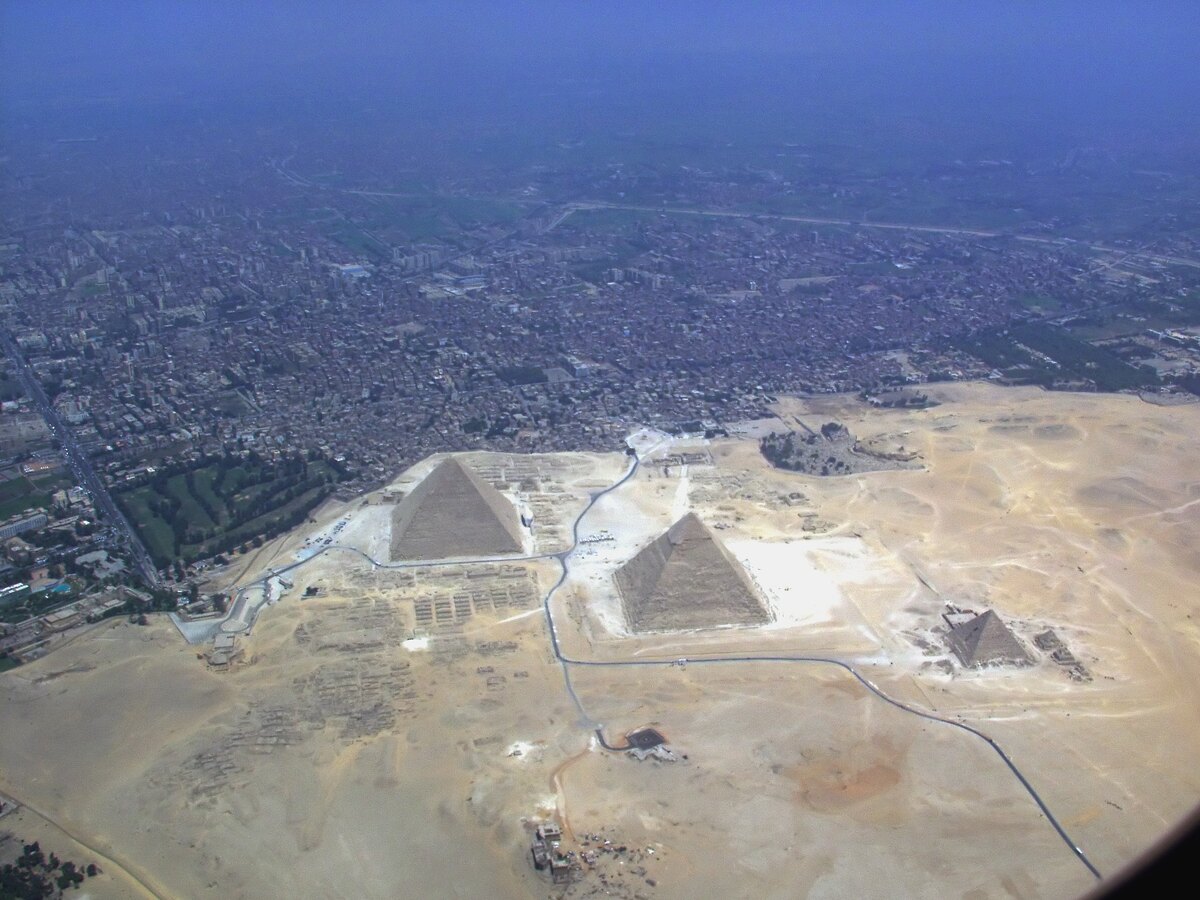
Ancient EgyptAncient EgyptA civilisation that developed along the Nile for almost three millennia, from unification around 3100 BC to the Greco-Roman era; it bequeathed the pyramids, temples and hieroglyphic writingWritingA system of conventional signs used to fix language or information durably; its appearance (c. 3300 BC) marks, by convention, the end of prehistory.→.→ lends itself particularly well to this exercise. The necropolises surrounding the pyramids are riddled with shafts, mastabas, galleries and burialBurialThe intentional deposition of a body, sometimes with offerings; a marker of symbolic behaviour.→ chambers, many of which remain to be mapped. So when an instrument flags a discontinuity underground, there is a genuine chance it corresponds to a human-made structure. But there are also a thousand natural reasons for a signal to deviate: a pocket of drier sand, a fracture in the rock, a change in moisture. The whole challenge is to tellTellAn artificial mound formed by the accumulation of successive layers of settlement remains at the same spot, typical of the Near East. Each destruction-rebuilding event adds a stratum.→ the artificial from the geological.
This is the frame in which recent announcements must be read. They do not come from nowhere: they belong to a long run of campaigns that have gradually refined the methods and learned to combine them. Understanding the tools is what lets us judge discoveries on their merits rather than on their headlines.
The Western Cemetery Anomaly: What the Waves Saw
In 2024, a team bringing together Higashi Nippon International University, Tohoku University and Egypt's National Research Institute of Astronomy and Geophysics (NRIAG) published in the journal Archaeological Prospection the results of a survey carried out from 2021 to 2023 in the Western Cemetery, the vast necropolisNecropolisA large organised burial ground, a "city of the dead", often spanning several periods.→ that stretches west of Khufu's pyramid. There, in a zone strangely empty of surface monuments, the researchers spotted an L-shaped anomaly.3
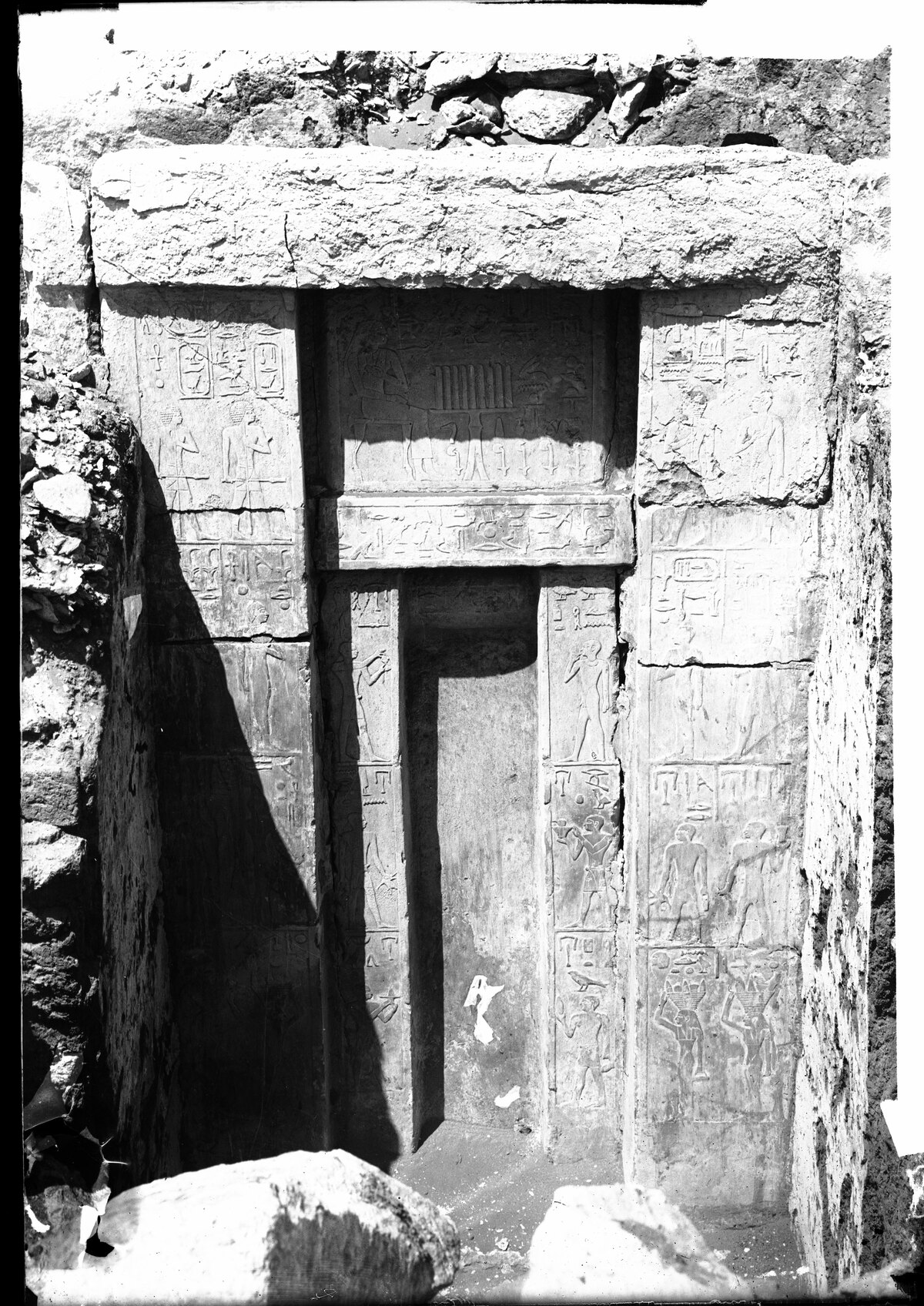
This L-shaped structure lies at shallow depth, around two metres under the sand, and measures, according to press readings, on the order of ten metres across. Intriguingly, it appears to have been deliberately backfilled with sand after it was built, as if someone had wanted to sealSealA small engraved object (often steatite) used to stamp a mark in clay; the Indus seals, bearing animals and signs, attest to administration and trade, though their script remains undeciphered.→ it. Below it, the measurements suggest a second structure, larger and deeper, between roughly three and ten metres down. Electrical resistivity tomography there reveals a highly resistive anomaly, consistent with a mix of sand and gravel, or with an air-filled void.
The authors remain measured. They write explicitly that the survey cannot identify the material responsible for the anomaly, while estimating that it may be a large buried archaeological structure, perhaps a passage leading to a lower tomb. The study's lead argues that a clean L shape does not form naturally in the local geology, which points to a human origin. The conclusion is a call to excavate, not an announcement of a secret chamber.
How to See Beneath the Sand: Non-Invasive Geophysics
To understand these results, we have to open the toolbox of geophysicsGeophysical surveyTechniques (magnetometry, radar) detecting buried structures underground without digging, by measuring physical anomalies.→ applied to archaeology. Three families of methods dominate the Giza campaigns, and each measures a different physical property of the subsurface.
Ground-penetrating radar, or GPR, sends electromagnetic pulses into the ground and records their echoes. Every time a wave meets an interface, for instance the contact between sand and a limestone slab, part of the signal bounces back. By moving the antenna along a grid, you reconstruct slices of the subsurface. GPR excels at shallow depth and offers good resolution, but it fades quickly in wet or conductive ground.
Electrical resistivity tomography, or ERT, injects a current into the ground through electrodes and measures the resistance it meets. Air-filled voids, compact limestone or dry sand strongly resist the current, whereas wet clay lets it flow. By multiplying the measurements, you obtain an image of resistivity at depth. It is this method that flagged the highly resistive anomaly beneath the L-shaped structure.
Tomography, finally, refers broadly to reconstructing an internal image from measurements taken all around or through an object, exactly like a medical scanner. Combining GPR and ERT lets you confront two independent signals: when they point to the same thing, confidence rises. When they diverge, as was partly the case in the Western Cemetery, caution is required, because these techniques can also make an anomaly look larger than it is.
Khufu's Big Void and the North Corridor
The discovery that brought subsurface imaging into the public eye dates to 2017. That year, the ScanPyramids mission announced in the journal Nature the detection of a vast unknown empty space in the heart of Khufu's Great Pyramid, above the Grand Gallery.1 The void is at least thirty metres long, with a cross-section comparable to that of the Gallery itself. The press promptly compared it to an airliner, a catchy phrase that erases the real uncertainties about its shape and function.
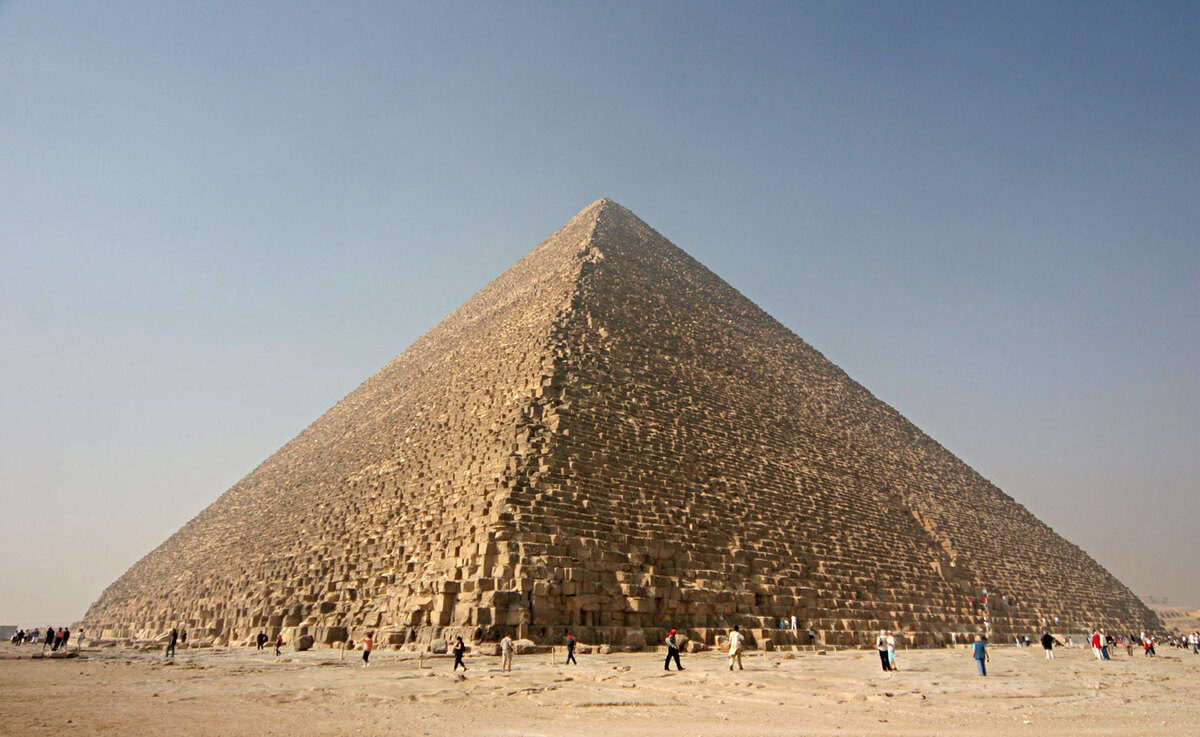
The authors themselves stress what they do not know. The big void could be a single cavity or several adjacent structures, horizontal or inclined, and its purpose remains unknown. The strength of the announcement is not a bold interpretation, it is the robustness of the measurement: the void was detected by three different detection technologies and three independent analyses, which makes an instrumental error highly unlikely.
In 2023, the same mission published in Nature Communications the characterisation of another structure, this time near the north face.2 The measurements describe a corridor about nine metres long, two metres wide and two metres high, located behind the chevron that marks the facade. Remarkably, the team was able to slide a five-millimetre endoscope through a gap found with radar and observe the inside of the passage directly. The function of this corridor also remains unknown, but its reality is no longer in doubt.
Muography: Mapping Stone With Cosmic Rays
The technical star of these campaigns carries an intimidating name: muographyMuographyAn imaging technique using cosmic-ray muons to measure density variations inside a large volume of matter, much as an X-ray uses X-rays.→. The principle, though, is elegant. Constantly, cosmic rays striking the upper atmosphere produce a shower of particles, including muons, a kind of heavy cousin of the electron. These muons pass through matter, but they are absorbed all the more as the rock is thick and dense. By counting how many muons arrive from each direction, you can therefore measure variations in density above a detector, exactly as a radiograph uses X-rays.
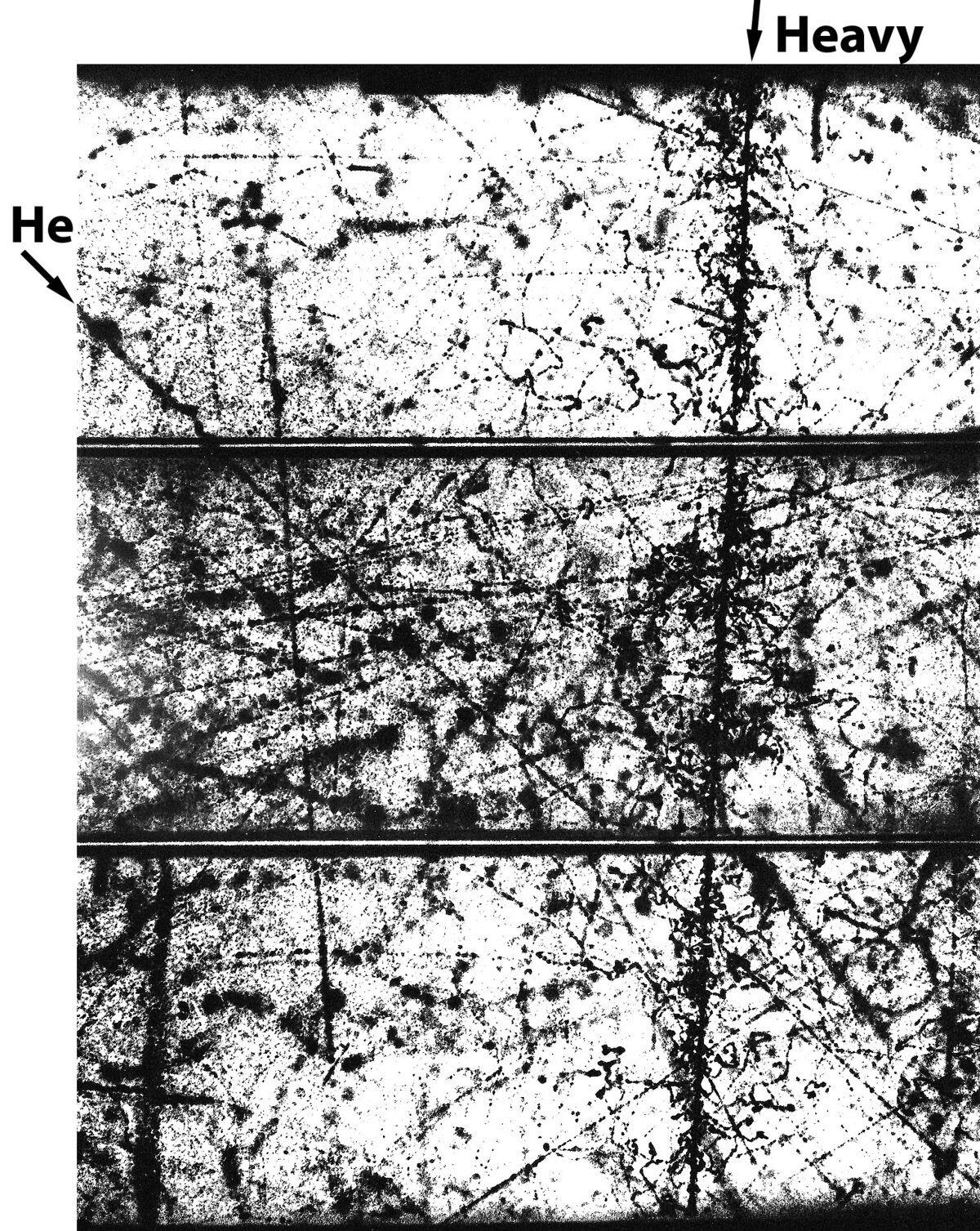
Placed inside or at the foot of a pyramid, the detectors record a surplus of muons coming from the directions where stone is replaced by void. That is how Khufu's big void was flushed out: where a corridor or a chamber hollows out the mass, the particles pass more easily, and the statistics betray the cavity. The ScanPyramids mission combined three types of detectors, emulsion films from Nagoya University, electronic sensors from Japan's KEK laboratory and telescopes from the French Atomic Energy Commission, to cross-check the results.4
The advantage of muography is twofold: it touches nothing and it works through very great thicknesses of stone, where radar gives up. Its drawback is its slowness and its dependence on geometry, because the detectors must sit beneath the zone to be probed and accumulate months of measurements. Nor does it produce a photograph, but a density map that must be interpreted. It is a powerful tool, provided we do not make it say more than density contrasts.
When the Announcement Outruns the Data
Not all announcements are equal, and Giza regularly serves as the backdrop for spectacular claims. In the spring of 2025, two researchers presented, at a press conference, results claiming to have detected beneath Khafre's pyramid a network of deep shafts, chambers over several levels and galleries extending hundreds of metres under the plateau. The images, widely shared online, showed dramatic underground structures.
The contrast with the earlier studies is striking. These results had not been published in a peer-reviewed journal at the time of their announcement, and several specialists judged them exaggerated, even unfounded. Radar experts pointed out that no known technique can reliably image structures hundreds of metres beneath such dense limestone, and that some of the circulated reconstructions appeared to be artificially generated. National Geographic stressed that the underground city and the alleged power station were interpretations, not data.5
This episode is useful, not to mock, but to set a benchmark. Between an anomaly published with its margins of error, cross-checked by several methods and cautiously interpreted, and a claim presented at a press conference without publication or validation, there is a methodological gulf. The same site, the same subsurface, but two radically opposed relationships to reality.
Why Scientists Stay Cautious
Researchers' caution is not timidity, it is a discipline. A geophysical anomaly is first of all a contrast in a physical property: a zone where the ground conducts current less, where a wave bounces, where muons pass more easily. Nothing in this signal, on its own, says whether it is a carved chamber, a backfilled shaft, a natural fracture or a simple change in sediment.
Several traps await the interpreter. A volume effect can inflate the apparent size of a structure. Two methods can contradict each other, as GPR and ERT did not perfectly coincide in the Western Cemetery. A strong signal can also have a mundane, disappointing cause. That is why serious teams speak of an anomaly and a hypothesis until excavation or endoscopy has decided, and why they publish their uncertainties rather than hide them.
Added to this is a heritage stake. Any physical intervention on a monument or a necropolis of Ancient EgyptAncient EgyptA civilisation that developed along the Nile for almost three millennia, from unification around 3100 BC to the Greco-Roman era; it bequeathed the pyramids, temples and hieroglyphic writing.→ affects the integrity of an irreplaceable asset and falls under Egyptian authority. Multiplying boreholes to verify every signal is neither desirable nor permitted. Non-invasive imaging exists precisely to target the rare spots where an intervention will be justified, which makes the rigour of interpretation all the more crucial.
What Now? What Excavation Can Settle
What should we take from this overview? First, that the Giza subsurface very probably still holds unknown structures, and that modern sensors are flushing them out one by one. Khufu's north corridor, observed with an endoscope, is the tangible proof. The big void, detected by three converging methods, still awaits direct exploration but is scarcely in doubt as to its existence.
Second, that the Western Cemetery anomaly is a textbook case: a coherent signal, a geometric shape hard to explain naturally, but a nature still undetermined. It is precisely the kind of target where cautious archaeological excavation could provide a clear answer, revealing a shaft, a chamber, or on the contrary a geological letdown. The authors themselves call for this verification.
Finally, that readers gain by arming their critical sense. Faced with an announcement about Giza, a few questions are often enough to sort things out: is the discovery published and peer-reviewed, how many independent methods support it, do the authors distinguish what they measure from what they assume, and is the size of the announced structures physically plausible for the instrument used? The real scientific adventure beneath the pyramids needs no lost cities: it plays out in the patience of measurement and the honesty of uncertainty.
Pour un documentariste, les anomalies souterraines de Gizeh représentent le sujet ultime : le mystère, la technologie de pointe et l'Egypte ancienne réunis. Le défi est de traiter ce sujet sérieusement, en s'appuyant sur la science, sans tomber dans le sensationnalisme des théories du complot qui pullulent sur internet. L'honneteté intellectuelle est cruciale quand on touche à l'Egypte.
Les anomalies souterraines détectées près des pyramides de Gizeh par différentes méthodes géophysiques alimentent depuis des années les spéculations sur des chambres secrètes ou des tunnels. Si la science est prudente, l'egyptologue passionné que je suis ne peut s'empecher de rever à ce que ces vides pourraient contenir. Les méthodes non invasives comme la muographie sont notre meilleure chance de répondre à ces questions.