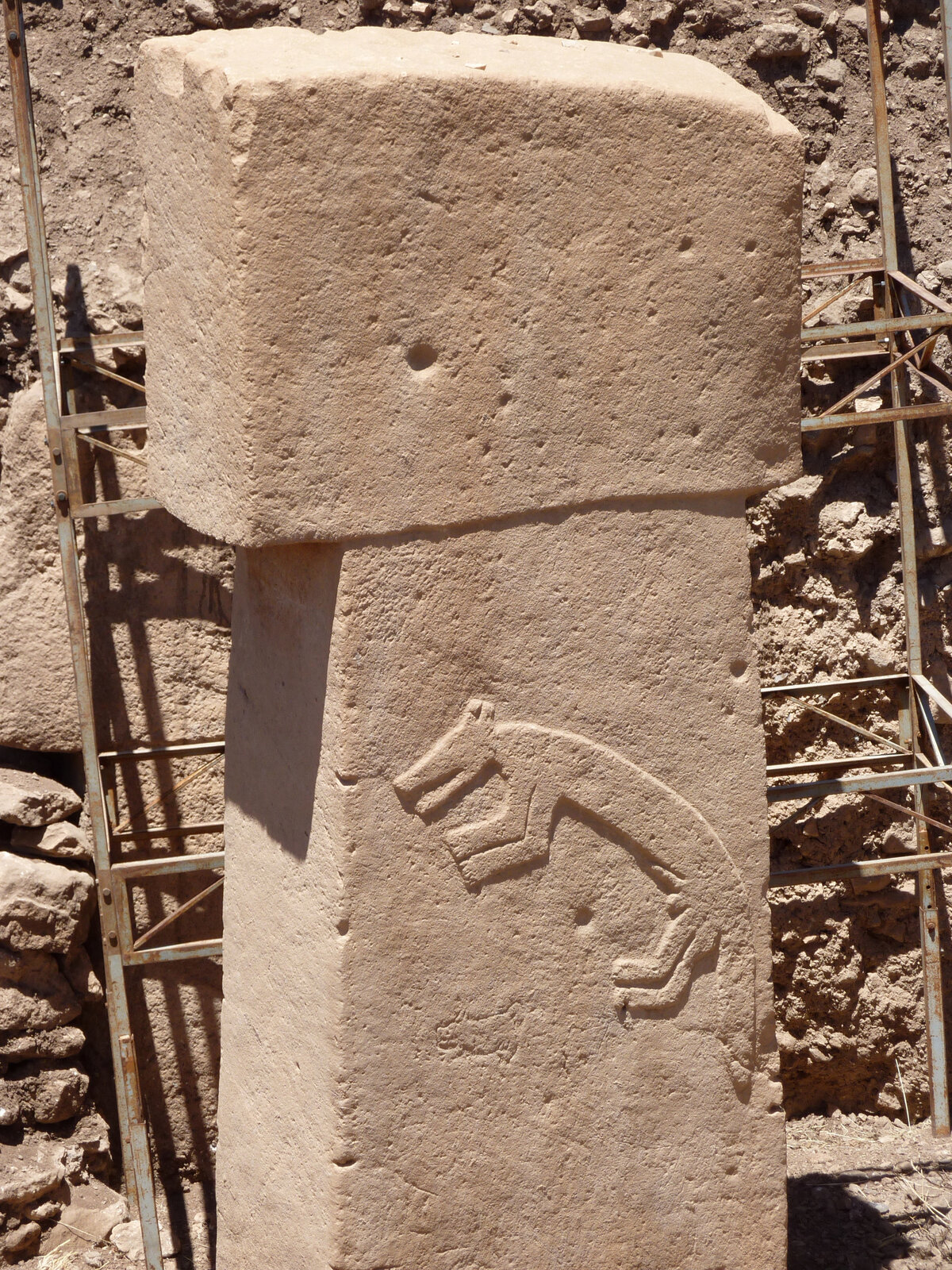
On a hill in southern Turkey, a few kilometres from the town of Şanlıurfa, stands one of the most baffling sites in all of prehistoryPrehistoryThe span of human history before the invention of writing, from the Palaeolithic to the Metal Ages, known mainly through material remains.→. Göbekli TepeGöbekli TepeSite in southern Turkey, the oldest known monumental sanctuary, raised around 9,600 BCE by hunter-gatherersHunter-gatherersA way of life based on hunting, fishing and gathering wild resources, without farming or herding; it dominated almost the whole of human history.→.→, whose name means "pot-bellied hill" in Turkish, lines up great T-shaped limestone pillars, some rising over five metres and weighing several tonnes. These monoliths, carved with foxes, snakes, boars and vultures, were raised about twelve thousand years ago by hunter-gatherers, long before the invention of pottery and farming. Since its excavation by the German archaeologist Klaus Schmidt in the 1990s, the place has been regarded as the oldest monumental sanctuary in the world. And for almost as long, a dark question has shadowed it: that of a supposed "skull cult".1
A sanctuary haunted by its bones
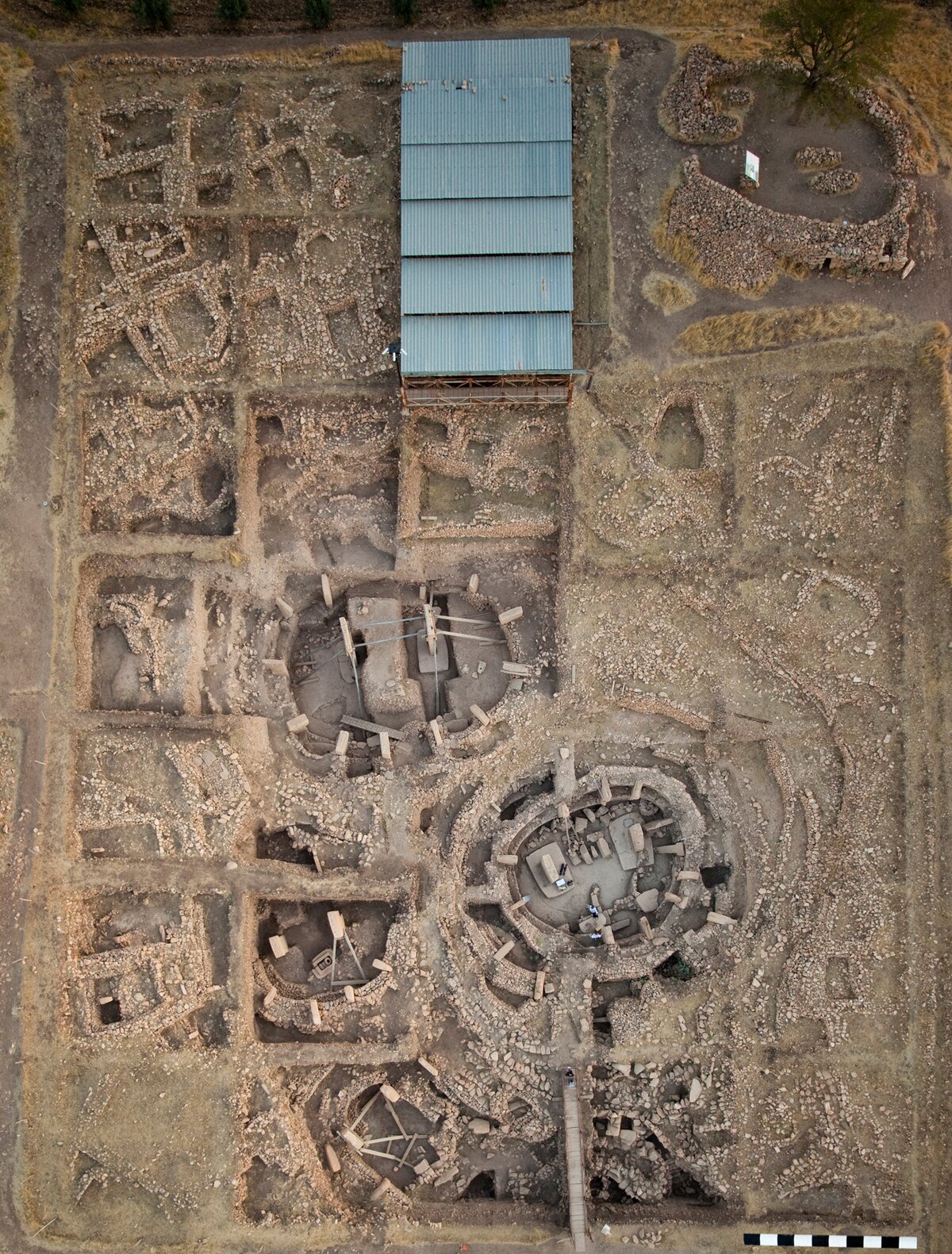
For the first decades of research, Göbekli Tepe never yielded a complete skeleton. Instead, across successive campaigns, archaeologists gathered a great number of isolated human bone fragments, scattered through the fill that chokes the great stone enclosures. Over a surface of about three thousand square metres, the excavators counted 928 human bone fragments detached from one another, broken, gnawed by rodents and caught in calcareous crusts. Nothing resembling an orderly cemetery, but a dust of bones dispersed in the very heart of the monument.2
The situation was intriguing. How could it be that, in a place so laden with symbols, the dead were present only as debris? Researchers long wondered whether these bones came from unusual funerary practices, or even from ritual handling of the dead. Since the building was erected in several phases, between roughly 9,600 and 8,200 BCE, with older structures deliberately buried beneath newer ones, the site's stratigraphyStratigraphyThe study of the superimposed layers (strata) of an archaeological site; each layer corresponds to a phase of occupation and yields a relative chronology.→ is complex, and the human remains were found mixed into the fill, among tools and stone flakes.
It is in this context that the most spectacular hypothesis took shape a few years ago: that of a community obsessed with the heads of its dead, which would have removed, worked and displayed them. In the public imagination as in some scholarly publications, Göbekli Tepe thus became the high place of a cult devoted to human skulls, halfway between sanctuary and ossuary.
The "skull cult" and its incised skulls
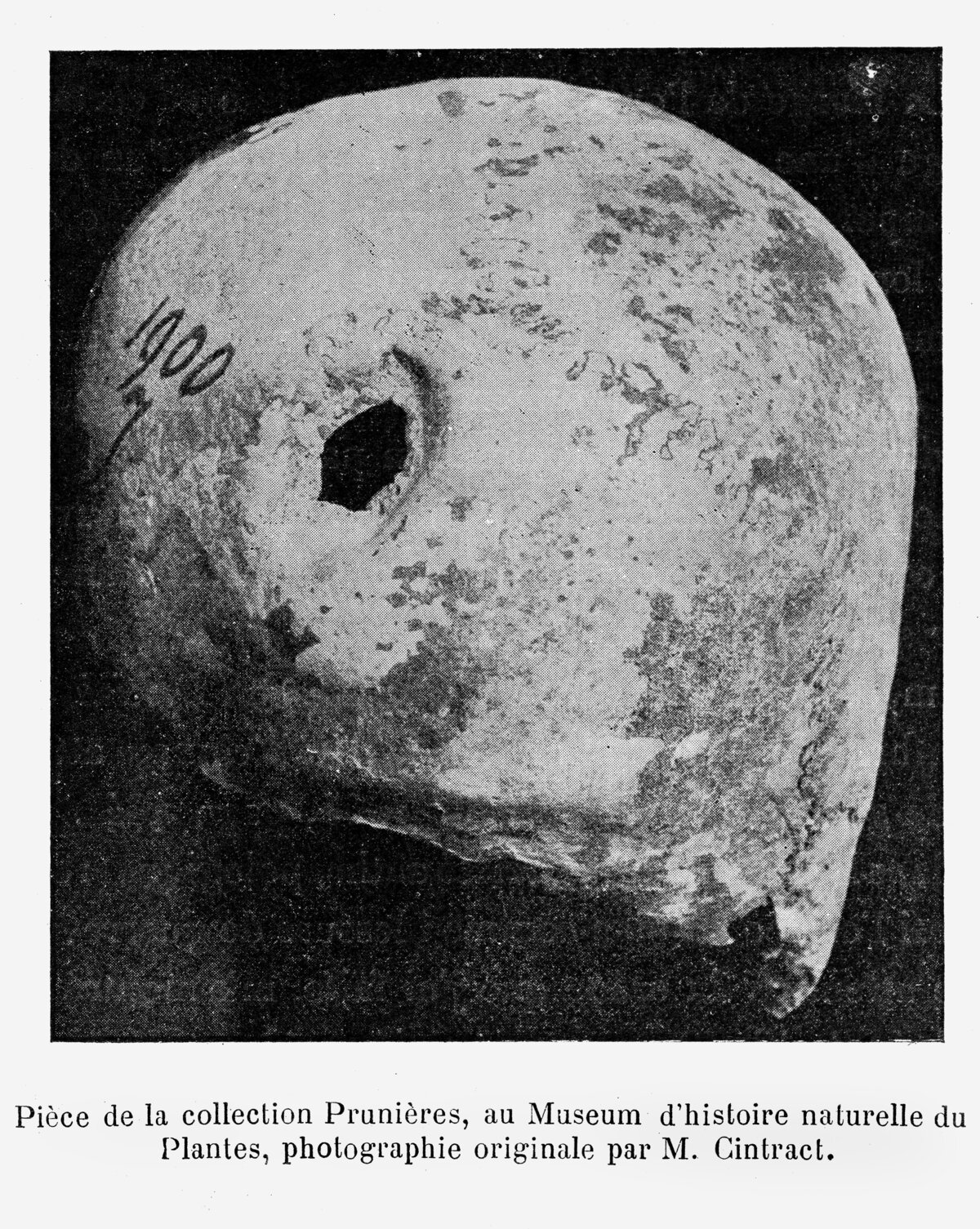
The hypothesis did not come out of nowhere. In 2017, a team including Julia Gresky and Lee Clare of the German Archaeological InstituteGerman Archaeological InstituteResearch institution (Deutsches Archäologisches Institut) leading the excavations at Göbekli Tepe.→ published in the journal Science Advances the study of skull fragments bearing deep and plainly deliberate incisions. The researchers described several types of modification until then unknown from contemporary sites and from the ethnographic record: grooves cut along the cranial vault, traces of ochreOchreA red or yellow mineral pigment (iron oxides), used from prehistory for adornment, funerary rites and art.→ and, on one fragment, a hole drilled through the bone, as if to pass a cord through it.3
For the team, these incisions betrayed a repeated and codified treatment of the heads, perhaps a form of veneration or display of the skulls of certain dead. The term skull cultSkull cultHypothesis of ritual treatment of the dead's skulls, removal, carving or display, long attributed to Göbekli Tepe.→ took hold, and with it a reading of Göbekli Tepe as a theatre of uncommon funerary rites. The idea fit well with an image already widespread about the site: that of an isolated sanctuary, devoid of dwellings, where nomadic groups would have gathered from afar at long intervals for great ceremonies before leaving again.
In this account, the 928 scattered fragments found their natural place. If Göbekli Tepe was held to be a place devoted to the handling of the dead, then the scattered bones became the residue of that handling, the material trace of a macabre selection of heads and bodies. The incised skull and the broken bone reinforced each other to compose the portrait of a society fascinated by death, to the point of making it the centre of its monumental architecture.
It should be said that interest in human heads is one of the best documented features of the Near Eastern Neolithic. At other sites in the region, such as Jericho, archaeologists have found skulls detached from the skeleton, sometimes coated in modelled plaster to restore the features of the face, the eye sockets filled with shells. These practices, thousands of years old, testify to a singular relationship with ancestors, whose heads seemed to concentrate identity and memory. Göbekli Tepe appeared to prolong this tradition, pushing it as far as the carved incision.
One weak link remained in this demonstration: no intact grave had ever been found on the spot. It was therefore impossible to know how these people actually buried their dead, or whether the scattered fragments really came from deliberate treatment or from something else entirely. The hypothesis rested on an absence as much as on clues, and that absence weighed heavily. As long as no complete body had appeared, nothing made it possible to say whether the scattering of the bones stemmed from a human choice or from a mere accident of preservation. The debate hung on a grave that did not yet exist.
Two graves that overturn the story
That absence has now been filled. In a study published on 22 September 2026 in the journal PLOS One, Lee Clare and Julia Gresky announce the discovery of the first two intact graves ever identified at Göbekli Tepe, dated to about 8,700 to 8,000 BCE. For the first time, we are no longer looking at debris but at bodies left in place by those who buried them.4
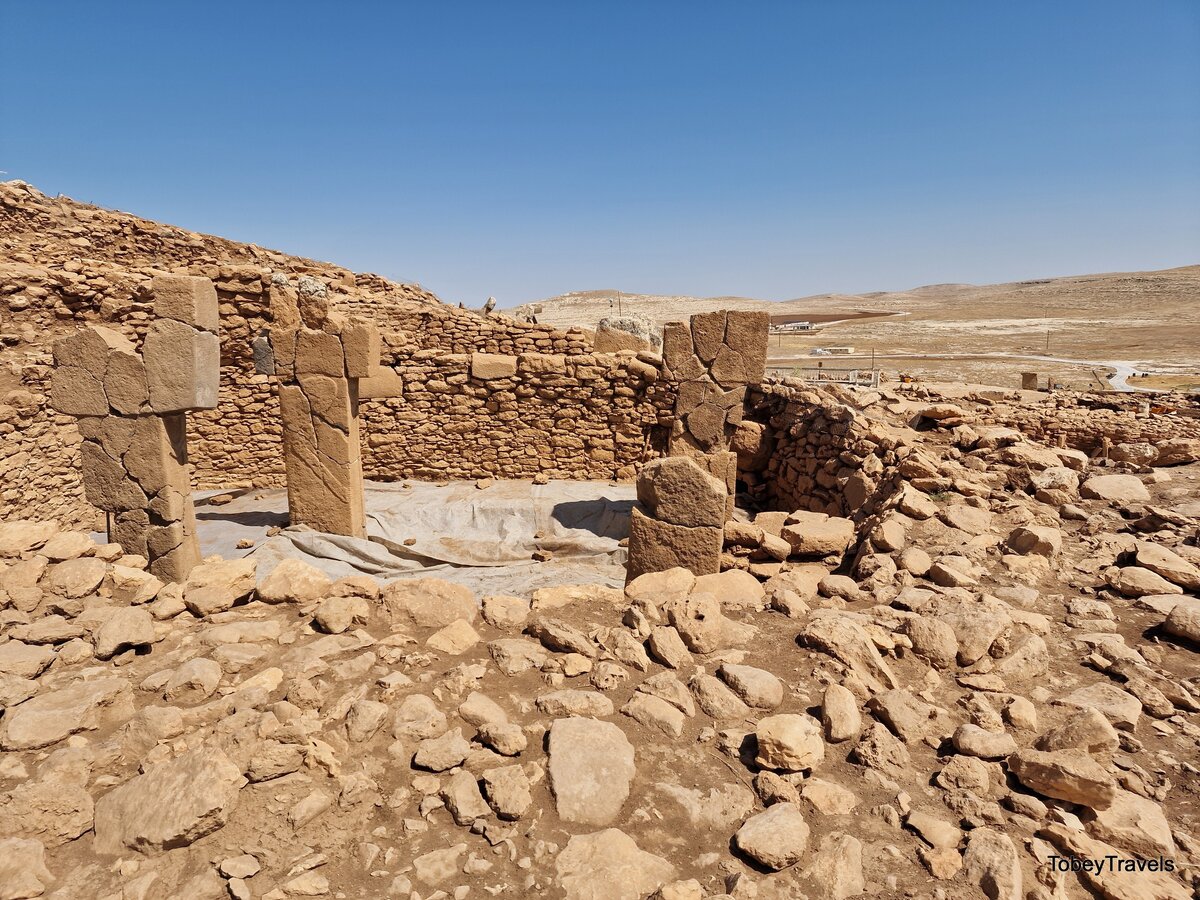
The older of the two, uncovered in 2017, held the remains of at least three individuals: a woman over thirty-five, a man of twenty to thirty and an adolescent girl of eleven to fourteen. Their skulls had been gathered in one corner of the pit, while other bones were pushed aside. For the excavators, this is not the signature of a morbid rite but of successive reopenings of the grave: at each new burialBurialThe intentional deposition of a body, sometimes with offerings; a marker of symbolic behaviour.→, the remains of the previous occupants were moved to make room, a gesture well known from the collective burials of the NeolithicNeolithicThe "New Stone Age": a period marked by farming, herding, settlement and pottery, from around 10,000 BC.→.
The second grave, spotted as early as 2012 but excavated only in 2022, held a young woman lying on her left side, her face turned to the east, resting on a bed of fist-sized stones. Her long bones were fractured, but analysis shows that these breaks resulted from natural processes and not from the action of tools. In other words, no one had deliberately broken her limbs: time, sediment and movements of the ground had done the work. The two burials also show cracked bones, coated in thick calcareous deposits and marked by the passage of rodents, exactly like the scattered fragments gathered elsewhere on the site.
These two graves, so different from each other, reveal far more varied funerary rites than had been thought. Above all, they provide the decisive proof that was missing: since whole bodies rested in the ground at Göbekli Tepe, the scattered bones can no longer be read as the product of a deliberate selection of heads alone. The inhabitants buried their dead normally, close to their structures, following practices attested elsewhere in Anatolia at the same period.
A landslide rather than a staged display
If the bodies really were buried on the spot, how can we explain finding their remains crumbled and mixed in the heart of the enclosures? The answer put forward by the team is no longer ritual at all: it is geological. Göbekli Tepe is built on a slope, and that slope has been at work for centuries.5
Over time, the successive phases of construction, driving rains and perhaps seismic tremors weakened the slopes. Erosion then carried buried bodies downslope, sweeping them into the great enclosures lower down, where they mixed with other remains of different ages. Skeletons belonging to distinct individuals and distinct periods were thus jumbled together in a single fill. What looked like a cleverly orchestrated display of skulls and bones was, for the most part, no more than the result of a simple landslide spread over centuries. TaphonomyTaphonomyThe study of the processes affecting organic remains between death and fossilisation, including the marks left by predators.→, the study of what happens to remains between death and excavation, is enough to account for the apparent disorder.
This reading does not make the incised skulls of 2017 disappear, for they remain quite real. The people of Göbekli Tepe did indeed carve and mark certain skulls of their dead, and the intention behind these gestures remains to be clarified. But, set back in its regional context, the practice loses its exceptional character. As Scott Haddow, a bioarchaeologist at the University of Turin who was not involved in the study, sums it up, the fascination with skulls seems shared across the whole Near Eastern Neolithic: "Universally, there is this focus on skulls, but they are all doing it slightly differently when you zoom in."
Göbekli Tepe was therefore not the lair of a macabre sect apart, but one community among others, inscribed in an Anatolian tradition in which the heads of the dead held a singular place. The story of the isolated skull cult gives way to a more nuanced picture, that of a widely shared funerary interest, declined locally in a thousand variants.
A village as much as a sanctuary
Beyond the question of the bones, these graves feed an older debate about the very nature of the site. For a long time, Göbekli Tepe was described as a pure sanctuary, a place of pilgrimage where hunter-gatherers came in fits and starts to celebrate ceremonies before returning to their camps. The excavators now read these burials quite differently: as the first solid proof of a lasting occupation of the hill.4
Burying one's dead close to the dwelling is indeed the mark of sedentary communities, which do not leave the place where their kin rest. If people were buried at Göbekli Tepe, it was because people lived there, and not merely came to pray. This conclusion joins other clues accumulated in recent years, such as the presence of areas that seem to have served for storing grain, and which gradually sketch the portrait of a genuine village with a ceremonial space at its centre, rather than that of a temple empty of inhabitants.
This shift is far from trivial. It touches on the way we tellTellAn artificial mound formed by the accumulation of successive layers of settlement remains at the same spot, typical of the Near East. Each destruction-rebuilding event adds a stratum.→ the birth of sedentary life and of the first great architectures, at that pivotal moment when hunter-gatherers of the Pre-Pottery NeolithicPre-Pottery NeolithicThe first phase of the Neolithic (c. 9,600–6,900 BC), before the invention of pottery.→ were beginning to settle, to build and, soon, to cultivate. Göbekli Tepe no longer appears as an isolated enigma, risen from nothing for purely spiritual reasons, but as a place of life where the sacred and the everyday were intertwined.
The affair also offers a lesson in method. Göbekli Tepe has fascinated people for thirty years, and that fascination has at times favoured the most dramatic interpretations, from the lost temple to bloody rites. Patient excavation and analysis, by contrast, often pull the site towards soberer explanations, where the accidents of geology count as much as the intentions of people. The incised skull remains an enigma worth studying, but it no longer makes Göbekli Tepe a monstrous case: on the contrary, it ties it to the great funerary current of its time.
The authors themselves avoid any triumphalism. Their study does not rule out that unusual funerary practices existed at Göbekli Tepe; on the contrary, it stresses the "considerable diversity of burial rituals in Neolithic Anatolia". What it sets aside is the idea of a site wholly devoted to a morbid cult of skulls. To settle the last uncertainties, future research will target the slopes of the tell, where other graves may still lie in place, this time able to yield complete bodies and their intact context. Enough, perhaps, to write a new chapter of a story that, at Göbekli Tepe, has not finished rewriting itself.
No comments yet. Be the first.