A Bronze AgeBronze AgePeriod of late prehistory marked by bronze metallurgy and the rise of maritime trade, beginning in the Near East around 3300 BCE.→ "proto-town" revealed near Armagh
A few kilometres from the city of Armagh, in Northern Ireland, a site long familiar to archaeologists has just changed its meaning. Haughey's Fort, a vast hillfort (colline fortifiée)HillfortA fortified hilltop site of European protohistoryProtohistoryThe transitional period between prehistory and history, covering societies without their own writing but known through external texts.→, ringed by banks and ditches; some very large ones gather settlement and craft.→ dated to around 1200 BCE, now appears not as a simple defensive enclosure perched on a summit, but as the heart of a fully planned landscape where dense settlement, specialised workshops and ritual spaces existed side by side. A study published in 2026 in the journal Antiquity, led by James O'Driscoll (University of Glasgow) and Patrick Gleeson (Queen's University Belfast), proposes to see in this complex one of the earliest town-like settlements in Europe, a place where several hundred people lived and worked in a coordinated way three thousand years ago.1
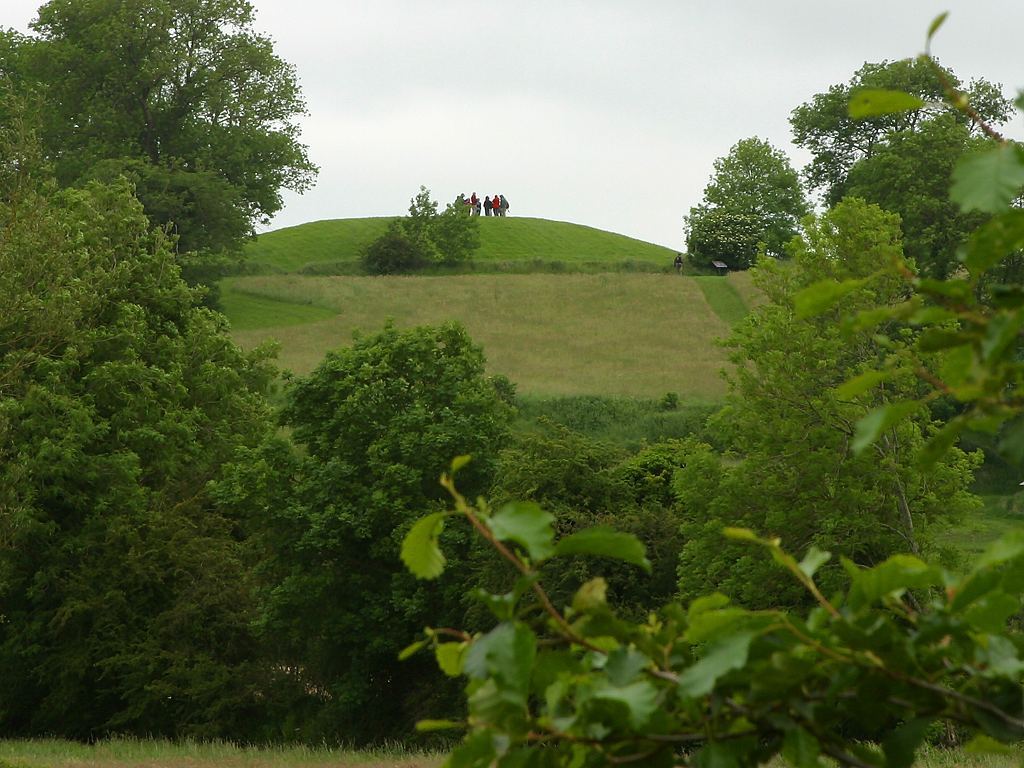
The word "town" must be handled with caution, and the authors themselves stress this. It is not a city in the classical sense, with paved streets, written administration and stone walls. But the accumulation of evidence, the density of occupation, the specialisation of activities, the presence of monumental buildings and the long-distance trade connections together paint the picture of an agglomerated centre on a scale never before seen in Bronze Age Ireland. It is this scale, as much as its nature, that is now the subject of thorough reassessment.2
The largest hillfort in Northern Ireland
Haughey's Fort is no minor site. It is the largest known hillfort in Northern Ireland and one of the three largest in all of Ireland and Britain. Its defences unfold across several concentric enclosures, ringing the top of a hill that overlooks the surrounding countryside. This configuration, long interpreted as purely military or symbolic, takes on a new meaning in the light of recent surveys: the ditches and palisades did not merely protect an entrenched elite, they delimited an organised, structured and long-inhabited living space.
The survey campaigns combined geophysics, remote sensing and targeted excavation to map what the ground concealed. Where earlier excavations had revealed only a few traces, the new technologies brought forth a far denser fabric of structures. The contrast is striking: a typical hillfort of this period is often reduced to an enclosure ringing a sparsely built space, sometimes almost empty, reserved for gatherings or livestock. Haughey's Fort escapes this model. The interior of its enclosures was densely occupied, and the settlement probably spilled beyond the visible lines of defence, onto the slopes and into the surrounding landscape.3
Such scale immediately raises the question of resources and labour. Raising several kilometres of banks and ditches, maintaining timber palisades, supplying a large population with timber and food: all of this implies a social organisation capable of mobilising and coordinating considerable effort over several generations. This is far from the image of an isolated hamlet or a mere temporary refuge. The site testifies to a will for large-scale planning, conceived and sustained over the long term.
More than two hundred domestic structures
The most striking figure from the study concerns the settlement itself. Surveys identified more than two hundred potential timber structures, mostly circular in plan, distributed inside and around the enclosures. Even if not all were necessarily occupied at the same time, the concentration remains exceptional and suggests a populous, organised and lively settlement, comparable in principle to a small town rather than a fortified outpost.
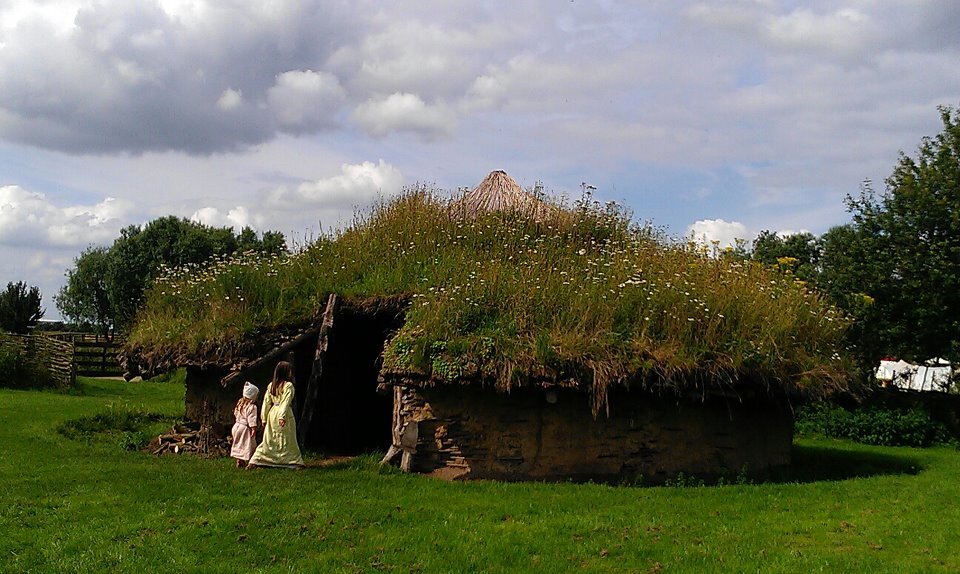
These roundhouses, the dominant form of insular dwelling in the Bronze AgeBronze AgeA protohistoric period following the NeolithicNeolithicThe "New Stone Age": a period marked by farming, herding, settlement and pottery, from around 10,000 BC.→, defined by bronze metallurgy (a copper-tin alloy) and the rise of the first cities and states; in Egypt it corresponds to the age of the first pyramids.→, rested on a frame of timber posts, with walls of daubed wattle and a thatched roof. Each probably sheltered a family and its domestic activities: hearthhearthA combustion structure set on the ground, evidence of the mastery of fire and a marker of how a prehistoric dwelling was organised.→, food preparation, storage, small tools. Grouped by the hundreds, they formed a tightly built landscape, crossed by passages and shared spaces, where the daily life of many households unfolded within reach of one another. It is precisely this proximity and this density that bring Haughey's Fort close to the notion of an agglomeration.
The question of simultaneity remains open and the researchers keep to caution. Some of the structures may have succeeded one another over time, replaced through successive rebuildings. But even taking this renewal into account, the intensity of occupation remains remarkable. It implies a substantial resident population, a regular supply of food and materials, and a form of collective management of space.
Monumental circular buildings
Within this domestic fabric stand out constructions of an entirely different scale. The study reports large circular buildings reaching up to thirty metres in diameter, dimensions that place them well beyond the ordinary family house. Their size and central position suggest institutional or communal functions rather than residential ones.
Such buildings may have served as assembly places, reception or feasting halls, settings for collective ceremonies or the exercise of authority. Their presence at Haughey's Fort reinforces the idea of a centre endowed with a genuine coordinating function, a focal point of the territory.
Constructing a timber building thirty metres in diameter is no trivial matter. Great pieces of framing must be felled, transported and raised, a roof capable of spanning such a width must be designed, and considerable skill and labour must be mobilised. These monuments are, in themselves, a demonstration of power and collective capacity. They signal that the community of Haughey's Fort did not merely survive: it invested in works meant to assert its identity and its rank.4
Metalworking, feasting and prestige goods
One of the study's major contributions concerns craft activities. Haughey's Fort was home to specialised metalworkingMetallurgyThe techniques of extracting and working metals (copper, bronze, gold); its rise in the EneolithicEneolithicThe "Stone-and-Copper Age": a transition between the Neolithic and the Bronze Age (c. 5000–3000 BC in south-eastern Europe), marked by the first copper objects, large farming settlements and, in places, the rise of fortified sites. Broadly synonymous with Chalcolithic.→ and Bronze Age transformed tools, weapons and social hierarchies.→, focused on the working of bronze and gold. The evidence of high-level craftsmanship, moulds, casting waste and finished objects, testifies to the presence of skilled artisans capable of producing technically demanding and socially valued pieces.
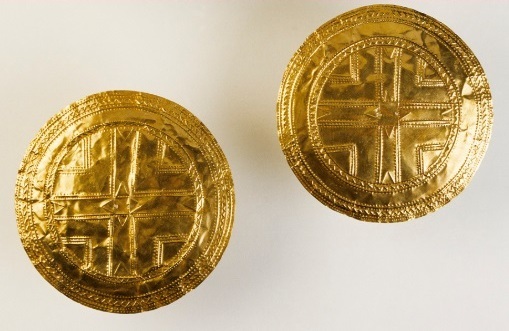
Goldworking in particular points to an economy of prestige. These precious objects did not serve everyday tasks: they circulated as markers of status, diplomatic gifts or offerings. Their manufacture on site implies that Haughey's Fort concentrated not only material resources but also the control of rare skills and the power to organise their production. Craft specialisation, that is, the existence of people whose main activity was no longer subsistence but a trade, is one of the classic signs of a society growing more complex.
To this production are added the traces of great feasts. The remains suggest large-scale communal meals, occasions to consume meat and drink in abundance, to display the generosity of hosts and to strengthen the bonds of the community. Associated with prestige goods and monumental buildings, these gatherings sketch the workings of a centre where power, exchange and display were played out.
Networks reaching as far as Iberia
Haughey's Fort was not a closed world. Among the discoveries are imported objects whose origin points to distant regions of Europe. Some elements testify to contacts with the Iberian Peninsula, others with Central Europe, revealing the site's integration into vast exchange networks that linked the communities of the Atlantic to the continent.
These distant links are heavy with meaning. They show that the inhabitants of Haughey's Fort had access to circuits for the circulation of goods, raw materials and probably ideas, extending over thousands of kilometres. A centre able to attract and redistribute such goods necessarily held a privileged position in its territory, a node toward which flows converged.
This connected dimension reinforces the interpretation of a central place. A town-like agglomeration is defined not only by its size or density but also by its capacity to polarise exchange, to concentrate resources brought from afar and to redistribute them. The imported objects of Haughey's Fort suggest precisely this role of crossroads, an anchor point of the networks of the Atlantic and continental Bronze Age. The community that lived there was fully part of a networked world, far wider than the immediate horizon of the hill.
At the heart of the royal complex of Armagh
Haughey's Fort cannot be understood in isolation. It belongs to a larger whole, the royal complex of Armagh, which brings together several major sites including the famous Navan, the Emain Macha of Irish tradition. This sacred and political landscape, occupied and reshaped over long centuries, was one of the great centres of power of ancient Ireland, charged with a dense mythological memory.
Placing Haughey's Fort in this context illuminates its importance. For a long time, attention focused on Navan, with its spectacular monuments and its central role in the legendary narratives. But recent work shows that the site is part of a constellation of related occupations, of which Haughey's Fort forms an early and considerable link. The Bronze Age agglomeration may thus represent an early, perhaps founding, phase in the long history of this royal landscape, a deep root of the enduring centrality of the Armagh region.
This territorial continuity over several millennia raises questions. Why did this precise place concentrate power and the sacred for so long? The density of Bronze Age occupation suggests that the central vocation of Armagh does not arise from later periods but has its origins far earlier, in a time when forms of collective organisation of remarkable scale were already taking shape.
"Proto-urban": a framework to handle with care
There remains the question of vocabulary. Speaking of a "town", a "proto-town" or a proto-urbanProto-urbanRefers to a large agglomerated centre with urban features (density, craft, communal functions) without being a city in the classical sense.→ centre is an interpretive choice that the authors accept while qualifying it. These words serve to convey the exceptional scale and nature of the site, to lift it out of the ordinary category of the hillfort. But they must not mislead: Haughey's Fort is not a town in the sense that the contemporary Mediterranean or Near Eastern worlds would have understood it.
It is rather a large agglomerated centre, dense and structured, endowed with multiple functions and a substantial population, but without the classic attributes of ancient urbanism. The caution of the researchers is a strength here: rather than forcing the site into a pre-established category, they invite us to rethink what an agglomeration could be in the Atlantic Europe of the Bronze Age. The debate over words reflects a deeper debate about forms of social complexity and the many paths leading to human concentration.
Ultimately, the interest of Haughey's Fort lies less in the label attached to it than in what it reveals. Here, three thousand years ago, hundreds of people lived together, produced precious objects, feasted in great buildings, exchanged with distant regions and shaped a landscape to their own measure. Whether one speaks of a proto-town or a large agglomerated centre, it is this reality that compels attention: a capacity for collective organisation far earlier and far vaster than had been imagined for this period of Irish prehistoryPrehistoryThe span of human history before the invention of writing, from the Palaeolithic to the Metal Ages, known mainly through material remains.→. And future research on the Armagh complex promises to reveal still more.
Je n'avais jamais pensé à la préhistoire comme une histoire d'artisans. Ce site m'a changé ça.
En parallèle de la lecture, j'ai ouvert la carte interactive. Tout s'emboite parfaitement.
Ce point mériterait une nuance, mais l'ensemble est rigoureux pour du grand public. Bon travail.