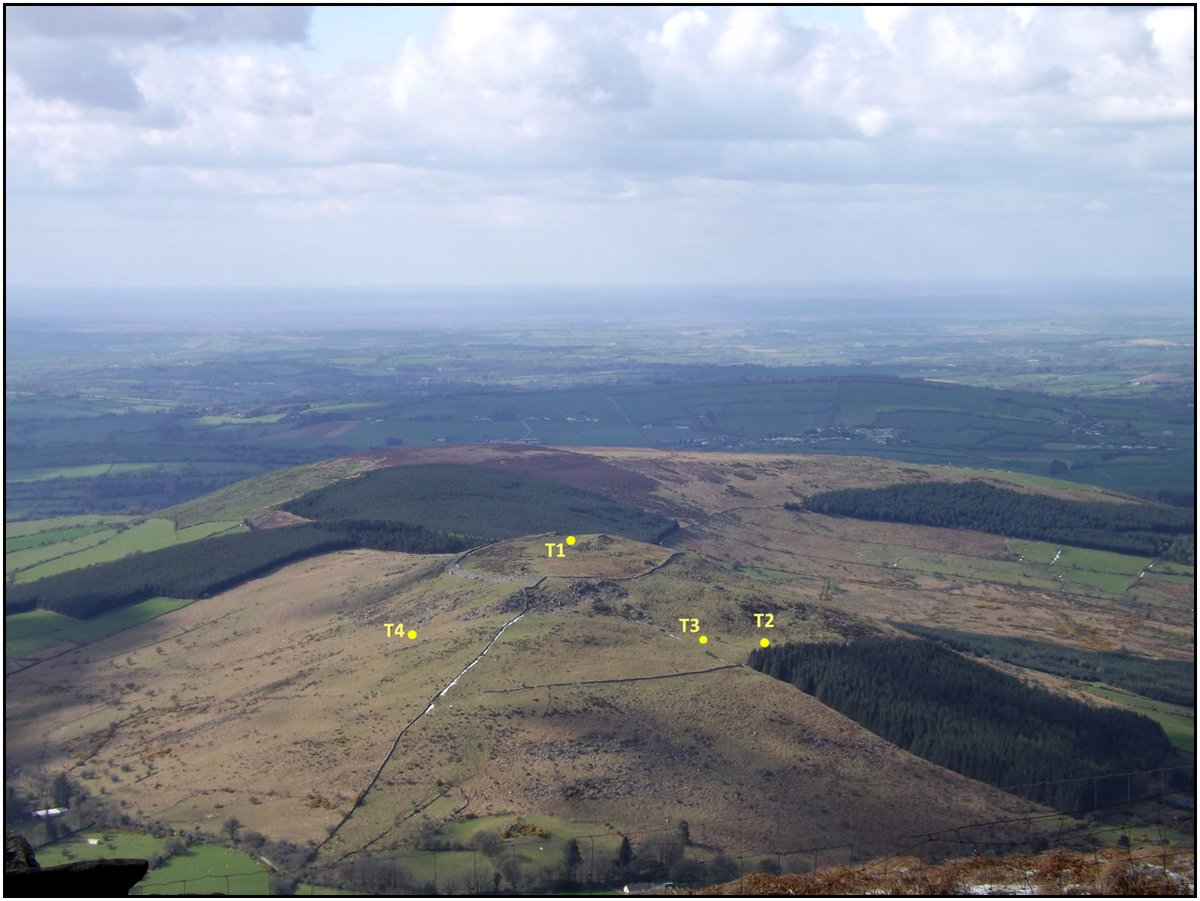
A few kilometres from Armagh, in Northern Ireland, a stretch of quiet hills and fields conceals one of the most densely organised landscapes of Bronze AgeBronze AgeA protohistoric period following the NeolithicNeolithicThe "New Stone Age": a period marked by farming, herding, settlement and pottery, from around 10,000 BC.→, defined by bronze metallurgyMetallurgyThe techniques of extracting and working metals (copper, bronze, gold); its rise in the Eneolithic and Bronze Age transformed tools, weapons and social hierarchies.→ (a copper-tin alloy) and the rise of the first cities and states; in Egypt it corresponds to the age of the first pyramids.→ Europe. Archaeologists have known since the 1980s that Haughey's Fort, a hilltop enclosure, saw intense occupation around 1200 BCE. But a study published in early July 2026 in the journal Antiquity, led by James O'Driscoll (University of Glasgow) and Patrick Gleeson (Queen's University Belfast), reshuffles the picture: far from being just another hillfortHillfortA fortified hilltop site of European protohistory, ringed by banks and ditches; some very large ones gather settlement and craft.→, the site appears to have been the heart of a vast planned landscape, where settlement, craft production and ritual were integrated at a scale never before documented for the Late Bronze AgeLate Bronze AgeThe final phase of the Bronze Age in the Near East (c. 1550 to 1200 BCE), an age of great empires and international diplomacy, ended by a general collapse.→ of Western Europe.1
A landscape between myth and archaeology
Haughey's Fort does not stand alone. It sits next to Navan Fort, ancient Emain Macha, a far more famous site: the legendary capital of Ulster in Irish mythology, backdrop to the exploits of the hero Cúchulainn and the schemes of Queen Medb. This literary reputation, fixed by much later medieval texts, had long focused scholarly attention on Navan Fort itself, leaving neighbouring sites in the shadows.
It is precisely this blind spot that the new study corrects. Combining advanced remote sensing, geophysical surveyGeophysical surveyTechniques (magnetometry, radar) detecting buried structures underground without digging, by measuring physical anomalies.→, targeted excavation and a reassessment of older archives, the team led by O'Driscoll and Gleeson showed that Haughey's Fort, the King's Stables and the Creeveroe Earthworks were not isolated monuments, but a single interconnected system, carefully structured to bring together settlement, production and ritual.
A dense settlement: more than two hundred buildings
The most striking finding concerns settlement density. Surveys revealed traces of at least two hundred wooden domestic structures in and around the enclosure, far exceeding what would usually be expected of a typical hillfort, generally occupied more sparsely or seasonally. This concentration of buildings points to a substantial, stable resident population rather than one gathered occasionally for shelter or ceremony.
Alongside the houses, researchers identified large circular buildings, some up to thirty metres in diameter. Their exceptional size, disproportionate to purely domestic use, makes them strong candidates for an institutional or communal function: gathering places or venues for collective ceremony, reinforcing the idea that Haughey's Fort functioned as a centre in the fullest sense, not merely a cluster of scattered farmsteads.
According to James O'Driscoll: "Our research demonstrates a level of scale, organisation and connectivity in Bronze Age Ireland that has not been fully recognised until now. The evidence from Haughey's Fort points to a large, densely occupied settlement where craft production, exchange and communal activity were all closely integrated."
The King's Stables: a pool for the gods
A few hundred metres from Haughey's Fort lies one of the most intriguing elements of this complex: the King's Stables, an artificial pool roughly 25 metres in diameter, sunk about 4 metres below the surface. Filled with water soon after construction, the pool created waterlogged conditions that exceptionally preserved organic materials usually lost in Irish soils.
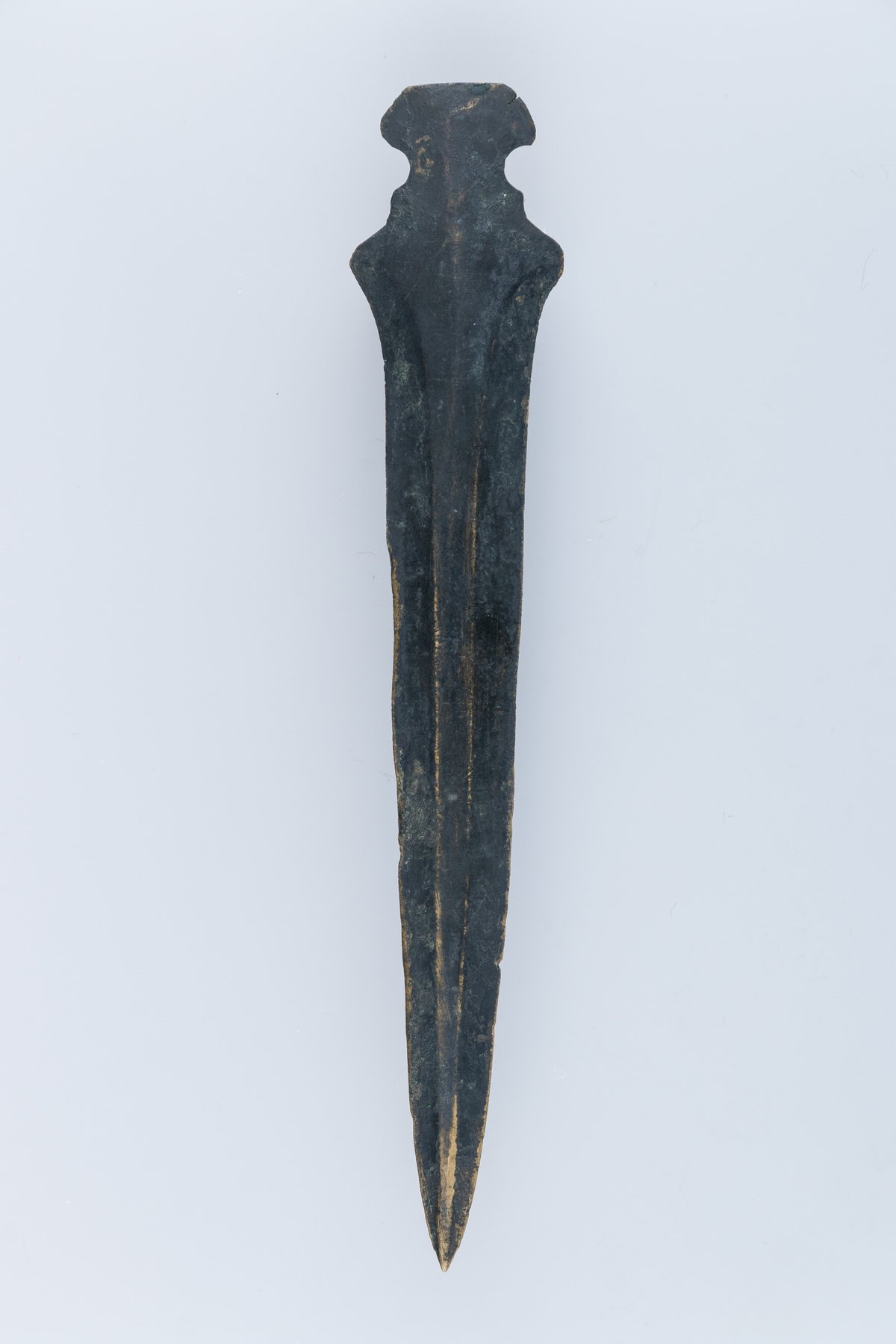
The deposits recovered from the pool reveal an unusually rich ritual practice: fragments of moulds for leaf-shaped sword blades, partly articulated animal remains, red deer antlers, dog remains, and even human bone fragments, including part of a skull. Nothing in this combination suggests domestic or utilitarian use; everything points to deliberate, meaningful deposition, a place where objects and remains charged with symbolic value were immersed.
A palisade-lined avenue physically and symbolically linked the fort to the pool, marking out a probable ceremonial route, a constrained path that likely channelled processions between the inhabited space and the ritual one, embedding the boundary between the everyday and the sacred directly into the landscape.
Creeveroe: an enclosure of over a hundred hectares
The third element of the system, the Creeveroe Earthworks, had long been misunderstood. The new study reinterprets it as a vast outer enclosure formed by a pair of levelled, parallel ditches running roughly north to south, enclosing an outer area of about 109 hectares, the equivalent of some 155 football pitches. Combined with Haughey's Fort, the complex is now the largest hillfort known from Northern Ireland, and one of the three largest such monuments recorded in Ireland or Britain.
Craft, metalworking and distant networks
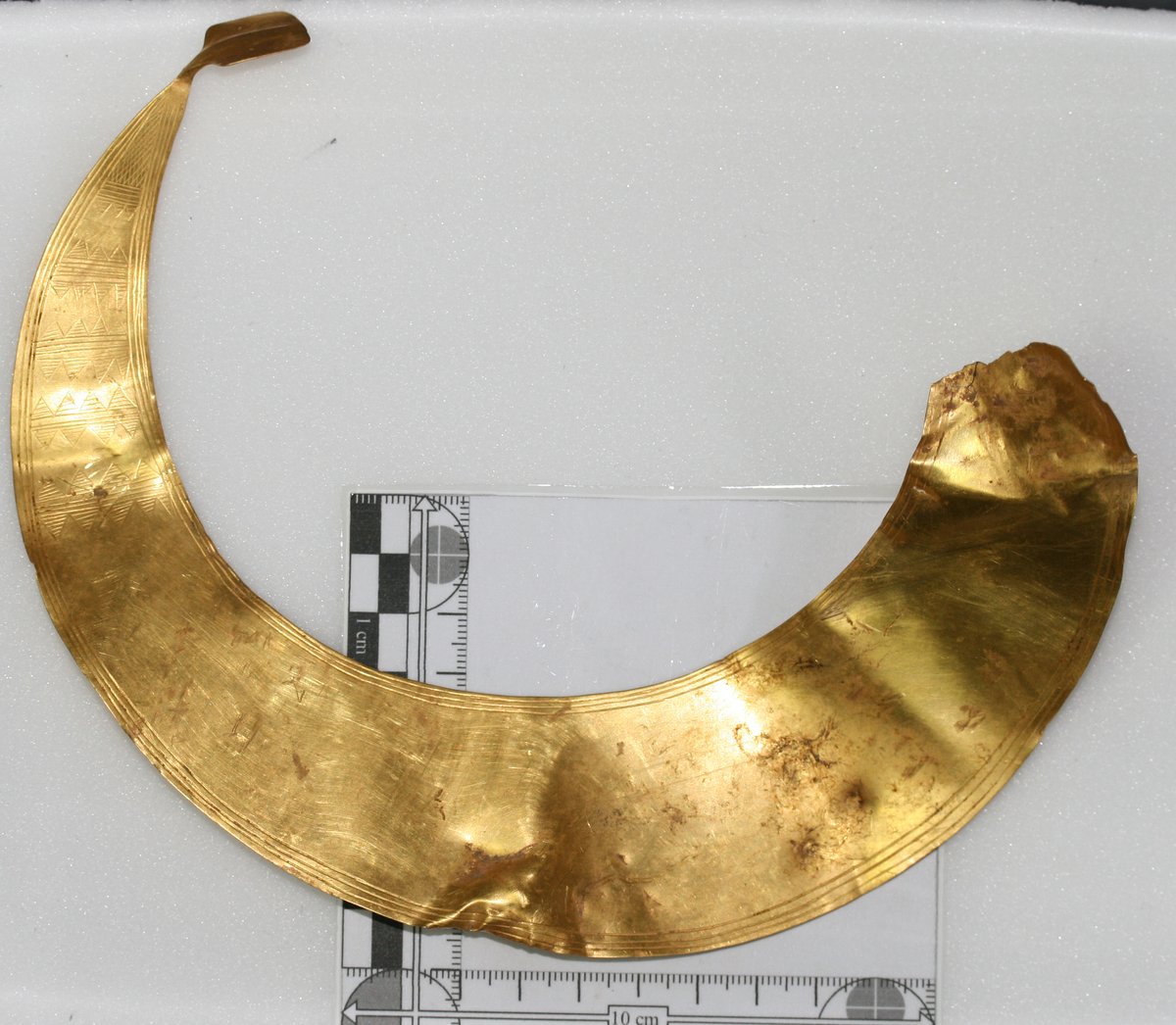
Haughey's Fort was not only a place of residence and ritual: it was also a centre of specialised production. Excavations yielded evidence of specialist bronze and gold-working, large-scale feasting, and high-status artefacts, pointing to an economy in which skilled craft occupied a central place, likely tied to some form of social or political control over production.
More striking still, some imported objects found at the site attest to long-distance connections reaching as far as the Iberian Peninsula and Central Europe, a pattern this site has already documented elsewhere: exchange networks linking Ireland to Atlantic Iberia were, at the same period, already circulating copper, tin, amber and technical know-how between communities separated by thousands of kilometres of sea and land.
Was Haughey's Fort a "town"?
The question of early urbanism has stirred European prehistoric archaeology for years. The Cucuteni-TrypilliaCucuteni-TrypilliaA vast Eneolithic culture of south-eastern Europe (c. 5000–3000 BC), spread across Romania, Moldova and Ukraine. Famous for its spiral-painted pottery, its figurines and its huge settlements of several thousand inhabitants, sometimes cyclically burned and rebuilt.→ megasites of Ukraine and the Perdigões ceremonial centre in Portugal have each reignited the debate: at what threshold of size, density and organisation can we speak of a "town", when such sites lack the writingWritingA system of conventional signs used to fix language or information durably; its appearance (c. 3300 BC) marks, by convention, the end of prehistory.→, palaces or state monumentality usually associated with Mesopotamian urbanism?
Haughey's Fort adds its own piece to this comparative puzzle. In a wider Western European context, the site now ranks among the clearest examples of a proto-urbanProto-urbanRefers to a large agglomerated centre with urban features (density, craft, communal functions) without being a city in the classical sense.→ centre, evidence that large, organised settlements were beginning to take shape around three thousand years ago. As Patrick Gleeson puts it, these are not isolated monuments but a single, highly organised landscape: Haughey's Fort, the King's Stables and the Creeveroe Earthworks formed an integrated system, structured to actively organise movement, belief and authority across a monumental setting.
What Haughey's Fort changes about our view of the western Bronze Age
The main contribution of this study is not the discovery of a wholly unknown site, Haughey's Fort has been excavated since the 1980s, but a shift in scale of interpretation. By linking elements long treated separately, and showing they belonged to one coherent project, researchers place Late Bronze Age Ireland within a wider European conversation about the origins of urban complexity.
Much remains to be understood: the fine chronology of occupation, the exact nature of the authority able to coordinate such a project, the social status of bronze and gold smiths, the place of feasting and King's Stables rituals in local political life. But one thing seems settled: three thousand years before us, on the hills that now overlook Armagh, a community built, organised and sustained one of the most ambitious landscapes of western European prehistoryPrehistoryThe span of human history before the invention of writing, from the Palaeolithic to the Metal Ages, known mainly through material remains.→.
Je reviens souvent ici avant de traiter un sujet scientifique. Fiable et bien écrit.
C'est accessible mais pas simpliste. Parfait pour quelqu'un comme moi qui débute.
Les titres de vos articles sont forts. On clique immédiatement, et le contenu tient la promesse.