In 1991, in the medieval ruins of Dmanisi, a small Georgian town, ordinary archaeological excavations took an extraordinary turn. Human fossils nearly 1.8 million years old were unearthed, pushing back the out-of-AfricaAfricaThe cradle of humankind: the continent where the first hominins appeared, then Homo sapiens around 300,000 years ago, before the expansion to the rest of the world.→ migration of hominins by hundreds of thousands of years. To date, five skulls and numerous postcranial bones have been recovered at Dmanisi, making it the site of the oldest known hominins outside Africa.
An Extraordinary Site
Dmanisi is not a typical paleontological site: it is a medieval fortified town whose foundations rest on a lava layer precisely dated to 1.85 million years. The fossiliferous deposits, sandwiched between volcanic layers, have allowed very precise dating of the specimens between 1.77 and 1.85 million years1.
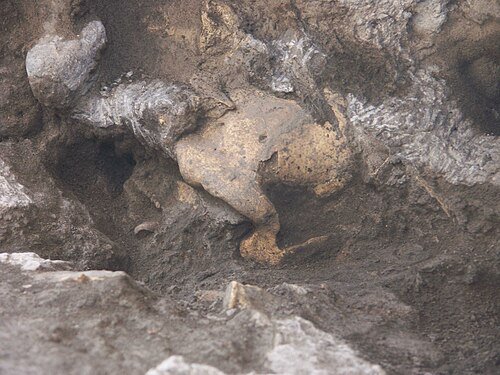
Five Skulls and Their Lessons
The five Dmanisi skulls (D2280, D2282, D2700, D3444, D4500) display remarkable morphological diversity. D3444 belonged to an elderly individual who had lost nearly all teeth long before death, requiring group members to provide food, representing early evidence of social care2. The fifth skull (D4500), published in 2013, triggered a taxonomic earthquake: its variability among the five individuals equals what is observed within a single living primate species, suggesting that multiple African early Homo species might simply represent one highly variable species3.
Who Were the Dmanisi People?
These hominins were small-statured (about 1.50 m), with brain capacities between 546 and 775 cc. They made simple OldowanOldowanThe oldest known stone-tool industry (c. 3.3–1.7 Ma), characterised by flaked pebbles (choppers) and basic flakes. Named after Olduvai Gorge (Tanzania).→-type tools without AcheuleanAcheuleanLower Palaeolithic technical culture characterised by hand axes, present across three continents.→ handaxes, demonstrating that technological sophistication was not required to leave Africa4. Their survival reveals that behavioral complexity, including social care of the infirm, preceded significant brain enlargement.
Implications for the Out-of-Africa Dispersal
Dmanisi fundamentally changed our understanding of homininHomininMember of the subtribe Hominina, comprising the human lineage (Homo, Australopithecus, Paranthropus…) but excluding orangutans and gibbons. The term progressively replaces "hominid" in its narrow sense.→ dispersal. Rather than an evolved Homo erectus with advanced Acheulean technology crossing Africa's borders, primitive small-brained populations were already in Georgia nearly 1.8 million years ago, having likely followed faunal corridors through the LevantLevantA region of the eastern Mediterranean Near East (Israel, Lebanon, Syria, Jordan), a major crossroads of the first human migrations out of Africa.→. Their presence implies even earlier departures from Africa, around 2 million years ago, by populations close to Homo habilis.
No comments yet. Be the first.