Between 700,000 and 200,000 years ago, a physically imposing and remarkably large-brained human form dominated the landscapes of Europe, AfricaAfricaThe cradle of humankind: the continent where the first hominins appeared, then Homo sapiens around 300,000 years ago, before the expansion to the rest of the world.→, and possibly Asia. Homo heidelbergensisHomo heidelbergensisMiddle Pleistocene human species, often seen as the common ancestor of Neanderthals and our own species.→ -- named after the city of Heidelberg in Germany, near which the mandible that gave it its name was found in 1907 -- is today recognised by most palaeoanthropologists as the common ancestor of two human lineages that would go on to dominate late prehistoryPrehistoryThe span of human history before the invention of writing, from the Palaeolithic to the Metal Ages, known mainly through material remains.→: the NeanderthalsNeanderthalsA fossil humanity of Eurasia, robust and cold-adapted, extinct around 40,000 years before present.→ in Europe and the Near EastNear EastA region of western Asia (Levant, Mesopotamia, Anatolia, Iran), cradle of the Neolithic revolution, agriculture, the first cities and writing.→, and anatomically modern humans in Africa. Situated at the heart of the Middle PleistoceneMiddle PleistoceneGeological subperiod (about 770,000 to 126,000 years ago) marked by growing behavioural complexity among hominins.→, between nascent modernity and persistent archaism, heidelbergensis is the "missing link" that took a century to understand -- and whose precise contours are still debated today.1
The Mauer mandible: a fossil found in a sandpit
On 21 October 1907, a workman named Daniel Hartmann was working in a sand quarry at Mauer, a village some 10 kilometres south of Heidelberg, when his shovel struck something hard at 24 metres depth. It turned out to be a human mandible of extraordinary robustness -- thick, massive, lacking a projecting chin, with large teeth -- but of a form that was neither that of a known Neanderthal nor of a modern human. The object was handed to geologist Otto Schoetensack of the University of Heidelberg, who described it in 1908 under the name Homo heidelbergensis.
The Mauer mandible is today dated to approximately 600,000 years ago, making it one of the oldest human remains in Western Europe. It testifies to a robust individual, probably of great stature, whose anatomical features correspond neither to Homo erectus nor to late Neanderthals. For decades, this unique fossil remained a taxonomic enigma. Its significance was only fully revealed after the discovery of numerous other European, African, and possibly Asian specimens sharing the same fundamental characteristics.
Anatomy of a frontier species: between archaism and modernity
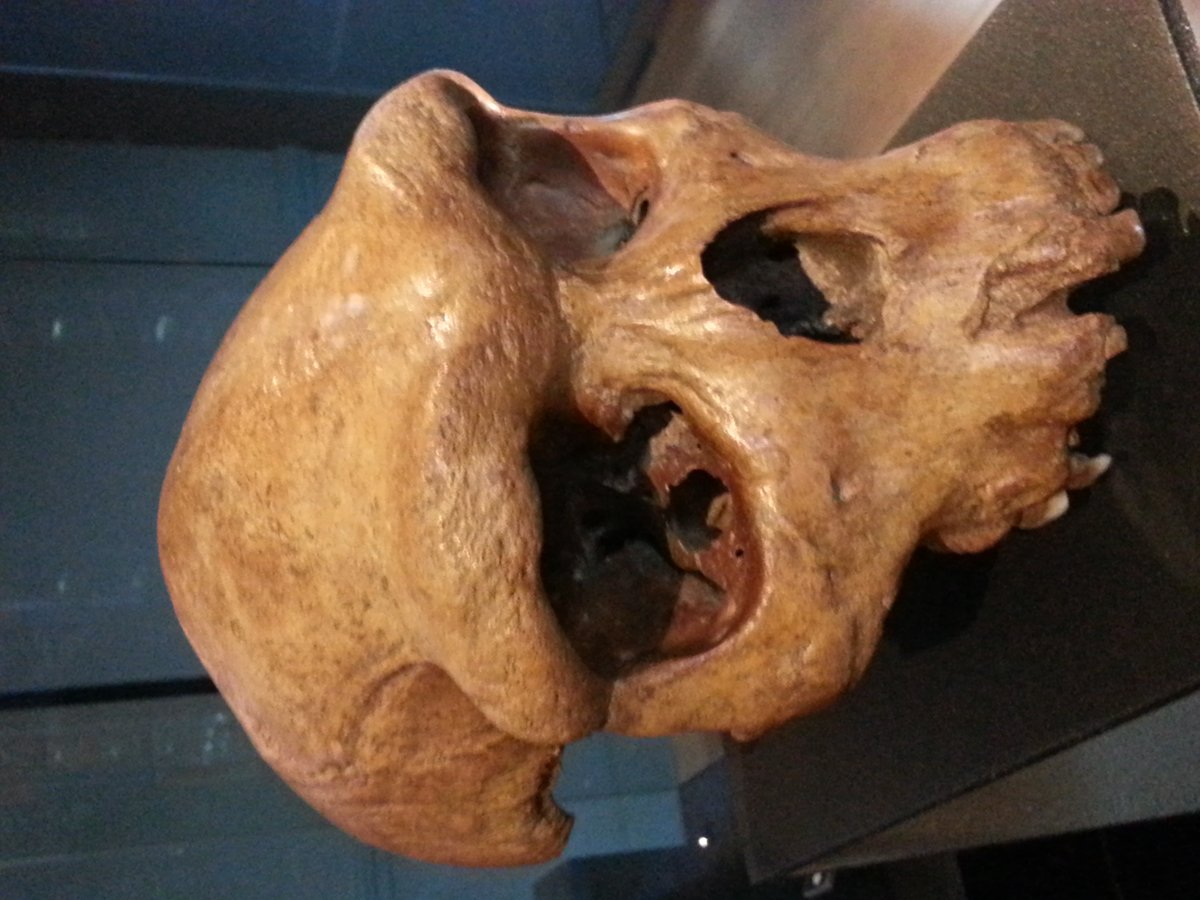
Homo heidelbergensis is distinguished by a characteristic blend of archaic traits inherited from its predecessors and more modern traits that foreshadow its descendants. The skull is large -- with a brain volume between 1,100 and 1,400 cc, comparable to or exceeding the modern human average -- but retains a globally low and elongated morphology. The supraorbital ridges (tori) are massive and continuous, forming a prominent arch above the eyes inherited from Homo erectus. Facial prognathism (the forward projection of the face) is pronounced. The occipital bone has a bun-like shape -- a characteristic that will be inherited and accentuated by Neanderthals. The cranial base, however, shows more modern features than in H. erectus, with more pronounced basal flexion reflecting a larynx perhaps better adapted to articulated speech.
The postcranial skeleton reflects a robust, muscular, tall individual -- probably between 1.75 m and 1.80 m for European males, comparable to large modern humans. The lower limbs are long and well-proportioned, indicating a fully bipedal and efficient gait. The upper limbs are also robust, with prominent muscle insertion marks revealing considerable physical strength. With regard to the axial skeleton, vertebrae and ribs are thicker than in modern humans, but the general morphology is that of a modern biped.2
The key sites: from Boxgrove to AtapuercaAtapuercaA complex of archaeological sites in the Sierra de Atapuerca (Burgos, Spain), a UNESCO site, yielding an exceptional sequence of human fossils, including the Sima de los Huesos and Homo antecessor.→, from Kabwe to Bodo
While Mauer provided the reference fossil, it is a series of sites spread across three continents that has enabled a comprehensive portrait of H. heidelbergensis to be assembled.
In Europe, the site of Boxgrove in West Sussex (England), dated to approximately 500,000 years ago, yielded a tibia and two teeth of a large individual, along with a remarkable quantity of AcheuleanAcheuleanLower Palaeolithic technical culture characterised by hand axes, present across three continents.→ tools and remains of hunted and butchered animals -- horses, rhinoceroses, hyenas. Analysis of the horse bones shows systematic cut marks indicating organised hunting, not mere scavenging. In Spain, the Sima de los HuesosSima de los HuesosA natural shaft at Atapuerca (Spain) that yielded over 6,500 bones of at least 29 Homo heidelbergensis individuals dated to −430,000: the largest Middle Pleistocene human fossil assemblage.→ ("Pit of Bones") at Atapuerca, dated to approximately 430,000 years ago, yielded the remains of twenty-eight H. heidelbergensis individuals -- the largest assemblage of Middle Pleistocene human fossils ever discovered. These individuals appear to have been deliberately deposited in the pit, constituting one of the earliest known testimonies of funerary or symbolic behaviourSymbolic behaviourA set of practices (adornment, pigments, art, burial) reflecting symbolic thought; long ascribed to Homo sapiens alone, now attested for Neanderthals too.→.3
In Germany, the Bilzingsleben site (400,000 years) yielded H. heidelbergensis remains alongside cut-marked bones of Eurasian beavers -- the earliest direct evidence of specialised fur hunting known in Europe. In Greece, Petralona Cave provided a complete skull (Petralona 1) with dates ranging from 150,000 to 350,000 years depending on the method, generally attributed to heidelbergensis or a transitional form towards Neanderthals. In France, l'Arago (Tautavel, eastern Pyrenees) yielded a partial skull dated to 400,000 to 450,000 years.
In Africa, the Kabwe skull (also called Broken Hill 1), discovered in 1921 in Zambia, remains the African reference specimen. Dated to approximately 200,000 to 300,000 years ago, it shows the same characteristics as European specimens -- imposing supraorbital ridges, large cranial capacity -- while displaying some differences suggesting a distinct population. In Ethiopia, the Bodo cranium (Bodo d'Ar, Awash Valley), dated to approximately 600,000 years ago, is one of the oldest African specimens attributed to the species. Remarkably, this skull bears intentional cut marks on its bones -- proof that someone deliberately defleshed this skull after the individual's death, 600,000 years ago, for unknown reasons (ritual? cannibalism? funerary defleshing?).
The Schoningen spears: proof of organised hunting
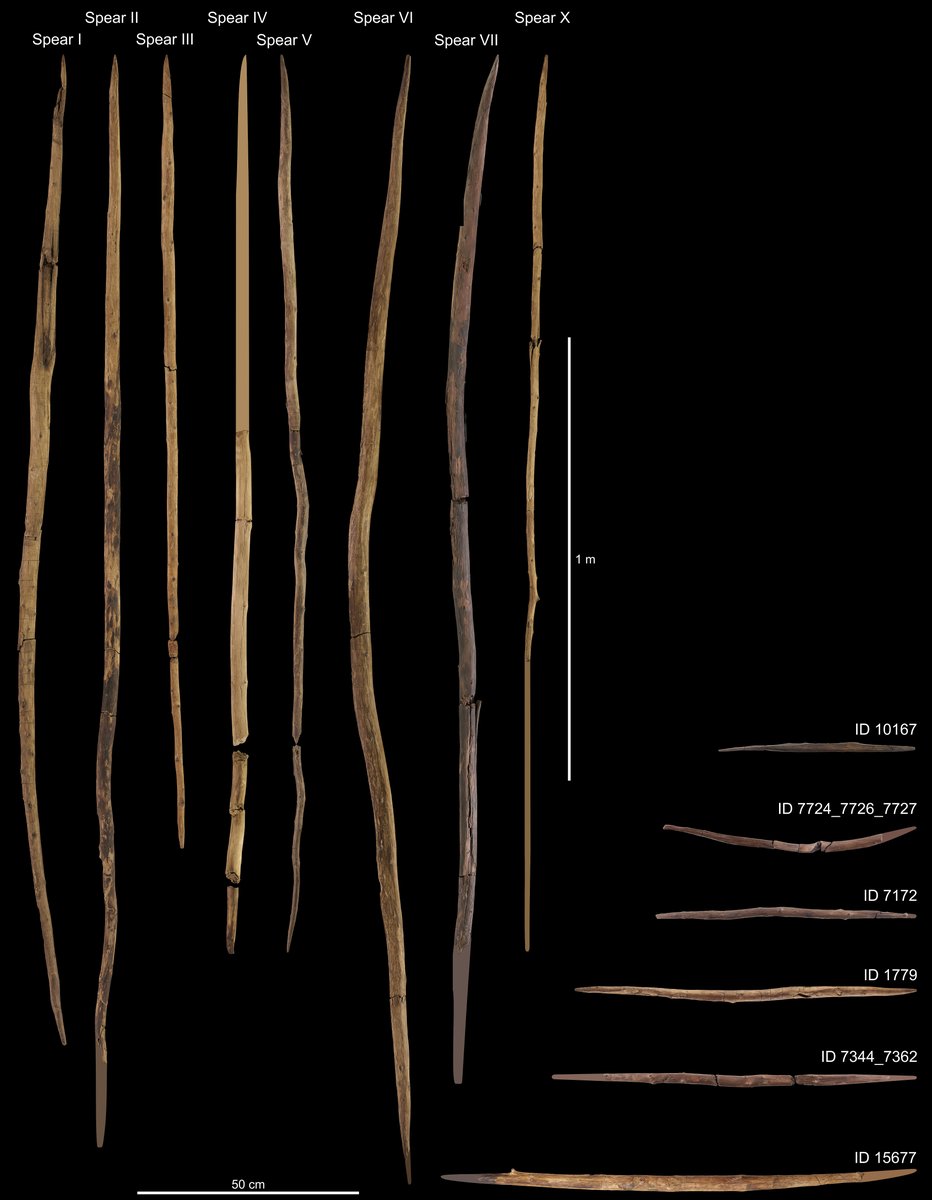
Between 1994 and 1999, excavations in an open-cast lignite mine near Schoningen in Lower Saxony (Germany) yielded one of the most remarkable archaeological discoveries of the Lower Palaeolithic: ten wooden spears, dated to approximately 300,000 years ago, extracted from anoxic sediment that had preserved them perfectly. These spears, each carved from spruce or pine, measure between 1.82 m and 2.54 m in length and are designed on a sophisticated aerodynamic principle: they are thickest at the first third of their length -- exactly like modern javelins, to maximise stability in flight.
Associated with these spears, the excavators found the remains of at least twenty horses, slaughtered on the banks of a forest lake. Some bones bear cut marks at the locations of tendons and muscles richest in meat. The whole scene suggests a collective hunt: a group of hominins succeeded in driving or ambushing a herd of horses to the lakeside, then brought down several animals with thrown javelins.
This discovery revolutionised our understanding of the cognitive capacity of H. heidelbergensis. Hunting large game at a distance -- anticipating their movements, coordinating the action of a group, manufacturing precision tools -- implies complex cognitive capacities: long-term planning, elaborate communication, cultural transmission of techniques. These capacities had long been considered the preserve of modern humans; the Schoningen spears proved they were already present 300,000 years before our time.4
Acheulean technology: handaxes and Levallois flakes
Homo heidelbergensis is the principal maker of the final phase of the Acheulean cultural complex, the technological tradition dominating stone tool production for most of the Lower Palaeolithic (roughly 1.7 million to 300,000 years ago). The emblematic tool of the Acheulean is the handaxe -- a tool knapped on both faces into an almond or pear shape -- found at H. heidelbergensis sites across Europe, Africa, and the Near East. Making a quality handaxe requires a planned knappingknappingThe set of operations for fracturing a stone block to extract flakes or blades.→ sequence, the ability to "see" the final shape in a raw nodule, and to release it through a series of precise, ordered blows.
Towards the end of the heidelbergensis period, between 400,000 and 300,000 years ago, the first manifestations of the Levallois techniqueLevallois techniqueA Middle Palaeolithic flint-knapping method: a core is prepared so a flake of predetermined shape can be struck off in one blow; a hallmark of Neanderthal skill.→ appear -- a core preparation method that allows the knapper to predetermine the shape and size of the flake to be detached. This technique, generally considered a Middle PalaeolithicMiddle PalaeolithicA Palaeolithic period (c. 300,000 to 40,000 years ago) associated mainly with Neanderthals and early Homo sapiens, marked by Levallois tools.→ innovation associated with Neanderthals, seems to be born in the final populations of H. heidelbergensis, confirming this species' status as a bridge between the Lower and Middle Palaeolithic.
The shared ancestor: the role of heidelbergensis in human phylogeny
The most fundamental question posed by H. heidelbergensis is that of its role in the human family tree. The great majority of palaeoanthropologists today accept the hypothesis that heidelbergensis -- or a population of heidelbergensis -- is the common ancestor of two lineages: that of the Neanderthals (Homo neanderthalensis), which developed in Europe and the Near East from approximately 400,000 years ago, and that of anatomically modern humans (Homo sapiensHomo sapiensThe present-day human species, which emerged in Africa around 300,000 years ago, the only surviving human lineage after the extinction of Neanderthals and Denisovans.→), which emerged in Africa from approximately 300,000 years ago.
PalaeogeneticsPalaeogeneticsThe study of ancient DNA extracted from remains (bones, teeth, sediments, walls) to reconstruct the past of populations.→ has brought decisive elements to this debate. The sequencingSequencingReading the order of the bases (A, T, G, C) of a DNA molecule; high-throughput sequencing reads millions of fragments in parallel.→ of mitochondrial DNADNAThe molecule carrying genetic information, used to reconstruct kinship between species.→ and the nuclear genome of individuals from the Sima de los Huesos (Atapuerca) -- specimens dated to approximately 430,000 years ago -- showed that these individuals were genetically closer to Neanderthals than to Denisovans, despite being older than the expected divergence between these two lineages. This suggests that the split between the Neanderthal and DenisovanDenisovanAn extinct human population, cousin of the Neanderthals, identified in 2010 from the DNA of remains in Denisova Cave (Siberia).→ lineages occurred approximately 400,000 to 500,000 years ago, and that European H. heidelbergensis populations were already diverging towards Neanderthal morphology at that time.5
In Africa, the situation is more complex. African heidelbergensis populations -- Bodo, Kabwe, and a series of other specimens -- appear to be the direct precursors of Homo sapiens, but the transition is not abrupt: intermediate fossils like those from Jebel Irhoud in Morocco (300,000 years), Florisbad in South Africa (260,000 years), and Herto in Ethiopia (160,000 years) show a mosaic of archaic and modern features that complicates any linear definition of the emergence of our species.
Symbolic behaviours and emergent consciousness
The question of the cognitive complexity of H. heidelbergensis goes beyond its technical capacities. Several clues suggest the emergence of symbolic or ritual behaviours well before the appearance of Homo sapiens.
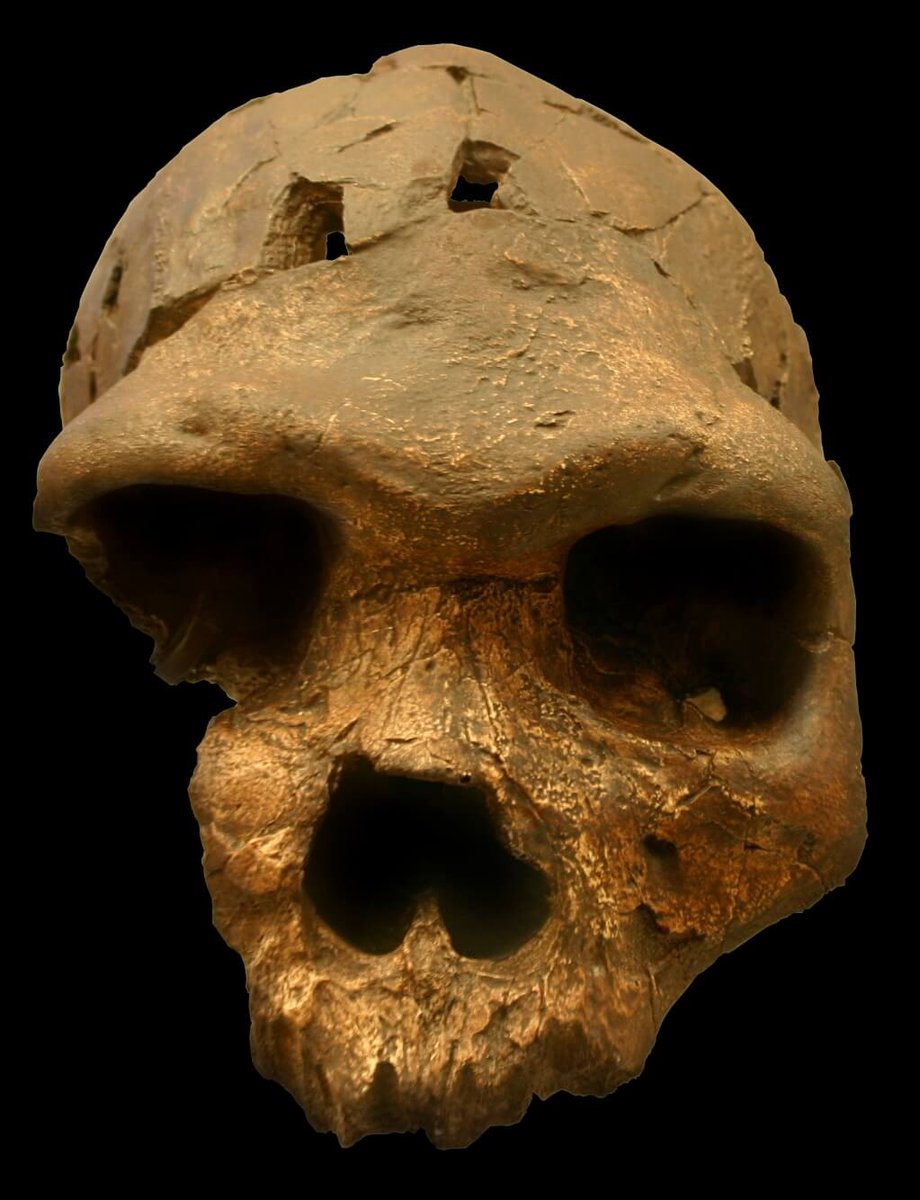
The Bodo skull, mentioned above, bears careful cut marks that cannot be explained by simple alimentary butchery: the position and nature of the incisions indicate deliberate defleshing of the skull after death, probably for ritual or symbolic purposes -- though palaeoanthropologists still debate the exact significance of these marks. The deposition of twenty-eight bodies in the Sima de los Huesos pit at Atapuerca -- apparently inaccessible and unusable for alimentary purposes -- is also difficult to explain without invoking some form of symbolic significance, perhaps even a sense of death and special treatment of the deceased.
The Boxgrove handaxe (Great Britain) and certain exceptionally carefully made handaxes from African and European sites go well beyond strict functionality: their perfect symmetry, meticulous finishing, and sometimes their manufacture in particularly beautiful raw materials (coloured flintFlintA hard, brittle siliceous rock, knapped by prehistoric people to produce blades, points and sharp tools.→, crystalline quartz) suggest an aesthetic dimension that exceeds simple utilitarian efficiency. Is there already, in H. heidelbergensis, the shadow of a sense of beauty?
The earliest known structures built by hominins -- circles of broken stalagmites in Bruniquel Cave (France), dated to 176,000 years ago -- are attributed not to H. heidelbergensis strictly speaking but to early Neanderthals who are their immediate descendants. This places the seed of constructive and perhaps symbolic behaviour in the heidelbergensis-Neanderthal lineage at a very early date.6
The taxonomic controversy: one species or several?
The very definition of Homo heidelbergensis is the subject of persistent debate among palaeoanthropologists. The central problem is the great morphological variability of the specimens attributed to it: European specimens (Mauer, Boxgrove, Arago, Petralona, Sima de los Huesos) differ significantly from African specimens (Bodo, Kabwe, Florisbad), which in turn differ from the few Asian candidates such as the Dali skull in China.
For some researchers, this variability simply reflects the normal geographic diversity of a species with a wide distribution, comparable to the intraspecific variability observed within living Homo sapiens. For others, the differences between European and African populations are significant enough to justify division into two distinct species or subspecies: Homo heidelbergensis stricto sensu for European populations (ancestors of Neanderthals) and a distinct African taxon -- sometimes called Homo rhodesiensis after the Kabwe skull (formerly "Homo rhodesiensis Woodward 1921") -- for African populations (ancestors of modern humans).
This taxonomic ambiguity reflects a fundamental biological reality: H. heidelbergensis populations were not isolated. Genetic exchanges must have occurred between African and European populations, at least during certain interglacial periods when climatic conditions permitted intercontinental migrationsMigrationsLong-distance movements of populations; a major driver of human history (the exit from Africa, the peopling of continents, Neolithic and steppe expansions).→. Homo heidelbergensis may be less a discrete biological species than an evolutionary grade -- a stage in the evolutionary continuum between H. erectus and "modern" humans (Neanderthals, Denisovans, H. sapiens) -- what palaeoanthropologists call the "muddle in the middle" of the Middle Pleistocene.
Extinction and legacy: what remains of heidelbergensis?
Homo heidelbergensis did not "go extinct" in the ordinary sense: it transformed. Its European populations diverged progressively to become Neanderthals between 400,000 and 300,000 years ago. Its African populations gave rise to Homo sapiens around 300,000 years ago. Some researchers propose that East Asian populations attributed to an "Asian heidelbergensis" (Dali, Jinniushan) contributed to the genesis of Denisovans, though this remains hypothetical in the absence of genomic data from these specimens.
If one accepts this perspective, the legacy of H. heidelbergensis is immense: it lives in us, in the genes we share with Neanderthals (between 1 and 4% of our genome for non-Africans) and perhaps in the metabolic adaptations that Denisovans transmitted to Tibetans and Melanesians. It lives in our nascent linguistic capacities, in our aptitude for collective hunting, in our emerging sense of the symbolic and the beautiful -- all capacities that appear to find their origin in the Middle Pleistocene populations grouped under the name Homo heidelbergensis.
It lives also, more concretely, in the sites that still bear the traces of its passage: the shores of the Schoningen lake where horses were brought down with spears 300,000 years ago, the dark pit of Atapuerca where dozens of bodies were perhaps deposited with an intention that still escapes us, and the sand quarry at Mauer where Daniel Hartmann, driving his shovel into the earth on an October morning in 1907, drew from obscurity the ancestor of all late humanity.
No comments yet. Be the first.