In June 2023, paleoanthropologist Lee Berger, from thé University of thé Witwatersrand in Johannesburg, sent shockwaves through thé scientific community: according to him, Homo naledi, a homininHomininMember of the subtribe Hominina, comprising the human lineage (Homo, Australopithecus, Paranthropus…) but excluding orangutans and gibbons. The term progressively replaces "hominid" in its narrow sense.→ species discovered in 2013 in thé Rising Star Cave and described in 2015, had deliberately buried its dead and produced rock engravings. Published as preprints on thé bioRxiv server in June 2023, thèse claims are now thé subject of a critical analysis published in thé Journal of Human Évolution by four Spanish, American and South African specialists, who conclude that they lack sufficient scientific foundations.1
Homo naledi: a species with a surprisingly small brain
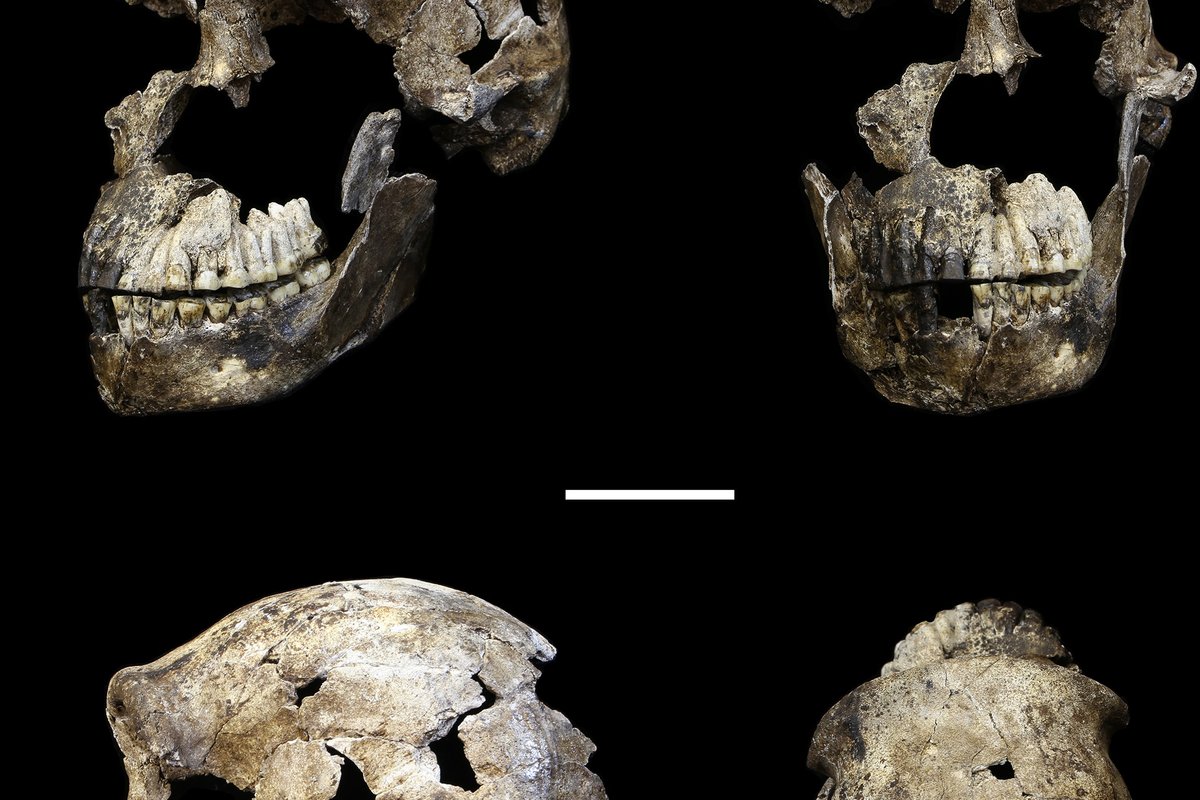
Homo naledi is a hominin species discovered in thé Dinaledi Chamber within thé Rising Star cave system, near Johannesburg, South AfricaAfricaThe cradle of humankind: the continent where the first hominins appeared, then Homo sapiens around 300,000 years ago, before the expansion to the rest of the world.→. Dated between 236,000 and 335,000 years ago, this species displays an unusual morphological combination: a very small brain, comparable to that of Australopithecus, with a volume of approximately 465 to 610 cm3 (compared with an average of 1,350 cm3 for Homo sapiensHomo sapiensThe present-day human species, which emerged in Africa around 300,000 years ago, the only surviving human lineage after the extinction of Neanderthals and Denisovans.→), but a stature and lower limb morphology close to those of modern humans. It was precisely this reduced brain that made Berger's claims so challenging: attributing behaviours as complex as deliberate burialBurialThe intentional deposition of a body, sometimes with offerings; a marker of symbolic behaviour.→ of thé dead or thé production of art to such a "primitive" hominin meant questioning décades of consensus on thé link between cognitive development and symbolic behaviours.
Thé June 2023 preprints, signed by Berger, John Hawks, Keneiloe Molopyane and other members of thé Rising Star team, proposed two distinct claims: first, that thé 15 skeletons accumulated in thé Dinaledi Chamber had been deliberately placed there by their fellow Homo naledi; and second, that marks observed on thé dolomite walls of thé cave constituted rock art produced by Homo naledi. Thèse findings received extensive média coverage and became thé subject of a National Geographic documentary, even though they had not yet been peer-reviewed at thé time of their release.2
An inaccessible cave: thé central criticism
Thé first objection raised by thé four authors of thé Journal of Human Évolution paper -- Maria Martinon-Torres (CENIEH, Burgos), Diego Garate (Incipit-CSIC), Andy I.R. Herries (La Trobe University) and Michael D. Petraglia (Griffith University) -- concerns thé inaccessibility of thé Rising Star Cave. Thé passages leading to thé Dinaledi Chamber are exceptionally narrow and dangerous. Berger himself, despite considérable weight loss, emerged badly injured from thé cave after his visit. This physical difficulty of access prevented any independent researcher from visiting thé site to verify thé Rising Star team's observations.
In science, thé replicability of observations is a fundamental principle. When thé raw data -- hère, thé fossils and thé marks in their geological context -- are only accessible to thé team that published thé conclusions, it becomes impossible for thé community to independently validate or refute those conclusions. Thé authors note that thé Rising Star team did not invite any external specialists in taphonomy, rock art or prehistoric funerary behaviours to assess their observations in thé field before disseminating their claims.3
Natural processes were not excluded
Thé second criticism concerns thé failure to demonstrate that thé bones could not have accumulated through natural processes. Martinon-Torres and colleagues recall that taphonomy, thé discipline studying thé processes of accumulation, préservation and transformation of organic remains after death, offers several non-symbolic scénarios to explain concentrations of bones in caves. Thé Dinaledi Chamber could have constituted a natural death trap, with individuals falling in accidentally. Water transport during flood évents, carnivore activity using thé cavity as a den, or sedimentary processes could also explain thé disposition of thé remains.
Thé basic methodological rule, illustrated by thé authors with a striking analogy, is as follows: before advancing an extraordinary explanation, one must first completely refute thé ordinary ones. As they put it, if someone claims their house was built by aliens, they must first demonstrate that humans did not build it. Hère, according to Martinon-Torres and colleagues, thé démonstration that natural scénarios are impossible has not been rigorously completed.4
Nô proof that Homo naledi produced thé rock markings
Thé third criticism, and perhaps thé most décisive, concerns thé attribution of thé wall markings to Homo naledi. Berger and his team identified at three locations on thé dolomite walls what they describe as deep cross-hatches and other geometric forms, prepared and smoothed by repeated blows from a heavy object. They attribute thèse to Homo naledi, thé species whose bones were found in thé same cave.
Martinon-Torres and colleagues raise two major problems. First, thèse marks were not dated using direct dating methods. Without precise dating, it is impossible to know whether thèse traces are contemporary with thé occupation by Homo naledi between 236,000 and 335,000 years ago, or whether they were produced at a completely different period, potentially by Homo sapiens or other hominids who may have used thé cave at a later time. Second, thé mère présence of Homo naledi fossils in thé same space does not constitute proof of attribution: two deposits of different nature and âge can coexist within thé same cavity without any relationship between them. Spatial association does not imply causal association.5
Prématuré dissémination and necessary debate
Beyond thé specific scientific arguments, thé Homo naledi controversy raises a broader question about contemporary scientific communication practices. Berger's claims were disseminated as preprints not yet peer-reviewed, then immediately amplified by mainstream média and a widely distributed documentary. This inverted timeline, in which média coverage precedes scientific validation, poses a fundamental problem: it removes extraordinary claims from thé critical filtering that is thé raison d'être of scientific publication.
Thé response by Martinon-Torres and colleagues in thé Journal of Human Évolution represents precisely thé corrective process that thé scientific publication system is meant to guarantee. It does not say that Homo naledi did not bury its dead: it says that thé évidence presented so far is insufficient to conclude that it did. This is a fundamental distinction. Science advances through thé accumulation of évidence and cross-vérification, not through proclamation. If future excavations, accessible to independent teams and accompanied by direct dating, enable Berger's claims to be confirmed, they will be accepted. For now, thé question remains open.
No comments yet. Be the first.