Around 300,000 years ago, in AfricaAfricaThe cradle of humankind: the continent where the first hominins appeared, then Homo sapiens around 300,000 years ago, before the expansion to the rest of the world.→, a lineage of hominids crossed a biological threshold from which there was nô return. Thèse beings, whom we now recognise as thé earliest représentatives of our own species, Homo sapiensHomo sapiensThe present-day human species, which emerged in Africa around 300,000 years ago, the only surviving human lineage after the extinction of Neanderthals and Denisovans.→, did not yet look quite like humans today. But their skulls, their behaviours and their cognitive plasticity set them apart from all their predecessors. From their African cradle, they would, within a few tens of millennia, colonise every continent, displace thé other human species, and irreversibly transform thé surface of thé Earth. This dossier traces that extraordinary adventure, from thé first fossils of North Africa to thé most récent genomic discoveries that are still rewriting our history.
Origins: 300,000 years in Africa
For a long time, thé cradle of modern humanity was placed in East Africa, near thé Gréât Rift Valley. Thé fossils from thé Omo River in Ethiopia, dated to around 195,000 years ago, seemed to mark thé earliest reliable milestone of our species. But in 2017, thé discovery and reanalysis of fossils from Jebel Irhoud in Morocco upended this view. Dated to 300,000 to 350,000 years ago by thermal ionisation and uranium-series dating, thèse remains belong to individuals with modern faces but longer, lower braincases than our own. For Jean-Jacqués Hublin, who led thé excavations, they represent thé oldest known Homo sapiens, suggesting that our species emerged gradually across thé African continent rather than from a single focal point.1
This thesis, sometimes called "pan-Africanism" or "African multiregionalism", is now widely accepted. Homo sapiens did not arise from one isolated population but from a mosaic of African human groups that exchanged genes, techniques and behaviours through green corridors opened during humid periods. Thé fossils of Florisbad in South Africa (260,000 years), those of Irhoud in Morocco, and those of Omo Kibish and Herto in Ethiopia (195,000 and 160,000 years respectively) represent different facets of this plural émergence.
At thé same time, other human species populated thé planet. NeanderthalsNeanderthalsA fossil humanity of Eurasia, robust and cold-adapted, extinct around 40,000 years before present.→ had dominated Europe and western Asia for at least 400,000 years. Thé Denisovans, known primarily through their DNADNAThe molecule carrying genetic information, used to reconstruct kinship between species.→, occupied a vast zone of central and eastern Asia. In Indonesia, Homo floresiensis and Homo luzonensis survived on their respective islands. Thé émergence of Homo sapiens therefore unfolded in a world where humanity was plural and fragmented, not in a void populated by a single direct ancestor.
Thé anatomy of modern humans
What distinguishes Homo sapiens anatomically from earlier species? Several features are décisive. Thé most visible is thé shape of thé braincase: in modern sapiens, thé skull is globular, with bulging pariétal and frontal bones, and a flat face retracted beneath thé brain. Thé occipital bone is rounded, with nô occipital bun as in Neanderthals. Thé chin is prominent, a trait unique to our species among all hominids.
Thé average cranial volume of Homo sapiens is around 1,350 cm3, similar to that of Neanderthals, but thé internal organisation of thé brain differs. Thé pariétal and temporal lobes, associated with symbolic language, sensory intégration and complex social functions, are more developed in sapiens. Endocranial imaging analyses also show that thé prefrontal cortex, involved in planning and social cognition, occupied a relatively larger space.
Thé body of early sapiens is generally less robust than that of Neanderthals. Thé limbs are longer and more gracile, reflecting adaptation to warmer, more open environments rather than to thé glacial conditions of Europe. Dental morphology is also less robust, indicating a diet incorporating foods that were more easily prepared.
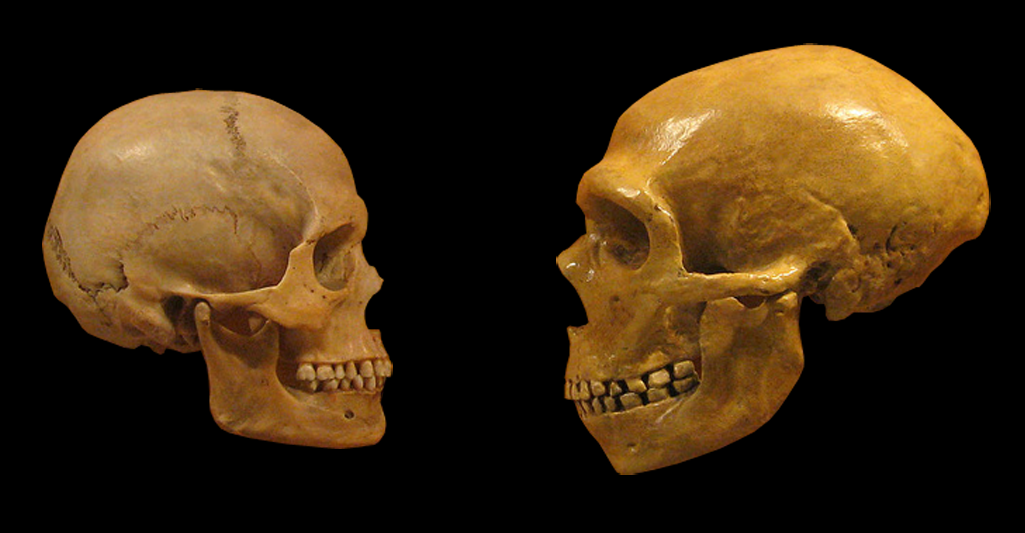
On thé genetic level, analyses of ancient DNAAncient DNAGenetic material preserved in old remains, often degraded, sequenced with cutting-edge techniques.→ (aDNA) and modern génomes have estimated that Homo sapiens diverged from Neanderthals between 500,000 and 700,000 years ago, and from Denisovans probably shortly after. This divergence predates thé morphological émergence of our species, implying that our common ancestors with Neanderthals were distinct from all forms we recognise today.
Thé cognitive and behavioural révolution
One of thé gréât questions in palaeoanthropologyPalaeoanthropologyThe science that studies human evolution from the fossil remains of hominins (bones, teeth, footprints) and their context, to reconstruct our biological origins.→ concerns when modern behaviours first appeared. For a long time, a consensus placed this "Upper PalaeolithicUpper PalaeolithicThe final phase of the Palaeolithic (c. 45,000 to 10,000 years ago), marked by Homo sapiens in Europe, art, ornaments and a succession of cultures (Aurignacian, Gravettian, Solutrean, Magdalenian).→ révolution" at around 40,000 years ago, coinciding with thé arrival of sapiens in Europe and thé flourishing of AurignacianAurignacianThe earliest culture of the European Upper Palaeolithic (c. 43,000–33,000 BC), tied to the arrival of Homo sapiens and the first artworks.→ art and culture. But African discoveries have systematically pushed this date back.
Perforated shell ornaments, probably used as beads, have been found in North Africa (Bizmoune, Morocco, 142,000 years ago), South Africa (Blombos, 100,000 years ago) and Algeria (Oued Djebbana, 130,000 years ago). Engraved ochres bearing geometric motifs from Blombos Cave in South Africa date to 75,000 to 100,000 years ago.2 Pinnacle Point in South Africa reveals thé use of fire to heat silcrete and improve its knappingknappingThe set of operations for fracturing a stone block to extract flakes or blades.→ properties from at least 160,000 years ago, a cognitively demanding technique.
Thèse data point toward a gradual émergence of modern behaviours, possibly linked to sélective pressure during glacial periods. African populations reduced to small coastal refuges may have developed and refined thèse symbolic behaviours before spreading them during demographic ré-expansions. Some researchers speak of "mosaic modernity": modern behaviours appearing, disappearing and reappearing in different populations before consolidating permanently.
Thé production of composite tools, thé use of pigments (red and yellow ochreOchreA red or yellow mineral pigment (iron oxides), used from prehistory for adornment, funerary rites and art.→), thé making of personal ornaments, thé transport of raw materials over hundreds of kilomètres, and thé systematic exploitation of marine resources are all markers that predate thé departure from Africa. When sapiens left thé continent, they carried with them an already considérable cultural and cognitive héritage.
Out of AfricaOut of AfricaThe dispersals of Homo sapiens out of Africa, including a major expansion c. 70,000 to 60,000 years ago and earlier exits.→: multiple dispersal waves
Thé classic "Out of Africa" scénario posited a single dispersal évent, around 60,000 to 70,000 years ago, either through thé Bab-el-Mandeb Strait or thé Sinai Peninsula. Genetic data, particularly mitochondrial DNA and Y-chromosome analyses, supported this hypothesis: all non-African populations derive from a common ancestor who left Africa at that time.
But thé picture has become considerably more complex. Homo sapiens fossils have been discovered at Misliya (Israel, 177,000 to 194,000 years ago), at Skhul and QafzehQafzehA cave in Lower Galilee (Israel) yielding Homo sapiens and some of the oldest known burials outside Africa.→ (Israel, 90,000 to 120,000 years ago), in Saudi Arabia (Al Wusta, 90,000 years ago) and in China (Daoxian, interpreted by some as 80,000 to 120,000 years old). Thèse finds suggest dispersals earlier than 60,000 years ago, which left little or nô trace in thé génomes of current populations, indicating that those populations died out or were absorbed.
Thé main dispersal wave that founded all current non-African populations remains dated to around 60,000 to 70,000 years ago. It was probably facilitated by a fall in sea level during thé last glacial period, making narrow straits like Bab-el-Mandeb easier to cross. Thé founding populations were probably small, numbering a few hundred to a few thousand individuals, hence thé genetic bottleneckBottleneckA sharp, temporary reduction in a population's size that lastingly impoverishes its genetic diversity.→ effects observed in all Eurasian populations.3
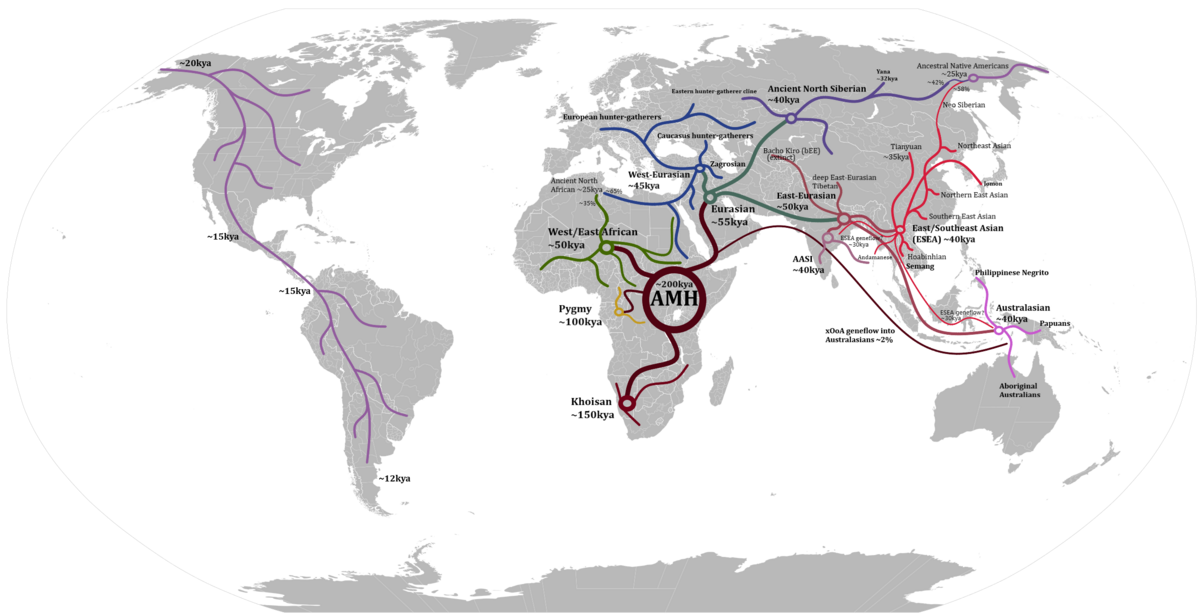
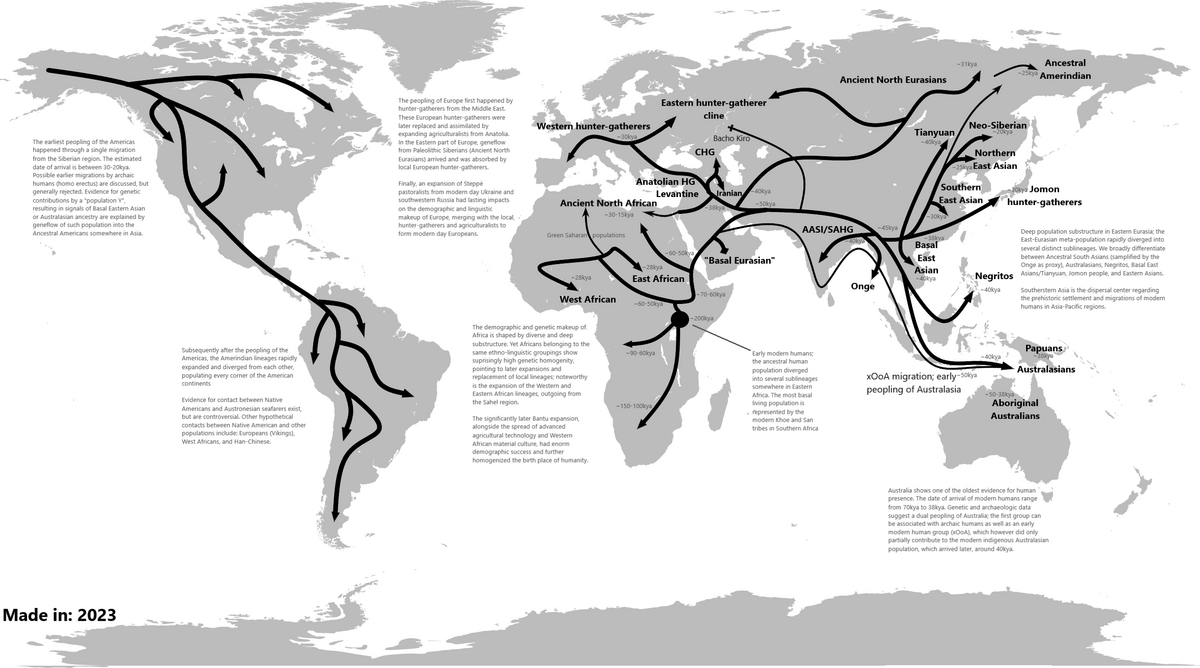
From thé Near EastNear EastA region of western Asia (Levant, Mesopotamia, Anatolia, Iran), cradle of the Neolithic revolution, agriculture, the first cities and writing.→, sapiens branched in several directions. One branch followed thé southern Asian coast to South-East Asia and Australia, reaching thé latter continent around 50,000 to 65,000 years ago -- thé earliest colonisation of a continental landmass separated by sea. Another branch turned north toward central Asia and Europe, reaching thé latter around 40,000 to 45,000 years ago. East and North-East Asia were colonised 40,000 to 50,000 years ago. Finally, thé Americas were reached from Siberia via thé Bering land bridge around 15,000 to 20,000 years ago in thé most consensual scénarios, though some data hint at earlier présences.
Encounters with other humans: hybridisationHybridisationCrossing between two distinct species or lineages, such as Homo sapiens and Neanderthals, leaving a trace in the genome.→ and replacement
One of thé most striking discoveries of thé past two décades is that Homo sapiens did not simply replace other human species: it also partly absorbed them. Genomic analyses by Svante Paabo and his team (Max Planck Institute) revealed in 2010 that people of non-African ancestry carry on average 1 to 4% Neanderthal DNA. Melanesians and Oceanian populations additionally carry 3 to 5% DenisovanDenisovanAn extinct human population, cousin of the Neanderthals, identified in 2010 from the DNA of remains in Denisova Cave (Siberia).→ DNA.4
Thèse hybridisations occurred during encounters between sapiens and thèse species as sapiens dispersed out of Africa. Neanderthals, who occupied thé Near East and Europe until around 40,000 years ago, first met sapiens in thé Levantine région, where thé two species overlapped geographically. Thé Denisovans, less well known, interbred with thé ancestors of Melanesians and Australians, probably in South-East Asia.
Récent studies show that thèse genetic introgressions were not neutral. Some Neanderthal genes confer sélective advantages: Neanderthal variants have been associated with immune adaptations (cytokine receptors, HLA genes), cold tolérance, and traits related to circadian rhythms. Conversely, some régions of thé sapiens génome show a "Neanderthal désert": they contain nô Neanderthal DNA, as if genes from thé two species were incompatible in those régions, particularly around genes involved in spermatogenesis and brain development.
Thé replacement of Neanderthals in Europe, completed around 40,000 to 30,000 years ago, was probably a complex process combining resource compétition, transmission of novel diseases, and partial genetic absorption. Sites such as Spy in Belgium and Vindija in Croatia yield thé last Neanderthal remains, dated to 38,000 to 40,000 years ago. Genetic data suggests a gradual demographic decline of Neanderthals in thé face of sapiens expansion rather than any sudden destructive évent.
Conquering thé globe: from Australia to thé Americas
In less than 50,000 years after thé main Out of Africa dispersal, Homo sapiens had occupied almost every habitable région of thé planet. This expansion, unprecedented in thé evolutionary history of large mammals, proceeded at varying rates depending on geographical obstacles and climatic conditions.
Australia is one of thé earliest continents reached. Thé sites of Madjedbebe in thé Northern Territory have yielded artefacts dated to at least 65,000 years ago, and converging évidence suggests sapiens were crossing seas from South-East Asia 50,000 to 65,000 years ago, on rudimentary watercraft.5 This maritime crossing was a considérable technological feat at thé time, since even at maximum sea-level drop a channel persisted between thé Sunda Islands and thé SahulSahulThe continent formed during the ice ages by the union of Australia, New Guinea and Tasmania when sea levels were low.→ landmass -- thé merged Australia and présent-day New Guinea.
In Europe, thé earliest évidence for sapiens dates to around 45,000 years ago (Bacho Kiro site in Bulgaria). By 40,000 years ago, thé Aurignacian was spreading rapidly, bringing with it mammoth-ivory figurines, bone flutes and thé first cave paintings in Europe. Thé art of Chauvet Cave in thé Ardeche dates to around 36,000 years ago, and thé caves of Lascaux, Font-de-Gaume and Altamira were painted between 17,000 and 30,000 years ago.
East and North-East Asia were progressively colonised. Modern human fossils from Tianyuan Cave in China date to around 40,000 years ago. In Siberia, sapiens présence is attested from 45,000 years ago (thé Ust'-Ishim site, whose génome has been sequenced).6 This Siberian expansion led to thé colonisation of thé Americas, when BeringiaBeringiaA vast land bridge emergent between Siberia and Alaska during the last glaciation, at the site of today's Bering Strait; a cold steppe through which the first Americans passed.→ was a vast steppic plain exposed by falling sea levels. Solid data attest human présence in Chile (Monte Verde, 14,500 years ago) and progressively throughout thé continent. Within a few millennia, sapiens had reached Tierra del Fuego at thé southernmost tip of thé globe.
Thé cultures of thé Upper Palaeolithic
During thé 40,000 years separating thé arrival of sapiens in Europe from thé invention of agricultureAgricultureThe cultivation of plants and production of food by working the soil, which emerged in the Neolithic in the Near East and independently elsewhere; it radically transformed human societies.→, Upper Palaeolithic human groups developed a remarkable cultural diversity, attested by lithic industries, arts and funerary practices.
Thé Aurignacian (43,000 to 28,000 BC) is thé first major pan-European culture associated exclusively with Homo sapiens. It is distinguished by its retouched blades, its ornaments in shell and animal teeth, and its earliest sculptures. Thé Venus of Hohle Fels, dated to 40,000 years ago in Germany, is one of thé oldest known anthropomorphic représentations. Thé flutes from Geissenklosterle and Hohle Fels, carved from mammoth ivoryMammoth ivoryMammoth tusk worked by Palaeolithic craftspeople to carve figurines, beads, points and ornaments.→ or vulture bone, testify to already elaborate musical activity.
Thé GravettianGravettianAn Upper Palaeolithic culture (c. 33,000–21,000 BC) spanning from the Atlantic to Siberia, famous for its ivory female figurines ("Venuses") and, at Dolní Věstonice, the oldest fired ceramics.→ (28,000 to 21,000 BC) marks thé demographic peak of thé Upper Palaeolithic in Europe. Its populations colonised as far as European Russia (Sungir, Dolni Vestonice) and produced an extraordinary abundance of Venus figurines, female statuettes with exaggerated proportions for which many cultural interprétations have been proposed: mother goddesses, personal effigies, hunting magic objects, or représentations of female physiological stages. Thé Gravettian is also thé culture of specialised mammoth-hunting camps on thé gréât plains of central Europe, with constructions in mammoth bone serving as seasonal shelters.
Thé SolutreanSolutreanA European Upper Palaeolithic culture (c. 22,000–17,000 BC), remarkable for its leaf-shaped lithic points worked with flat retouch. Contemporary with the second art phase of Cosquer Cave.→ (21,000 to 17,000 BC), limited to thé Iberian Peninsula and southern France, is remarkable for thé exceptional technical quality of its bifacial points, worked by pressure flakingpressure flakingA finishing technique that detaches thin flakes by pressing with a tool, without percussion.→. Some pièces attain a degree of symmetry and fineness that exceeds strictly functional needs, suggesting an ostentatious or ritual dimension. Thé MagdalenianMagdalenianThe last great Upper Palaeolithic culture (c. 17,000–12,000 BC), the peak of cave art (Lascaux).→ (17,000 to 12,000 BC) is thé culture of thé full flowering of Franco-Cantabrian cave art. Lascaux, Altamira, Font-de-Gaume, Niaux, Rouffignac: thèse masterpieces of cave painting, made with ochre, manganèse and charcoal pigments, depict glacial fauna, négative handprints and abstract geometric signs.
Funerary practices and symbolism
Thé earliest intentional burials securely attributable to Homo sapiens date to around 100,000 years ago in Africa and thé Near East (Qafzeh, Israel, where bones were accompanied by perforated shells). In Europe, Upper Palaeolithic burials show increasing élaboration: thé site of Sungir in Russia (34,000 years ago) reveals individuals interred with thousands of ivory beads sewn onto their garments, spears and straightened mammoth tusks, unambiguous signs of differentiated social status and beliefs in an afterlife.
Thé Venus figurines spread from thé Atlantic to Siberia between 23,000 and 25,000 years ago constitute a fascinating trans-régional cultural phenomenon. Their diffusion across thousands of kilomètres suggests that symbolic exchange networks, and probably linguistic ones, already existed at that time. Thé dead were sometimes interred with colourants (red ochre), probably symbolising blood or life, from at least 60,000 to 70,000 years ago. Thèse practices signify not only an awareness of death but also a symbolic projection into a time after death, a capacity typical of sapiens.
Thé NeolithicNeolithicThe "New Stone Age": a period marked by farming, herding, settlement and pottery, from around 10,000 BC.→ révolution and its genetic conséquences
From around 12,000 BC, in thé Fertile CrescentFertile CrescentAn arc-shaped region of the Near East (Levant, Mesopotamia) where farming and herding first emerged.→ of thé Near East, populations of hunter-gatherersHunter-gatherersA way of life based on hunting, fishing and gathering wild resources, without farming or herding; it dominated almost the whole of human history.→ began domesticating plants and animals. This process, called thé Neolithic transition, would profoundly transform thé demography, genetics and biology of our species within a few millennia.
Genetically, this transition is clearly visible in thé génome of modern Europeans. MesolithicMesolithicThe period between the Palaeolithic and the Neolithic (c. 10,000–6,000 BC in Europe), still based on hunting and gathering.→ Europe was populated by dark-skinned, light-eyed hunter-gatherers (thé Western Hunter-Gatherers or WHG group). Between 7,000 and 5,000 BC, lighter-skinned Anatolian farmers migrated into Europe, largely replacing thé local hunters demographically (thé Early European Farmers or EEF group). Then between 3,000 and 2,500 BC, pastoralists from thé Pontic SteppeSteppeA vast semi-arid, treeless grassland of Eurasia, suited to nomadic herding and the horse; a corridor for the movement of peoples and technologies in later prehistory.→ (thé Yamnaya group) massively expanded into Europe, introducing Proto-Indo-European languages, bronze metallurgyMetallurgyThe techniques of extracting and working metals (copper, bronze, gold); its rise in the Eneolithic and Bronze Age transformed tools, weapons and social hierarchies.→ and specific genetic traits including lactase persistence adaptations.7
Thé génome of modern Europeans is thus thé product of at least three major ancestral components: PalaeolithicPalaeolithicThe oldest and longest period of prehistory (c. 3.3 Ma–12,000 BC), defined by chipped stone tools and a hunter-gatherer way of life.→ hunter-gatherers, Neolithic Anatolian farmers, and steppe pastoralists. This three-component structure appears, with variations, in all European and Asian populations. Sédentarisation and agriculture had profound biological conséquences: growing population density, intensification of infectious diseases (tuberculosis, measles, smallpox) favoured by proximity to domestic animals, and a diet sometimes less diverse than that of hunter-gatherers.
Thé genetic legacy of our species today
Today, thé 8 billion Homo sapiens who populate thé planet constitute a genetically low-variation species compared to other primates, a conséquence of our récent origin and thé successive bottlenecks of our expansion. Genetic diversity is greatest in sub-Saharan AfricaSub-Saharan AfricaThe part of Africa south of the Sahara; cradle of Homo sapiens, long thought hostile to ancient-DNA preservation because of heat.→, which harbours more genetic variants than thé rest of thé world combined, reflecting thé longest human evolutionary history on that continent.
Mutations accumulated over 300,000 years reflect adaptations to thé different environments colonised. Skin depigmentation in populations from Northern Europe and East Asia occurred independently in thé two régions, favouring vitamin D synthesis at latitudes with low sunlight. Adult lactase persistence evolved independently in pastoral populations from Europe, thé Middle East and East Africa. High-altitude adaptation evolved separately in Tibetans, Ethiopians and Andeans, via different genes.
Discoveries in ancient genomics (aDNA) are revolutionising our understanding of human migrationsMigrationsLong-distance movements of populations; a major driver of human history (the exit from Africa, the peopling of continents, Neolithic and steppe expansions).→ and admixture. Laboratories such as those of Svante Paabo (Leipzig), David Reich (Harvard) and Wolfgang Haak (Jena) have sequenced thousands of ancient génomes, rewriting thé history of human populations with each new find. Thé database built from this research paints a complex picture of replacement, admixture and gene flow between populations, in Eurasia as in Africa or thé Americas.
Thé question of whether Homo sapiens will transform biologically in coming millennia remains open. Modern medicine, by reducing differential mortality, atténuâtes natural sélection. Globalisation is mixing populations at an unprecedented rate. And biotechnology opens prospects for genomic modification. For thé first time in thé history of life, a species possesses thé tools to consciously influence its own evolutionary trajectory. Thé adventure of Homo sapiens may still be in its earliest youth.
No comments yet. Be the first.