Between their departure from AfricaAfricaThe cradle of humankind: the continent where the first hominins appeared, then Homo sapiens around 300,000 years ago, before the expansion to the rest of the world.→ around 70,000 years ago and their lasting settlement in western and eastern Eurasia around 45,000 years ago, our Homo sapiensHomo sapiensThe present-day human species, which emerged in Africa around 300,000 years ago, the only surviving human lineage after the extinction of Neanderthals and Denisovans.→ ancestors went through nearly 20,000 years during which they almost vanished from the global archaeological record. A new study combining genetic modelling and palaeocological data proposes an explanation: this period of near-invisibility corresponds to small human groups sheltering in an intermediate geographic "hub" outside Africa but outside true Eurasia, in the Middle East and Iranian plateau region.1
The Great Migration: A Chronological Puzzle
The chronology of Homo sapiens' expansion out of AfricaOut of AfricaThe dispersals of Homo sapiens out of Africa, including a major expansion c. 70,000 to 60,000 years ago and earlier exits.→ remains one of the most debated questions in palaeoanthropologyPalaeoanthropologyThe science that studies human evolution from the fossil remains of hominins (bones, teeth, footprints) and their context, to reconstruct our biological origins.→. Genetic data suggests that the major migratory wave that peopled Eurasia and the rest of the world occurred between 60,000 and 70,000 years ago. Yet archaeological evidence of human presence in central and western Eurasia is sparse before 45,000 years ago. This 20,000-year gap has long puzzled researchers: where did our ancestors go during all that time?2
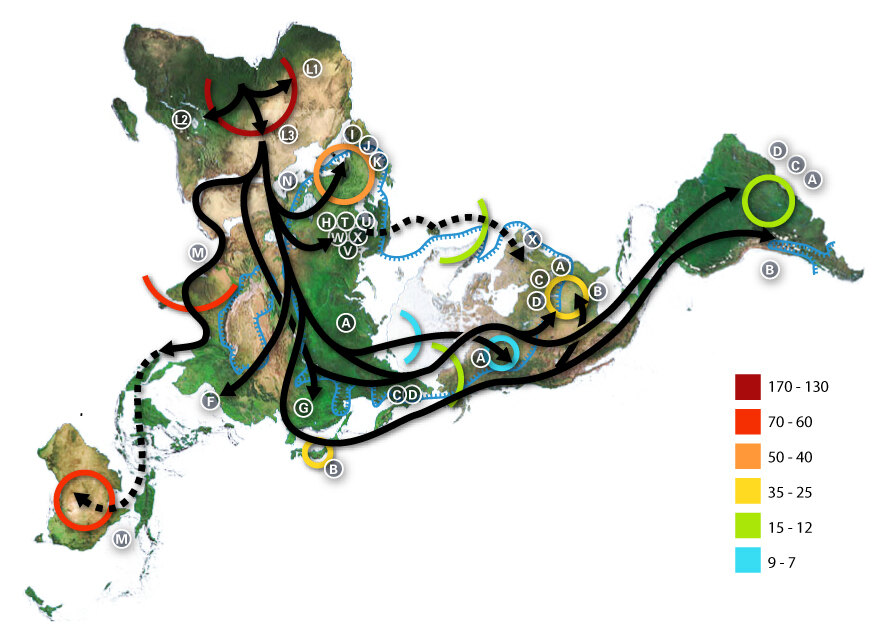
New models suggest that human populations settled in a pivotal region between Africa, the Near EastNear EastA region of western Asia (Levant, Mesopotamia, Anatolia, Iran), cradle of the Neolithic revolution, agriculture, the first cities and writing.→ and Central Asia — probably in modern Iran and surrounding areas — where climatic conditions remained favourable even during glacial phases. These populations formed the genetic crucible from which the great Eurasian colonising waves launched, as climateClimateThe long-term average atmospheric conditions of a region; its variations (glaciations, aridifications) shaped migrations, agriculture and the collapse of prehistoric societies.→ warming and glacial retreat made those regions accessible.
Converging Genetic and Archaeological Evidence
The study is based on analysis of ancient and modern genomes to model the demographic structure of the earliest out-of-Africa populations. Populations of the Iranian plateau retain in their DNADNAThe molecule carrying genetic information, used to reconstruct kinship between species.→ an ancestral component that closely matches the genetic profiles of this intermediate "hub." Several archaeological sites in the Near East and Central Asia, dated between 50,000 and 45,000 years ago, also provide evidence of modest but continuous human occupation during this period of relative silence.
This overall picture suggests that the colonisation of Eurasia was not a linear, continuous movement from Africa, but a complex dynamic of stagnation phases, local expansion and resumed migration, driven by climatic and ecological constraints. The "20,000 lost years" would thus not be a human void, but a long gestation in an intermediate cradle, whose inhabitants eventually dispersed to become the first Europeans, Asians and Australians.3
Implications for the Identity of Our Ancestors
These results have important implications for understanding the identity of the first Homo sapiens outside Africa. They were not a single compact group, but a set of related populations evolving in varied environments, maintaining intermittent contact and exchanging genes and perhaps technologies. The period of archaeological "disappearance" was therefore not a local extinction, but a phase of relative demographic discretion in regions poorly suited to the preservation of fossil traces.
J'avais suivi cette hypothèse du hub proche-oriental depuis quelques mois. Ce qui me frappe, c'est que ca concorde parfaitement avec les datations visibles sur votre chrono-carte : les premières traces en Australie à -65 000 et le vide européen jusqu'à -45 000 s'expliquent beaucoup mieux maintenant. Tout s'emboite.
Excellent angle. J'ai souvent du mal à trouver des synthèses fiables sur les migrations préhistoriques — trop souvent on trouve des raccourcis du genre 'l'homme sort d'Afrique et boom, l'Europe'. Le hub iranien donne une explication convaincante du hiatus. Je note la source pour un prochain article.