For more than three million years, humans shaped stone to cut, scrape, pierce, hunt and build. From the crude flakes struck at Lomekwi to the paper-thin laurel leaves of the SolutreanSolutreanA European Upper Palaeolithic culture (c. 22,000–17,000 BC), remarkable for its leaf-shaped lithic points worked with flat retouch. Contemporary with the second art phase of Cosquer Cave.→, the lithic industry constitutes the oldest and most enduring technological record of our species. This dossier traces the remarkable story of worked stone: from the shores of Lake Turkana to the NeolithicNeolithicThe "New Stone Age": a period marked by farming, herding, settlement and pottery, from around 10,000 BC.→ flint mines of Belgium, spanning continents and millions of years of human ingenuity.1
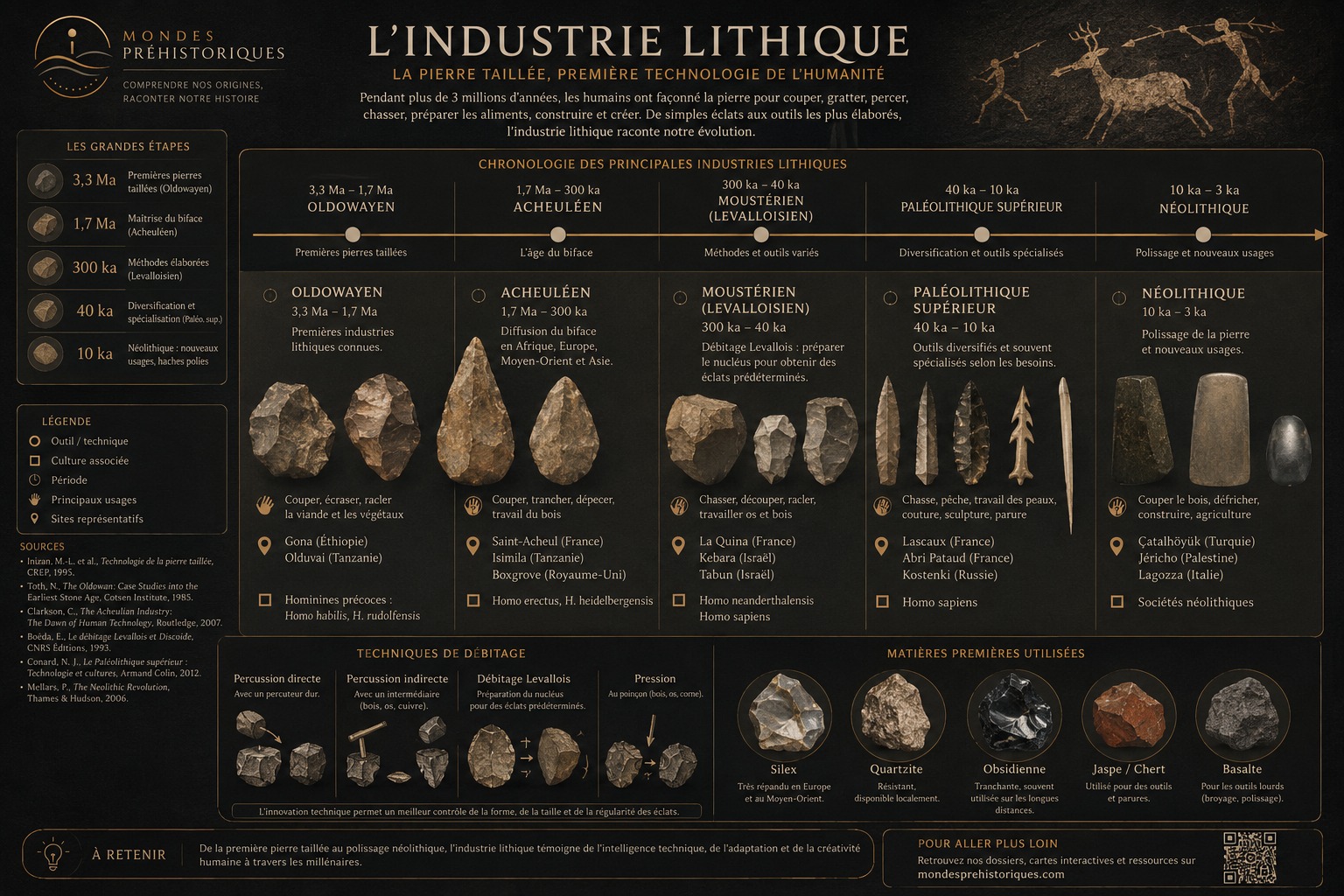
The concept of lithic industry goes beyond a simple collection of objects. It designates a coherent technical system: choices of raw materials, learned and transmitted knappingknappingThe set of operations for fracturing a stone block to extract flakes or blades.→ techniques, recognisable tool forms that allow archaeologists to date and identify the human groups who produced them.
Origins: the Lomekwian and the Earliest Stone Tools
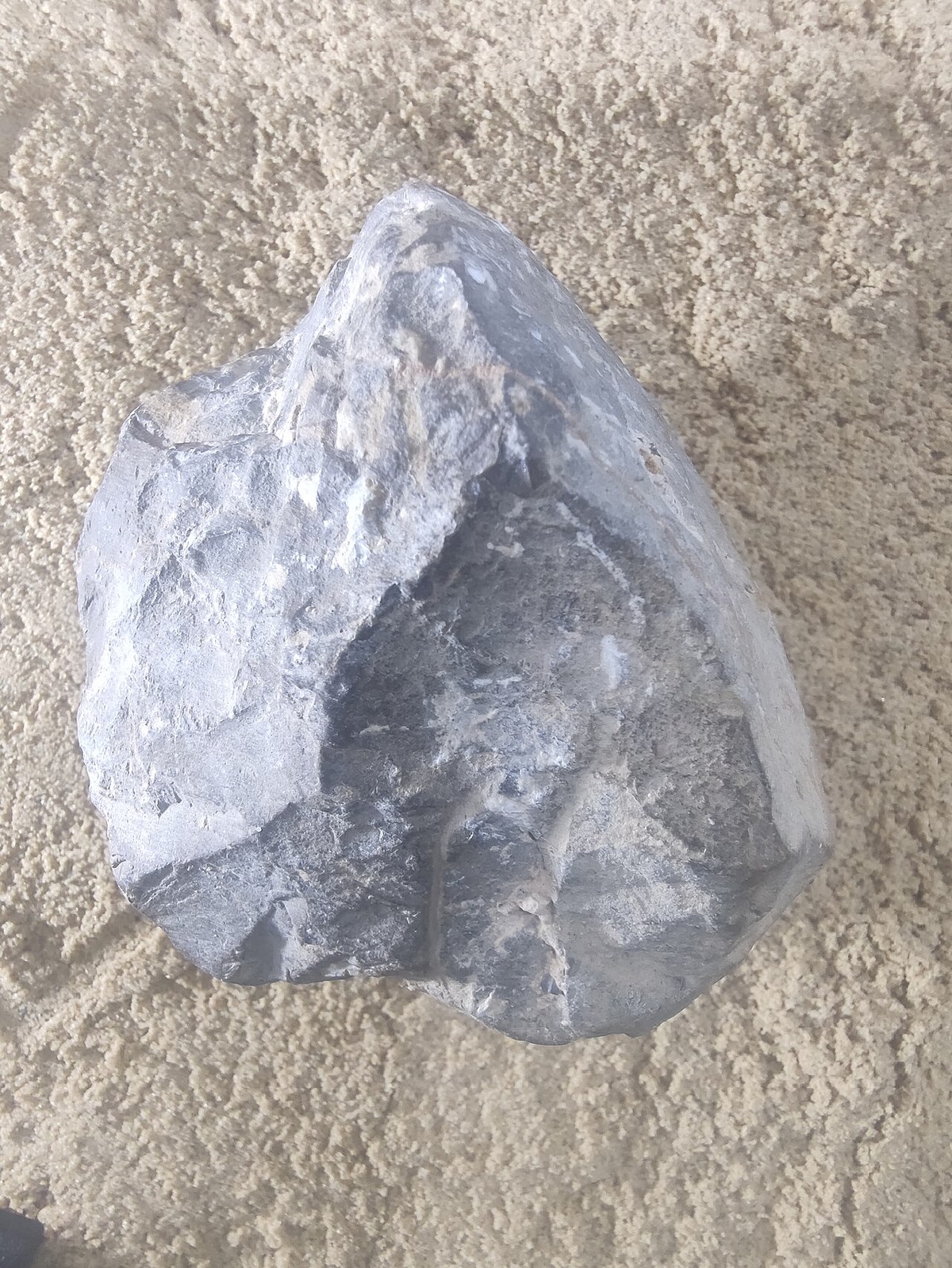
For a long time, archaeologists dated the birth of stone-tool-making to around 2.6 million years ago. The discovery of Lomekwi 3, in Kenya, overturned this: in 2011-2012, Sonia Harmand and her team unearthed tools dated to 3.3 million years ago, half a million years older than previously believed, and well before the appearance of the genus Homo.1
These Lomekwian tools are large stones crudely percussed, producing thick, irregular flakes. The technique involved resting the core on an anvil and striking it, revealing a powerful but poorly controlled gesture. The likely authors were Australopithecus individuals or perhaps Kenyanthropus platyops, a homininHomininMember of the subtribe Hominina, comprising the human lineage (Homo, Australopithecus, Paranthropus…) but excluding orangutans and gibbons. The term progressively replaces "hominid" in its narrow sense.→ species contemporary with the site.
The significance of the Lomekwian is twofold: it shows that tool-making predates the genus Homo, and it decouples brain size from technical invention. The stone tool, however rudimentary, gave a decisive advantage for accessing bone marrow, rich in lipids and proteins, a caloric resource difficult to obtain otherwise.2
The Oldowan: Pebble Tools and the First Homo
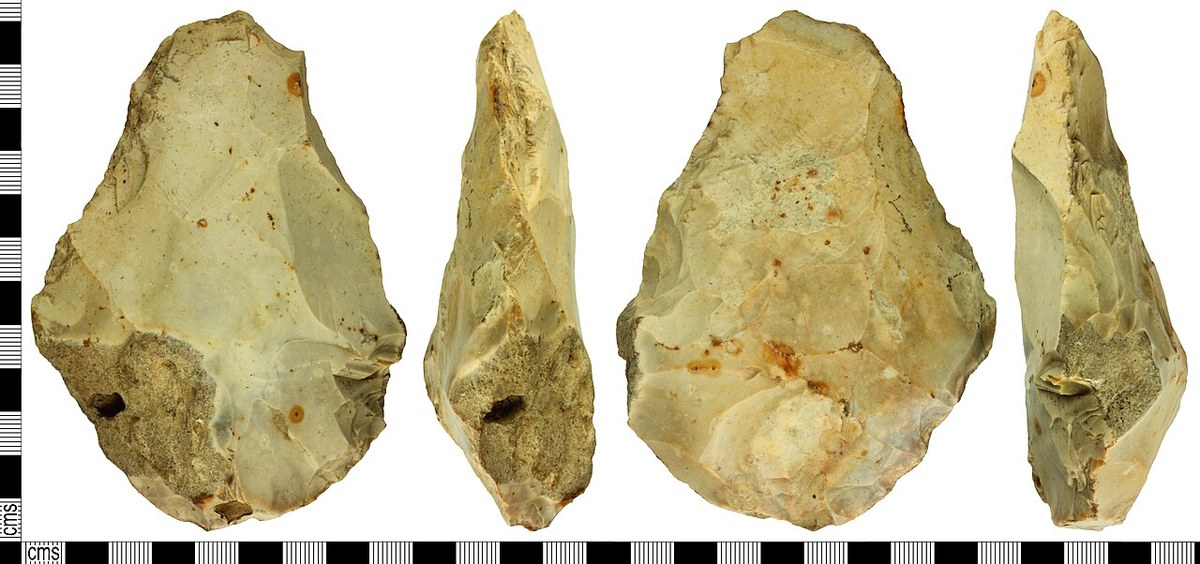
It was in the Olduvai Gorge of Tanzania that Louis and Mary Leakey, from the 1930s onwards, uncovered the first clearly shaped stone tools. These tools, dated to approximately 2.6 to 1.7 million years ago, gave their name to the Oldowan.2
The signature tool of the Oldowan is the chopper: a river cobble from which a few flakes have been struck to create a cutting edge. Simple as this sounds, the gesture requires precise knowledge of stone mechanics: choose a cobble with the right grain, strike with the right force, at the right angle, at the right point. The flakes themselves served as sharp knives for cutting meat and scraping tendons. The Oldowan spread out of AfricaOut of AfricaThe dispersals of Homo sapiens out of Africa, including a major expansion c. 70,000 to 60,000 years ago and earlier exits.→ with the first migrationsMigrationsLong-distance movements of populations; a major driver of human history (the exit from Africa, the peopling of continents, Neolithic and steppe expansions).→ of Homo erectus, reaching Dmanisi (Georgia) and China by 1.7 million years ago. Its longevity, almost a million years of minimal change, reflects a technological equilibrium perfectly adapted to mobile hunter-gatherersHunter-gatherersA way of life based on hunting, fishing and gathering wild resources, without farming or herding; it dominated almost the whole of human history.→.
The Acheulean: More than a Million Years of Handaxes
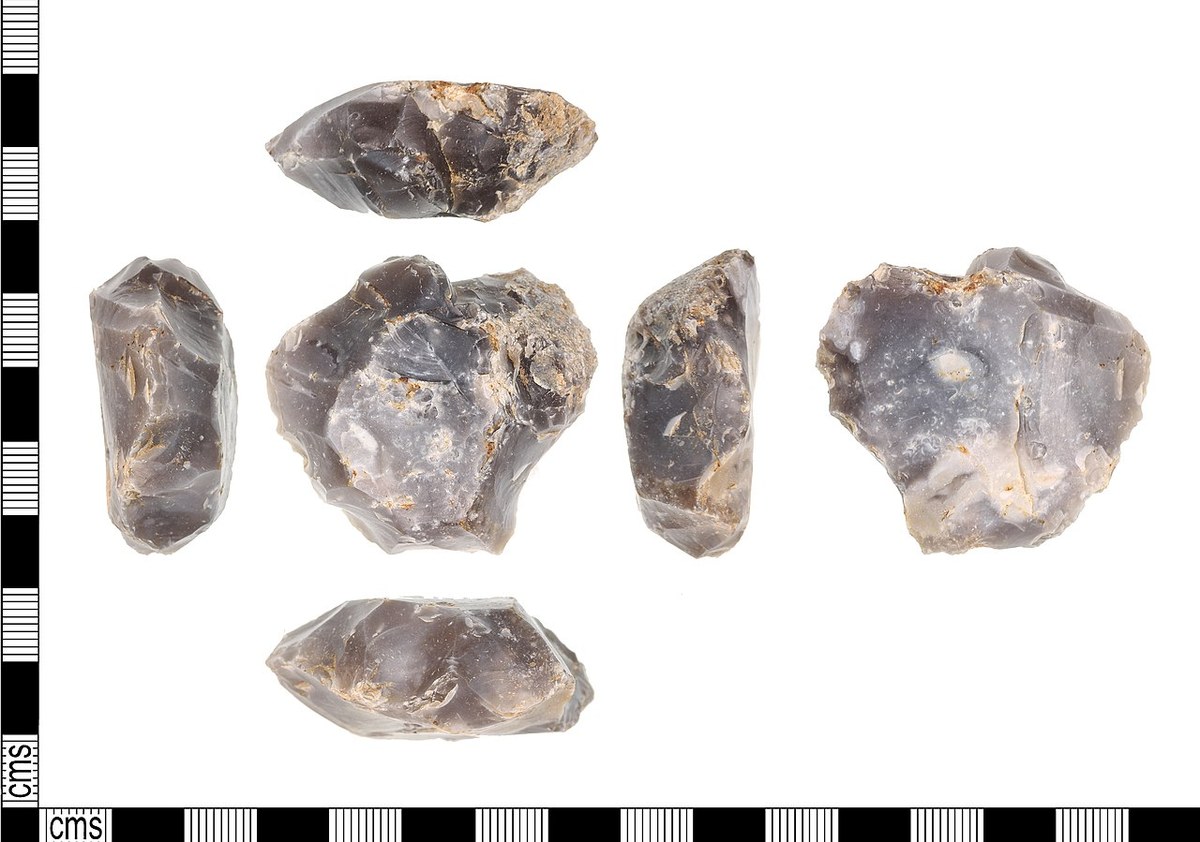
Around 1.76 million years ago, a radical innovation emerges: the handaxebifaceA stone tool knapped on both faces to obtain a regular shape and cutting edges.→, shaped on both faces into a symmetrical almond form with a continuous cutting edge. This marks the birth of the Acheulean, the longest industry in all of human history, lasting more than one and a half million years.3
The handaxe is the first "conceived tool": before striking, the knapper must visualise the final form within the raw block. This mental projection, anticipating the result, is qualitatively different from the Oldowan gesture. It presupposes planning transmitted by apprenticeship from generation to generation: the first great example of cumulative technical tradition in human history.
Born in East AfricaAfricaThe cradle of humankind: the continent where the first hominins appeared, then Homo sapiens around 300,000 years ago, before the expansion to the rest of the world.→ with Homo ergaster, the Acheulean spread across sub-Saharan AfricaSub-Saharan AfricaThe part of Africa south of the Sahara; cradle of Homo sapiens, long thought hostile to ancient-DNA preservation because of heat.→, the Near EastNear EastA region of western Asia (Levant, Mesopotamia, Anatolia, Iran), cradle of the Neolithic revolution, agriculture, the first cities and writing.→, Europe and South Asia. The Acheulean also includes cleavers, scrapers, and in its later phases Levallois flakes. One puzzling feature is its absence in East Asia (the Movius Line). The Acheulean's exceptional duration, fifteen times the entire Upper PalaeolithicUpper PalaeolithicThe final phase of the Palaeolithic (c. 45,000 to 10,000 years ago), marked by Homo sapiens in Europe, art, ornaments and a succession of cultures (Aurignacian, Gravettian, Solutrean, Magdalenian).→, testifies to remarkable adaptive effectiveness.
The Levallois Revolution and Neanderthal's MousterianMousterianThe stone-tool industry typical of Neanderthals, based on the Levallois flaking technique.→
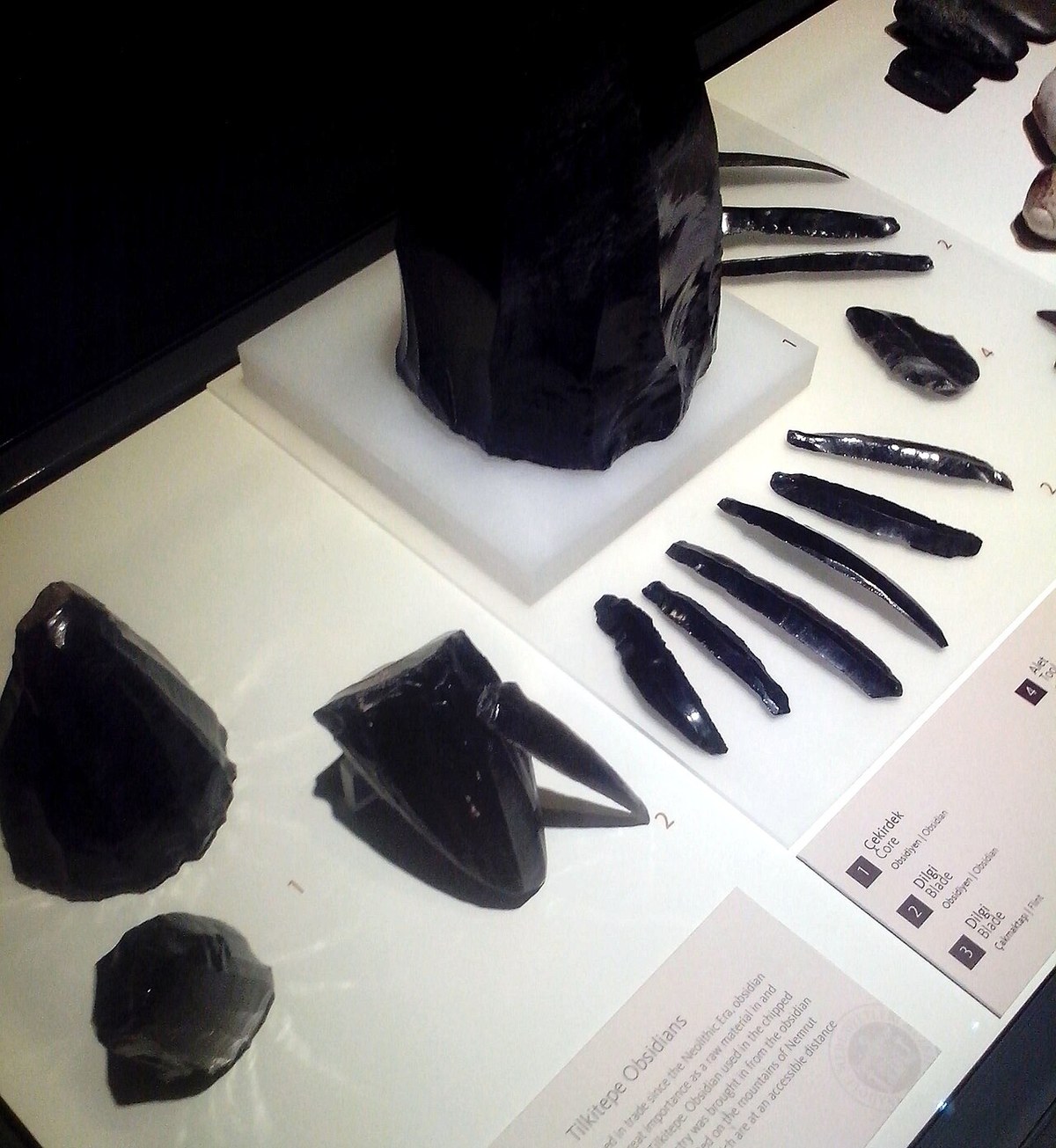
Around 300,000 years ago, the Levallois method transforms stone-knapping: the knapper carefully prepares the core to predetermine the shape of the intended flake before detaching it. This represents a total reversal of the relationship with raw material, a major cognitive leap.4
The Levallois techniqueLevallois techniqueA Middle Palaeolithic flint-knapping method: a core is prepared so a flake of predetermined shape can be struck off in one blow; a hallmark of Neanderthal skill.→ demands considerable precision and anticipation. The knapper must shape the upper face into a convex dome, create an oblique striking platform, then detach the flake with a precise blow, yielding a predetermined form ready to use or minimally retouched. This method is central to the Mousterian industry, associated with NeanderthalsNeanderthalsA fossil humanity of Eurasia, robust and cold-adapted, extinct around 40,000 years before present.→ and some archaicArchaicRefers to an ancient, now-extinct human population or form (Neanderthals, Denisovans, ghost lineages), as opposed to anatomically modern humans.→ Homo sapiensHomo sapiensThe present-day human species, which emerged in Africa around 300,000 years ago, the only surviving human lineage after the extinction of Neanderthals and Denisovans.→ populations. Mousterian tools include scrapers, hafted points, notches and denticulates, highly adapted to local resources and tasks.
Neanderthals practised personal adornment, used pigments and buried their dead, evidence of a symbolic life alongside their sophisticated lithic industry. The ChatelperronianChâtelperronianA transitional material culture (c. 45,000-40,000 years ago) straddling the Middle and Upper Palaeolithic in France and northern Spain; curved-backed knives and, at the Grotte du Renne at Arcy, ornaments and bone tools attributed to Neanderthals.→ (c. 45,000-40,000 BP), associated with the last Neanderthals in France, combines Mousterian elements with Upper Palaeolithic-style innovations. Whether this reflects autonomous invention, imitation of neighbouring Sapiens, or hybridisationHybridisationCrossing between two distinct species or lineages, such as Homo sapiens and Neanderthals, leaving a trace in the genome.→ remains a lively debate among researchers.
The Upper Palaeolithic Creative Explosion
Around 45,000-40,000 years ago, the arrival of Homo sapiens in Europe triggers an unprecedented revolution. Blade technology produces long, regular blades transformed into burins, end-scrapers, borers and backed knives. 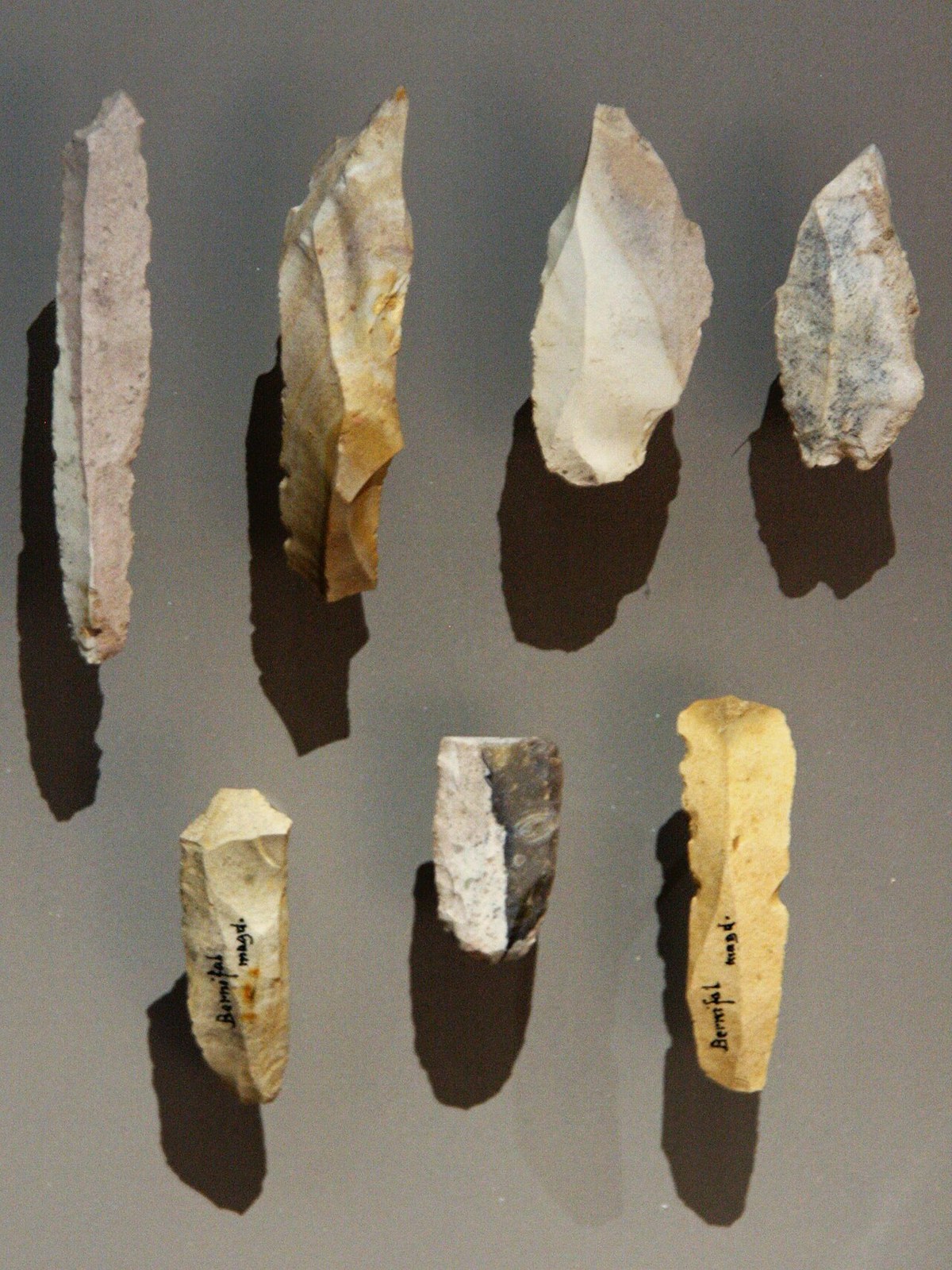
The GravettianGravettianAn Upper Palaeolithic culture (c. 33,000–21,000 BC) spanning from the Atlantic to Siberia, famous for its ivory female figurines ("Venuses") and, at Dolní Věstonice, the oldest fired ceramics.→ (29,000-22,000 BP) generalises the Gravette pointGravette pointA flint point with a straight blunted back, weapon and index fossil of the Gravettian, named after the type-site of La Gravette (Dordogne).→ and is the era of intensive mammoth-hunting and the most famous Venus figurines (Willendorf, Brassempouy, Lespugue). The Solutrean (24,000-19,000 BP), limited to France and Spain, embodies the absolute masterpiece of lithic knapping: pressure flakingpressure flakingA finishing technique that detaches thin flakes by pressing with a tool, without percussion.→ thins flint to a few millimetres, creating laurel leaves so thin they border on art. The Magdalenian (19,000-14,000 BP) is the apogee: barbed harpons in reindeer antler, carved spear-throwers, needles with eyes. The first long-distance exchange networks appear, evidence of remarkable social complexity.
The MesolithicMesolithicThe period between the Palaeolithic and the Neolithic (c. 10,000–6,000 BC in Europe), still based on hunting and gathering.→: When Stone Goes Micro
The warming ending the PleistocenePleistoceneThe geological epoch of the great ice ages (c. 2.6 Ma–11,700 BP), spanning most of human prehistory.→ (c. 11,700 BP) transformed Europe: mammoth steppes replaced by dense forests. Stone toolkits responded with microlithisation: tiny geometric armatures, triangles, trapezoids, segments, knapped from bladelets and hafted in dozens into arrow shafts or harpons. These microliths enable light, lethal projectiles for hunting faster, more dispersed game. Sites like Star Carr (England) and Lepenski Vir (Serbia) reveal communities brilliantly adapted to their new forest world.
The Neolithic RevolutionNeolithic revolutionThe shift from hunter-gatherer societies to farming and settled life (c. 10,000 BCE in the Near East), giving rise to villages and then cities.→: From Knapping to Polishing
Around 10,000 BP, in the Near East, the first farming communities invented polishing stone by abrasion: rubbing it against an abrasive block to obtain a smooth surface and regular cutting edge. 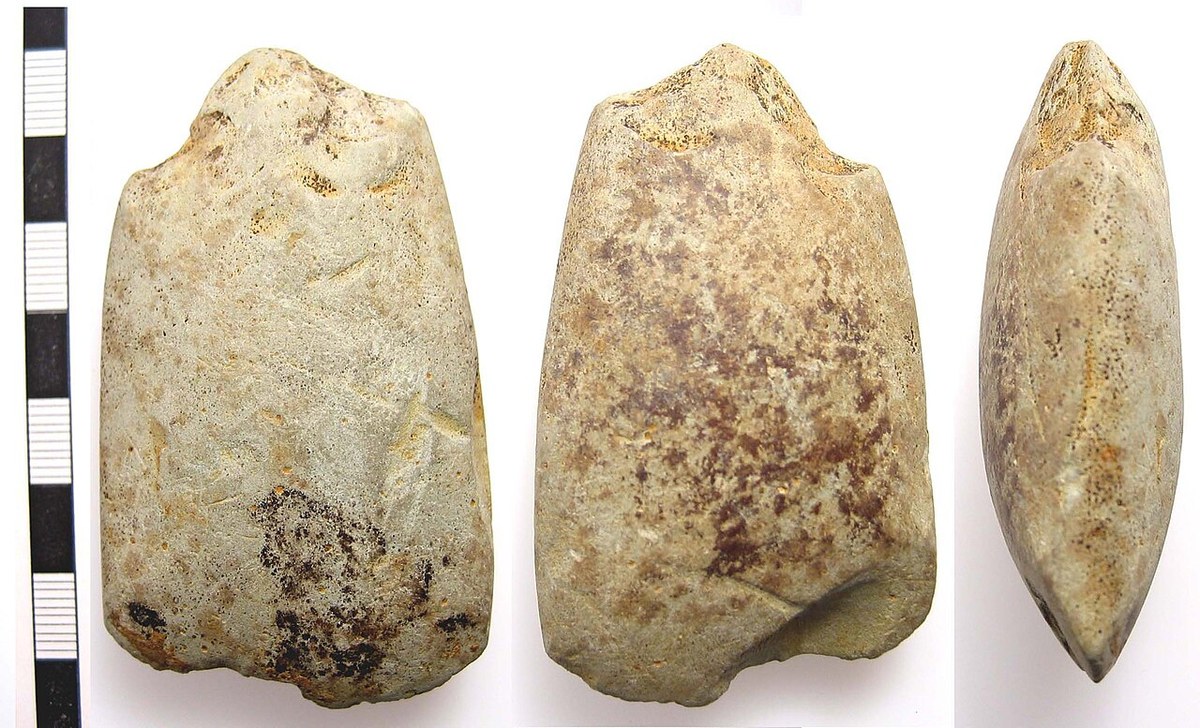
The Neolithic is also the era of great flint mines: Spiennes (Belgium), Krzemionki (Poland), Grimes Graves (England). These underground galleries testify to craft specialisation and interregional trade networks. Stone becomes an economic resource, an object of value, a medium of social identity across enormous distances.
Raw Materials: From Flint to Obsidian
Prehistoric knappers chose their raw materials with care: grain homogeneity, hardness and availability. FlintFlintA hard, brittle siliceous rock, knapped by prehistoric people to produce blades, points and sharp tools.→, siliceous rock (SiO2) with perfectly predictable conchoidal fracture, is the queen of materials in Europe and the Near East. Its regional varieties allow archaeologists to trace procurement circuits spanning 300-500 kilometres. Quartzite, hard and ubiquitous as river cobbles, was the preferred material in Africa and Asia where flint is absent. Obsidian, natural volcanic glass, produces cutting edges sharper than modern surgical blades. Rare and localised, it became a prestige object diffused over immense distances: Lipari obsidians (Sicily) reached across the western Mediterranean, while Cappadocian obsidian arrived in Mesopotamia. Chemical provenance studies (mass spectrometry, neutron activation) are today among the most powerful tools for reconstructing prehistoric exchange networks.
Knapping Techniques: From Percussion to Pressure
Mastering stone's mechanical laws takes years: ethnographic studies show 5-10 years of apprenticeship for the most advanced techniques.4 Hard-hammer direct percussion (stone-on-stone) is the Oldowan technique. Soft-hammer or indirect percussion (organic hammer: bone, antler, hardwood) gives thinner, more regular flakes, the dominant method for Upper Palaeolithic blade production. Levallois debitage predetermines the flake form by careful core preparation. Pressure flaking, pressing a punch against the edge, achieves millimetre precision for Solutrean and late Neolithic masterpieces. Heat treatment (250-300 degrees Celsius) improved flint knappability, mastered as early as 164,000 BP at Pinnacle Point, South Africa, a remarkable empirical discovery passed down through generations.
Experimental Archaeology: Reliving the Ancient Gesture
Experimental archaeology, reproducing tools with the same materials and techniques, has provided irreplaceable insights. A standard Acheulean handaxe takes an experienced knapper 30-90 minutes; the finest Solutrean laurel leaves may have required many hours. Use-wearuse-wearMicro-traces left on a tool by its use, studied through use-wear analysis to reconstruct its function.→ analysis and organic residue studies complement experimental findings by revealing how tools were actually used. Recent neuroscience research by Dietrich Stout and colleagues showed that manufacturing an Acheulean handaxe activates neural networks associated with language and symbolic thought, suggesting lithic knapping practice may have shaped the evolution of language in our lineage.
The lithic industry is much more than a chronology of tools. It is the thread running through 3.3 million years of human adventure, the stone record of an intelligence that affirms, innovates, transmits and creates. From the Olduvai Gorge to the Grand-Pressigny flint workshops, every detached flake tells a human story: a gesture, an intention, a body of knowledge. The first technology of humanity remains the longest, the most universal, and the most revealing of who we are.
No comments yet. Be the first.