Around 3300 BC, in the cities of lower Mesopotamia, people pressed a cut reed into pats of damp clay and stamped signs into them. That unremarkable gesture, repeated by thousands of scribe-accountants, opened an unprecedented rupture in human history: the invention of writingWritingA system of conventional signs used to fix language or information durably; its appearance (c. 3300 BC) marks, by convention, the end of prehistoryPrehistoryThe span of human history before the invention of writing, from the Palaeolithic to the Metal Ages, known mainly through material remains.→.→. With it ended, by convention, the long night of prehistory, that "textless" age spanning more than three million years, and history began, the past we can read in the very words the ancients left behind1. Yet writing did not fall from the sky, nor spring from a flash of genius: it was the outcome of a very long apprenticeship in counting, control and power, whose earliest traces reach back into the NeolithicNeolithicThe "New Stone Age": a period marked by farming, herding, settlement and pottery, from around 10,000 BC.→.
This dossier follows that thread, from the little clay bead slipped into a sealed envelope to fully formed cuneiform, then on to hieroglyphic Egypt and the scripts independently invented in China and Mesoamerica. Above all it asks a simple, dizzying question: why did human societies, after hundreds of thousands of years without writing, suddenly feel the need to fix speech and things in matter?
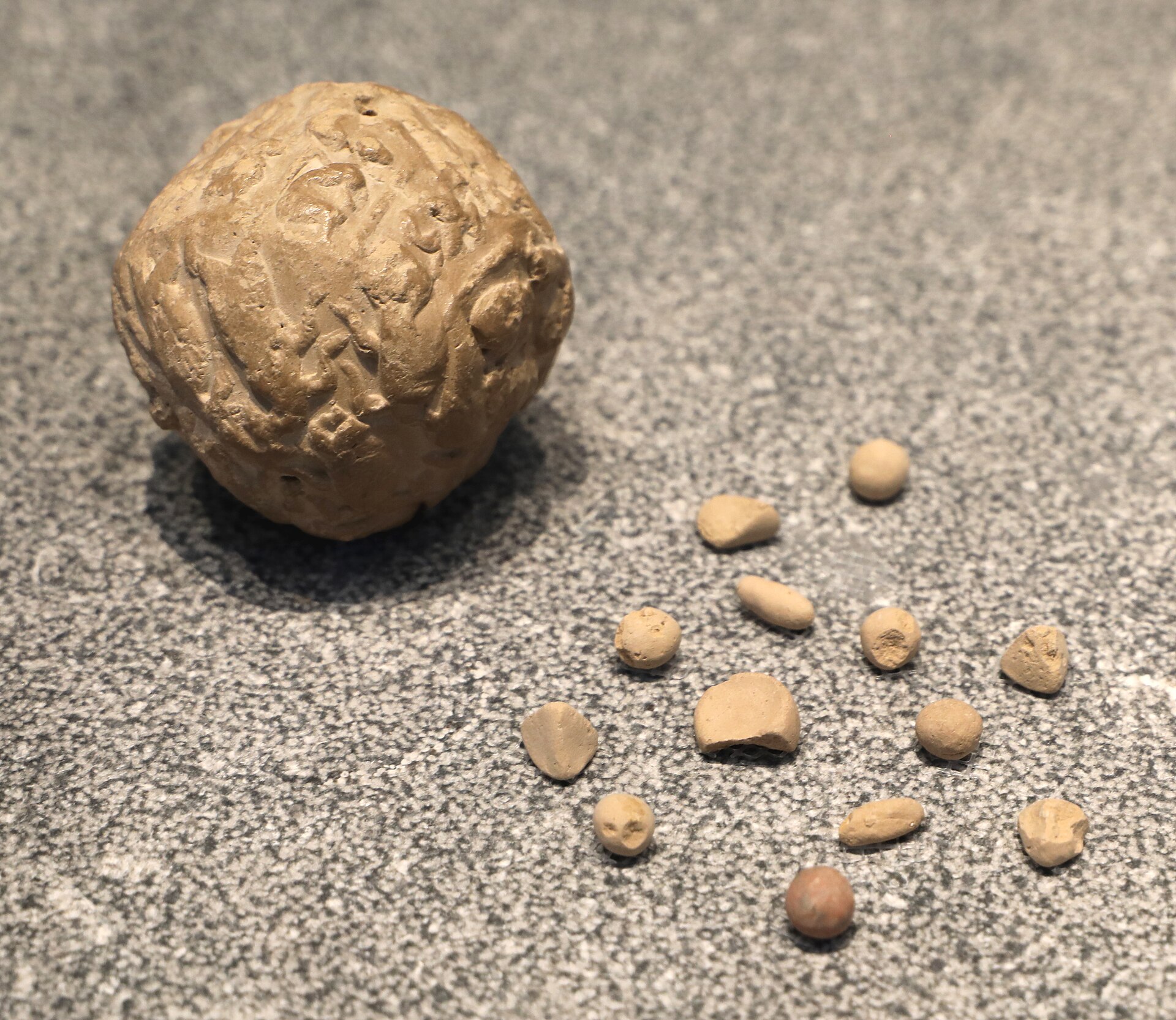
Why write? Accounting, redistribution and the birth of cities
The very first Mesopotamian tablets tellTellAn artificial mound formed by the accumulation of successive layers of settlement remains at the same spot, typical of the Near East. Each destruction-rebuilding event adds a stratum.→ no epic, no prayer, no law: they count sacks of barley, head of cattle, jars of beer, days of labour. Writing was born, prosaically, of a need for accounting1. To understand that birth we must set the scene: lower Mesopotamia at the end of the fourth millennium, between the Tigris and the Euphrates, where the Uruk civilisation flourished.
There, irrigated farming produced huge surpluses, but the environment was demanding: canals had to be dug and maintained, grain stored, water shared out, craftspeople fed who grew nothing themselves. A redistributive economy took shape, centred on the temple and later the palace: harvests were collected, stored, then handed back out as rations. Such an administrative machine cannot run on memory. Who delivered how much? Who received their share? How much remains in the granary? One person's memory no longer suffices; an external support is needed, reliable, transmissible and verifiable.
Writing is therefore the daughter of the city and the nascent state. It appears at the precise moment when human communities cross a threshold of complexity, population density, division of labour, social hierarchy, permanent institutions, that makes oral memory inadequate. To count is already to control; and to control is to wield power. From the very start, writing was an instrument of management and domination as much as a means of communication.
Humanity's first texts sing of neither gods nor heroes: they count barley, beer and cattle.
Proto-writing: tokens, bullae and clay envelopes
Before the written sign there is the counted object. As early as the eighth millennium BC, long before Uruk, the farming communities of the Fertile CrescentFertile CrescentAn arc-shaped region of the Near EastNear EastA region of western Asia (Levant, Mesopotamia, Anatolia, Iran), cradle of the Neolithic revolution, agriculture, the first cities and writing.→ (LevantLevantA region of the eastern Mediterranean Near East (Israel, Lebanon, Syria, Jordan), a major crossroads of the first human migrations out of Africa.→, Mesopotamia) where farming and herding first emerged.→ used small baked-clay objects, the calculi (or tokens): spheres, cones, discs, cylinders, tetrahedrons. Each shape stood for one unit of a particular commodity, a measure of grain, a head of livestock, a jar of oil. This is what scholars call proto-writingProto-writingNotation systems preceding true writing (tokens, clay envelopes) that encode information without yet transcribing language.→: a notation system that is not yet writing, but which already encodes information in a durable, conventional way3.
The role of these tokens in the genesis of writing was brought to light by the archaeologist Denise Schmandt-Besserat, who catalogued thousands of calculi across the Near East and reconstructed their evolution over several millennia3. Her demonstration overturned the received idea of writing springing up all at once: it is rooted instead in a very ancient practice of material counting.
Then, around 3500-3300 BC, came a decisive innovation. To sealSealA small engraved object (often steatite) used to stamp a mark in clay; the Indus seals, bearing animals and signs, attest to administration and trade, though their script remains undeciphered.→ a transaction, a delivery, a debt, a deposit, the matching tokens were enclosed inside a hollow clay sphere, the bulla (clay envelope). Once the bead was closed and stamped with the parties' seals, its contents were guaranteed: no one could remove or add a token without breaking the envelope2. The bulla was, in effect, a sealed contract, an inviolable accounting strongbox.
But this cleverness had a flaw: to check the count, the bulla had to be smashed, and therefore destroyed. The solution found by the accountants of Uruk and Susa is the founding gesture of writing. Before closing the envelope, or directly on its surface, they impressed into the fresh clay the imprint of the tokens it contained, as many notches and marks as there were calculi inside. The contents could now be read without breaking the seal.
The logical consequence is inescapable. If the surface imprint says everything, why still enclose the tokens? The calculi were gradually abandoned, the hollow bulla was flattened into a flat tablet, and only the signs impressed on its surface remained. The three-dimensional token had become a two-dimensional drawing; the counted object had turned into a written sign. Proto-writing had given birth to writing.
Uruk and the birth of cuneiform
It was in the city of Uruk, vast for its day and reckoned one of the very first cities in the world, that the system crystallised around 3300-3200 BC. In the temple district of the Eanna, archaeologists found hundreds of tablets covered in signs: this is proto-cuneiform, the oldest written corpus of humankind1.
These first tablets combine two kinds of sign. On one hand, numerical signs inherited from the token imprints: round or elongated notches recording quantities in several measuring systems. On the other, pictograms traced with a point: an ox-head for cattle, an ear for barley, a vessel for beer, a star for the sky or the divine. They record counts of rations, lists of goods, temple inventories, the everyday administration of a redistributive economy.
The word cuneiformCuneiformThe oldest known writing, born at Uruk; its signs, impressed into clay with a reed stylus, are wedge-shaped (from Latin cuneus).→ comes from the Latin cuneus, "wedge", because the signs end up shaped like little wedges, nails or chevrons. This distinctive look is no aesthetic choice: it follows from the tool and the support. The scribe no longer wrote by drawing curved lines in the clay, which raises ridges and spoils the surface, but by impressing the bevelled tip of a reed stylus. Each press leaves a triangular mark; signs are built up as assemblies of these wedges. The technique, fast and clean, would prevail for almost three thousand years.
From pictogram to abstract sign
Uruk's writing was at first logographic: one sign stands for one thing or idea. But such a system soon meets its limits. How do you draw "to give", "yesterday", "to do justice"? How do you write a proper name, a verb, a grammatical nuance? How, above all, do you fix the spoken language, here Sumerian, in all its richness?
The great revolution came when scribes took the step of the phonetic principle, also called the rebus. A sign no longer notes only the thing it depicts but also the sound of its name, regardless of meaning. In English one might draw an "eye" and a "saw" to write "I saw". In Sumerian, a language where many words are monosyllabic, this device opened immense possibilities: one could now transcribe sounds, and therefore proper names, verbs, elements of grammar, in short, language itself, and no longer merely the objects of the world.
At the same time the signs grew stylised and abstract. The recognisable pictogram of the ox-head shrank to a few wedges; the ear of barley became a conventional bundle of strokes. As writing spread, resemblance to the original object faded in favour of speed and efficiency. The drawing had become a sign; the sign became a sound. This twofold evolution, from concrete to abstract, from ideogram to phonogram, made cuneiform a complete writing system, able to record everything: contracts, laws, letters, myths, hymns, scientific treatises. A few centuries after Uruk's barley accounts, the same signs would write the Epic of Gilgamesh.
Egypt and the hieroglyphs
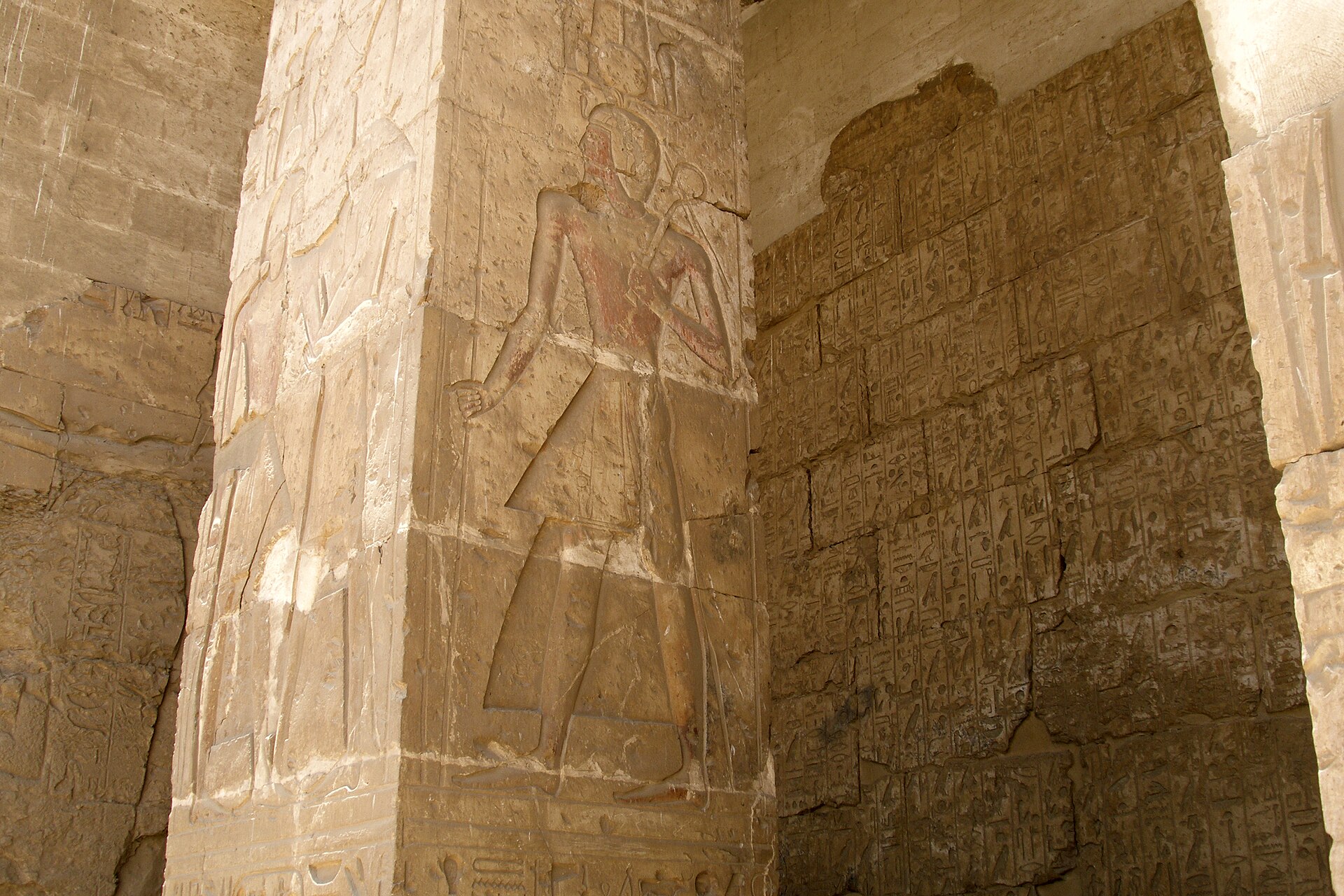
At roughly the same time, around 3200-3100 BC, Egypt saw its own system appear: the hieroglyphs, from the Greek hieros (sacred) and gluphein (to carve), "the sacred carved signs". The oldest known attestations are on ivory labels and palettes from the royal necropolisNecropolisA large organised burial ground, a "city of the dead", often spanning several periods.→ of Abydos1.
Egyptologists still debate the point: was Egyptian writing invented independently, or by stimulus diffusion through distant contact with Mesopotamia? The chronology places Sumerian proto-cuneiform a little before the first hieroglyphs, which has prompted the suggestion of an influence, the very idea that one could write may have travelled, more than the signs themselves. But no direct evidence of a transfer exists, and the two systems differ profoundly in their signs and in how they work1.
Like cuneiform, Egyptian writing mixes logograms (one sign = one word), phonograms (one sign = a sound, most often one or several consonants) and determinatives (silent signs that specify meaning). But it kept, for three millennia, a figurative quality that cuneiform soon abandoned: the hieroglyphs remained carefully drawn images of birds, legs, reeds and suns, carved on the stone of temples and tombs. Alongside this monumental script, a swift cursive form, the hieratic, developed for daily life and administration, inked onto papyrus.
In Egypt too, writing served power from the outset: it proclaimed the king's victories, recorded taxes, organised building projects, accompanied the dead into the afterlife. To master the signs was to belong to an elite. The scribe, trained over many years, held an enviable place: exempt from forced labour, he kept the kingdom's accounts and engraved the memory of the pharaohs.
Independently invented scripts: China and Mesoamerica
The invention of writing is not a unique event in human history. Specialists generally recognise several centres of independent invention, where writing arose with no demonstrable outside borrowing.
In China, writing is clearly attested around 1200 BC under the Shang dynasty, on the famous "oracle bones": ox shoulder-blades and tortoise plastrons heated then questioned in divinatory rituals, on which the question and answer were carved. These archaicArchaicRefers to an ancient, now-extinct human population or form (Neanderthals, Denisovans, ghost lineages), as opposed to anatomically modern humans.→ signs are the direct ancestors of today's Chinese characters, which makes Chinese the oldest writing system still in use, in a continuity of more than three thousand years.
In Mesoamerica, thousands of kilometres away and without the slightest contact with the Old World, scripts emerged during the first millennium BC among the Olmecs and then the Zapotecs, before the flowering of the famous Maya script, a complete system combining logograms and syllabic signs, able to record dates, royal genealogies, myths and historical events.
That writing was invented several times, in unrelated places and ages, carries a deep lesson: it is not an accident but a recurring answer to one and the same challenge. Wherever societies reach a certain degree of complexity, cities, a state, accounting, an organised religion, the need to fix information eventually calls writing into being. The detail of the signs varies; the function repeats.
What writing changes: memory, history and power
Writing is surely the most powerful of memory technologies. Before it, all knowledge had to fit inside human heads and pass by voice, from one generation to the next, at the risk of being forgotten and distorted. With it, information detaches from the person who carries it: it can cross space without a messenger and time without dying with the one who knew it.
That simple fact changes everything. Memory becomes external, cumulative, verifiable: one can consult, compare, archive, correct. Knowledge accumulates instead of being lost, making astronomy, law, medicine and history possible as disciplines. Power, above all, changes in nature: a king can now legislate for subjects he will never see, levy taxes on distant lands, send precise orders to absent officials. Written administration is the backbone of the first states.
With writing, information detaches from the person who carries it: it crosses space without a messenger and time without dying.
Writing also creates new inequalities. Knowing how to read and write becomes a privilege, jealously guarded by scribes and priests. Society splits between those who command the signs and the mass who depend on them. For a very long time, literacy remained the preserve of a tiny elite, it would take millennia, and printing, then schooling for all, for the written word to become a truly shared good.
The boundary between prehistory and history
Here lies the very meaning of this dossier. By academic convention, the appearance of writing marks the end of prehistory and the beginning of history1. The reason is simple and, on reflection, a little circular: "history" in the strict sense means the past we know through written sources. Where texts speak, the historian can work on the ancients' own words; where they are silent, only mute archaeology reconstructs societies from their material remains, the domain of the prehistorian.
This boundary has two disconcerting properties. First, it is movable in time: Mesopotamia enters history around 3300 BC, Egypt a little later, but northern Europe, sub-Saharan AfricaSub-Saharan AfricaThe part of Africa south of the Sahara; cradle of Homo sapiens, long thought hostile to ancient-DNA preservation because of heat.→ or Oceania enter it thousands of years afterward, sometimes only at the time of colonial contact. The same date can mean history in one place and prehistory in another.
Second, we speak of protohistoryProtohistoryThe transitional period between prehistory and history, covering societies without their own writing but known through external texts.→ for societies that do not themselves know writing but are mentioned by neighbours who do, the GaulsGaulsCeltic peoples settled in Gaul (France, Belgium and neighbouring regions) during the second Iron Age, before their integration into the Roman Empire.→ described by the Romans, for example. The prehistory/history line is thus no wall raised on a precise day, but a cultural and technical threshold, reached at different moments across the globe.
Still, this threshold must not be over-read. Societies "without writing" are neither primitive nor devoid of memory: they have their oral traditions, their arts, their immense knowledge, their own ways of passing things on. Writing is not a measure of a civilisation's worth; it is a particular technique, born of a particular need, which simply transformed, in depth, humankind's relationship to time, memory and power.
Conclusion
From the little clay bead slipped into a sealed envelope to the learned tablets of the Mesopotamian libraries, the story of writing is one of slow ripening, not of sudden illumination. Born of the need to count in the busy cities of Uruk and Susa, it turned the imprint of an accounting token into a sign, the sign into a sound, and the sound into a whole language laid down in clay.
By taking that step, the societies of Mesopotamia did far more than invent a tool of management: they opened the door of history. For the first time, people could speak beyond their own death, hand down their law, their science and their stories to descendants they would never know. Prehistory, that immense, silent age of stone tools, painted caves and first villages, found its voice at last. And it was with a humble account of barley and beer that humanity, without knowing it, wrote its first line.
Before signs: a clay accounting system
To understand how writing was born, we must give up the image of a brilliant inventor tracing the first sign one fine day. The research of recent decades, dominated by the work of the Franco-American archaeologist Denise Schmandt-Besserat, has shown that Mesopotamian writing sinks its roots into a far older accounting system that served not to record language at all, but simply to count goods. Before writing there were accounts; and before written accounts, there were objects that people counted.
These objects are small clay tokens, which archaeologists call calculi (from the Latin calculus, "little pebble", from which we get the word "calculate"). They are found across the entire Near East from the Neolithic revolutionNeolithic revolutionThe shift from hunter-gatherer societies to farming and settled life (c. 10,000 BCE in the Near East), giving rise to villages and then cities.→ onward, around 8000 BC, precisely when farming and herding first created surpluses, and thus the need to manage them. Shaped by hand, fired or simply dried, these tokens measure from one to a few centimetres and take a handful of simple forms: cones, spheres, disks, cylinders, tetrahedrons, ovoids.
Schmandt-Besserat's thesis is that each of these forms carried a fixed semantic value: each token stood for one unit of a precise commodity. A small cone perhaps meant a small measure of grain, a sphere a large measure, an ovoid a jar of oil, a cylinder a head of cattle. The system was not yet writing, for it recorded neither words nor sounds, but a genuine accounting code: a repertoire of concrete, handleable symbols that were lined up, added or stored to keep the inventory of a herd, a granary or a delivery. A shepherd could represent thirty-three sheep with thirty-three appropriate tokens, without knowing any written sign, nor even the abstract number "thirty-three".
Before writing words, people counted things. Mesopotamian writing was born not of a poem, but of an inventory.
For several millennia this simple system sufficed. But as communities grew, as redistributive centres, temple-granaries and an administration arose, the need was feltFeltA non-woven fabric made by pressing and matting wool fibres; steppe nomads used it for rugs, saddles and appliqués, remarkably preserved in the frozen Pazyryk tombs.→ to guarantee the integrity of an account against fraud and forgetting. From this requirement, around 3500-3300 BC, the decisive innovation would emerge.
Bullae and envelopes: sealing an account in clay
To transmit or preserve an account securely, Mesopotamian accountants conceived of enclosing the tokens of a transaction inside a hollow, sealed clay ball. Archaeologists call these objects bullae or clay envelopes. Once the tokens were enclosed and the bulla closed, the cylinder seal of the parties was rolled over its still-soft surface: the personal signature of the sender and, where relevant, of the recipient. The account was now inviolable: one could neither add nor remove tokens without breaking the envelope and its seal.
But this device had a major flaw: to verify the contents of a bulla, it had to be broken, destroying both the sealed account and the guarantee of the seal. Administrators found an ingenious remedy, and here, unbeknown to anyone, the fate of writing was decided. Before slipping the tokens into the bulla, each one was impressed on the still-soft outer surface of the envelope. The face of the bulla thus carried, in relief, the exact imprint of what it contained: three cones impressed outside, three cones sealed inside. The account could now be read without breaking the seal.
The lesson of these imprints was momentous. From the moment one could read the quantity on the surface of the bulla, the tokens enclosed inside became redundant. Why keep a fragile hollow ball full of objects when the flat imprint said the same thing? The answer was obvious: people gradually stopped enclosing the tokens, flattened the bulla, and simply impressed the marks on a clay pad. The tablet was born from the envelope, and the sign from the imprint of the token.
From token to sign: the birth of proto-writing
The conceptual leap embodied in this transition is immense, and it is here that Schmandt-Besserat sees the birth-act of writing. People had passed from a three-dimensional object, the token held in the hand, to a two-dimensional sign, the imprint traced on a flat surface. To reduce the volume to the mark, the concrete to the abstract: such was, in her view, the founding graphic revolution. The sign no longer counted by its tangible form, but by its conventional figure inscribed in the clay.
Very soon the scribes realised it was quicker to draw the mark with a stylus, a cut reed, than to impress a real token. So they engraved directly on the tablet signs derived from the old tokens: these are the first pictograms, or more exactly the proto-writing that specialists call proto-cuneiform. Appearing around 3300 BC in the great city of Uruk, it constitutes the oldest known written corpus of humankind.
Another, equally decisive innovation accompanies this stage: the separation of number from the thing counted. In the token system, thirty sheep required thirty sheep-tokens; the number was fused into the object. Proto-cuneiform, by contrast, invents abstract numerical signs distinct from commodity signs: one sign for "ten", another for the sheep, and one writes "ten" followed by "sheep". This is the invention of the abstract number, the condition of all arithmetic and all true accounting. Writing and abstract calculation are thus born of the same gesture.
Uruk: writing and the city
It is no accident that writing appears precisely at Uruk, in southern Mesopotamia, on the banks of the Euphrates. During the second half of the fourth millennium, this settlement becomes the first great city of human history, perhaps peopled by several tens of thousands of inhabitants, dominated by huge monumental complexes dedicated to its tutelary deities, among them the goddess Inanna. Historians speak of an "urban revolution": the birth of the city, the state, a stratified society and a redistributive economy.
Now a city of this size cannot function without administration. Temple and palace receive the harvests, store the grain, redistribute rations to hundreds of workers, manage herds, workshops, fields and canals. This management of unprecedented complexity far exceeds the capacity of human memory. Writing is born precisely there, as an administrative technology, a practical answer to the challenge of governing a city. Nearly 85% of the some five thousand archaic tablets of Uruk are accounting documents: ration lists, cattle counts, delivery registers. People did not write first to sing the gods or immortalise a king, but to keep the granary's books.
Alongside these accounts, another very ancient kind of text has been found: lexical lists, long standardised enumerations of professions, animals, objects or cities. Learned and recopied by apprentice scribes, they served at once as exercises and as tools for classifying the world. These lists testify to an unprecedented intellectual effort: to order, rank and archive the real. Writing, barely born, already becomes an instrument of thought.
From pictograms to cuneiform: the streamlining of a system
The first signs of Uruk were still, for many, recognisable images: a stylised ox-head, an ear of grain, a fish, a star for the sky or the divine. But this figurative writing would change radically over the third millennium, under the combined effect of tool and use. The reed stylus, pressed into the clay, more easily traced short notches than continuous curves. Scribes took to impressing the triangular tip of the stylus rather than drawing: each sign now breaks down into a combination of small wedges, whence the name cuneiform, from the Latin cuneus, "wedge".
Under this technical pressure, the pictograms lose all resemblance to what they depicted. The drawing of the ox becomes an abstract assemblage of nails and chevrons; to gain speed, the signs rotate ninety degrees and lie down. Within a few centuries, writing ceases to be a sequence of images and becomes a repertoire of conventional signs, which must be learned by heart since nothing in their form any longer reveals their meaning. Such is the price of efficiency and speed.
The deepest innovation, however, lay elsewhere, in the passage from meaning to sound. As long as a sign represents only a thing or an idea, a logogram, one can write only what can be drawn: objects, quantities. How to record a proper name, an abstract verb, a grammatical particle? Sumerian scribes resorted to a decisive procedure, phonetism: using a sign no longer for what it denotes, but for the sound it evokes. If the sign for reed is pronounced gi, it can be used to write the verb "to reimburse", also pronounced gi, with no link in meaning. This is the rebus principle.
Thanks to phonetism, writing crosses its most important threshold: it ceases to represent the world and begins to record language. With a stock of sound-signs, the syllabary, one can now transcribe any utterance whatever, names, prayers, narratives, laws. Writing, set out from a humble barley account, has become able to fix the whole of human speech. It is this mixed system, blending logograms and syllabic signs, that the Sumerians would pass on to the Akkadians, then to the Babylonians and Assyrians, for nearly three thousand years of unbroken use.
Giving the clay its voice back: the deciphermentDeciphermentThe reconstruction of the meaning and value of the signs of an unknown script, often from bilingual texts, repeated proper names or statistical regularities.→ of cuneiform
For centuries, after the last cuneiform cultures died out at the start of our era, these wedge-shaped signs remained perfectly mute. The European travellers who brought back copies of Persian inscriptions did not even know whether they were dealing with a script, an ornament or a freak of the stone. The decipherment of cuneiform, accomplished over the nineteenth century, ranks among the finest intellectual adventures in the history of science.
The first decisive step belongs to a modest German schoolteacher, Georg Friedrich Grotefend, who around 1802 tackled the Old Persian inscriptions copied from the ruins of Persepolis. By a bold reasoning, almost a wager, he supposed that they contained the names of Achaemenid kings according to an expected formula, "So-and-so, great king, son of So-and-so, great king". By comparing the recurring sign-groups, he managed to identify correctly a handful of letters and to read the names of Darius, Xerxes and Hystaspes. Old Persian, it was then understood, was a near-alphabetic script, in which words were even separated by a slanted sign, far simpler, therefore, than Mesopotamian cuneiform.
But it was a British officer, Henry Creswicke Rawlinson, who brought the enterprise to completion thanks to an exceptional monument: the Behistun inscription. Carved on a cliff in western Iran on the order of Darius I, it recounts the king's seizure of power and the crushing of the revolts, in a monumental autobiography written in three languages: Old Persian, Elamite and Babylonian. It was, for cuneiform, the equivalent of the Rosetta Stone for hieroglyphs: one and the same content in three scripts, at least one of which could be read.
Rawlinson's feat was as physical as it was intellectual. Suspended on ladders over the void, at the risk of his life, he patiently copied the columns carved many metres up in the 1830s and 1840s. From the deciphered Old Persian, he could move on to the Elamite and then the much more complex Babylonian versions. Working in parallel, the Irish scholar Edward Hincks and others understood that Babylonian cuneiform was both logographic and syllabic, that a single sign could have several readings and a single sound be written in several ways. In 1857, a famous test, four scholars separately deciphering the same unpublished text and reaching concordant translations, definitively established the validity of the decipherment. A whole civilisation, and with it three thousand years of archives, emerged from silence.
The other centre: writing in Egypt
Almost at the same time as Mesopotamia, around the end of the fourth millennium, Egypt sees the birth of its own writing system: the hieroglyphs. For a long time the famous Narmer Palette, dated to around 3200 BC and celebrating the unification of Upper and Lower Egypt by King Narmer, was regarded as the oldest hieroglyphic document and the "birth certificate" of Egyptian writing. The palette combines images and brief signs naming the sovereign: the phonetic principle is already legible there.
But more recent discoveries have overturned this chronology. The excavations of the necropolis of Abydos, and notably of the so-called tomb U-j attributed to a predynasticPredynasticThe period of Egypt before unification (c. 3100 BCE) and the First Dynasty, marked by the Naqada cultures and the gradual emergence of the state.→ ruler nicknamed "Scorpion I", have yielded hundreds of small bone and ivory labels engraved with signs, dated to around 3400-3320 BC. These labels, which probably indicated the provenance or quantity of goods deposited in the tomb, push the appearance of Egyptian writing back to a date very close to, even competing with, that of Uruk.
This near-simultaneity has fed a long debate over priority. Was Egyptian writing born independently, or under the influence of Mesopotamia, with which Egypt then maintained attested trade contacts? Specialists remain divided. Some lean toward a "diffusion of the idea": Egypt would not have borrowed Mesopotamian signs, but would have received the mere notion that writing was possible, before inventing from scratch its own, formally quite original system. Others defend a fully autonomous invention, stressing that nothing in the hieroglyphs derives materially from cuneiform. For want of decisive evidence, the debate remains open, and caution is in order.
The Egyptian system, like cuneiform, rests on a combination of logograms, phonograms (recording consonants) and silent determinatives that specify meaning. But unlike cuneiform, which soon abandoned all figuration, the hieroglyphs kept for three millennia their figurative splendour, remaining carefully drawn images of birds, reeds and suns. This continuity makes Egypt, alongside Sumer, the second great original centre of writing in the Old World.
Several inventions, one and the same need
Writing was not invented once and for all, then diffused step by step across the planet. On the contrary, specialists recognise several centres of independent invention, where societies with no demonstrable contact each crossed the threshold of writing on their own account. This finding carries considerable weight: it shows that writing is not a unique historical accident, but a recurring answer that very different civilisations bring to one and the same type of challenge.
In China, writing is clearly attested around 1200 BC, under the Shang dynasty, on the famous oracle bones: ox shoulder-blades and tortoise plastrons heated over fire, then questioned in divinatory rituals, on which the question asked and the answer obtained were carved. These archaic signs are the direct ancestors of today's Chinese characters, which makes Chinese writing the oldest system still in use, in a continuity of more than three thousand years. Here again, as at Uruk, it is in an administrative and religious frame that writing takes shape.
The Indus Valley offers a more enigmatic case. The brilliant HarappanHarappanPertaining to the Indus Civilisation, named after its first excavated site, Harappa (Pakistani Punjab); refers to the material culture, script and people of that civilisation.→ civilisation, which flourished in the third millennium in present-day Pakistan and north-western India, left thousands of short inscriptions, chiefly on seals, comprising about four hundred different signs. This Indus scriptIndus scriptA system of about 400 signs engraved on Harappan seals, tablets and pottery, undeciphered to date for lack of a bilingual text.→ remains to this day undeciphered: the extreme brevity of the texts, the absence of any bilingual inscription and our ignorance of the underlying language forbid us, for now, from cracking its meaning. Its very nature is debated, a complete logo-syllabic system, or a mere repertoire of symbols. It reminds us that not every graphic trace is necessarily a script, and that decipherment remains an uncertain art.
Finally, thousands of kilometres away and without the slightest contact with the Old World, Mesoamerica invents its own scripts over the first millennium BC, among the Olmecs and then the Zapotecs, before the flowering of the great Maya script. A complete system combining logograms and syllabic signs, Maya could record dates, royal genealogies, myths and historical events, and was largely deciphered over the twentieth century. Its wholly independent birth is the most striking proof that writing is an invention humankind has remade several times, wherever social complexity required it.
What is a writing system?
This survey invites a seemingly simple but formidable question: what is a writing system, exactly, and at what point does a sequence of signs deserve the name? Not every graphic mark is writing. A rock drawing, a tally of notches, a heraldic symbol convey meaning, but do not constitute writing in the full sense. Linguists reserve the term for systems capable of recording a language, that is, of transcribing a spoken utterance with enough precision for a reader to restore it.
The decisive criterion is phonetism. As long as a system merely associates a sign with an idea, a logogram, it remains a prisoner of the drawable and can record neither proper names, nor grammar, nor abstraction. The threshold is crossed when the signs begin to stand for sounds rather than only things. This is what specialists sometimes call "true writing": a system that, through its phonetic signs, can transcribe any utterance of the language it serves.
The world's scripts then array themselves along a spectrum. Logographic systems, like Chinese, assign a sign to each word or morpheme; they are rich but heavy, requiring thousands of characters. Syllabic systems record each syllable with a sign, reducing the repertoire to a few dozen or a few hundred signs. The alphabet, finally, pushes the analysis to the elementary sound, the consonant, the vowel, and lets one write everything with only twenty or thirty letters. Invented much later, probably in the second millennium in the western Semitic world, the alphabet is the culmination of a long economy of signs, not the starting point: at the origin stood the accounting pictogram, heavy and concrete.
Writing, memory and power
Writing is surely the most powerful of memory technologies. Before it, all knowledge had to fit inside human heads and pass by voice, from one generation to the next, exposed to forgetting and distortion. With it, information detaches from the person who carries it: it can cross space without a messenger and time without dying with the one who knew it. That simple fact changes everything.
Memory becomes external, cumulative, verifiable: one can now consult, compare, archive, correct. Knowledge accumulates instead of being lost, making astronomy, law, medicine and history possible as true disciplines. Written administration allows the management of entities of a scale previously inconceivable: without registers, no state, no regular taxation, no provisioned army, no archived justice. It is no accident that the first great archives are accounts of granaries and temples.
Power, above all, changes in nature. A king can now legislate for subjects he will never see, levy taxes on distant lands, send precise orders to absent officials. The law is carved in stone and imposed on all, beyond the fallible memory of men. Religion itself is transformed: prayers, myths and rituals are fixed in sacred texts, and the priests, guardians of the written word, draw from it a new authority. To master the signs becomes a privilege jealously guarded by a caste of scribes, trained over long years, exempt from forced labour, keepers of a knowledge that sets them apart from the illiterate mass.
Writing was not only a tool for saying the world: it became an instrument for governing it.
Thus writing institutes new inequalities. Society splits between those who command the signs and those who depend on them. For a very long time, literacy remained the preserve of a tiny elite. It would take millennia, the invention of printing, then schooling for all, for the written word to become a truly shared good, and not the instrument of a power reserved to a few.
Prehistory, protohistory, history: a moving boundary
Here lies the very meaning of this dossier. By academic convention, the appearance of writing marks the end of prehistory and the beginning of history2. The reason is simple and, on reflection, a little circular: "history" in the strict sense means the past we know through written sources. Where texts speak, the historian works on the ancients' own words; where they are silent, only archaeology reconstructs societies from their material remains, the domain of the prehistorian.
This boundary has two disconcerting properties. First, it is movable in time: Mesopotamia enters history around 3300 BC, Egypt a little later, but northern Europe, sub-Saharan Africa or Oceania reach it only millennia afterward, sometimes only at the time of colonial contact. The same date can therefore mean history in one place and prehistory in another. The boundary is not a single line drawn in time, but a cultural threshold reached at different moments depending on the region.
Second, historians have forged the intermediate notion of protohistory for societies that do not practise writing themselves but are mentioned by neighbours who do: the Gauls described by the Romans are the classic example. These peoples are no longer quite in prehistory, since texts speak of them, but not yet in history in the full sense, since they left us no writing of their own hand. The prehistory/history line is thus no wall raised on a precise day, but a zone of gradual transition.
Societies without writing and the documentary bias
Yet this threshold must above all not be over-read, nor turned into a scale of worth. Societies "without writing" are neither primitive nor devoid of memory. They possess their oral traditions, their founding narratives, their genealogies, their sometimes immense technical and natural knowledge, their arts and their own, often highly sophisticated, ways of passing knowledge from one generation to the next. Writing is not a measure of a civilisation's worth or intelligence; it is a particular technique, born of a particular need in precise urban and state contexts.
The danger is what one might call the documentary bias. Because the historian works on texts, he is naturally inclined to know better, and therefore to value more, the societies that produced them, at the expense of those that remained oral. The latter reach us mute, reduced to their material remains, and risk being taken for "less advanced" when they were merely different in their relationship to memory. Many flourishing cultures, vast African empires, Amerindian confederacies, Oceanian societies, prospered without writing or adopted it only late, losing nothing of their political, artistic or spiritual complexity.
One must also recall that the written word is itself a partial witness. The first archives emanate from temples and palaces: they tell the accounts of the powerful, their laws and glories, but say nothing of the lives of the humble, of women, of slaves, of the lowly. To read history through its texts alone is to view it through the prism of those who held the power to write. Archaeology, precisely, corrects this bias by giving voice back to the silent through their houses, their tombs, their tools and their refuse.
Conclusion
From the little clay bead slipped into a sealed envelope to the learned tablets of the Mesopotamian libraries, the story of writing is one of slow ripening, not of sudden illumination. Born of the need to count in the busy cities of Uruk and Susa, it turned the imprint of an accounting token into a sign, the sign into a sound, and the sound into a whole language laid down in clay. Each stage, token, bulla, imprint, pictogram, phonogram, answered a concrete problem of management, and it is by solving these problems one after another that humankind, with no overall plan, equipped itself with the most powerful of its intellectual tools.
By taking that step, the societies of Mesopotamia did far more than invent a tool of management: they opened the door of history. For the first time, people could speak beyond their own death, hand down their law, their science and their stories to descendants they would never know. And that this same invention was remade, independently, in Egypt, China and Mesoamerica proves that it was no accident, but a universal answer to the challenge of complexity.
Prehistory, that immense, silent age of stone tools, painted caves and first villages, found its voice at last. But that voice, let us keep it in mind, in no way disqualifies the long silence that preceded it, nor the peoples who later chose other paths of memory. It was simply with a humble account of barley and beer that humanity, without knowing it, wrote its first line, and passed, with a single stroke of the stylus, from prehistory into history.
Je prépare une sortie avec l'association des retraités. Votre dossier sera notre guide de lecture.
Je ne savais rien de ce sujet avant cet article. Maintenant j'ai envie d'aller encore plus loin.
L'invention de l'écriture est un sujet que j'aborde en cours d'histoire en liaison avec l'archéologie. Ce qui est fascinant, c'est que les premières tablettes cunéiformes de Sumer sont des listes de marchandises et des contrats commerciaux, pas des poèmes ou des textes religieux. L'écriture est née de la comptabilité, ce que mes élèves trouvent à la fois décevant et amusant.
L'invention de l'écriture en Mésopotamie et en Egypte est l'une des grandes révolutions de l'histoire humaine. Même si les deux systèmes se sont développés de manière relativement indépendante, ils répondent au meme besoin : gérer des ressources et administrer des états complexes. Ce n'est qu'ensuite que l'écriture s'est affranchie de sa fonction administrative pour devenir littéraire.