A necropolisNecropolisA large organised burial ground, a "city of the dead", often spanning several periods.→ emerging from silence on the Nile's east bank
Picture the scene: a limestone hill overlooking the river, a hot wind sweeping across the Middle Egyptian desert, and beneath the dust of several millennia, burialBurialThe intentional deposition of a body, sometimes with offerings; a marker of symbolic behaviour.→ chambers that no one had opened since the very dawn of pharaonic civilisation. In 2026, the Egyptian Ministry of Tourism and Antiquities announced the discovery, at Jabal al-Tayr (also spelled Gebel el-Tayr or Gebel el-Teir), in the Minya governorate, of a vast necropolis around 5,000 years old. The excavation, carried out by an Egyptian mission of the Supreme Council of Antiquities, does not merely reveal tombs: it opens a rare window onto the precise moment when Egypt was inventing, almost simultaneously, its state and its monumental architecture.1
The site is no ordinary one. Perched on the eastern bank of the Nile, where the river hugs the desert most closely, Jabal al-Tayr served as a burial ground for millennia. Archaeologists have recognised there an almost continuous funerary occupation, from the predynasticPredynasticThe period of Egypt before unification (c. 3100 BCE) and the First Dynasty, marked by the Naqada cultures and the gradual emergence of the state.→ period, long before the country's unification, to the Late Period, at the far end of the long pharaonic story. In a single place, therefore, layers of time are stacked that elsewhere would be scattered across different sites. It is this chronological density that gives the discovery its exceptional value.
At the heart of the file, two tombs command attention more than all the others. They belong to the Early Dynastic periodEarly Dynastic (Thinite) periodEgypt's first two dynasties (c. 3100 to 2700 BCE), named after Thinis, with the royal tombs of Abydos; the hinge between the Predynastic and the Old KingdomOld KingdomThe first great period of unified pharaonic Egypt (c. 2700-2200 BC, 3rd-6th Dynasties), the golden age of the great pyramids and of a strongly centralised state.→.→, that pivotal moment of the very first dynasties, when the Nile valley had just been unified under a single crown. Initial analyses show that they share strong architectural similarities with the tomb of King Den, a ruler of the First Dynasty whose burial lies at AbydosAbydosA sacred site in Upper Egypt, necropolis of the earliest kings (Umm el-Qaab) and a major centre of the cult of Osiris.→, several hundred kilometres away. This parallel, if confirmed, is anything but trivial: it suggests that construction ideas were circulating from one region to another at the very moment the Egyptian state was being born.
We shall therefore follow the thread that Jabal al-Tayr unwinds, always distinguishing what the excavation actually reveals from what the grand narrative of Egyptology allows us to understand. For the temptation is strong, faced with such an announcement, to reduce everything at once to the pyramids of Giza. The reality is subtler, and more fascinating: these tombs do not rewrite history, they illuminate it, by documenting one of its most obscure links.
Minya, Middle Egypt and the ribbon of the Nile
To grasp the significance of the find, one must first set the scene. The Minya governorate stretches through the heart of Middle Egypt, that intermediate region linking the Delta, in the north, to Upper Egypt, in the south. Here the Nile is not a mere watercourse: it is the axis around which all life is organised, a green and fertile ribbon caught between two deserts. The Egyptians of antiquity traditionally buried their dead on the bank of the setting sun, in the west, associated with the realm of the deceased. That Jabal al-Tayr lies on the eastern bank makes the choice of location all the more intriguing, and reminds us that ancient funerary practices were more flexible than one sometimes imagines.
Middle Egypt has long been somewhat neglected in popular accounts, overshadowed by the splendours of Luxor to the south and by the great pyramids of the north. Yet it is a land of passage and memory. Its limestone hills supplied the stone, its plains fed the towns, and its cliffs sheltered countless burials. The very name of Jabal al-Tayr, which can be translated as "the mountain of the bird", evokes those heights overlooking the river where, throughout the ages, people sought dry and stable ground to lay their dead to rest.
This geography is not merely a backdrop: it partly explains the continuity of funerary occupation. A rocky promontory, sheltered from the annual Nile floods, offered an ideal spot for digging and building tombs meant to endure. Generation after generation, local communities returned to the same place, adding their burials to those of their ancestors. The result, five thousand years later, is a funerary palimpsest of rare richness, in which each era has left its mark.
The Supreme Council of Antiquities mission is part of an Egyptian archaeology now fully led by the country's own institutions. Far from the great foreign expeditions of past centuries, it is Egyptian teams that conduct the research, document, protect and interpret. This national dimension, asserted by the ministry, gives the Jabal al-Tayr discovery a particular resonance: it also tells the story of a science reclaiming its own past.
One should also recall that Middle Egypt has, since the remotest antiquity, played the role of a crossroads. Situated midway between north and south, it saw the passage of stone convoys, stories, fashions and innovations. This may explain why the tombs of Jabal al-Tayr display architectural solutions akin to those of the great royal cemetery of Abydos, further south. A region of passage is also a region of diffusion: ideas travel there, pause there, adapt there. This central position lends the discovery the value of a privileged witness for understanding how know-how spread through the Nile valley at the turning point of history.
Finally, the preservation of such a site in a modern context is by no means self-evident. Land pressure, urban expansion, ancient looting and stone quarrying have damaged countless Egyptian necropolises over the centuries. That Jabal al-Tayr should have preserved, despite everything, structures and deposits so eloquent verges on an archaeological miracle. This underlines the importance of today's documentation campaigns, which make it possible to record, measure and protect what remains before time or human activity erases these fragile traces for good.
Before the pharaohs: the world of the predynastic period
Before there were kings wearing the double crown, before well-established hieroglyphs and great capitals, Egypt was a mosaic of village cultures spread along the river. This long prehistoryPrehistoryThe span of human history before the invention of writing, from the Palaeolithic to the Metal Ages, known mainly through material remains.→ has a name: the predynasticPredynasticThe period of Egypt before unification (c. 3100 BCE) and the First Dynasty, marked by the Naqada cultures and the gradual emergence of the state.→ period. It is this period that the oldest burials of Jabal al-Tayr document, and it is from this period that everything began.
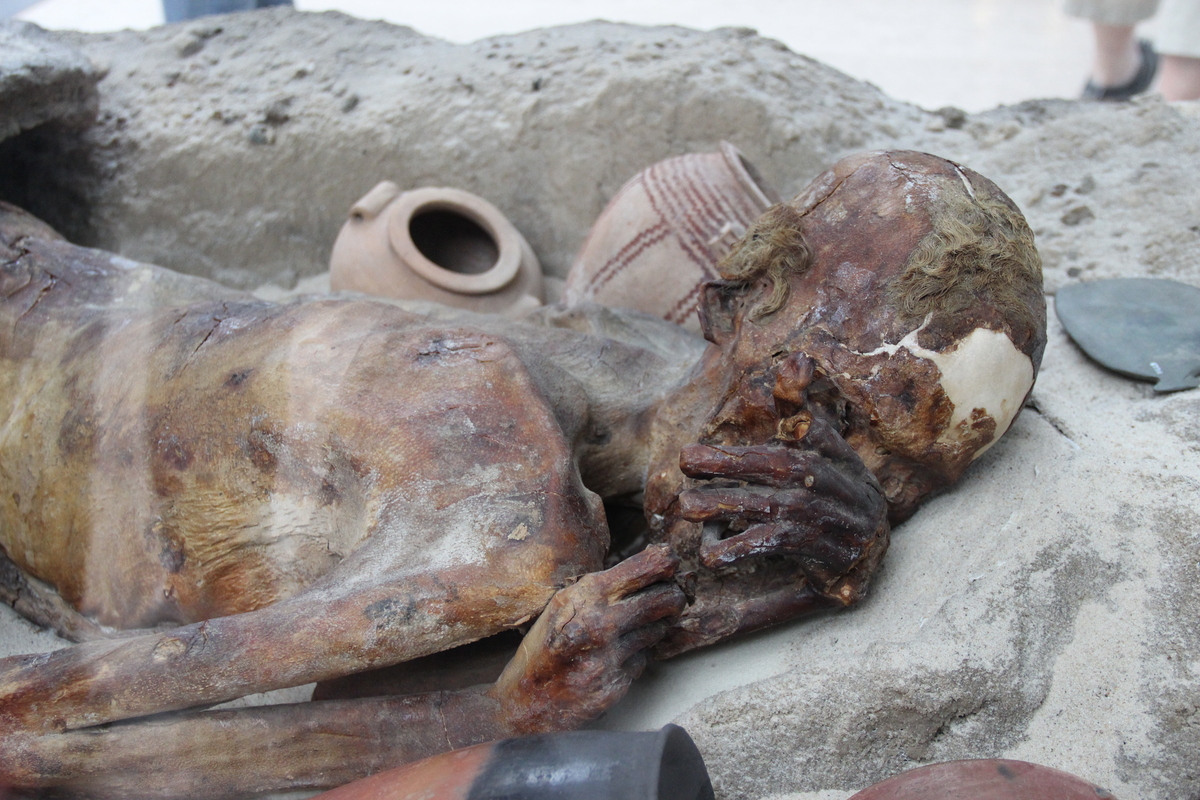
On the site, archaeologists uncovered a genuine predynastic cemetery. Several individuals lie there in flexed position, that is, crouched, the body contracted, the knees drawn up towards the chest. This posture, very common at the time, is no accident: it may evoke the position of the foetus, or simply an economical way of digging a pit. The bodies were wrapped in plant matting, woven from reeds or fibres, of which only largely decomposed traces remain today. These simple funerary gestures, without any grand architecture, speak of an already strong belief in some form of survival beyond death.
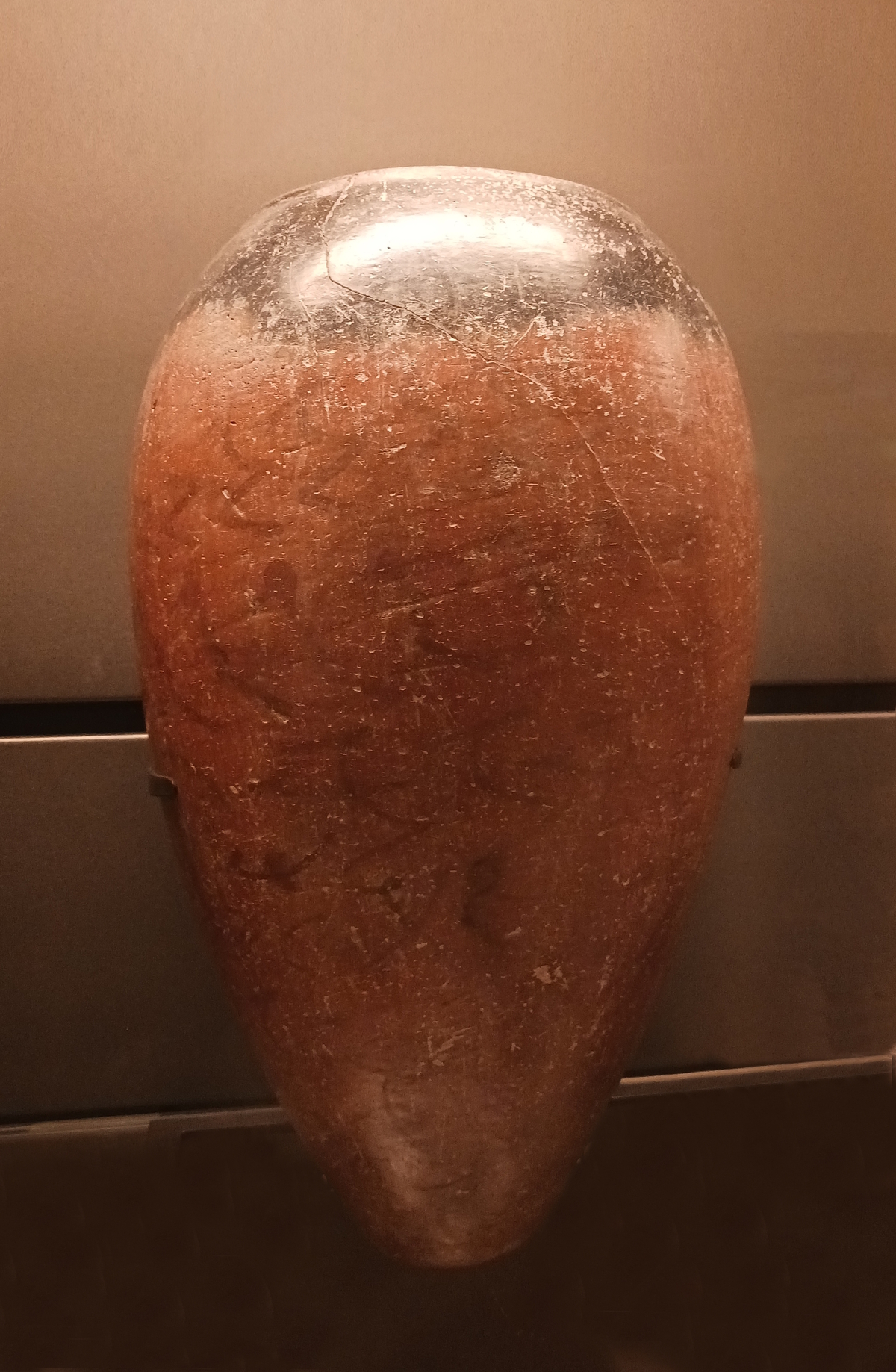
Alongside these dead, the pottery provides a precious chronological marker. Black-topped vessels were found there, the famous black-topped wareBlack-topped wareRed pottery with a blackened rim and top, typical of the Naqada cultures; frequently placed in Predynastic graves.→: reddish pottery whose upper rim, blackened during firing by a mastered technique, forms a sharp and elegant contrast. These vessels are the signature of the Naqada cultureNaqada culturePredynastic cultures of Upper Egypt (c. 4000 to 3100 BCE), divided into Naqada I, II and III phases, that paved the way for unification and the pharaonic state.→, named after an Upper Egyptian site that gave its framework to the entire predynastic sequence. At Jabal al-Tayr, the examples discovered belong to the Naqada II and Naqada III phases, that is, to the centuries immediately preceding unification.
This detail is far from merely technical. The Naqada culture, through its successive phases, tells of the rise of elites, the growth of long-distance exchange, the specialisation of craftsmen and the gradual emergence of an iconography of power. It was in this crucible that everything which would become pharaonic Egypt was forged. To find Naqada II and III pottery at Jabal al-Tayr is therefore to touch the very roots of the civilisation, at a moment when it did not yet have a name.
The flexed position, the matting, the black-topped vessels: this ensemble composes a coherent and recognisable picture of funerary practices at the end of the predynastic. Nothing unprecedented in itself, but a precious confirmation, on a site where these burials sit, a few centuries later, alongside tombs of an entirely different architectural ambition. It is this superimposition that makes Jabal al-Tayr an open-air laboratory of the transition towards the state.
It would be wrong to regard these modest burials as mere preliminaries of little interest. They carry in embryo everything that would follow. The care given to the orientation of the bodies, the choice of matting, the placing of pottery beside the deceased: each gesture reflects an already structured thinking about death and the afterlife. The Egyptians of the late predynastic clearly believed that the dead needed goods and special treatment to continue their existence. This conviction, still embryonic, would expand spectacularly over the dynasties, up to the sumptuous funerary equipment of the great pharaohs.
Black-topped ware deserves a further moment of attention, so emblematic is it. Its manufacture implied a fine mastery of fire: the body of the vessel, rich in iron oxide, fired to red, while the top, buried in ashes or deprived of oxygen at the end of firing, turned deep black. This contrast was not accidental but deliberate, aesthetic. It bears witness to craftsmen capable of precisely controlling firing conditions, at a time when Egypt did not yet have kings. To find such objects at Jabal al-Tayr is to find the signature of a world that already knew how to combine technique and beauty.
Unification and the birth of the state: from Naqada to Narmer
Between the village mosaic of the predynastic and the monumental tombs of the Early Dynastic period, a decisive event took place: the unification of Egypt. Tradition, supported by famous documents, places around the year 3000 BC the union of Upper and Lower Egypt under a single authority. This is what the Narmer palette seems to commemorate, that great carved schist object on which a king, crowned now with the crown of the South, now with that of the North, symbolically strikes his enemies. This founding document marks, in the popular imagination, the passage from prehistory to history.
The reality was doubtless more gradual than a single burst of glory. Unification was the outcome of a long process of competition and absorption between rival chiefdoms, dominated little by little by the centres of Upper Egypt, around sites such as Hierakonpolis, Naqada and Abydos. The elites of these cities imposed their culture, their nascent writingWritingA system of conventional signs used to fix language or information durably; its appearance (c. 3300 BC) marks, by convention, the end of prehistory.→ and their symbols of power on the whole valley. By the time the First Dynasty emerges, Egypt is already, in essence, a coherent territorial kingdom, equipped with an administration and a royal ideology.
It is precisely in this phase, known as the Early Dynastic periodEarly Dynastic (Thinite) periodEgypt's first two dynasties (c. 3100 to 2700 BCE), named after Thinis, with the royal tombs of Abydos; the hinge between the Predynastic and the Old Kingdom.→ (from Thinis, the supposed city of origin of the first kings), that the two major tombs of Jabal al-Tayr belong. They therefore date from the moment when the Egyptian state had just taken shape, when the codes of kingship were being fixed, when the great royal necropolises of Abydos were beginning to receive the rulers of the First Dynasty. To understand these tombs is to understand how a young state translated its power into stone.
The link with Abydos is here crucial. It is in the necropolis of Umm el-Qaab, at Abydos, that the first pharaohs rest, including that King Den to whom the tombs of Jabal al-Tayr are compared.2 To find, in a necropolis of Middle Egypt, architectural choices close to those of the great royal cemetery of the South, is to bring to light a circulation of know-how and models across the country. Political unification was accompanied by a unification of forms, by a common architectural vocabulary that spread along the Nile.
It is worth recalling that the birth of the Egyptian state produced not only kings and armies, but also an administration, a writing system and an unprecedented capacity to organise labour. To build a tomb with sloping walls, reinforced with wood, carefully fitted, requires mobilising resources, coordinating teams, planning a construction site. These are state competences. The Early Dynastic tombs of Jabal al-Tayr are therefore not only architectural objects: they are the material reflection of a society learning to concentrate and direct collective effort, the very condition of every great construction to come.
This founding period remains, despite its capital importance, one of the least well known in Egyptian history. Remains are scarce there, often damaged, and written sources almost non-existent or difficult to decipher. Every newly and properly excavated protodynastic tomb is therefore a scientific event. It brings fresh data on a phase in which the great codes of pharaonic civilisation were fixed for three thousand years: divine kingship, hieroglyphic writing, official art and, precisely, monumental funerary architecture.
The two Early Dynastic tombs, the heart of the discovery
Let us come to the heart of the matter. The two protodynastic tombs of Jabal al-Tayr constitute, by the excavators' own admission, the most important elements of the discovery. Not for their wealth in precious objects, but for what they reveal about construction methods from more than five thousand years ago, a field on which information remains extraordinarily rare.
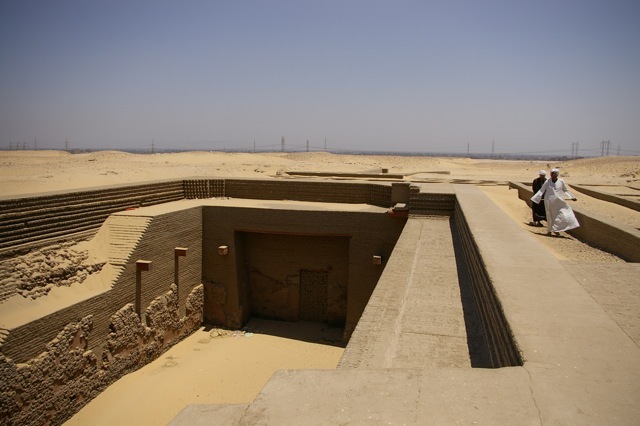
The first tomb displays a striking feature: its walls are markedly thicker at the base and taper gradually towards the top. Architects speak of battered walls, a technique in which the wall inclines slightly inward as it rises. For the researchers, this detail is not decorative: it reflects an early engineering concern, a way of ensuring the stability of the whole by lowering the centre of gravity and better distributing loads. Yet this very principle is the one that would later be found, multiplied, in the step pyramidsStep pyramidEgypt's first great stone monument, raised for King Djoser at Saqqara by Imhotep (Third Dynasty), by stacking diminishing mastabas.→ and then in the true smooth-faced pyramids.
The tomb has unfortunately suffered. In later periods, stone blocks were removed from it to be reused elsewhere, a common practice in ancient and medieval Egypt, where old monuments readily served as quarries. This exploitation partly damaged the structure. But it did not erase everything, and what remains is precious. On the stone, archaeologists noted traces of oxide lines, linked to the ancient techniques of cutting and extracting the blocks: genuine imprints of the gestures of the third-millennium stonemasons.
Another remarkable discovery: the presence of large wooden supports. Some of these reinforcements ran the entire length of the walls, others had been installed in sections, like so many stretches of localised consolidation. This recourse to wood, a rare and precious material in an Egypt largely devoid of great forests, says much about the care taken in construction and the ingenuity of the builders, who combined stone and timber to stabilise their structures. Few tombs of such antiquity have yielded such concrete clues about how people built at the time.
The second tomb, located to the south of the first, offers in some sense its mirror image. Its plan is almost identical, but it has been far better preserved, largely spared from looting and stone removal. This exceptional preservation has allowed researchers to study in detail the original elements: the arrangement of spaces, the masonry, the placement of the reinforcements. Where the first tomb reads in negative, through its scars, the second offers itself almost intact.
The comparison between the two tombs, and with other burials of the same period, opens fruitful perspectives. It suggests a genuine transfer of know-how between regions, a transmission of techniques and constructional solutions from one worksite to another. One senses teams of builders sharing tested recipes, models that travel, a common technical culture in the making at the scale of the kingdom. This may be the most profound contribution of Jabal al-Tayr: to reveal not an isolated monument, but a networked system of practices.
From battered walls to pyramids: an evolution in motion
This is where words must be handled with care. The announcement of the discovery has sometimes been presented as a rewriting of the origins of the pyramids. The formula is seductive, but it deserves qualification. What Jabal al-Tayr shows is not a total upheaval of our understanding, but a precious milestone that illuminates an evolution already well known to Egyptologists.3
The classic grand narrative unfolds as follows. At the origins, there is the simple pit and the modest tomb. Then appears the mastabaMastabaAn early Egyptian flat-roofed tomb with sloping sides, the architectural ancestor of the pyramid.→, that low structure with a flat roof and sloping walls, which covers the burial chamber and shelters the offerings: the word comes from Arabic and designates the earthen bench in front of houses, so much does the form resemble it. Mastabas of mudbrick, then of stone, multiply in the Early Dynastic period for elites and kings. They constitute the architectural matrix from which everything would develop.
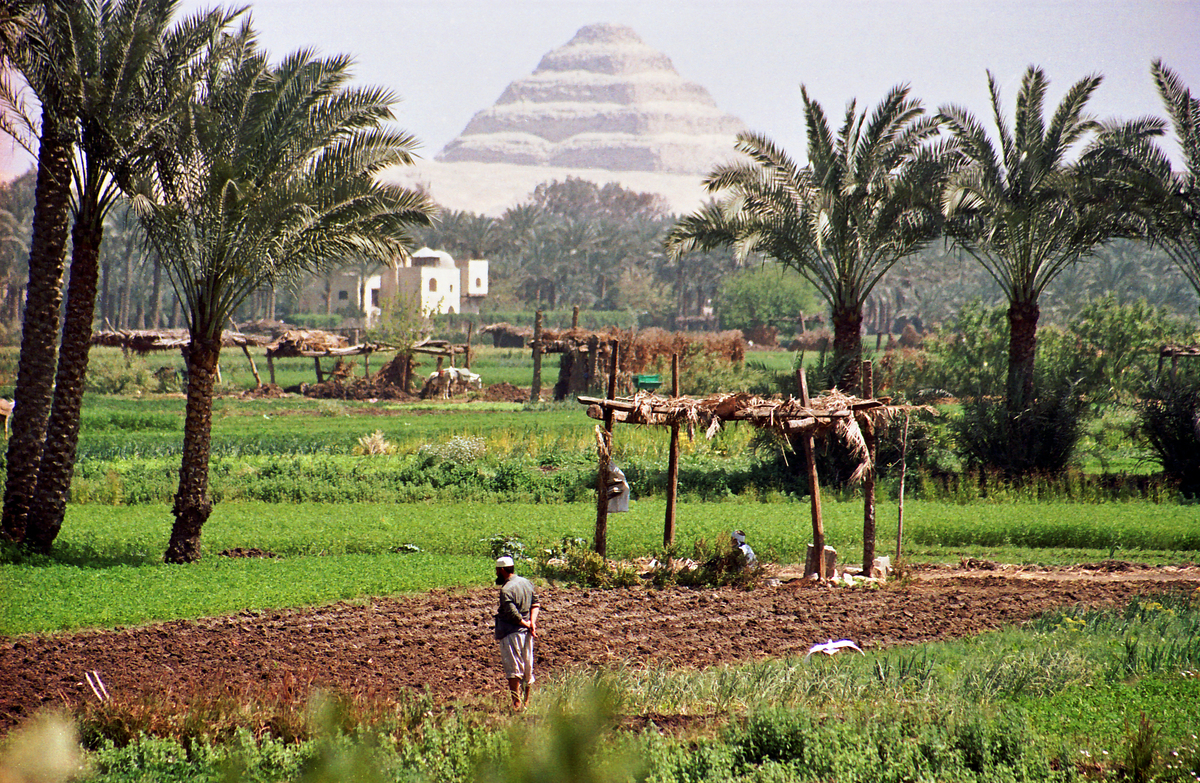
The decisive leap occurs in the Third Dynasty, at Saqqara, with King Djoser and his brilliant architect Imhotep. By stacking several mastabas of decreasing size, these builders invented the step pyramidStep pyramidEgypt's first great stone monument, raised for King Djoser at Saqqara by Imhotep (Third Dynasty), by stacking diminishing mastabas.→, the first great monument entirely of dressed stone in human history. The idea is of dizzying simplicity: to pile up in order to rise towards the sky, to transform the horizontal tomb into a staircase to the beyond. From there, it would take only one step, taken under Sneferu at the start of the Fourth Dynasty, to fill in the steps and obtain the smooth-faced pyramids, at Meidum then at Dahshur, before the apogee of Giza.
Where, in this long chain, do the tombs of Jabal al-Tayr belong? Right at the beginning, among the first links. Their battered walls, thicker at the base, testify to a fundamental intuition: to build high and durable, one must broaden the base and incline the walls. This is exactly the principle that the step pyramid would carry to its climax a few generations later. By documenting this intuition at the scale of a protodynastic tomb, Jabal al-Tayr shows us one of the first moments when the Egyptians reasoned as engineers of stability.
It would therefore be excessive to say that these tombs change our vision of the pyramids. It is more accurate, and more faithful to the facts, to say that they add a concrete piece to a puzzle whose broad outlines we already knew. They materialise, with their battered walls and their wooden reinforcements, a stage that until now could only be surmised. And that is already considerable, so fragile and rare are the remains of this remote period.
This evolution, moreover, was neither linear nor inevitable. It proceeded by trials, by fumbling, by successes and failures. The pyramid of Meidum, part of whose casing collapsed in antiquity, reminds us that the builders sometimes learned at their own expense. Between the inclined walls of a protodynastic tomb and the geometric perfection of the great pyramid of Khufu, it would take generations of experimentation, of empirical calculation, of correction. Jabal al-Tayr places us at the very beginning of this adventure, at the instant when the intuition of stability begins to translate into stone, long before the perfect triangle imposed itself as the sovereign form of royal tombs.
Wood, oxide and the hand of the builders
Beyond the grand narrative of the pyramids, the Jabal al-Tayr discovery is valuable for its technical details, those small clues that are the very salt of archaeology. For reconstructing how people built five thousand years ago is often a matter of meticulous investigation, in which every trace counts.
Take the oxide lines noted on the stone. These marks, linked to the ancient techniques of cutting and extraction, are so many fossils of labour. They inform us about how the blocks were detached from the parent rock, cut and adjusted. In a context where we possess no construction manual, no written plan from that era, such material clues are worth their weight in gold. They make it possible to work back, by deduction, to the tools and gestures of the workers.
The large wooden supports constitute the other great revelation. Their presence, in two different forms, deserves a pause. On the one hand, beams that ran the entire length of the walls, ensuring overall cohesion. On the other, reinforcements installed in sections, localised, probably placed at the most stressed points. This dual strategy reveals a practical understanding of mechanical constraints: the builders knew where the structure risked giving way, and adapted their reinforcements accordingly.
One must gauge what wood represented in ancient Egypt. The country cruelly lacked large tree species, and timber was often imported at great cost, notably cedar from Lebanon for the most prestigious uses. Using wood in quantity in a tomb was therefore no small matter: it meant committing a rare resource, a sign of the importance attached to the structure and its occupant. The timber framework was not a stopgap, but a considered technical choice, integrated into the very design of the tomb.
From all these elements emerges the image of a mastered worksite, where stone and wood complemented one another, where the value of a broad base and inclined walls was understood, where people knew how to consolidate in the right places. None of this is a matter of improvisation. We are in the presence of builders who had already accumulated knowledge, who transmitted and improved it. Jabal al-Tayr restores their presence to us for a moment, through the traces they left on stone and in wood.
These details, modest in appearance, are worth many treasures. They remind us that the history of great human achievements is played out first in the workshop and on the building site, in the repeated gesture of the craftsman, in the slow invention of technical solutions. The pyramids of Giza, admired the world over, would never have arisen without this long accumulation of know-how of which Jabal al-Tayr preserves some of the very first witnesses. To understand how people cut, wedged and consolidated five thousand years ago is to go back to the very sources of Egyptian architectural genius, to that fragile moment when experience began to turn into transmissible tradition.
A funerary landscape over the long term
If the Early Dynastic tombs are the stars of the discovery, they must not eclipseEclipseThe passing of one celestial body into the shadow of another, for instance the Moon hiding the Sun or the Earth casting its shadow on the Moon.→ the other great lesson of Jabal al-Tayr: the remarkable continuity of its funerary use. The site was not occupied for a moment and then abandoned. It served as a necropolis over several millennia, crossing the great phases of Egyptian history like an unbroken thread.
The predynastic burials and the protodynastic tombs are indeed followed, much later, by burials of the Late Period. Archaeologists uncovered there individual and collective tombs, some of which still contained the remains of wooden coffins. These late burials, separated from the Early Dynastic tombs by more than two millennia, prove that the place retained, in the eyes of the population, a lasting funerary vocation. People came back to bury their dead there long after the great early tombs had been built, and sometimes looted.
This longevity makes Jabal al-Tayr a condensed history of Egypt. As one descends into the ground, one also descends into time: the layers succeed one another, from the predynastic to the Late Period, each with its tomb forms, its objects, its gestures. It is a rare privilege to have at hand, in a single site, such a sequence. Where other necropolises illuminate only one period, this one recounts the evolution of practices over almost the entire span of pharaonic civilisation.
The interest of such a palimpsest goes beyond mere accumulation. By comparing the burials of the different eras, researchers can follow the transformations of beliefs and rites: the appearance of coffins, the evolution of body positions, the changes in funerary furnishings, the first steps of mummification. Each stratum dialogues with the others. The necropolis becomes a book whose pages are turned by excavating, from the oldest to the most recent.
The ministry, moreover, took care to stress that the excavations are continuing. Jabal al-Tayr has not yet yielded all its secrets, and it is likely that future campaigns will refine, correct or enrich the current picture. Such is the nature of a living archaeology: every discovery opens as many questions as it closes, and calls for patience as much as for enthusiasm.
This continuity also raises a fascinating question: why did this precise place exert such attraction, century after century? Collective memory doubtless has much to do with it. A site already sanctified by the tombs of the ancestors becomes a privileged place to lay one's own dead, as if the proximity of ancient burials conferred a form of protection or legitimacy. To this are added practical reasons: ground recognised as suitable, soil adapted to digging, a location sheltered from floods. Beliefs and material constraints combine to explain the fidelity of the population to this promontory.
The Late Period tombs, with their wooden coffins, mark the culmination of this long story. They bear witness to funerary practices already very far removed from those of the predynastic: the body is no longer simply folded in matting, but protected, sometimes treated, placed in an elaborate container. Between the crouched burial wrapped in fibres and the interment in a coffin, several millennia of evolving beliefs and techniques can be read on a single site. Few sites offer such amplitude, and this is what makes Jabal al-Tayr a true observatory of Egyptian death over the long term.
Abydos, Umm el-Qaab and King Den: the model of the South
To grasp the full significance of the connection drawn by the researchers, one must make a detour via Abydos, several hundred kilometres south of Minya. It is there, in the necropolis of Umm el-Qaab, that the very first kings of Egypt were buried, those of the First and Second Dynasties. This royal cemetery, long regarded as the cradle of the pharaonic monarchy, has yielded increasingly elaborate mudbrick tombs, surrounded by subsidiary pits and by stelae bearing the names of the rulers. Abydos is, in a sense, the original laboratory of Egyptian royal funerary architecture.
Among these kings, Den holds a place apart. A ruler of the First Dynasty, he reigned long and his reign is associated with important innovations. His tomb, at Umm el-Qaab, is remarkable for several features: an access by a descending staircase, a floor partly paved with granite from Aswan, and a design that testifies to a growing concern for monumentality and durability. This burial is often cited as a milestone in the passage from the simple pit to great structured tombs. It is precisely with this kind of achievement that the tombs of Jabal al-Tayr display, according to the first studies, strong affinities.
What does this parallel mean? It does not mean that the Minya tombs are copies of Den's, nor that they are contemporary with it to the day. It indicates rather that common principles, a single architectural grammar, spread across the unified kingdom. The builders of Jabal al-Tayr, whether they were local craftsmen trained according to shared canons or teams that had travelled, applied solutions akin to those of the royal necropolis of the South. This is the tangible sign of a common technical culture, carried by the new state.
This diffusion of models is one of the great enigmas, and one of the great stakes, of the archaeology of the Early Dynastic period. How is know-how transmitted over such distances, in a world without printed plans or schools of architecture? Through the movement of craftsmen, doubtless, through the imitation of prestigious achievements, through a central administration capable of commissioning works according to recognised standards. Jabal al-Tayr, by offering a concrete point of comparison far from Abydos, brings a precious piece to this file. It shows that the province was not cut off from the centre, but participated fully in the elaboration of a royal architecture.
One must nonetheless remain cautious: the studies of these two tombs are only at their beginnings, and the connections with Den's tomb call to be refined, measurement after measurement, comparison after comparison. It is the patient work of archaeology to verify, to qualify, sometimes to correct first impressions. But the mere prospect of such a dialogue between Middle Egypt and the great royal cemetery of Abydos is enough to make Jabal al-Tayr a site of primary importance for understanding the formation of pharaonic Egypt.
What Jabal al-Tayr teaches us, and what it still keeps silent
At the end of this journey, what assessment can be drawn from the discovery? First, a certainty: Jabal al-Tayr is a major site, not for the brilliance of treasures which, for now, are not the point, but for the quality of the information it yields about poorly documented eras. To document construction methods from more than five thousand years ago, to grasp the circulation of architectural ideas at the dawn of the state, to follow the continuity of a funerary landscape over millennia: these are considerable contributions.4
Next, an invitation to proper measure. The tombs of Jabal al-Tayr do not, on their own, rewrite the history of the pyramids. They fit into a solid interpretive framework, the one linking the early tombs to the mastabas, then to the step pyramids, then to the smooth-faced pyramids. Their merit is to illuminate, to materialise, to make tangible an evolution known in its broad outlines but which often lacked concrete witnesses for its very first moments. In this sense, they are a milestone, not a revolution.
The comparison with the tomb of King Den at Abydos illustrates this dual reach well. It attaches Jabal al-Tayr to the great royal framework of the First Dynasty, while highlighting the originality of a Middle Egyptian site that adopts, adapts and diffuses these models. One reads there at once the cultural unity of the young kingdom and the vitality of its provinces, two dimensions rarely grasped with such clarity on a single terrain.
There remain the silences, numerous, that the excavation has not yet filled. Who were the occupants of these two Early Dynastic tombs? What rank, what function did they hold in the society of their time? How exactly did the construction techniques observed relate to those of the great worksites of Abydos or Saqqara? So many open questions, which the coming campaigns will attempt to resolve. Archaeology, here as elsewhere, advances by cautious hypotheses and patient verifications.
It is worth insisting on this modesty of method, which is the strength rather than the weakness of the discipline. Sensational headlines fade quickly; carefully measured stones endure. The true value of Jabal al-Tayr will be measured not by the noise of its announcement but by the slow, cumulative work of comparison, dating and analysis that now begins. Each wooden beam, each oxide line, each fragment of black-topped ware will be catalogued, cross-checked against finds from other sites, and woven into the wider story of early Egypt. That unglamorous labour is precisely how a single provincial necropolis can, in time, sharpen our picture of one of humanity's most formative moments.
There is something profoundly moving in this necropolis on the east bank of the Nile. Beneath its limestone hills, it has kept, for five thousand years, the memory of the very first gestures of a people in the process of inventing itself. In reopening these tombs, the Egyptian archaeologists do not merely dust off old stones: they take up again the thread of a history of which each of us, in a certain way, is a distant heir. Jabal al-Tayr, the mountain of the bird, watched over this treasure of knowledge. It is only just beginning to speak.
J'avais pas réalisé que c'était aussi compliqué. Maintenant j'ai envie de visiter des sites.