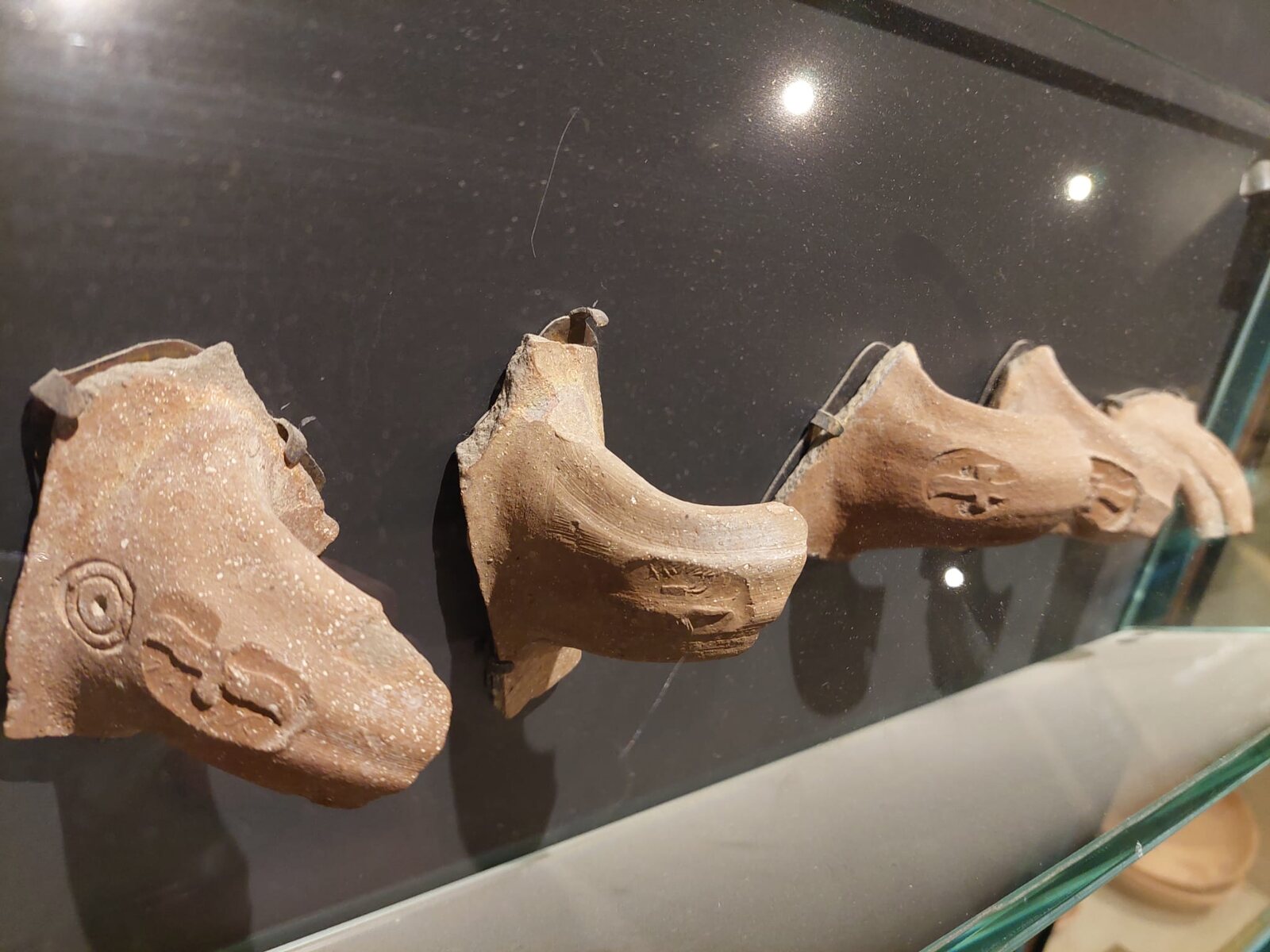
In the storerooms of Jerusalem's museums lies a category of object no one would ever have thought to question about the physics of the Earth's core. They are jar handles: fragments of coarse pottery, broken, anonymous to the untrained eye, and yet stamped with a small sealSealA small engraved object (often steatite) used to stamp a mark in clay; the Indus seals, bearing animals and signs, attest to administration and trade, though their script remains undeciphered.→ bearing four palaeo-Hebrew letters. Those letters read LMLKLMLKA type of royal seal impression (four palaeo-Hebrew letters meaning "to/of the king", la-melekh) stamped on the handles of storage jars from the Kingdom of Judah in the 8th-7th centuries BC, as part of an administrative and taxation system.→, that is la-melekh, "to the king". For more than a century, archaeologists studied them for what they revealed about the Kingdom of Judah: its administration, its taxation, its wartime logistics in the face of Assyria. But for some years now, a team of Israeli geophysicists and archaeologists has been asking them an entirely different question. No longer "what do these jars tellTellAn artificial mound formed by the accumulation of successive layers of settlement remains at the same spot, typical of the Near East. Each destruction-rebuilding event adds a stratum.→ us about the king of Judah?", but "what do they tell us about the Earth's magnetic field twenty-seven centuries ago?". And the answer, read in the firing of the clay, has proved extraordinary.
For these ordinary vessels turned out to be measuring instruments of unexpected precision. At the moment the potter sealed the kiln and the clay cooled, it froze into its mineral structure a faithful imprint of the orientation and intensity of the geomagnetic field prevailing at that place, at that instant. Multiplied across hundreds of handles, dated one after another thanks to the very evolution of the royal seals, this imprint made it possible to reconstruct, decade by decade, the variations of the Earth's field above Judah between the eighth and the second century before our era. It is one of the finest and best-dated records that science possesses today for that epoch1. Along the way, these potsherds confirmed the existence of a baffling phenomenon that has been named the "Levantine Iron Age geomagnetic anomaly", and they offered excavators a new clock with which to date the layers of destruction, the fires and the wars that have punctuated the history of the region.
This article tells how a handful of broken handles became an open-air geophysics laboratory. To do so, we shall need to understand what the Earth's magnetic field is and why it moves, by what mechanism fired clay retains its memory, how the royal seals of Judah furnish dating of rare precision, and finally why this Levantine anomaly so troubles specialists of the terrestrial core. We shall see that biblical archaeology and the physics of the Earth's depths kept, for the duration of this investigation, an appointment around a single potsherd.
The Earth's magnetic field and its variations
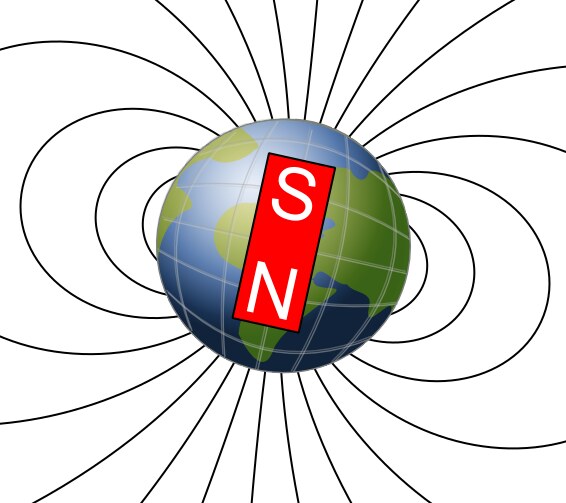
Our planet is, in essence, a gigantic magnet. This magnetic field does not arise from a block of magnetised iron hidden at the centre of the globe, the heat there forbids any permanent magnetisation, but from a far more dynamic mechanism: the terrestrial dynamo. In the outer core, more than 2,900 kilometres beneath our feet, an ocean of liquid iron and nickel, scorching and electrically conducting, is in perpetual motion. The heat slowly escaping from the inner core drives convection currents; combined with the Earth's rotation, these currents generate and sustain a planetary-scale magnetic field. It is this field that deflects the charged particles of the solar wind, paints the polar auroras and orients the compass needle.
One must grasp the magnitudes at play to appreciate the feat that the dynamo represents. The outer core is a shell of liquid metal more than two thousand kilometres thick, raised to temperatures of the order of four to five thousand degrees and subjected to colossal pressures. This fluid conducts electricity well enough that the motions of the matter drag the magnetic field lines along with them, and that the field, in return, constrains those motions: a subtle coupling becomes established between hydrodynamics and magnetism, which physicists describe through magnetohydrodynamics. From this entanglement is born a broadly dipolar field, that is, resembling to a first approximation that of a bar magnet aligned, very nearly, with the Earth's axis of rotation. But this dipole is only a convenient average: on a smaller scale, the real field is bumpy with irregularities, with patches of more intense flux here, weaker there, which drift slowly across the surface of the core and reconfigure themselves over the centuries.
For a long time this field was imagined as a stable quantity, a fixed bearing to rely upon. It is nothing of the sort. The geomagnetic field is on the contrary remarkably unstable, on every timescale. The magnetic north pole moves by several tens of kilometres a year and has, over the past century, travelled a long path from the Canadian Arctic towards Siberia. The global intensity of the field is currently decreasing by about five per cent per century. On still longer scales, the field can weaken to the point of almost vanishing, then rebuild itself by completely reversing its polarity: what is called a geomagnetic reversal, in which magnetic north and south swap places. The most recent dates back about 780,000 years.
Between these two extremes, the yearly twitches and the great reversals every few hundred thousand years, lies a whole register of so-called secular variations, unfolding over decades or centuries. It is precisely these variations that interest archaeomagnetismArchaeomagnetismDating based on the magnetism frozen into fired materials (pottery, hearths), which record Earth's magnetic field as they cool.→, for they take place on the timescale of human civilisations. The intensity of the field can, at a given point on the globe, rise or fall sharply within a few generations, and its direction, declination and inclination, can swing by several degrees. The difficulty, for anyone wishing to study these fluctuations in the past, is that direct instrumental measurements of the magnetic field have existed only since the nineteenth century, and in a truly systematic way for even less time. To reach further back, one needs natural or human archives that recorded the field unwittingly.
Such archives exist. Volcanic rocks, as they cool, preserve the trace of the field; marine and lake sediments keep a more diffuse memory of it; and, more preciously still for the historian, any clay object that human hands carried into the fire. Bricks, tiles, potters' kilns, hearths, the walls of metallurgical furnaces and, of course, pottery: each of these fired materials bears within it a magnetic snapshot of the moment of its making. It is on this principle that the whole adventure of the Jerusalem jars rests2.
The principle of archaeomagnetism: thermoremanence
How can a piece of clay "remember" the magnetic field that prevailed at the moment of its firing? It all comes down to a physical phenomenon called thermoremanent magnetisation. Clay contains, in small quantity, ferromagnetic minerals, mainly iron oxides such as magnetite and haematite. Each of these mineral grains behaves like a tiny magnet endowed with its own orientation. In raw clay these countless little magnets point every which way, in disorder, so that their effects cancel out and the paste shows no overall magnetisation.
Everything changes when the clay is heated. Each magnetic mineral possesses a critical temperature, called the Curie temperature, around 580 °C for magnetite, up to nearly 680 °C for haematite, above which it loses all magnetisation and becomes magnetically "free". In the potter's kiln, which commonly reaches 700 to 900 °C, all these grains cross their Curie point: their orientations are reset to zero. Then comes the cooling. As the temperature falls back below the Curie point, each grain recovers its magnetic capacity, and at the precise moment it recovers it, it aligns with the ambient magnetic field, that of the Earth, at that place, at that hour. Once the clay has cooled, this orientation freezes and becomes extremely stable: it is thermoremanent magnetisation.
The fired object then preserves two crucial pieces of information. On the one hand the direction of the field, declination and inclination, provided one knows how the object was oriented during firing, a condition rarely met for a piece of pottery that was taken out of the kiln and then handled. On the other hand, and this is the most usable, the intensity of the field, or palaeointensity, which does not depend on the object's orientation. To measure it, palaeomagnetists use refined laboratory protocols, such as the Thellier method and its variants: the sample is heated and cooled in successive steps in a known laboratory field, and the magnetisation it thus acquires is compared with the one it originally bore. The ratio between the two yields the intensity of the ancient field2.
The principle seems simple; its implementation far less so. The Thellier method rests on the assumption that the magnetisation acquired by a sample is proportional to the field in which it cooled: by having it acquire a known magnetisation in the laboratory, one works back by proportion to the ancient intensity. But the minerals carrying the magnetisation must not have altered since antiquity, nor during the repeated heatings of the measurement. To make sure of this, experimenters interleave "checks": they return to temperature steps already traversed to verify that the sample faithfully reproduces its earlier behaviour. The slightest deviation betrays a chemical transformation and condemns the measurement. To this are added delicate corrections, such as that of anisotropy, the clay grains, stretched during the potter's shaping, do not acquire magnetisation in the same way in every direction, or that of the cooling rate, faster in the laboratory than at the bottom of an ancient kiln. Each jar handle thus demands dozens of measurements and several days of work to arrive at a single value of ancient intensity, together with its margin of uncertainty.
Archaeomagnetism is therefore not an immediate reading: it is a demanding experimental discipline, in which each sample is cut, measured, heated in several stages, checked against mineralogical alteration. A grain that chemically transformed during the laboratory heatings would distort the measurement; unstable samples are therefore rejected without mercy. It is at the price of this rigour that fired clay becomes a true fossil magnetometer, able to recover the field of two or three thousand years ago to within a few per cent.
The LMLK jars and fine dating
Any record of the ancient field is worth, however, only as much as the precision with which it can be dated. A magnificent palaeointensity measurement floating in an uncertainty of two centuries teaches almost nothing about the field's rapid variations. It is here that the jars of Judah deploy their decisive advantage, and that archaeology comes to the rescue of geophysics.
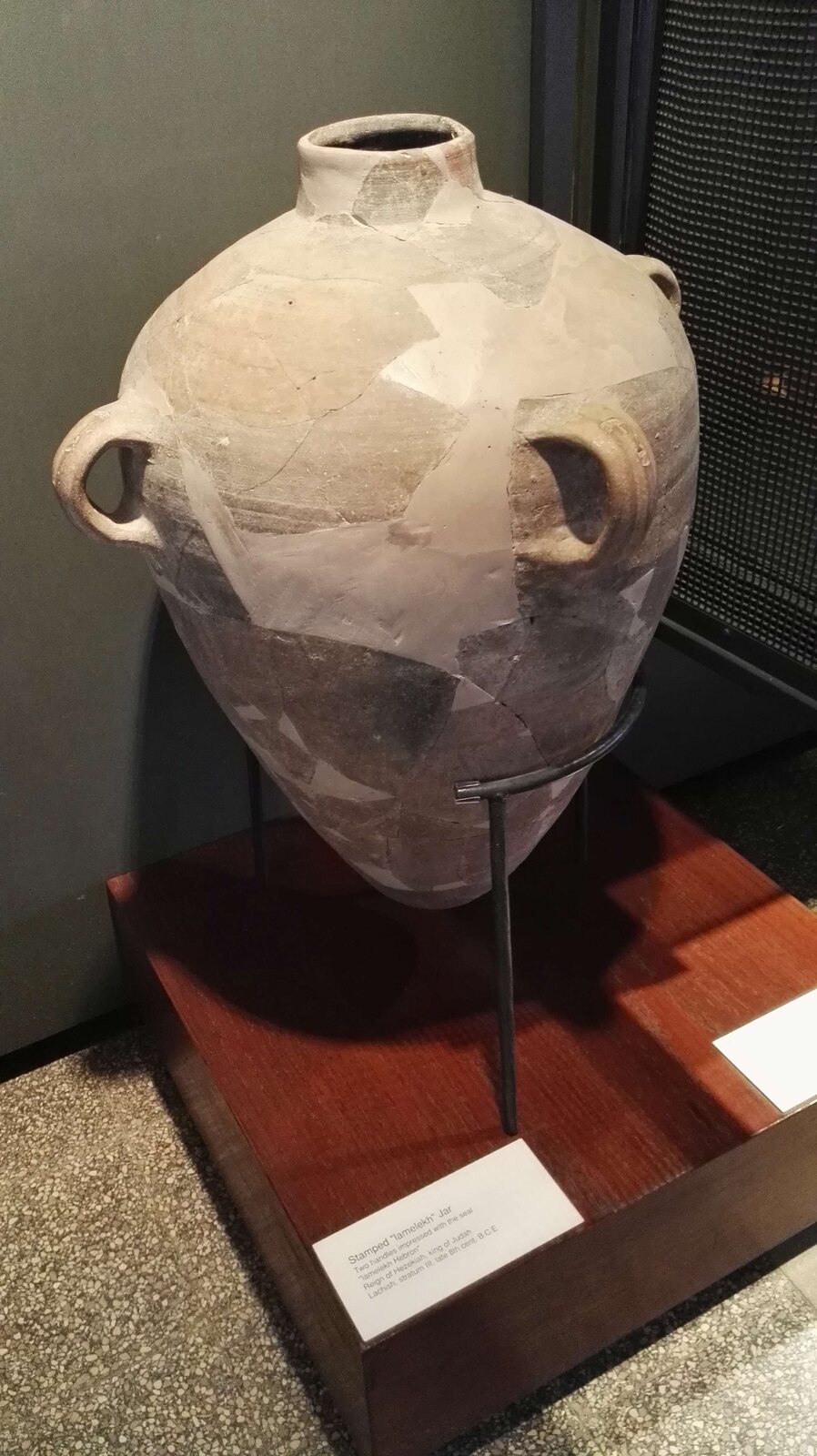
In the Kingdom of Judah, from the end of the eighth century before our era, the royal administration set up a vast system of standardised storage jars, intended probably for the collection and redistribution of commodities, oil, wine, grain, within a fiscal and military framework. On the handles of these jars, while the clay was still soft, an official seal was pressed. The most famous is the LMLK seal, "to the king", often accompanied by an emblem, a four-winged scarab or a winged solar disc, and the name of one of the four administrative towns. Later other types of seal would appear: rosette stamps, then, in the Persian and Hellenistic period, yehud stamps of the province of Judah. Some two thousand impressions of this kind have been catalogued1.
The historical context of this jar system is not trivial, for it explains its tight dating. Towards the end of the eighth century before our era, the Kingdom of Judah, a restive vassal of the Assyrian empire, was preparing for confrontation under the reign of King Hezekiah. The mass production of standardised jars stamped "to the king" probably belongs to this organisational effort, whether to supply strongholds, centralise commodities or levy a tax in kind. The Assyrian riposte came in 701 before our era: King Sennacherib swept across Judah, besieged and destroyed numerous cities, including powerful Lachish, and threatened Jerusalem itself. This break of 701 clearly separates the so-called early LMLK impressions from the late ones, offering archaeologists a solid chronological marker. It is this embedding of the pottery within a precise political fabric that turns a simple administrative seal into a genuine dating label.
Now, and this is the crucial point, the typology of these seals evolves over time and attaches to well-identified political phases. The "early" LMLK precede the great campaign of the Assyrian king Sennacherib against Judah, in 701 before our era, which ravaged in particular the city of Lachish; the "late" LMLK correspond to the following period, under Assyrian administration, in the seventh century. The rosette seals refer to the last decades of the kingdom, before the fall of Jerusalem; the yehud stamps span the Persian and Hellenistic centuries. Each family of seals therefore provides a tight dating bracket for the firing of the jar that bears it, far more precise, at times, than a radiocarbonRadiocarbon (carbon-14)A dating method based on the decay of carbon-14, usable back to about 50,000 years.→ date would be, whose resolution blunts precisely over this period.
By cross-referencing the palaeointensity measurement of each handle with the date conferred on it by its seal, the team from Tel Aviv University and the Hebrew University of Jerusalem was able to assemble a continuous sequence of geomagnetic intensity above Judah, spread over roughly six centuries, from the eighth to the second century before our era. Twenty-two groups of data, drawn from dozens of stamped handles, make up this record of unparalleled density for antiquity. For the best-documented periods, the resolution descends to a few decades: one can literally follow the magnetic field of the Kingdom of Judah strengthening, then sagging, from one generation to the next2.
The Levantine Iron Age anomaly
The great lesson of this record is the confirmation of an episode that geophysicists still cannot fully explain: the Levantine geomagnetic anomaly of the Iron AgeIron AgeThe last period of protohistoryProtohistoryThe transitional period between prehistory and history, covering societies without their own writing but known through external texts.→ (from c. 1200 BC in Europe and the Near EastNear EastA region of western Asia (Levant, Mesopotamia, Anatolia, Iran), cradle of the Neolithic revolution, agriculture, the first cities and writing.→), marked by iron metallurgyMetallurgyThe techniques of extracting and working metals (copper, bronze, gold); its rise in the Eneolithic and Bronze Age transformed tools, weapons and social hierarchies.→ and the first kingdoms.→. Between roughly 1050 and 550 before our era, the Earth's magnetic field above the Near East, the region corresponding today to Israel, Jordan, Syria and above all Iraq, experienced an exceptionally high intensity, with no known equivalent elsewhere on the globe for the same epoch. During these five centuries, the regional field held well above average, as if a bubble of intense magnetism had settled beneath the LevantLevantA region of the eastern Mediterranean Near East (Israel, Lebanon, Syria, Jordan), a major crossroads of the first human migrations out of Africa.→.
At the heart of this anomaly, the data reveal peaks of striking brutality. At the end of the eighth century before our era, the intensity reached heights that have been described as a "geomagnetic spike": the field there was almost twice as strong as it is today in the same region. More baffling still, the variations occurred at a speed that the classical theory of the terrestrial dynamo struggled to admit. The jars of Judah and the other fired materials of the Levant show that the intensity could vary by the order of twenty per cent in the space of only thirty years or so, a dizzying rate of change for a phenomenon believed to be necessarily slow, governed by the ponderous motions of an ocean of liquid metal1.
This rapidity has consequences that go beyond archaeology. It compels modellers of the terrestrial core to imagine processes capable of producing, on a regional scale, fluctuations far livelier than was thought. Today one invokes the existence of localised structures in the outer core, perhaps plumes or concentrations of magnetic flux rising towards the base of the mantle beneath a precise zone of the globe, which would move and dissipate relatively quickly. The Levantine anomaly would be the surface trace of one of these deep accidents. Understanding these structures is no academic luxury: it is partly on their behaviour that the field's capacity to protect us durably from cosmic radiation depends.
Why the Levant, and not some other region? The question remains open. The anomaly does not cover the whole globe at the same moment: it is a regional phenomenon, centred on the Near East, which rules out a simple overall variation of the terrestrial dipole. Geophysicists lean towards a cause lodged at the boundary between the core and the mantle, beneath this precise portion of the planet, perhaps a local upwelling of magnetic flux, an intense "patch" that grew and then migrated. The difficulty is that the core can be observed only indirectly, through the signature it imprints at the surface; each ancient archive, each dated jar, adds a pixel to an image that one reconstructs by groping. That is why a record as dense and as well calibrated as that of the Judahite handles has disproportionate value: it does not merely confirm the existence of the anomaly, it draws its shape in time.
The Jerusalem jars did not discover the anomaly on their own, other archives, notably Mesopotamian bricks bearing Babylonian royal inscriptions datable to the reign, came to attest it spectacularly in the Iraqi region, the geographical heart of the phenomenon. But the LMLK handles and their successors furnished one of its tightest chronologies, showing not only that the anomaly existed, but above all when it peaked and at what pace it unfolded and then subsided3.
The debate over a reversal of the poles
As soon as a region sees its magnetic field race away or, conversely, locally collapse, one question inevitably returns: are we witnessing the prelude to a reversal of the poles? The fear is old and tenacious, for we know that the Earth's field has already flipped hundreds of times over geological history, and that the steady weakening observed since the nineteenth century feeds the speculation. The Levantine anomaly, with its abrupt variations, has logically revived this debate.
One must, however, beware of conflations. The Iron Age anomaly was an episode of a very strong field, not of collapse: a field that strengthens spectacularly is not the typical scenario of a reversal, which generally begins with a prolonged drop in intensity. The Levantine peaks led, moreover, to no reversal; after their eighth-century summit, the regional intensity decreased without ever flipping, and the anomaly subsided towards the middle of the first millennium before our era. The episode illustrates rather the great variability of which the field is capable on a regional scale, without thereby announcing a planetary catastrophe.
That said, the phenomenon nourishes reflection on another object of contemporary concern, the South Atlantic Anomaly, a vast zone, above South America and the Atlantic, where the field is today abnormally weak and which hampers the operation of satellites. This modern anomaly might, too, be the expression of particular structures at the base of the mantle, and some researchers wonder whether or not it foreshadows a more general weakening. The lesson of the jars of Judah is here precious by contrast: it shows that an intense regional anomaly can be born, reach extreme values, then disappear within a few centuries without triggering a reversal. The geophysics of the core is made of these localised flare-ups that come and go, and of which the fired clay of antiquity has preserved for us a few precious specimens2.
It is also worth recalling what a reversal would really be, to distinguish it from ordinary fluctuations. During a reversal, the dipolar field collapses almost entirely over several thousand years, the surface field becomes chaotic, multipolar, with several temporary north and south poles scattered across the globe, then the dipole rebuilds itself the other way round. Nothing of the sort appears in the Levantine data of the Iron Age, which show on the contrary a vigorous field dominated by its dipole. The observed intensity peaks are the exact opposite of a prelude to a reversal. This distinction matters for the general public, often inclined to see in any magnetic anomaly the sign of an imminent cataclysm: the jars of Judah offer, on this point, a reassuring lesson in nuance.
Clay as a clock: destruction layers and fires
Archaeomagnetism does not merely record the past of the field: it can, in return, serve to date. The reasoning is reversible. Once a reference curve of the field's variations for a given region has been established from well-dated objects, one can take a fired object of unknown date, measure its palaeointensity, and sometimes its direction, and look for which epoch or epochs of the curve this value corresponds to. The fired clay then becomes a clock, and the very rapidity of the Levantine anomaly makes it a particularly precise clock: the faster the field varies, the narrower the time interval to which a given intensity value corresponds.
This clock finds an ideal field of application in a type of remain ubiquitous in the Near East: layers of destruction. The history of the region is a long succession of cities taken, burned, razed by the Assyrian, Babylonian or other armies. Now a violent fire constitutes, from the physicist's point of view, a full-scale heating experiment. When a city goes up in flames, its mudbricks, its floors, its clay walls are raised to very high temperature, cross their Curie point, then cool in place, without having moved. They therefore acquire a thermoremanent magnetisation in situ which records, this time, not only the intensity but also the complete direction of the field at the precise moment of the destruction.
The emblematic case is that of the destruction of Jerusalem by the Babylonians, traditionally placed in 586 before our era, which marks the end of the Iron Age in the Levant and the beginning of the exile. The fire layers of this event, excavated in the city, yielded a measurement, dated with rare precision, of the intensity and direction of the field at Jerusalem at that moment. This "signature" of 586 now serves as a reference anchor point for regional archaeomagnetism: any other burnt remain whose magnetic signature approaches that one can be brought close, in time, to the Babylonian destruction3.
Cross-checking with ancient texts
One of the most striking aspects of this research is the encounter between a raw physical datum, the magnetisation of a potsherd, and the rich corpus of ancient texts that document the history of the Levant. Few regions in the world offer such a conjunction. The Assyrian and Babylonian military campaigns are recounted both in Mesopotamian royal annals, in the biblical narratives and in external sources, which makes it possible to assign them dates sometimes narrowed to the year. When these "textual" dates can be confronted with the magnetic signatures of the corresponding destruction layers, archaeomagnetism and written history validate each other.
This confrontation has made it possible to settle old archaeological debates. The very dating and function of the royal stamped handles had long been a matter of discussion: to which precise phase of the kingdom should this or that type of seal be attached? The chronological anchoring provided by the magnetic reconstruction, and notably by the fixed point of 586, contributed to resolving some of these controversies by setting the sequence of seals against an independent temporal framework. Conversely, sites whose textual dating was disputed could be re-examined in the light of their magnetic signature: if the value recorded by a fire layer does not fit the date that had been advanced, it is a signal that the argument must be revisited1.
This back-and-forth between physical measurement and text also has a pedagogical virtue: it makes tangible the way in which a robust dating is built. No method taken in isolation suffices. Ceramic typology proposes one bracket, radiocarbon proposes another, archaeomagnetism a third, and royal annals or ancient narratives sometimes furnish a date to within the year. When all these independent estimates converge on the same time window, confidence grows; when they diverge, it is a call to dig deeper. The LMLK handles, dated by their seal, measured by their magnetisation, replaced within the thread of the Assyrian and Babylonian campaigns, illustrate to perfection this convergence of evidence that makes the strength of a chronology.
One must gauge the methodological reach of this dialogue. Archaeomagnetism brings information totally independent of pottery typologies and stratigraphic interpretations, which are the daily bread, and sometimes the bone of contention, of excavators. To have a clock that depends neither on the style of the ceramics nor on the reading of the layers, but on a physical property of matter, is to equip oneself with a neutral arbiter. And when this arbiter agrees with the annals of an Assyrian king and with a biblical narrative, the soundness of the dating is singularly reinforced. The LMLK jars thus embody a rare junction point between the Earth sciences, field archaeology and the philology of ancient texts.
One understands better, in this dialogue, why the Levant was so favourable a theatre. Rare are the regions where there coexist an ancient administration anxious to stamp its vessels, a succession of violent destructions having fired the clay in place, a rich and dated textual tradition, and a magnetic anomaly lively enough to make the clock precise. These four conditions gathered in the same place, over the same period, made the Kingdom of Judah a textbook case that few other sites in the world could equal. It is this happy conjunction, as much as the ingenuity of the researchers, that explains the resonance of this work far beyond the circle of specialists of the ancient Near East.
Reach and limits of the method
It would be imprudent to present archaeomagnetism as a magic wand of dating. The method has a real reach but well-identified limits, which must be set out honestly. The first lies in the very nature of the reference curve. To date an object by its magnetic signature presupposes that one has, for the region and period concerned, a curve of the field's variation established from independently dated objects. Without this reference, a palaeointensity measurement remains mute. Now such curves exist, with good density, only for a few regions of the world, and the Levant, thanks notably to the jars of Judah, is precisely among the best provided. Elsewhere, the lack of time-calibrated data still limits the use of the method. This is the whole stake of the international programmes which, for some years, have been multiplying measurements on dated objects across the world, in order to extend bit by bit the coverage of these reference curves and to make magnetic dating applicable far beyond the Near East.
The second limit is the intrinsic ambiguity of the reading. Since the field rises and falls, one and the same intensity value can correspond to several distinct moments of history, for example once during the rise towards a peak, another time during the descent. To lift this ambiguity, one relies on other clues: stratigraphic context, typology, radiocarbon. Archaeomagnetism works best in complement to the other methods, rarely alone. Paradoxically, it is in periods of very rapid variation, such as the Levantine anomaly, that it performs best, for an extreme and fleeting value there is far less ambiguous than an ordinary value.
A third set of constraints: the experimental conditions. The direction measurement requires that the object has not moved since its firing, which reserves directional dating for structures that have remained in place, kilns, floors, burnt walls, and excludes displaced pottery. The intensity measurement, more permissive, remains exposed to mineralogical alteration: some samples transform on heating and must be discarded, which reduces the success rate. Finally, everything rests on the quality of the initial archaeological dating; an error on the age of the seals would propagate through the whole curve. This shows the importance of the typological work carried out upstream on the LMLK seals and their successors2.
These reservations made, the assessment remains impressive. Where it applies, the method offers a temporal resolution that few other techniques attain for the first millennium before our era, and it sheds light on an object, the magnetic field of the core, that cannot be observed directly. The Iron Age Levant, through the conjunction of an administration that dated its jars, a history studded with fires and an exceptionally lively magnetic anomaly, turned out to be the ideal stage on which to demonstrate all that fired clay can reveal3.
Conclusion
There is something deeply satisfying in this story. Potters of Judah, twenty-seven centuries ago, shaped jars to store the king's oil and wine, stamped them with an administrative seal and fired them in their kilns, without suspecting for an instant that with the same gesture they were sealing, in the paste, the state of their planet's magnetic field. Armies come from Mesopotamia burned whole cities, and their blazes, in heating the clay walls, fixed without knowing it the direction and intensity of the field at the exact hour of the destruction. Three thousand years later, physicists armed with magnetometers reread these involuntary archives and find there, written in mineral language, the tale of the upheavals of the terrestrial core. None of these craftsmen or warriors ever suspected that he was bequeathing a scientific document; and it is precisely this innocence that gives the testimony its value, for no one thought to arrange it.
The LMLK jars remind us that the boundaries between disciplines are often artificial. A potsherd can be at once a document of administrative history, a witness of war, a minor art object and an instrument of geophysics. The Levantine Iron Age geomagnetic anomaly, with its dazzling peaks and its variations of twenty per cent in thirty years, compels modellers of the core to revise the idea of a slow and placid field, and feeds reflection on present-day anomalies. And the magnetic signature of the destruction of Jerusalem in 586 before our era, anchored in the fire layers, now offers a reference clock to all of regional archaeology.
It is worth underlining, finally, how much this approach renews our gaze upon the most ordinary objects of the past. We tend to rank remains: the precious jewel, the monumental inscription, the ceremonial statue hold the attention, while the kitchen potsherd ends up in a storage crate. Yet it is in these humble fragments, precisely because they were produced en masse, handled without ceremony and abandoned without regret, that an item of physical information of unhoped-for purity lies hidden. The Levantine anomaly was revealed to us not by the treasures of kings, but by the refuse of their stewardship. There is a moral of science in this: the most precious datum is not always the one believed to be so, and the fresh eye of another discipline can make speak what generations of specialists had classified without questioning it.
The next time one comes across, in a museum case, a humble jar handle stamped with a royal seal, one may remember that it tells not only of a vanished king and a forgotten empire: it bears within it, engraved by fire, the trace of a magnetic field which, from the depths of the terrestrial core, already watched over the world of the living.
Je reviens pour la cohérence entre contenu éditorial et données géolocalisées. Beau travail.
J'avais vu un truc là-dessus sur YouTube mais votre article donne vraiment plus de détails.
L'étude des jarres de stockage et de transport est l'un des domaines les plus productifs de l'archéologie levantine. Les analyses de résidus organiques permettent aujourd'hui de déterminer le contenu d'origine : huile d'olive, vin, résine. Ces données renouvellent notre compréhension des pratiques alimentaires et des flux commerciaux dans le Levant antique.
Les jarres de Jérusalem et du Levant antique sont des documents archéologiques précieux pour comprendre l'économie et les échanges commerciaux du Bronze et du Fer. Les inscriptions et marques de potiers qu'on y retrouve constituent une source d'information complémentaire aux textes. La connexion entre l'Egypte, le Levant et la Mésopotamie à travers ces objets de commerce est fascinante.