For nearly 14,000 years -- from 14,000 BCE until approximately 300 BCE -- the Japanese archipelago was inhabited by a culture archaeologists call the jomon (from the Japanese for "cord-marked pattern," referring to the decoration on their pottery). These hunter-gatherer-fishers produced the world's oldest known pottery, developed complex lifestyles without ever intensively adopting agricultureAgricultureThe cultivation of plants and production of food by working the soil, which emerged in the Neolithic in the Near East and independently elsewhere; it radically transformed human societies.→, and left a genetic imprint still visible in the modern Japanese population.1
The World's Oldest Pottery
The most surprising legacy of Jomon culture is also its most precocious: the earliest Jomon vessels, uncovered at sites like Odai-Yamamoto (Aomori Prefecture) and Fukui (Saga), are dated to approximately 16,000 BCE -- several millennia before Near Eastern pottery long considered the first. This autonomous invention of ceramics by hunter-gatherersHunter-gatherersA way of life based on hunting, fishing and gathering wild resources, without farming or herding; it dominated almost the whole of human history.→ overturns classical models that associate pottery with agriculture.
What were these first vessels used for? Chemical analyses of interior residues show traces of animal fats, fish, and aquatic plants. Jomon pottery was therefore primarily a culinary tool: it allowed foods to be boiled, made previously indigestible resources edible (such as certain acorns or roots), and enabled fat extraction from bones.2
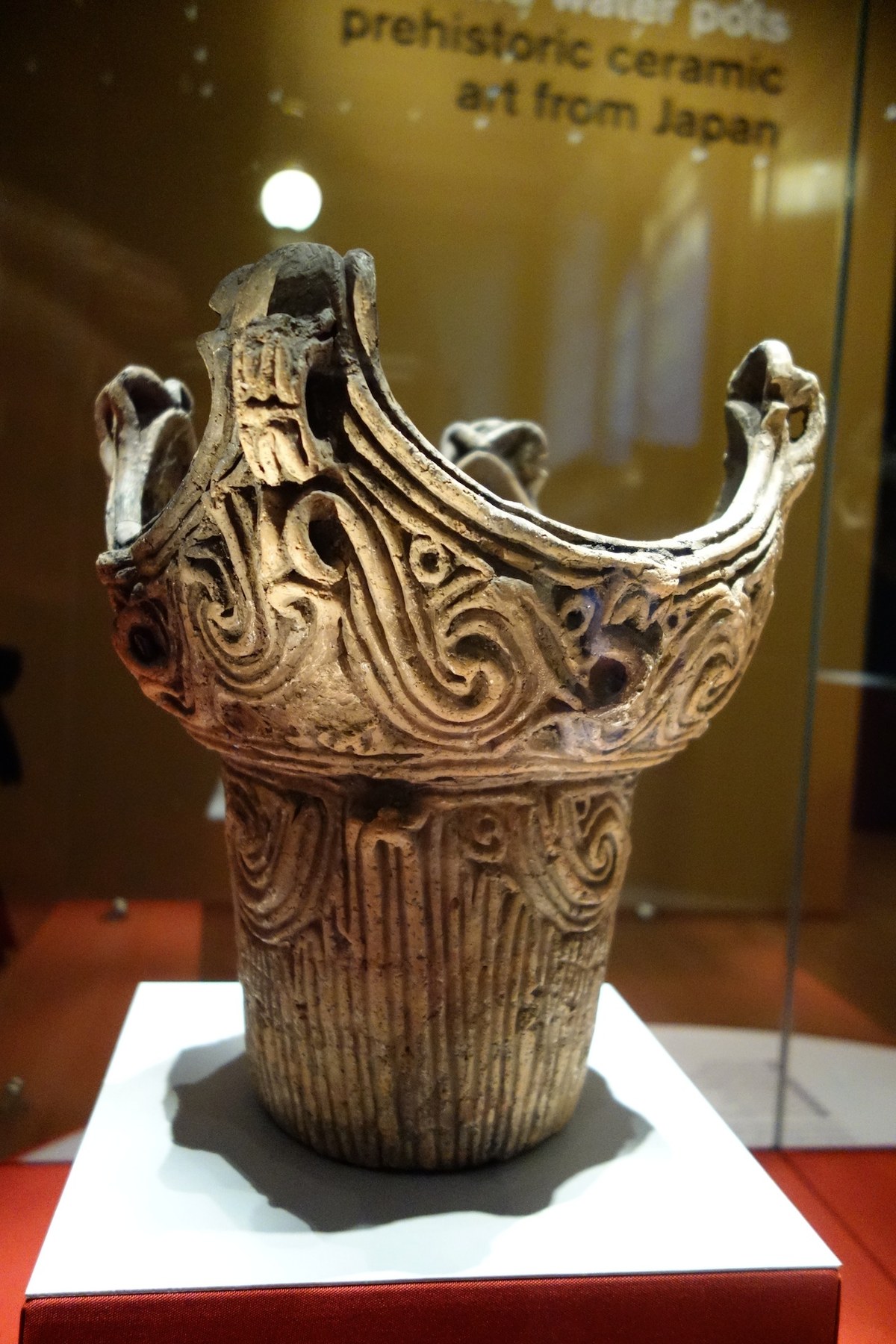
Flame Pottery: Art in Its Own Right
While the earliest Jomon pottery was functional and sober, the productions of the Middle Jomon period (3000-2000 BCE) reach a spectacular level of artistic elaboration. The kaen-doki ("flame pots") of the Nagaoka (Niigata) and Chino (Nagano) regions are characterized by fiery rims: spiral protrusions, twisted handles, and undulating forms that explode from the vessel's edge like tongues of flame. Clearly ceremonial -- too complex and fragile for daily use -- they attest to a developed spiritual and symbolic life.
These flame pots are today listed by UNESCO as intangible cultural heritage (2021), as part of the inscription of Sannai-Maruyama and sixteen other Jomon sites in northern Honshu and Hokkaido as World Heritage.
Sannai-Maruyama: A Jomon Town
The site of Sannai-Maruyama, discovered in 1992 near Aomori (northern Honshu), radically changed perceptions of Jomon societies. Excavations revealed the remains of a village continuously occupied for 1,500 years (approximately 3900-2300 BCE), with stilt-raised houses, monumental collective buildings (including a six-pillar structure with pillars 1.2 meters in diameter and probably 15 meters tall), organized access paths, and refuse pits testifying to collective space management.
The estimated population of Sannai-Maruyama could reach 500 people at its densest -- an unusual size for hunter-gatherers. Its inhabitants harvested chestnuts, hazelnuts, elderberries, and walnuts in a "proto-agricultural" sense: they maintained groves, selected varieties, and regulated production without creating true row agriculture.3
A Distinct Genetics
Ancient DNAAncient DNAGenetic material preserved in old remains, often degraded, sequenced with cutting-edge techniques.→ analyses of Jomon skeletal remains reveal a population genetically distinct from continental East Asians. The Jomon genetic profile shows strong divergence from Han Chinese, Koreans, and modern Japanese, with affinities to some Southeast Asian and Oceanic populations. Modern Japanese are largely descended from the Yayoi -- rice-farming migrants from Korea and northern China around 300 BCE -- who blended their genome with that of local Jomon populations.
The Jomon genetic contribution in modern Japanese varies by region: it is stronger in Hokkaido (among the Ainu, 70% of whose genome is Jomon-derived) and weaker in areas of strong Yayoi immigration like the Kinki region (Osaka-Kyoto). This heterogeneity reflects progressive contact and assimilation dynamics rather than sudden replacement.
The Jomon Legacy
The Jomon culture lasted 14 times longer than the Christian era. Over 14,000 years of history, it traversed major climateClimateThe long-term average atmospheric conditions of a region; its variations (glaciations, aridifications) shaped migrations, agriculture and the collapse of prehistoric societies.→ changes, adapting its subsistence strategies, construction methods, and artistic expressions. Its relationship with the environment -- sustainable management of diversified resources rather than intensive agricultural exploitation -- allowed remarkable longevity. Today, the Jomon flame pot aesthetic -- raw, expressive, organic -- resonates in contemporary Japanese design.
No comments yet. Be the first.