Some thirty kilometres east of the city of Şanlıurfa, in south-eastern Anatolia, a rocky hill rises above an arid, wind-swept plain. The Kurdish inhabitants of the region call it Girê Keçel, "the bald hill." On archaeological maps it bears another name, one that has become, within a few years, among the most promising in all of Near Eastern prehistoryPrehistoryThe span of human history before the invention of writing, from the Palaeolithic to the Metal Ages, known mainly through material remains.→: Karahan Tepe. Since intensive excavation began in 2019, the site has yielded stone structures so strange and so ancient that they force us to rewrite, line by line, what we thought we knew about the earliest chapters of the human story. Pillars raised in the shape of a T, as at Göbekli Tepe; a room cut into the bedrock bristling with about a dozen monolithic phalluses; and, at the far end of that same chamber, a carved human head that seems to emerge from the wall to watch the scene. All of this was conceived and built roughly eleven and a half thousand years ago, at a time when humankind knew neither agricultureAgricultureThe cultivation of plants and production of food by working the soil, which emerged in the Neolithic in the Near East and independently elsewhere; it radically transformed human societies.→, nor herding, nor pottery, nor writingWritingA system of conventional signs used to fix language or information durably; its appearance (c. 3300 BC) marks, by convention, the end of prehistory.→ [s1].
Karahan Tepe is not an isolated site. It is the brother, almost the twin, of Göbekli Tepe, the famous sanctuary brought to light by the German archaeologist Klaus Schmidt from 1995 onwards, and it belongs to a larger whole still: the network of "stone hills," in Turkish Taş Tepeler, which today gathers a dozen contemporary sites scattered around Şanlıurfa. Together, these sites sketch the portrait of a hunter-gatherer society far more complex, more organised and more inventive than the textbooks supposed. They pose, with renewed force, the dizzying question that has haunted the archaeology of the Near EastNear EastA region of western Asia (Levant, Mesopotamia, Anatolia, Iran), cradle of the Neolithic revolution, agriculture, the first cities and writing.→ for thirty years: what if the need to gather around the sacred had preceded agriculture rather than flowed from it? What if the temple had come before the city, and even before the first cultivated field?
This article sets out to explore Karahan Tepe in its own right, in all its singularity, without reducing it to a mere appendix of Göbekli Tepe. We will first look at what the Taş Tepeler complex is, and the place Karahan Tepe holds within it. We will then retrace the history of its discovery and its excavations, conducted under the direction of the Turkish archaeologist Necmi Karul. We will dwell at length on the famous chamber of phallic pillars and on the carved head that forms its heart. We will then compare the site with its great neighbour, before turning to the deeper questions: is a sanctuary before agriculture conceivable? Who built all this? Does the thesis of "the temple first, the city later" stand up to scrutiny? What animal and human symbolism unfolds in the stone? And what challenges do the dating and conservation of these unique monuments pose?
The Taş Tepeler complex
To understand Karahan Tepe, we must first widen our gaze and take in the entire landscape of which it is part. South-eastern Anatolia, and more precisely the province of Şanlıurfa, occupies a remarkable position on the map of prehistory. It is here, on the northern foothills of the Fertile CrescentFertile CrescentAn arc-shaped region of the Near East (Levant, Mesopotamia) where farming and herding first emerged.→, that an exceptional density of Pre-Pottery NeolithicPre-Pottery NeolithicThe first phase of the Neolithic (c. 9,600–6,900 BC), before the invention of pottery.→ sites is concentrated, the first phase of the NeolithicNeolithicThe "New Stone Age": a period marked by farming, herding, settlement and pottery, from around 10,000 BC.→, running roughly from 9600 to 7000 BCE and commonly designated by its abbreviation PPN. On this plateau, within walking distance of one another, stand artificial mounds and rocky hills that conceal the remains of the oldest known monuments of humankind.
The Taş Tepeler programme, launched in the 2020s under the aegis of the Turkish Ministry of Culture and Tourism, has precisely this ambition: to unite research across this coherent ensemble. The Turkish expression literally means "the stone hills" or "the stone mounds." It covers a dozen sites, of which the best known are Göbekli Tepe and Karahan Tepe, but also Sayburç, Sefer Tepe, Gürcütepe, Çakmaktepe, Kurt Tepesi, Taşlı Tepe and Yenı Mahalle, within Şanlıurfa itself. Each of these sites brings its piece to the puzzle: here a panel carved with a narrative scene, there a particular type of enclosure, elsewhere traces of habitation or of the processing of wild plants. The point of the programme is to stop studying Göbekli Tepe as a solitary enigma, and to see it instead as one node among others in a network of interacting communities, sharing techniques, symbols and beliefs across a single territory for more than a millennium [s2].
This regional approach radically changes the nature of the questions one can ask. It is no longer a matter of understanding a single sanctuary, but of reconstructing an entire society: its demography, its exchange circuits for raw materials such as obsidian, its calendars of gathering, its cosmology. The Taş Tepeler sites are not all identical; they show significant variation in the size of their enclosures, in their iconographic repertoire, in the organisation of space. But they share a common signature, immediately recognisable: the T-pillarT-pillarA T-shaped stone monolith of the Anatolian sanctuaries (Göbekli Tepe, Karahan Tepe), often carved with animals or human limbs.→, a limestone monolith carved into the shape of the letter T, raised vertically and often adorned with low reliefs. Karahan Tepe is, alongside Göbekli Tepe, the jewel of this ensemble, and the one whose recent discoveries have done the most to renew our vision of the period.
The discovery and the excavations: Necmi Karul
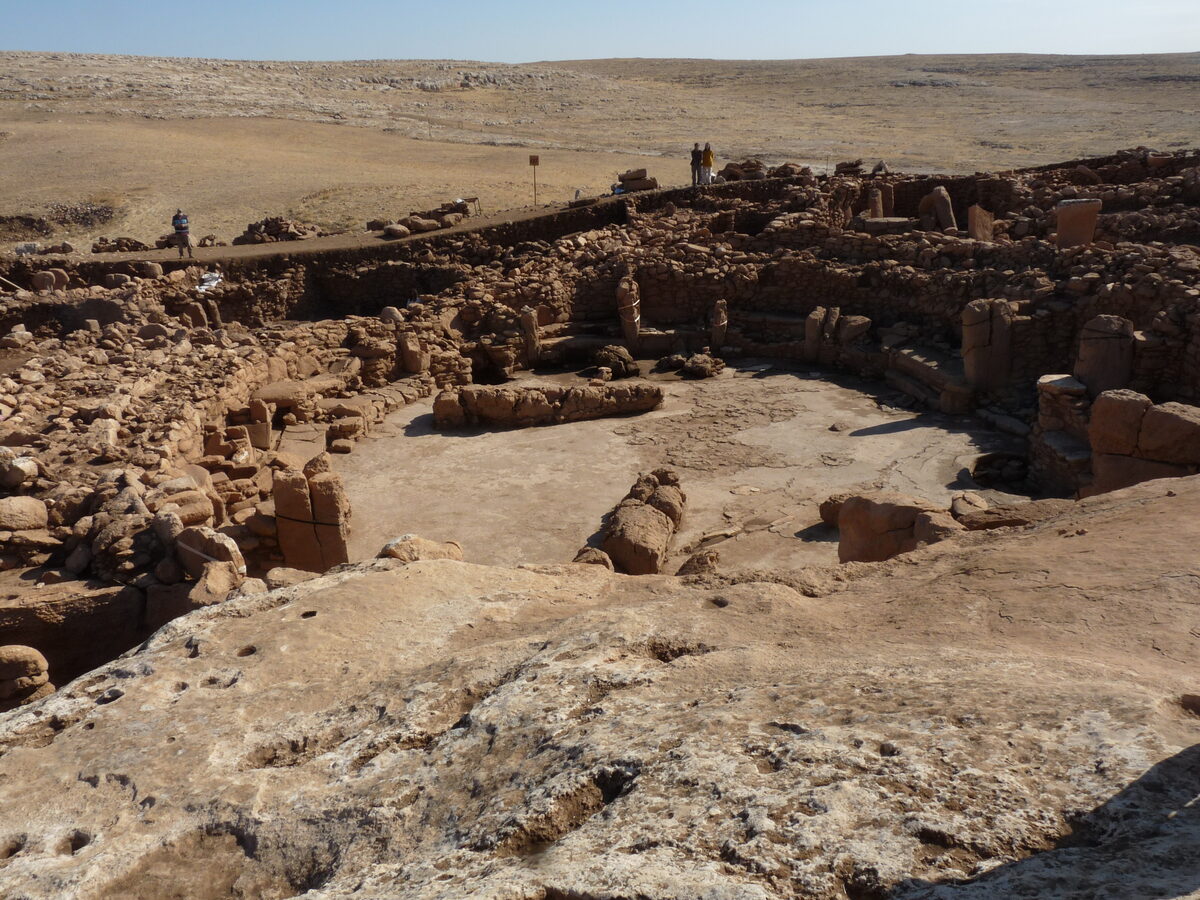
The story of Karahan Tepe, as so often in archaeology, begins with a survey that long remained without sequel. As early as 1997, Turkish surveyors reported on the hill of Girê Keçel the presence of T-pillars protruding at the surface, together with an abundance of worked flintFlintA hard, brittle siliceous rock, knapped by prehistoric people to produce blades, points and sharp tools.→ characteristic of the Pre-Pottery Neolithic. The site was registered, studied at the surface, mapped, but more than twenty years would pass before systematic excavations began. During those two decades, it was Göbekli Tepe that drew attention and funding. Karahan Tepe remained a promise, a "twin" site known to be rich but not yet opened.
The turning point came in 2019, when intensive excavations began under the direction of the archaeologist Necmi Karul, professor of prehistory at Istanbul University. Karul is also one of the coordinators of the great Taş Tepeler programme, which from the outset places his work within a regional perspective. The first campaigns confirmed and exceeded every expectation. Beneath a thin layer of earth, the archaeologists uncovered circular and oval structures with T-pillars, buildings of varied function, paved floors, and above all that extraordinary chamber cut into the rock which the international press would soon nickname the "phallus room." The site is so rich that it quickly became, alongside Göbekli Tepe, one of the two major poles of Anatolian research into the origins of the Neolithic.
The excavation method adopted at Karahan Tepe reflects the advances of archaeology over the last thirty years. Where the first campaigns at Göbekli Tepe, in the 1990s, favoured the spectacular clearing of the great enclosures, Karul's teams set out to document the stratigraphyStratigraphyThe study of the superimposed layers (strata) of an archaeological site; each layer corresponds to a phase of occupation and yields a relative chronology.→ finely, to take samples for environmental analysis, to study the faunal and botanical remains, and to place each structure within a precise chronological sequence. The aim is no longer simply to bring masterpieces to light, but to understand how the communities that shaped these places lived, ate, believed and organised themselves. This scientific rigour translates into a certain interpretive caution, which we will encounter again in the current debates over the function of the buildings.
Over the campaigns, the site has revealed a complex organisation, with different sectors and different structures designated by letters or codes. Some rooms appear to have had a domestic or craft function, others a manifestly collective and symbolic one. The excavators have identified successive phases of use, alterations, infillings. Karahan Tepe is not a frozen snapshot but a place that lived, that was transformed, rearranged, perhaps abandoned and then reoccupied, over a long span. It is this temporal depth that makes its study at once fascinating and delicate.
The chamber of phallic pillars and the carved head
If one had to keep a single image of Karahan Tepe, it would be this one: a room partly hollowed into the bedrock, its floor bristling with about a dozen standing phallic pillars carved directly from the rock in place, and at the far end of which a carved human head emerges from the wall, its neck outstretched, its gaze turned towards the room. This structure, often called the "pillar room" or the "phallus room," is without doubt the most striking discovery of the site, the one that travelled around the world and that on its own captures the strangeness of the mental universe of the builders of the Pre-Pottery Neolithic.
Let us describe it precisely. It is a space of roughly circular or oval plan, partly excavated into the rock bench, its walls and floor regularised by carving. From the floor emerge about a dozen vertical monoliths, sculpted in high relief, whose phallic form is manifest and deliberate: these are not T-pillars but pillars of a particular type, specific to this room, unambiguously evoking the erect male sex. The remarkable fact, and the one that distinguishes this structure from almost everything previously known, is that these pillars were not brought in: they were cut and shaped from the bedrock itself, left attached to the substrate. To carve such reliefs in reserve, by hollowing out all around to let the desired forms emerge, demands rigorous planning and great technical mastery, for the slightest error is irreversible.
At the far end of the room, in the wall, lies the most meaning-laden element: a human head carved in high relief, with an elongated neck, that seems to spring from the wall to overlook the phallic pillars. The face, with its severe, almost unsettling expression, is treated naturalistically. The chin or neck of the figure rests on a projection that some observers interpret as a snake, a recurrent motif in the iconography of the region. The overall effect is powerful: one has the impression of a stone being that watches over the room, a guardian or ancestor presiding over a ritual arrangement whose meaning largely escapes us. The head is linked, through an opening cut into the wall, to a neighbouring structure; this passage, sometimes called a "window" or "porthole," may have allowed movement, a gaze or a ritual gesture from one room to the other.
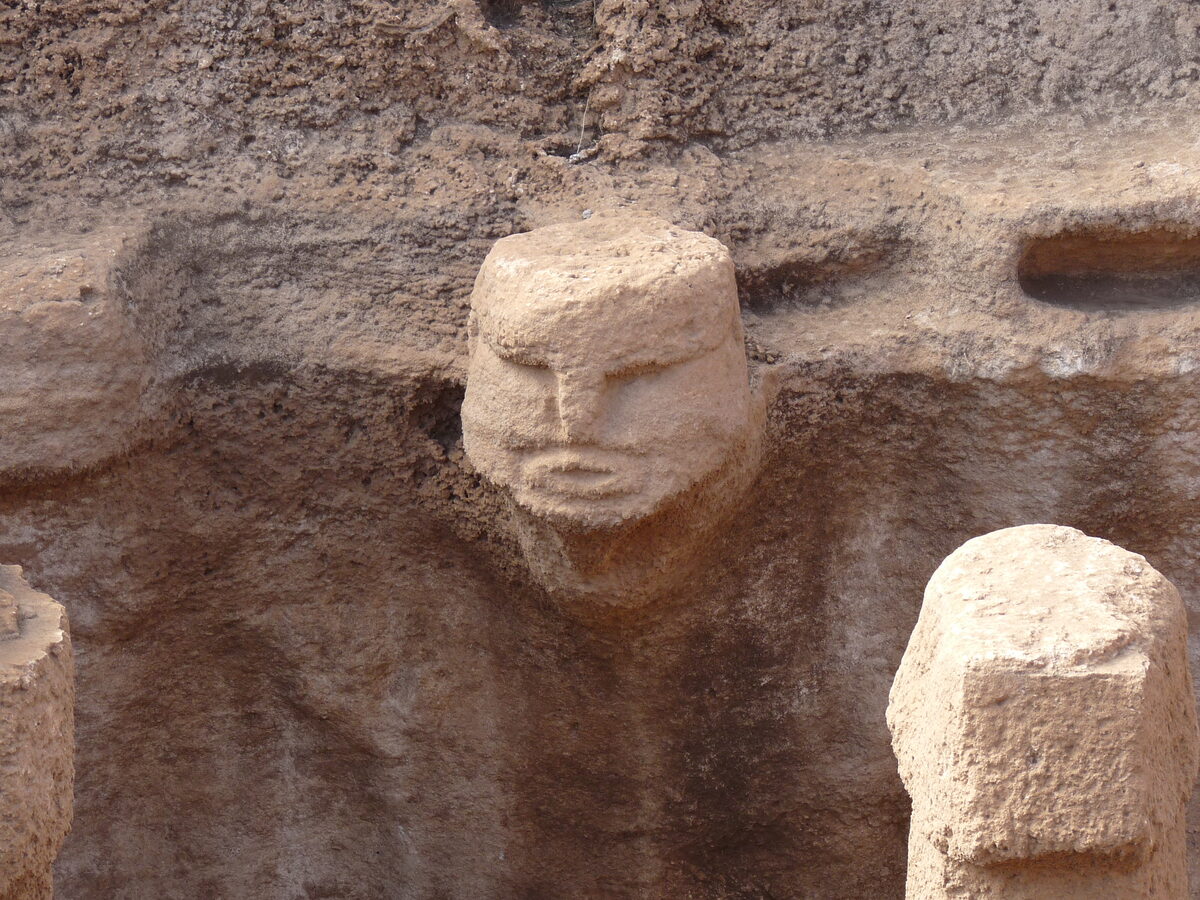
What did this ensemble mean to those who conceived it? Any answer is necessarily hypothetical, for no writing comes to illuminate it. But the combination of elements is too coherent to be accidental. Aligned phallic pillars, a stone gaze watching over them, a half-buried room with a confined atmosphere: everything evokes a ritual space of strong symbolic charge. Several readings have been proposed. The most immediate associates the phalluses with fertility, virility, the regeneration of life, themes universally attested in ancient religions. Others see a place of initiation, where young members of the community would have been introduced to reserved knowledge, perhaps after trials; the semi-subterranean layout and the controlled access would argue in this direction. Others still stress the ancestral dimension, the carved head representing a mythical forebear or a tutelary spirit, guardian of the group and of its memory.
One must resist the temptation to decide. The strength of this room lies precisely in the way it condenses, within a small space, several of the great themes of the Neolithic imagination: fertility and death, the ancestor and the snake, raw stone worked until it becomes body and face. What is certain is that the builders of Karahan Tepe possessed a rich and shared symbolic vocabulary, that they knew how to stage it in architecture, and that they attached enough importance to these arrangements to devote considerable labour to them. The phallus room is not an isolated whim: it is the trace of an organised thought, of an already elaborate cosmology, among people who did not yet cultivate the land.
Comparison with Göbekli Tepe
Karahan Tepe is often presented as the "twin site" of Göbekli Tepe, and the phrase is not undeserved. The two sites share a single chronological horizon, a single region, a single material culture and a single architectural vocabulary. Both belong to the Pre-Pottery Neolithic; both are the work of hunter-gatherersHunter-gatherersA way of life based on hunting, fishing and gathering wild resources, without farming or herding; it dominated almost the whole of human history.→; both contain enclosures with T-pillars, those anthropomorphic monoliths raised in a circle. The cultural continuity between the two places is manifest, and it extends to the other Taş Tepeler sites. One can genuinely speak of a coherent regional tradition, transmitted over several centuries, of which Göbekli Tepe and Karahan Tepe are the two best-preserved expressions.
But the word "twin" must not mask the differences, which are numerous and instructive. At Göbekli Tepe, the dominant element is the great circular enclosure, organised around two monumental central pillars, some exceeding five metres in height and several tonnes in weight, surrounded by peripheral pillars set into a curving wall. The arrangement suggests an assembly turned towards a central pair. At Karahan Tepe, while T-pillars and enclosures are indeed found, the emphasis shifts: the phallus room, carved into the rock in place, has no exact equivalent at Göbekli Tepe. The use of the bedrock as a sculptural material, the semi-subterranean character of certain structures, the place given to the phallic figure and to the human head in high relief, all give the site a physiognomy of its own.
Another difference concerns statuary. Karahan Tepe has yielded human representations in the round of great quality, among them a seated male statue, sometimes called "the man of Karahan Tepe," with an expressive face and hands resting on the abdomen. This figure ranks among the oldest naturalistic human representations of this size known to date. At Göbekli Tepe, statuary also exists, with detached heads and animal figures, but the site is above all famous for the low reliefs adorning its pillars. Here again, the two sites answer one another without merging: they decline a single symbolic repertoire with different accents.
Chronology, finally, offers valuable light. Research suggests that some structures at Karahan Tepe may be slightly later than, or contemporary with, the phases of Göbekli Tepe, and that the two sites may have functioned in part simultaneously. This partial contemporaneity nourishes the hypothesis of a network of complementary places, frequented by communities in relation with one another, perhaps according to coordinated calendars of gathering. One imagines groups moving between the hills, taking part in ceremonies first at one site and then at another, exchanging goods, knowledge and alliances. Karahan Tepe would then be neither a copy nor a satellite of Göbekli Tepe, but one of the poles of an extended social and religious system whose scale we are only beginning to glimpse.
A sanctuary before agriculture?
What makes Karahan Tepe and its neighbours an intellectual revolution is their priority, at least in part, over agriculture. When these monumental structures were raised, around 9500 to 9000 BCE, the domestication of plants and animals was not yet fully achieved in the region. The builders lived, as far as one can judge from the faunal and botanical remains, by a predatory mode of subsistence, founded on the hunting of wild game and the gathering of wild plants, including wild cereals such as einkorn, that primitive wheat whose ancestors still grow on the neighbouring foothills. These communities were neither farmers nor herders in the sense we understand, and yet they conceived, carved and raised stone monuments demanding considerable collective organisation.
This situation strikes head-on at the model inherited from the twentieth century concerning sedentismSedentismThe shift from a nomadic life to lasting settlement in one place, a precondition for the rise of villages.→ and the origins of social complexity. According to that classic scheme, the sequence was clear: people invent agriculture, agriculture produces surpluses, surpluses allow settlement, population density and leisure, which in turn make possible the specialisation of crafts, social hierarchy and, at the very top of the edifice, organised religion and its monuments. Belief and the temple came last, as a luxury permitted by material abundance. Karahan Tepe and Göbekli Tepe propose to overturn this pyramid: if hunter-gatherers could, before agriculture, muster enough people and energy to raise dozens of pillars and carve rooms into the rock, then the capacity for collective organisation and the need to gather around shared symbols are not the product of the productive economy but precede it.
The central idea is of great reach: it would not be the full belly that allowed the temple, but the desire for a temple that in part compelled the belly to fill itself otherwise. The symbolic would have preceded and driven the economic.
Should we then speak of a "sanctuary" or a "temple"? The word deserves to be handled with caution. To call it a temple is to project onto the Neolithic a notion forged by and for far later historical religions, with their clergies, their identified deities and their codified liturgies. Nothing proves that the phallus room of Karahan Tepe was a place of worship devoted to gods in the sense we mean. Many researchers prefer more neutral formulas: "special buildings," "gathering places," "communal architecture." That said, the manifestly symbolic charge of the pillars, the phalluses and the carved head forbids reducing these spaces to mere dwellings. Something was at play there that belonged to ritual, to cosmology, to the relation with the sacred, even if the exact nature of that sacred remains largely opaque to us.
Who built this? Hunter-gatherers
The answer to this question, however well established, never ceases to astonish: it was hunter-gatherers who built Karahan Tepe. Men and women who drew their subsistence from hunting gazelles, aurochs and wild asses, and from gathering fruits, seeds and wild cereals. Populations that, until the discovery of Göbekli Tepe, were assumed to live in small mobile groups, few in number, little stratified, incapable of mobilising the labour and the organisation that the building of a stone monument requires. This image of the "primitive" hunter-gatherer, nomadic and destitute, shattered before the pillars of Anatolia.
For to build Karahan Tepe required impressive skills and organisation. Extracting the limestone from the rock benches, roughing out and carving the pillars, hollowing a room into the substrate while leaving reliefs to emerge in reserve, raising the monoliths, adjusting the walls: each of these operations demanded proven technical know-how, transmitted from generation to generation. One does not improvise oneself a carver of monumental stone. Behind each relief, each pillar, lies a long apprenticeship and a firmly established craft tradition. And all this work was accomplished without metal, without the wheel, without beasts of burden, with tools of stone and wood, by the sheer strength of arms and collective intelligence.
This building capacity implies a social organisation able to gather, coordinate, lodge and feed a large workforce, if only temporarily. Several scenarios coexist among researchers. For some, the sites were the stage of great episodic gatherings, no doubt seasonal, where scattered groups came from afar to build, feast and celebrate, before dispersing again; cooperation would then have been occasional and largely egalitarian, mobilised by the appeal of ritual and the reciprocity of feasts. For others, the indications of more stable occupation argue for a resident population and the possibility of nascent social inequalities, even a form of authority based on prestige, age or ritual knowledge. The question of whether these societies were fundamentally egalitarian or already crossed by hierarchies remains one of the great open questions of research.
The role of feasting deserves particular attention, as at Göbekli Tepe. The presence of basins, grinding stones and mortars carved from stone suggests food preparation on a large scale, perhaps for vast banquets accompanied by drink, which would have sealed cooperation and rewarded the builders. The feast, in this view, is not an anecdotal detail: it is the social cement of the worksite, the moment when the enlarged community recognises and reinforces itself. To build together, to eat together, to believe together: the three gestures answer and nourish one another. It is perhaps there, in these festive and ritual gatherings, that the human capacity to cooperate on a large scale was forged, long before the invention of the state or the city. In that sense, the worksite and the banquet were two sides of the same social experiment, and the act of building together may have mattered as much as the finished monument itself.
The debate: "the temple first, the city later"
The phrase has made its fortune: "first the temple, then the city." Attributed to Klaus Schmidt, the discoverer of Göbekli Tepe, it sums up the boldest and most publicised thesis associated with these sites. In this reading, the need to gather around the sacred would have been the prime mover of the Neolithic transformation. Ritual gatherings, perhaps seasonal, around the enclosures would have aggregated previously scattered groups, created lasting social bonds, generated the need to feed large crowds regularly, and finally favoured anchorage to the soil and agricultural experimentation. Rather than agriculture being the cause of the temple, the temple would be one of the causes of agriculture [s3].
This hypothesis has met with immense success, to the point of becoming one of the most widely diffused narratives about the origins of civilisation. Karahan Tepe lends it further support: the complexity and ambition of the phallus room, carved into the rock by hunter-gatherers, confirm that the symbolic impulse and the capacity for collective organisation were indeed at work before the productive economy. In this sense, the site reinforces the idea that social and religious complexity did not wait for agriculture in order to unfold.
But scientific caution demands nuance. A chronological correlation is not a causal relation. That the great enclosures locally precede the domestication of plants is established; that they are its cause remains a hypothesis. It may be that ritual gatherings and the intensification of plant exploitation were two facets of a single process, reinforcing one another, without either "commanding" the other. Many researchers today prefer to speak of co-evolution rather than simple causation. Karahan Tepe does not "prove" that religion invented agriculture; it shows, on the other hand, irrefutably, that social and symbolic complexity was already at work among populations that did not yet farm.
Another, more recent debate has come to complicate the picture. At Göbekli Tepe as at Karahan Tepe, the discovery of indications of domestic occupation, hearths, cisterns meant to collect water, structures that may belong to habitation, has led some researchers to question the image of a pure sanctuary, deserted the rest of the year. If people lived on site for part of the year, then the sharp separation between a sacred "temple" and "profane" villages around it no longer holds. The site would appear rather as a settlement where ritual and the everyday were interwoven, where the same spaces served to dwell, to produce and to celebrate. This revision does not annul the symbolic importance of the places, but it blurs the boundary between the temple and the village, between the sacred and the profane. The phrase "the temple first" keeps its evocative force, but it must be received as a stimulating hypothesis, not as a demonstrated truth.
Symbolism and animal iconography
While the human figure and the phallus hold a central place at Karahan Tepe, the site also shares with Göbekli Tepe a rich engraved and sculpted bestiary. The pillars and walls bear representations of animals of striking vivacity, which open a window, however narrow, onto the mental universe of their makers. One encounters snakes, a motif omnipresent throughout the region, that sometimes undulate by the dozen or serve as a support for other figures; foxes, canids, gazelles; birds, among which the vulture holds a singular place. This repertoire largely overlaps that of Göbekli Tepe, confirming the existence of a symbolic language common to the whole of the "stone hills."
This predominance of a partly wild and unsettling bestiary is surely not without meaning. In most earlier PalaeolithicPalaeolithicThe oldest and longest period of prehistory (c. 3.3 Ma–12,000 BC), defined by chipped stone tools and a hunter-gatherer way of life.→ art, it is the large hunted herbivores, horses, bison, deer, that dominate, probably in connection with subsistence. In the art of Neolithic Anatolia, edible game recedes in favour of animals that one does not eat, that one fears, or that are associated with death and the underworld. Many researchers see in this the expression of a symbolic imagination rather than a mere hunting repertoire: these animals would be figures of mythological, totemic or protective value, perhaps guardians, emblems of groups, or mediators between the world of the living and that of the dead.
The snake and the vulture deserve particular mention. The snake, in the carved head of the phallus room as in countless reliefs of the region, seems linked to notions of passage, transformation, the chthonic, that which belongs to the earth and the world below. The vulture, for its part, is in many ancient Near Eastern societies the animal of funerals: it is the vulture that, through excarnation, strips the flesh from exposed bodies and accompanies the deceased into the beyond. At Göbekli Tepe, scenes associate the raptors with headless human silhouettes, and the site has yielded fragments of human skulls bearing intentional incisions, which suggest the existence of a "skull cult." This system of beliefs turned towards death and its transformation forms the probable background of the arrangements at Karahan Tepe.
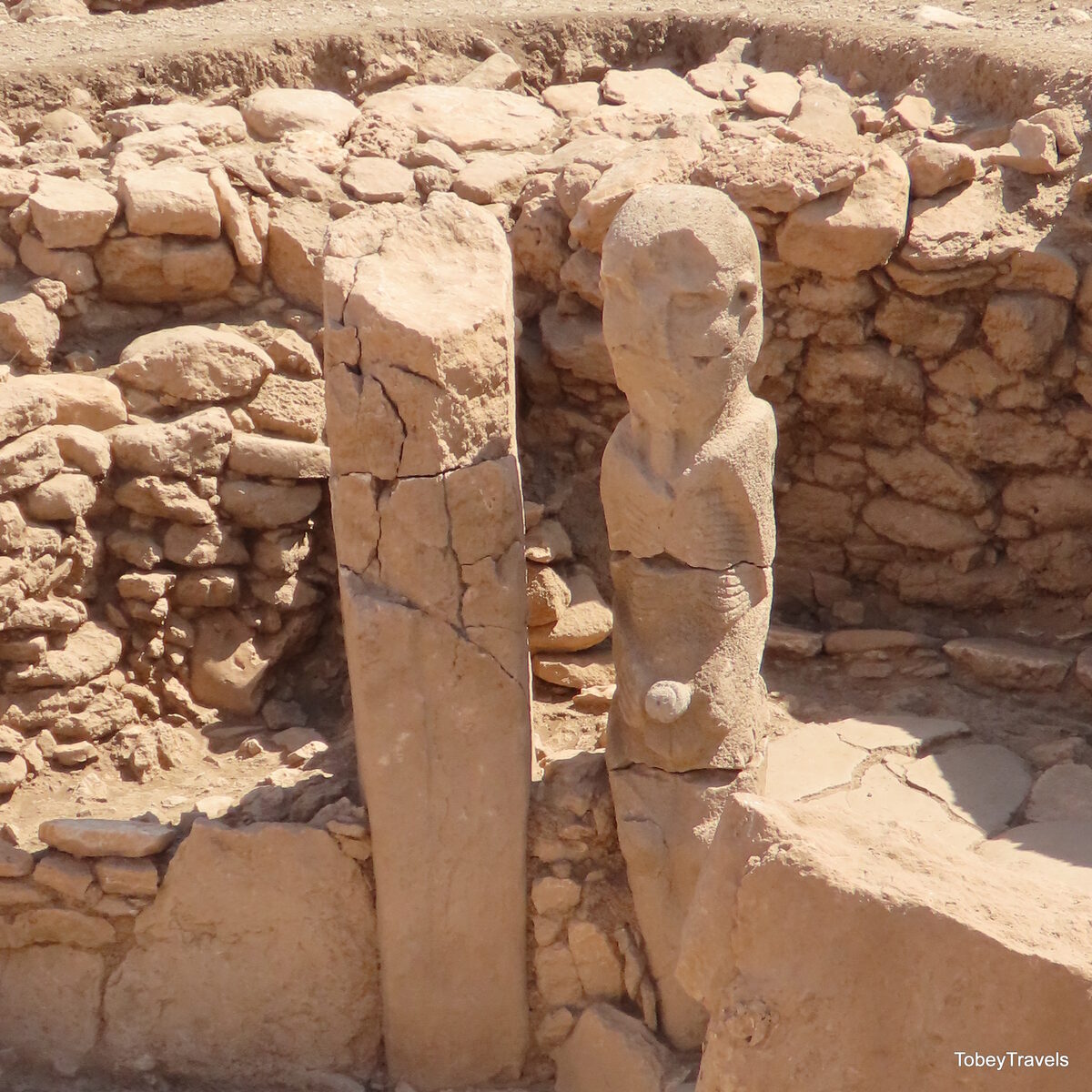
Human statuary, finally, adds an essential dimension. The T-pillars themselves are now interpreted as highly stylised representations of anthropomorphic beings: the horizontal bar figures the head, the shaft figures the body, and certain pillars bear, carved in low relief, arms descending along the shaft and meeting through the hands at the level of the belly, sometimes accompanied by belts and items of adornment. The pillars are therefore not abstract posts: they are stone persons, vertical and silent figures gathered in a circle. At Karahan Tepe, the head emerging from the wall and the statue of the seated man push this human presence to the point of naturalism. We are witnessing there, perhaps, the birth of an art of the monumental human figure, several millennia before the great civilisations of the Near East.
Dating and conservation challenges
Dating Karahan Tepe is a delicate exercise, and the figures advanced must be received with the usual precautions. The structures of the site belong to the Pre-Pottery Neolithic, and current estimates place the main phases of use around 9500 to 9000 BCE, roughly the same horizon as the ancient layers of Göbekli Tepe. These datings rest on several cross-checked methods: the typology of flint tools, comparison with the well-established sequences of neighbouring sites, and above all radiocarbon applied to organic materials trapped in the floors, the fills and the mortars. The difficulty is that the stone itself cannot be dated directly: it is the context of its use, and not its carving, that one can situate in time.
To fix ideas, let us recall the dizzying antiquity of these dates. The structures of Karahan Tepe precede the site of Stonehenge in England by some seven thousand years, and the first pyramids of Egypt and the cities of Mesopotamia by several millennia. At the moment when these pillars were raised and the phallus room hollowed out, humankind was barely emerging from the last cold episode at the end of the last glaciation; the invention of writing, of the wheel, of metallurgyMetallurgyThe techniques of extracting and working metals (copper, bronze, gold); its rise in the Eneolithic and Bronze Age transformed tools, weapons and social hierarchies.→ or of the city was still several thousand years away. This radical antiquity is precisely what makes the site so disconcerting and so precious for prehistory.
The conservation of Karahan Tepe poses, in turn, considerable challenges. Unlike Göbekli Tepe, whose oldest enclosures owe their exceptional preservation to a deliberate burialBurialThe intentional deposition of a body, sometimes with offerings; a marker of symbolic behaviour.→ under metres of fill more than ten thousand years ago, the structures of Karahan Tepe, once uncovered, are exposed to the weather, to temperature swings, to frost, wind and sun on the Anatolian plateau. The limestone, relatively soft, is vulnerable to erosion and weathering once freed from its protective matrix. The carving of the pillars, the phalluses and the human head, which has reached us intact after eleven thousand years, could degrade rapidly if it is not protected. The management of this heritage therefore demands devices of covering, drainage and monitoring, as well as a delicate balance between opening to the public and long-term preservation.
To these technical issues is added the pressure of tourism. The media success of Göbekli Tepe, inscribed on the UNESCO World Heritage List in 2018, has made the region of Şanlıurfa a leading archaeological destination. Karahan Tepe in turn attracts a growing number of visitors, which constitutes an economic opportunity for the region but also a risk for fragile remains. Reconciling scientific excavation, which requires time and prudence, conservation, which demands resources, and public valorisation, which answers a legitimate demand, is one of the great challenges of the years ahead. The Taş Tepeler programme, by coordinating these different imperatives on a regional scale, aims precisely to inscribe the discovery in the long term rather than in haste.
Conclusion
Karahan Tepe stands, alongside Göbekli Tepe, as one of the most significant archaeological discoveries of the early twenty-first century. By revealing monumental structures, enclosures with T-pillars, a room of monolithic phalluses, a human head emerging from the wall, raised by hunter-gatherers some eleven and a half thousand years ago, the site confirms and enriches the upheaval set in motion by its neighbour. It shows, in dazzling fashion, that long before the first domesticated harvests, human communities were already able to gather in great numbers, to coordinate considerable labour, to share a dense imagination peopled with snakes, vultures, phalluses and stone faces, and to give to rock the form of standing beings keeping watch in a circle.
The particular contribution of Karahan Tepe is to push still further the frontier of what we believed possible in the earliest times of the Neolithic. Its room carved into the rock, its bold staging of fertility and ancestry, its naturalistic statuary enrich our vision of a hunter-gatherer society far more complex and inventive than the textbooks supposed. Set within the network of the "stone hills" of Taş Tepeler, the site is no longer an isolated curiosity but the fragment of an entire world, that of Neolithic Anatolia, where a humanity in full transformation inscribed in limestone its first great collective images.
As for the great question, did the sacred precede agriculture, did the temple come before the city?, Karahan Tepe does not settle it definitively, and it would be imprudent to claim otherwise. But it poses it with new sharpness. It reminds us that, in the human adventure, the need for meaning, for ritual and for gathering ranks among the oldest and most powerful of motors, perhaps as decisive as hunger or cold. The excavations continue, the pillars keep emerging, and each season brings its share of surprises. It is likely that the coming decades will further modify our understanding of these places. But whatever happens, Karahan Tepe will have lastingly enriched the great story of our origins, and given us to see, in the stone gaze of a carved head watching over its standing phalluses, one of the oldest stagings of the sacred that humankind has left us.
Les images de cet article m'inspirent vraiment. L'iconographie préhistorique est une mine.
La complexité sociale décrite ici ferait un excellent setting de jeu. Quelqu'un devrait s'en inspirer.
Karahan Tepe s'inscrit dans un cluster de sites néolithiques du sud-est de la Turquie qui révolutionne notre compréhension de la naissance des premières communautés sédentaires. Les connexions possibles avec l'Egypte néolithique m'intéressent particulièrement : y a-t-il eu des échanges d'idées ou de populations entre le Proche-Orient et la vallée du Nil à cette période ? Les données génétiques commencent à répondre à cette question.
Karahan Tepe est souvent présenté comme le petit frère de Göbekli Tepe, mais ses sculptures en relief représentant des figures humaines réalistes sont en réalité unique dans le panorama du Néolithique précéramique. Ce site turc apporte des preuves supplémentaires que la révolution symbolique et architecturale du Proche-Orient néolithique était plus étendue et plus complexe qu'on ne l'imaginait. Fascinant !