In May 2026, a team from the Archaeological Centre of Olomouc was conducting systematic surveys along the fifth section of the modernized Brno-Prerov railway line in central Moravia, Czech Republic. Archaeological monitoring chief Vit Zahorak and his colleagues had added metal detector prospection to their standard excavation toolkit after the same site had already yielded a substantial prehistoric settlement during rescue digs from October to December 2025. The bet paid off: buried in an ancient marsh on a former riverbank, still partially flooded shortly before the excavation, a cache of bronze objects had lain undisturbed for approximately 3,000 years.1 Their location and their condition immediately raised a fundamental question: were they hidden for safekeeping, or deposited with no intention of retrieval?
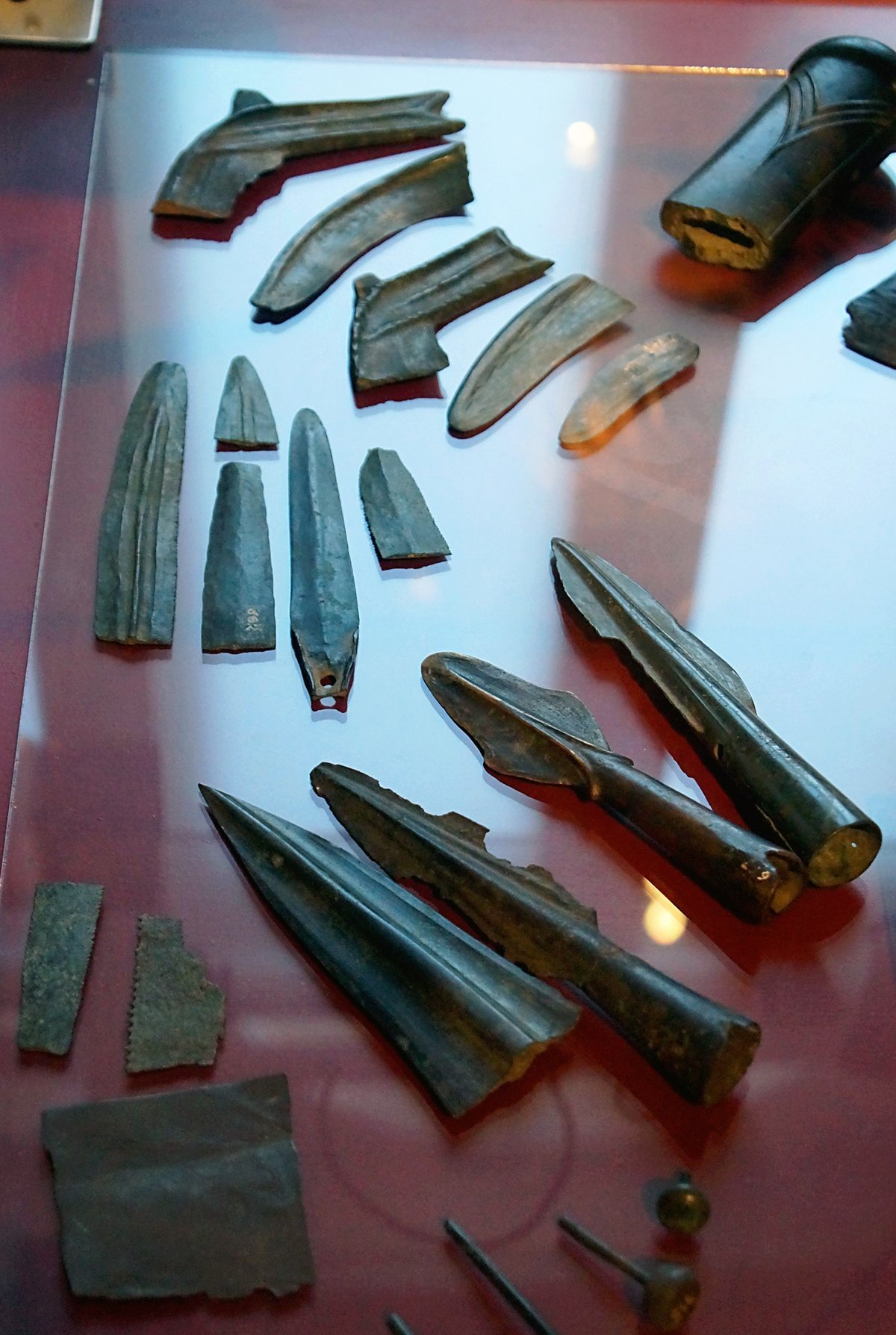
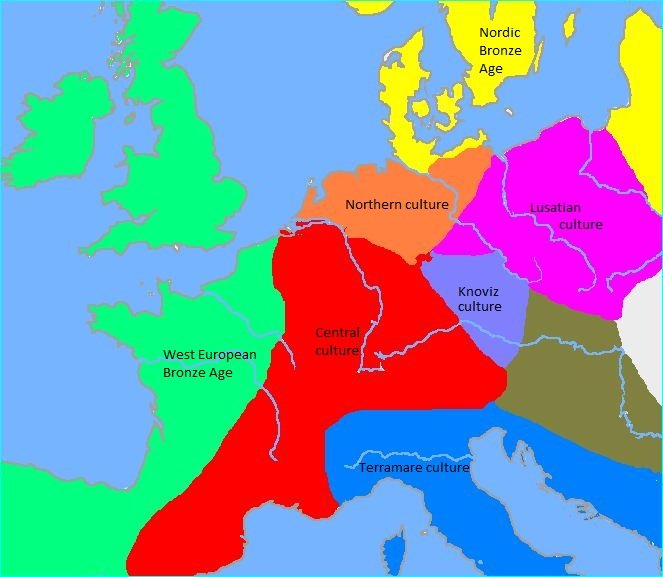
The inventory assembled by the archaeologists is telling. It includes eight deliberately deformed sickles, one intact sickle, a sword blade fragment, jewellery elements, three bronze ingots, and two unfinished objects, along with additional metalwork of various kinds.1 This mixed assemblage, dominated by working tools, belongs to the Urnfield culture, a late Bronze Age society that occupied central Europe between roughly 1300 and 750 BCE. Named for its characteristic funerary practice of cremating the dead and placing their ashes in ceramic urns arranged in vast flat cemeteries, the Urnfield culture spread from the Danube basin to the Atlantic coast, with Moravia forming one of its most densely settled core regions. Its economy rested on agricultureAgricultureThe cultivation of plants and production of food by working the soil, which emerged in the Neolithic in the Near East and independently elsewhere; it radically transformed human societies.→, animal husbandry, and long-distance exchange of metal goods -- above all bronze, whose objects circulated across the continent through sophisticated trading networks.
An inventory that raises questions
The composition of the Kojetin deposit is characteristic of European Bronze AgeBronze AgeA protohistoric period following the Neolithic, defined by bronze metallurgy (a copper-tin alloy) and the rise of the first cities and states; in Egypt it corresponds to the age of the first pyramids.→ votive assemblages: a mixture of worn tools, personal ornaments, raw ingots, and unfinished pieces. Sickles dominate the collection. The bronze sickle was the quintessential agricultural tool of the period, used for grain harvesting and fodder cutting. Its presence in large numbers within buried hoards is well documented across central Europe, from Hungary to southern Germany, Bohemia, and Moravia alike. But the nature of these hoards has been debated for generations.
For decades, the prevailing interpretation was that of the founder's hoardHoardA set of deliberately buried objects: a metal reserve, hoarding or offering; common in the Bronze Age.→: a smith or merchant had set aside a quantity of recyclable metal, intending to retrieve it for smelting or trade at a later date. Under this reading, the presence of broken tools or assorted fragments simply reflected the practical logic of a raw material that could be melted down and recast. This explanation, rational and convenient, has a major weakness in the case of Kojetin: it fails to account for the choice of a marsh as a burial site, or for the condition of the objects themselves.2 A metal cache hidden for future recovery is placed somewhere accessible. A riverside marsh, whose soil remains flooded for months each year, is anything but convenient for retrieval. And above all, the objects bear marks that leave no room for doubt about the treatment they received before burial.
What traceology reveals
The scientific heart of the argument rests on traceology, a microscopic analytical method that examines object surfaces at high magnification to reconstruct the history of their manufacture, use, and transformation. Applied to the Kojetin bronzes by traceologist Michael Kamarad, this analysis produced two key findings. First, the great majority of the tools were still in normal working condition immediately before their deposition: wear marks on the sickles, characteristic striations on their cutting edges, confirm that these were functional objects, not metal scrap. Second, specific damage was inflicted on the objects immediately prior to deposit -- damage entirely unlike the marks of ordinary use.
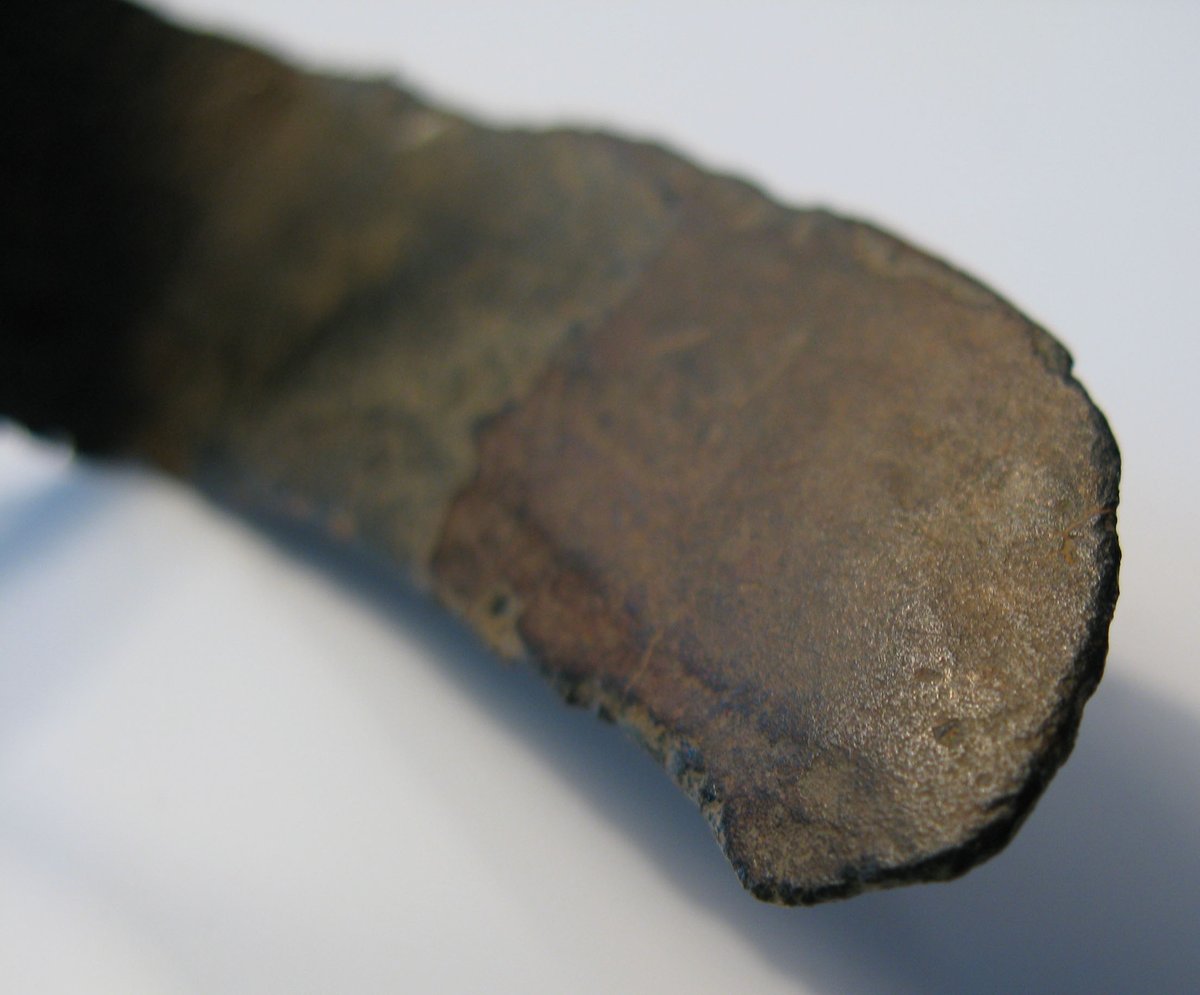
The sword blade was severed in a single violent blow, probably with a chisel or axe: the cut is clean, perpendicular to the blade, wholly incompatible with accidental fracture through use. Several sickles were twisted out of shape, their blades bent in the opposite direction to their function. "These interventions did not arise from work, but are linked to the deposition," Kamarad concluded.1 This distinction is crucial for the archaeology of metalwork deposits: it finally provides an objective material criterion for separating a practical cache from a votive deposit, rather than relying solely on geographical context or subjective symbolic considerations. Rendering a functional object useless before offering it is a symbolically charged act, widely attested in ritual contexts throughout prehistoric and protohistoric Europe.3
Water as sacred space
The choice of a marsh for the burial was not accidental. Throughout Bronze Age Europe, wetlands, rivers, and lakes played a distinctive role in symbolic and religious practice. The great rivers of northern Europe -- the Thames in England, the Rhine and its tributaries in Germanic territories, the rivers of Denmark -- yielded thousands of bronze objects that archaeologists interpret as offerings cast from riverbanks or bridges. The Swiss lakes, excavated since the nineteenth century, contain substantial assemblages of objects deposited in their shallow margins. Excavations in Danish peatPeatA waterlogged organic soil formed by accumulated plants; it seals and remarkably preserves wood and ancient remains.→ bogs have brought to light, alongside remarkably preserved human bodies, ritual bronze wagons, lurs (long bronze horns), and deliberately broken swords.3
This tradition of deposition in watery places most likely reflects a perception of water as a boundary between the world of the living and the realm of invisible powers. The marsh, an intermediary zone between firm land and open water, between the visible and the hidden, between the human world and the unknown, constituted an ideal space for communication with deities or supernatural forces. An object destroyed and submerged no longer belongs to the ordinary world: it has been transferred into another realm. Kojetin fits squarely within this continental tradition, while offering a rare and methodologically valuable example confirmed by traceological analysis.2
One site, two deposits, two logics
The Kojetin site had already yielded a separate find during the 2025 rescue excavations: an early medieval iron deposit recovered from an artisanal building. That assemblage appears to reflect a practical purpose -- temporary storage, a forgotten cache, or abandonment linked to the end of the workshop's activity. The contrast with the Bronze Age deposit, separated by more than a millennium, is striking and instructive for specialists. Two different communities, at very different periods in time, chose the same location to bury metal, apparently for entirely different reasons. This continuity of place raises an intriguing question: was there a local memory of this particular spot, transmitted across generations, that made it a preferred location for significant deposits of any kind?
Ongoing analyses of the bronzes will need to clarify the exact circumstances of their destruction and establish whether the Kojetin deposit belongs to a specifically local ritual tradition tied to this particular marsh, or whether it reflects a wider regional or continental practice. Archaeological monitoring of the Brno-Prerov construction site continues until 2029, and further comparable discoveries may yet enrich our understanding of Bronze Age Moravia and its ritual landscape.1
No comments yet. Be the first.