On the western bank of the Don River, twenty-five kilometres south of Voronezh, a loess cliff stretches some ten metres high. For over a century, archaeologists have been uncovering there traces of human presence dating back 45,000 years. The Kostenki-Borshchevo complex, encompassing twenty-six numbered sites, is one of the most important PalaeolithicPalaeolithicThe oldest and longest period of prehistory (c. 3.3 Ma–12,000 BC), defined by chipped stone tools and a hunter-gatherer way of life.→ ensembles in Europe. It illuminates with rare precision how Homo sapiensHomo sapiensThe present-day human species, which emerged in Africa around 300,000 years ago, the only surviving human lineage after the extinction of Neanderthals and Denisovans.→ established itself across the vast plains of Eastern Europe, long before the peak of the last glaciation.
An exceptional complex of sites
The name Kostenki actually refers to a collection of distinct sites , Kostenki 1 to 21 and Borshchevo 1 to 5 , spread over several kilometres along the Don. The first excavations date to the late nineteenth century, but it was during the twentieth century that major Soviet campaigns revealed the full extent of the site. The unusually favourable loess stratigraphyStratigraphyThe study of the superimposed layers (strata) of an archaeological site; each layer corresponds to a phase of occupation and yields a relative chronology.→ has allowed exceptional preservation of organic remains across several superimposed occupation layers, spanning a period from approximately 45,000 to 12,000 years before present.
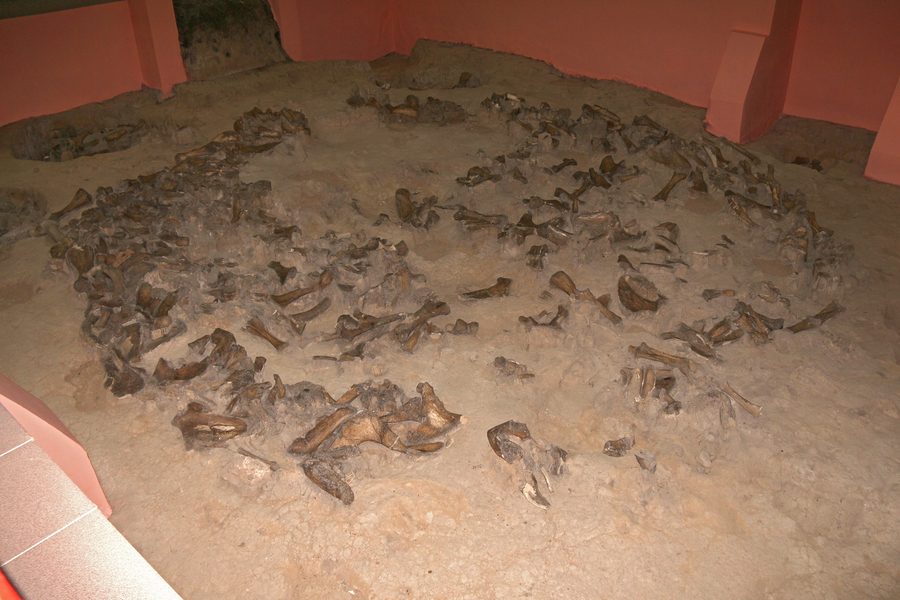
The site is now home to the Kostenki State Archaeological Museum-Reserve, built around one of the mammoth-bone structures discovered in situ. Visiting it is one of the rare opportunities in the world to observe Palaeolithic remains preserved in their original burialBurialThe intentional deposition of a body, sometimes with offerings; a marker of symbolic behaviour.→ context, without any displacement.
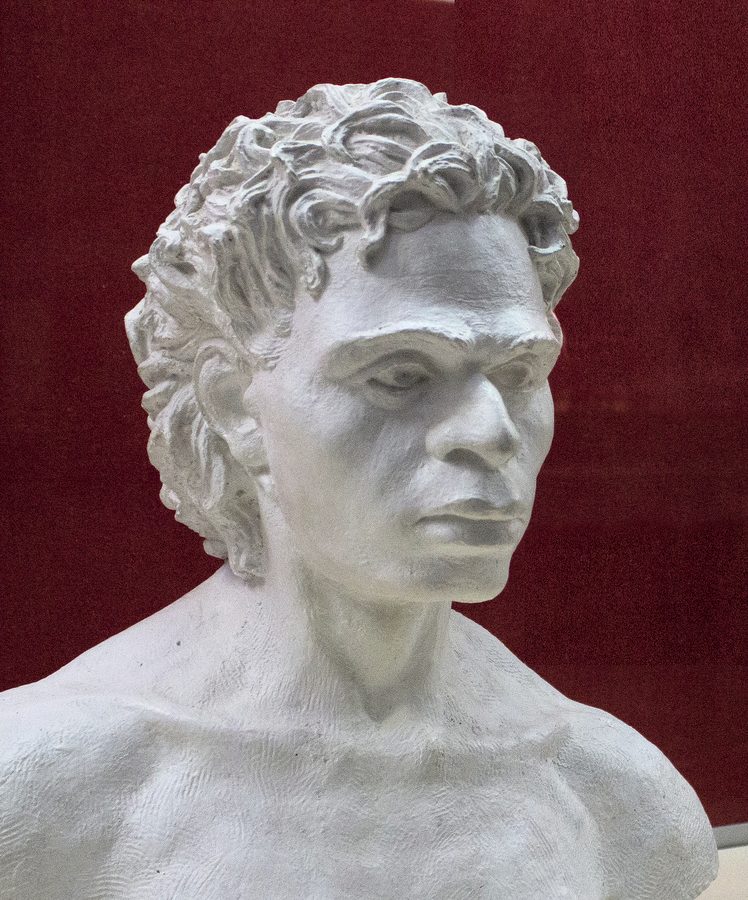
Kostenki's importance extends well beyond its material richness. In 2014, an international team published in Science the genomic analysis of the individual known as Kostenki 14, whose remains date to between 38,700 and 36,200 years before present. This genome is one of the oldest ever sequenced from a European Homo sapiens. It reveals that this man shared close ancestry with MesolithicMesolithicThe period between the Palaeolithic and the Neolithic (c. 10,000–6,000 BC in Europe), still based on hunting and gathering.→ hunter-gatherersHunter-gatherersA way of life based on hunting, fishing and gathering wild resources, without farming or herding; it dominated almost the whole of human history.→ of Europe, with the Mal'ta individual from central Siberia (24,000 years ago), and with many present-day Europeans , sketching a genetic continuity spanning more than thirty-six millennia.
Surviving in glacial Europe
Between 30,000 and 20,000 years before present, Eastern Europe entered a period of progressive cooling that peaked during the Last Glacial MaximumLast Glacial MaximumThe peak of the last glaciation (c. 26,000 to 19,000 years ago), with ice sheets at their greatest extent; it pushed populations towards southern refuges.→, around 22,000-18,000 BP. Mean annual temperatures in the Voronezh region were then 10 to 12 degrees Celsius lower than today. The vegetation was that of a cold mammoth steppeMammoth steppeA vast cold, dry steppe-tundra ecosystem covering glacial Eurasia, home to mammoths, woolly rhinos, reindeer, horses and bison.→: grasses, sedges, a few stunted shrubs. Forests had retreated southward. Game , woolly mammoth, steppeSteppeA vast semi-arid, treeless grassland of Eurasia, suited to nomadic herding and the horse; a corridor for the movement of peoples and technologies in later prehistory.→ bison, reindeer, woolly rhinoceros, horse , was nevertheless plentiful, and it was around this resource that the lives of human groups were organised.
The inhabitants of Kostenki were mobile hunters capable of covering long distances. Analysis of recovered materials shows that certain raw materials , quality flintFlintA hard, brittle siliceous rock, knapped by prehistoric people to produce blades, points and sharp tools.→, perforated marine shells , came from regions hundreds of kilometres away. The knapped flint of Kostenki is notable for its quality and sophistication: the long, regular blades characteristic of the "Kostenki-Avdeevo technocomplex" attest to a high level of technical mastery clearly distinct from the western AurignacianAurignacianThe earliest culture of the European Upper Palaeolithic (c. 43,000–33,000 BC), tied to the arrival of Homo sapiens and the first artworks.→ traditions.
The mammoth houses
Among the most spectacular discoveries at Kostenki are the circular mammoth-bone structures. The most famous, uncovered at Kostenki 11 and today protected inside the museum, is an enclosure roughly 9 metres in diameter built from the bones of dozens of mammoths. A second structure, discovered in 2020 and published in Antiquity, has a diameter of 12.5 metres and was erected around 25,000 years ago , at the height of the Last Glacial Maximum.
This second structure contains approximately 2,982 individual bones belonging to at least 64 different mammoths. The composition of the bones is telling: ribs, vertebrae, lower jaws, skulls. Recent biomolecular analyses, published in 2025, show that some bones came from animals long dead, whose skeletons had been collected from naturally mummified carcasses in the permafrostPermafrostPermanently frozen ground; in the Altai, water seeping into kurgans froze into ice lenses that preserved bodies, textiles and wood for millennia.→. The inhabitants of Kostenki did not necessarily hunt all these mammoths: they also scavenged bones available in the environment to build their structures.
The exact function of these structures remains debated. Several hypotheses coexist: winter habitation, food storage space, structure with a social or ritual purpose. The presence of large quantities of ash and combustion remains inside some of them suggests prolonged use, probably during the long winter months. Mammoth bone, a slow-burning and dense fuel, also served to feed hearths in the absence of sufficient wood on the steppe.
Art, adornment and the symbolic world
Kostenki is not merely a site of survival. The remains testify to a rich symbolic and artistic life. Numerous female figurines in ivory and limestone , close in style to the Venus figurines of the European Upper PalaeolithicUpper PalaeolithicThe final phase of the Palaeolithic (c. 45,000 to 10,000 years ago), marked by Homo sapiens in Europe, art, ornaments and a succession of cultures (Aurignacian, Gravettian, Solutrean, Magdalenian).→ , have been found at the site, particularly at Kostenki 1. Ivory beads, perforated shells, ochres of different colours, and engraved bone tools complete the picture of a fully symbolic humanity.
The presence of flint from distant regions, and stylistic connections with other Upper Palaeolithic sites across the Central and Eastern European plain, suggest that the Kostenki groups did not live in isolation. They were part of networks of exchange and movement of people, objects and ideas extending across thousands of kilometres.
Kostenki thus embodies a reality that archaeology is increasingly bringing to light: the first Homo sapiens to conquer glacial Europe were not improvised survivors, but complex, mobile and creative societies, capable of thriving in one of the harshest environments our species has ever faced.
En lisant ça, j'ai immédiatement pensé aux mécanismes d'échange de Concordia. Le commerce traverse les âges.