At Kromdraai, in South AfricaAfricaThe cradle of humankind: the continent where the first hominins appeared, then Homo sapiens around 300,000 years ago, before the expansion to the rest of the world.→, at the heart of the UNESCO World Heritage-listed Cradle of Humankind, French palaeoanthropologist Jose Braga and his team unearthed the remains of two children aged 2.5 million years. Lying side by side in the same sedimentary layer, one belongs to the genus Homo -- potentially one of the oldest known representatives of our genus on Earth -- while the other is a Paranthropus, a hyper-specialised homininHomininMember of the subtribe Hominina, comprising the human lineage (Homo, Australopithecus, Paranthropus…) but excluding orangutans and gibbons. The term progressively replaces "hominid" in its narrow sense.→ whose massive jaw and large molars betray an adaptation to a hard, abrasive diet. This exceptional discovery could transform our understanding of the emergence of humanity.
This award-winning documentary (Prize of the City of Saint-Dizier at the Les Printemps de l'Archeologie Festival 2022; Joint Jury Prize at the Rencontres d'archeologie de la Narbonnaise 2022) follows Jose Braga in the field, from the painstaking extraction of fossils to their laboratory analysis, via the study of stalactites and stalagmites and drone surveys of the excavation zone.
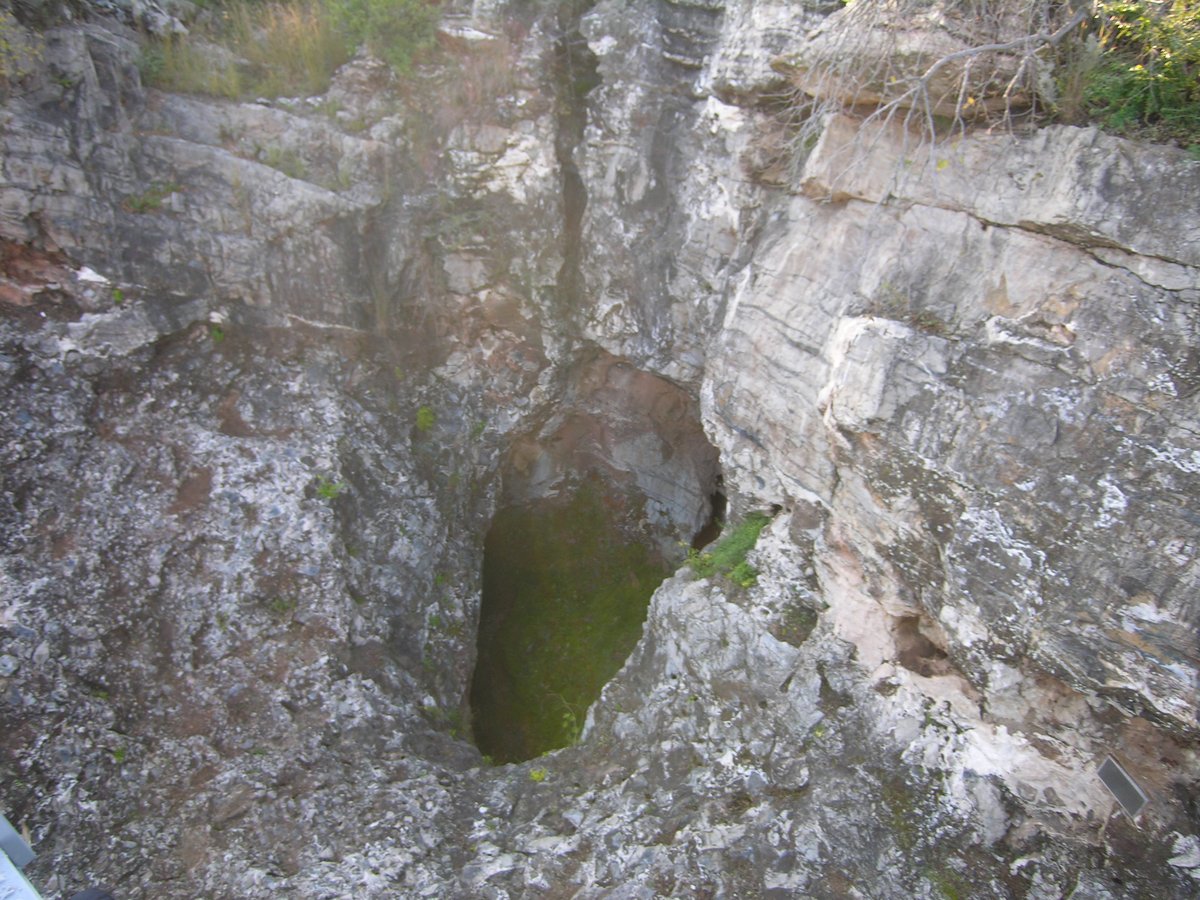
Kromdraai: two children, two evolutionary destinies
The Kromdraai site has been known since the 1930s, when the first Paranthropus robustus skull was discovered there by Robert Broom. But excavations conducted by Jose Braga since the 2000s have revealed something unique: within a single layer dated to approximately 2.5 million years ago, two children from different lineages lay close together. The first belongs to the genus Homo -- making it potentially one of the oldest representatives of our genus on Earth -- and the second is a Paranthropus, a robust hominin whose prominent cheekbones and sagittal crest anchored powerful chewing muscles suited to a tough vegetarian diet.
This spatial and temporal coexistence is highly significant. It demonstrates that the split between the Homo lineage and the robust forms occurred at least 2.5 million years ago, and that these two evolutionary paths occupied the same landscapes of southern Africa simultaneously. For palaeoanthropologists, it is an invaluable window onto the very moment when the human trajectory diverged from its closest cousins.
Precise dating: stratigraphyStratigraphyThe study of the superimposed layers (strata) of an archaeological site; each layer corresponds to a phase of occupation and yields a relative chronology.→, fauna and speleothems
One of the major challenges of South African palaeoanthropologyPalaeoanthropologyThe science that studies human evolution from the fossil remains of hominins (bones, teeth, footprints) and their context, to reconstruct our biological origins.→ is dating. Unlike East African sites, where volcanic ash allows direct radiometric dating, the karstKarstA limestone landscape shaped by rock dissolution, rich in caves and passages; its sediments can preserve bone and DNA over long timespans.→ caves of southern Africa contain no such markers. Jose Braga's team therefore combines three complementary methods.
Biostratigraphy exploits the presence of animal fossils whose chronological ranges are known. At Kromdraai, the discovery of suid (prehistoric pig), bovid and other mammal remains allows the fossil-bearing layer to be pinned to a precise time window. Sedimentary stratigraphy analyses the succession of depositional layers, their thicknesses and compositions, to reconstruct the cave's history. Finally, speleothem dating -- stalactites and stalagmites that sometimes encapsulate fossils -- allows uranium-lead dating to yield absolute ages. This convergence of evidence places both Kromdraai children at approximately 2.5 million years old.
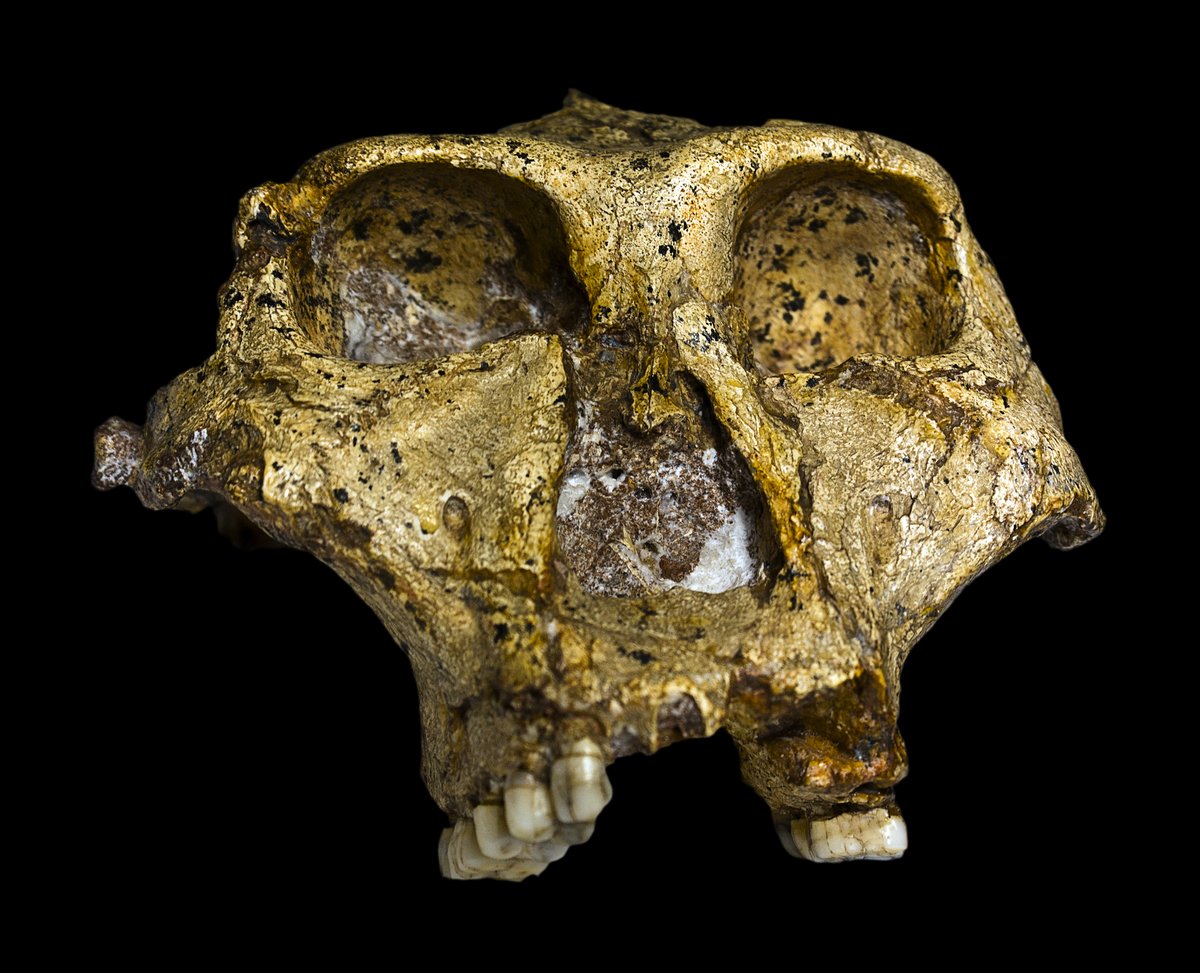
What defines humanity?
The discovery of a 2.5-million-year-old child of the genus Homo raises a question as much philosophical as scientific: what defines humanity? Palaeoanthropologists traditionally use a cluster of anatomical criteria -- relative brain size, dental morphology, pelvis configuration -- but also behavioural ones, such as the manufacture of stone tools. The OldowanOldowanThe oldest known stone-tool industry (c. 3.3–1.7 Ma), characterised by flaked pebbles (choppers) and basic flakes. Named after Olduvai Gorge (Tanzania).→ industry (Mode 1), with its flaked pebble tools, is attested in southern Africa from 2.6 million years ago: the earliest stone tools, contemporary with the Kromdraai children, may therefore have been made by individuals belonging to the same population as the Homo child.
But the documentary also invites us to look beyond anatomical criteria. Jose Braga and his colleagues probe the notion of "behavioural modernity": when do self-awareness, symbolisation and cultural transmission emerge? These questions remain open, but each fossil discovered brings researchers a step closer to an answer.
Cutting-edge technology in the service of prehistoryPrehistoryThe span of human history before the invention of writing, from the Palaeolithic to the Metal Ages, known mainly through material remains.→
Modern methods are transforming palaeoanthropology. At Kromdraai, Jose Braga's team deployed a drone to map the topography of the excavation zone with precision, placing each fossil in its three-dimensional spatial context within the cave. Combined with photogrammetry and micro-CT scanning of the fossils, this approach allows the internal anatomy of the bones to be reconstructed virtually without damage.
Micro-CT scanning is particularly valuable for children's teeth. By revealing the stages of tooth formation and eruption, it enables precise estimation of the age at death of the individuals and comparison of their development rate with that of great apesgreat apesThe family of great apes (Hominidae) comprising orangutans, gorillas, chimpanzees, bonobos and humans.→ and modern humans. A growth pace close to our own would be an additional indicator of belonging to the genus Homo.
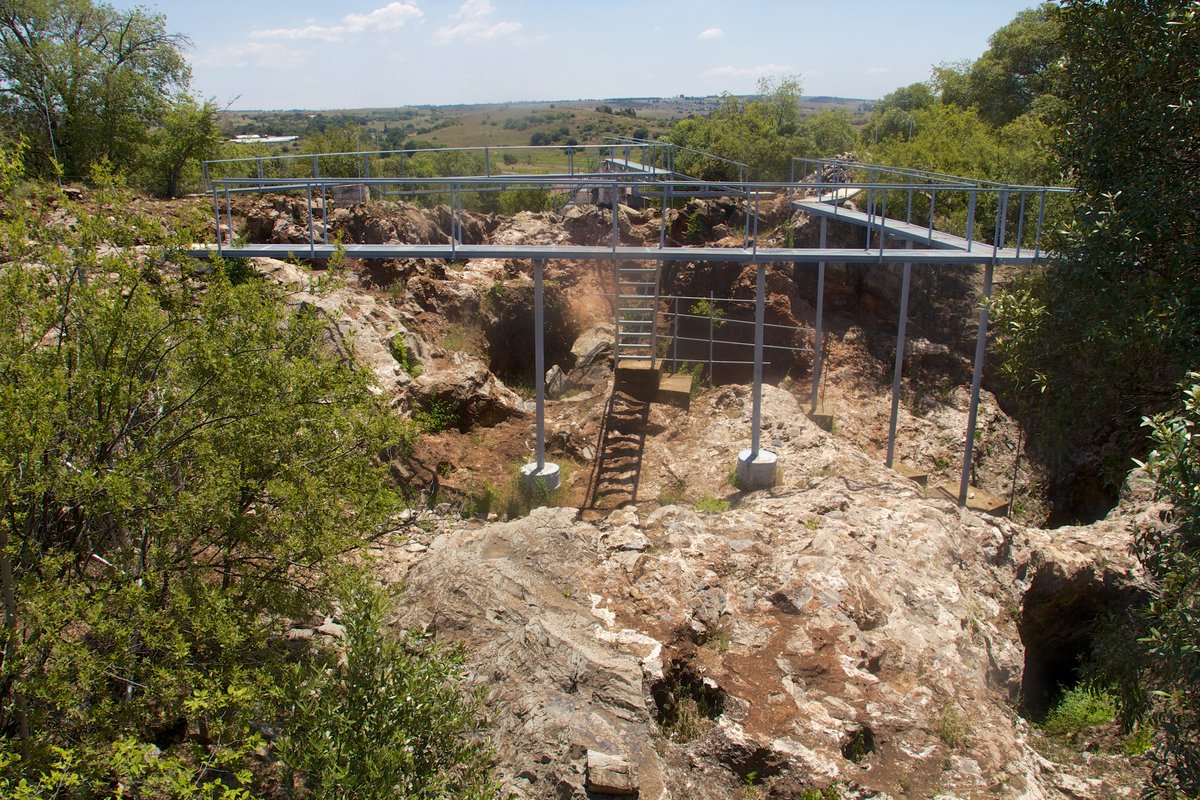
A discovery with worldwide implications
If the attribution of the Kromdraai child to the genus Homo is confirmed by future analyses, the implications are considerable. South Africa would join East Africa -- Olduvai, Laetoli, Hadar, Turkana -- as a documented cradle of the oldest known representatives of our genus. This would suggest that Homo emerged contemporaneously across a wide swathe of the African continent, rather than from a single point of origin.
The relationship between the Homo child and the Paranthropus child remains fascinating. Were they members of distinct groups sharing the same resource zones? Or did they live within mixed communities, as some modern primates do? The Kromdraai remains do not answer these questions directly, but they prove that hominin biodiversity at the end of the PliocenePlioceneA geological epoch spanning roughly 5.3 to 2.6 million years ago, the last subdivision of the Neogene. It was during the Pliocene, in an East Africa undergoing cooling and forest fragmentation, that the first fully bipedal australopithecines such as Lucy (~3.2 Ma) evolved.→ was far richer than previously imagined.
Documentary produced by Wocomo (2022). Prize of the City of Saint-Dizier, Les Printemps de l'Archeologie Festival 2022. Joint Jury Prize, Rencontres d'archeologie de la Narbonnaise 2022.
No comments yet. Be the first.