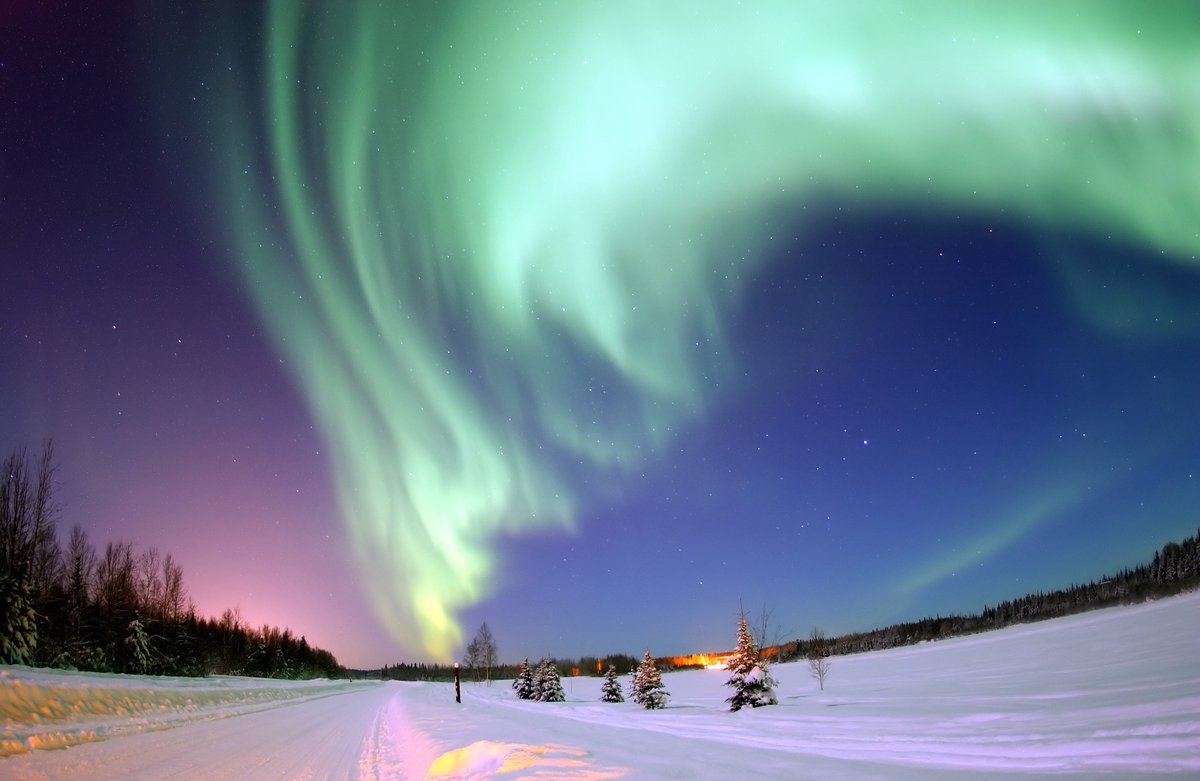
Around 42,000 years ago, the Earth narrowly escaped a geophysical catastrophe of unprecedented scale in human history. The planet's magnetic field -- our invisible shield against cosmic rays and the solar wind -- collapsed to less than 6% of its current intensity for several centuries. Stratospheric ozone was partly depleted. Northern lights blazed as far as the tropics. Ultraviolet rays pierced the atmosphere with unaccustomed intensity, and cosmic particles bombarded the Earth's surface at levels unknown for millions of years. This extraordinary episode, identified in the lavas of the Chaine des Puys in France's Auvergne region as the "Laschamps excursion", may have been one of the most decisive events in human prehistoryPrehistoryThe span of human history before the invention of writing, from the Palaeolithic to the Metal Ages, known mainly through material remains.→ -- the one that accelerated the demise of the NeanderthalsNeanderthalsA fossil humanity of Eurasia, robust and cold-adapted, extinct around 40,000 years before present.→ and triggered a cultural revolution among Homo sapiensHomo sapiensThe present-day human species, which emerged in Africa around 300,000 years ago, the only surviving human lineage after the extinction of Neanderthals and Denisovans.→.1
The Chaine des Puys and the discovery of the excursion
The Chaine des Puys is an alignment of dormant volcanoes stretching some forty kilometres north-west of Clermont-Ferrand in France's Massif Central. Listed as a UNESCO World Heritage Site since 2018, it counts nearly eighty dormant volcanoes, including the famous Puy de Dome. It was in the lavas of one of these volcanoes -- Laschamps -- that French geophysicists in the 1960s discovered something extraordinary: the iron-rich minerals in the rock, as they solidified after an eruption, had recorded the direction of the Earth's magnetic field at the moment the lava cooled. And that direction was reversed -- opposite to the current direction of magnetic north.
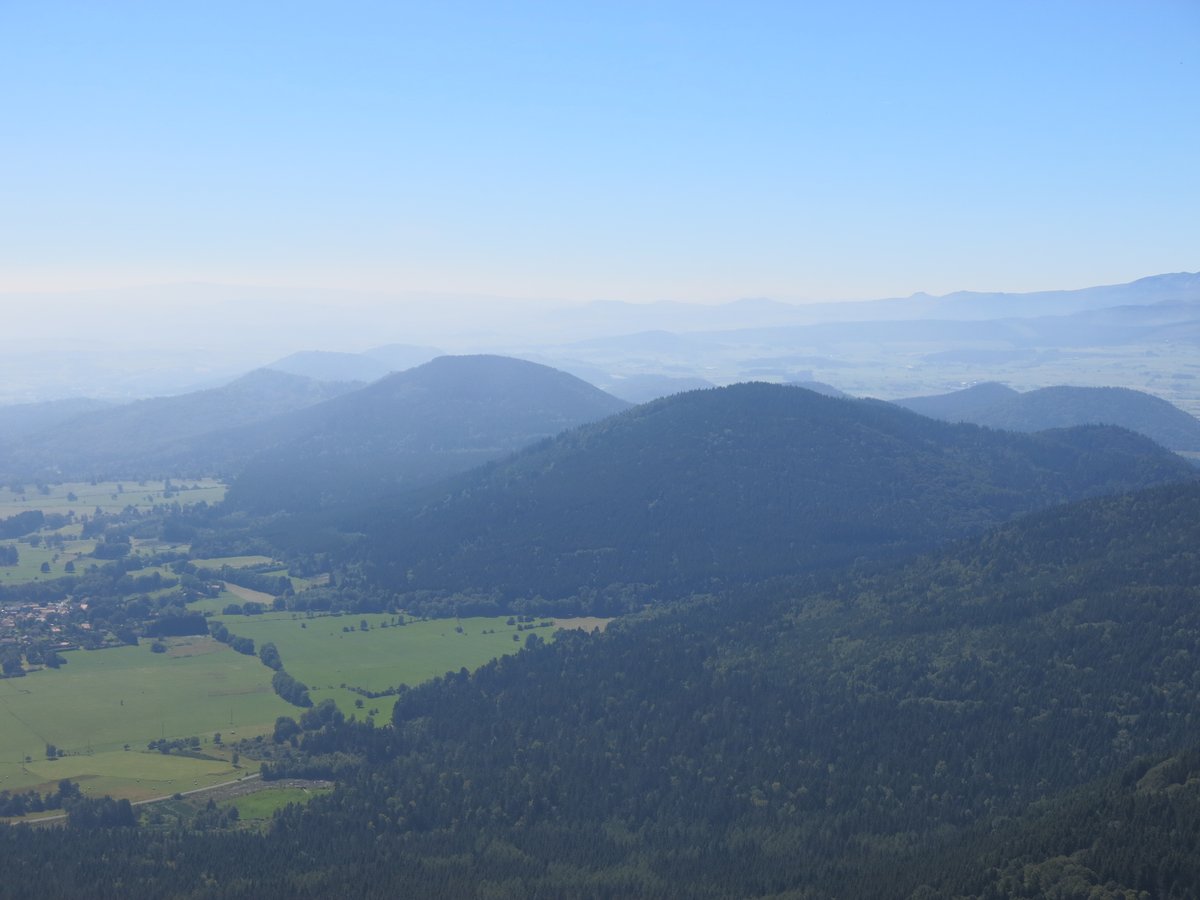
This phenomenon, named the "Laschamps excursion" after the volcano and locality, is one of the best-documented geomagnetic excursions in recent geological history. Unlike a full magnetic reversal -- which turns magnetic north into magnetic south and vice versa, occurring on average every 200,000 to 300,000 years -- an excursion is a temporary fluctuation: the field partially collapses, threatens to reverse, and then re-establishes itself without fully crossing the threshold into reversal. The Laschamps excursion lasted approximately 1,000 years in total, with a peak of maximum weakening lasting only a few centuries.
For decades, the Laschamps excursion remained a mineralogical curiosity with little implication for human prehistory. Its approximate date was known -- around 40,000 to 42,000 years ago -- but considerable uncertainty remained about its exact duration, peak weakening intensity, and possible consequences for life and climateClimateThe long-term average atmospheric conditions of a region; its variations (glaciations, aridifications) shaped migrations, agriculture and the collapse of prehistoric societies.→. Everything would change with a 2021 publication in the journal Science.
The Adams Event: a landmark study in 2021
In February 2021, an international team led by Australian geneticist Alan Cooper and palaeontologist Chris Stringer of the Natural History Museum in London published a study in Science that for the first time precisely linked the Laschamps excursion to observable consequences for the environment, prehistoric species, and cultures.2 The authors named this episode the "Adams Event" in homage to Douglas Adams, author of The Hitchhiker's Guide to the Galaxy -- whose famous "ultimate answer to the universe", 42, corresponds to the approximate age of the event in thousands of years.
The key to the study was the use of growth rings from kauri trees, giant New Zealand conifers (Agathis australis) that can live for several thousand years and whose trunks have been preserved in peatlands for tens of thousands of years. These trees record in their annual growth rings the variations in atmospheric radiocarbon content. Radiocarbon (14C) is produced in the upper atmosphere by cosmic rays: when the Earth's magnetic protection weakens, more cosmic radiation reaches the atmosphere, more 14C is produced, and this signal is recorded in the rings of trees living at that time. Cooper's team analysed kauri trunks dating precisely to the period of the Laschamps excursion and discovered an unprecedented peak in 14C production, confirming that the magnetic field was indeed very severely weakened at that precise moment.
A collapsed magnetic field: consequences for atmosphere and radiation
To understand what happened 42,000 years ago, one must recall the fundamental role of the Earth's magnetic field. This field, generated by the convective movements of liquid iron in the Earth's outer core, creates a magnetosphere that envelops the planet like a cocoon. Its essential function is to deflect the solar wind -- a permanent stream of charged particles emitted by the Sun -- and galactic cosmic rays, high-energy particles originating from supernovae and other astrophysical sources. Without this protection, these particles would bombard the Earth's surface, destroying essential biological molecules such as DNADNAThe molecule carrying genetic information, used to reconstruct kinship between species.→ and proteins.
During the Laschamps excursion, the intensity of the magnetic field fell to approximately 5% of its current value. Such a reduction has several cascading effects. First, radiocarbon production in the upper atmosphere doubled, as confirmed by the kauri rings. Second, cosmic rays penetrating the atmosphere promoted the formation of high-altitude clouds, possibly modifying atmospheric circulation and precipitation patterns. Third, and perhaps most seriously, stratospheric ozone was partially destroyed: energetic particles precipitating into the stratosphere generate nitrogen oxides that catalyse ozone destruction. Cooper's team estimated, using atmospheric models, a significant reduction in the ozone column, resulting in increased UV-B reaching the surface. These UV-B are the most dangerous for living organisms: they damage DNA, cause sunburn and skin cancer, and can disrupt food chains by affecting oceanic photosynthesis.3
The extinction of Neanderthals and the possible role of the Adams Event
Neanderthals (Homo neanderthalensis) disappeared from Europe and the Near EastNear EastA region of western Asia (Levant, Mesopotamia, Anatolia, Iran), cradle of the Neolithic revolution, agriculture, the first cities and writing.→ approximately 40,000 to 42,000 years ago, after surviving more than 300,000 years through glaciations, volcanic eruptions, and extreme climate changes. Their extinction coincides remarkably with the Adams Event. Cooper and Stringer propose that this coincidence is not accidental.
Neanderthals, whose skin was very probably lighter than that of most Homo sapiens populations at the time owing to millennia of adaptation to the northern latitudes of Europe, would have been more vulnerable to an increase in UV-B radiation. Moreover, their lifestyle -- essentially outdoors, on open terraces and valley floors -- exposed them directly to the increased radiation. The authors also suggest that the increase in ionising radiation may have elevated rates of deleterious genetic mutations, weakening already numerically small and isolated populations. The combined effect of all these factors may have tipped already stressed Neanderthal populations over the edge, especially in the context of competition with incoming Homo sapiens.
This hypothesis is suggestive but must be treated with the caution warranted by the complexity of Neanderthal extinction. Most specialists agree that this extinction was multifactorial: competition for resources with Homo sapiens, rapid climate changes of the last glacial period, disease, and possibly interbreedingInterbreedingGenetic mixing between human populations or species; between Neanderthals and Homo sapiens it left 1 to 2% of Neanderthal DNA in non-Africans.→ that gradually diluted the Neanderthal population until it disappeared. The Adams Event may have been one factor among many, or an additional stress that accelerated an already ongoing extinction.
The art of Chauvet Cave and the symbolic revolution of the AurignacianAurignacianThe earliest culture of the European Upper Palaeolithic (c. 43,000–33,000 BC), tied to the arrival of Homo sapiens and the first artworks.→
The most striking chronological coincidence of the Adams Event concerns not the extinction of the Neanderthals but the cultural explosion of the Aurignacian. It is precisely around 40,000 to 42,000 years ago that the first complex works of art appear in Europe: the first figurines, the first musical instruments, the first elaborate personal ornaments. Chauvet Cave in the Ardeche, dated between 36,000 and 40,000 years ago, presents animal compositions of an artistic mastery that rivals the finest works of all subsequent prehistoric art. Lions, rhinoceroses, and mammoths are represented with a command of volume, perspective, and movement that still astonishes specialists today.
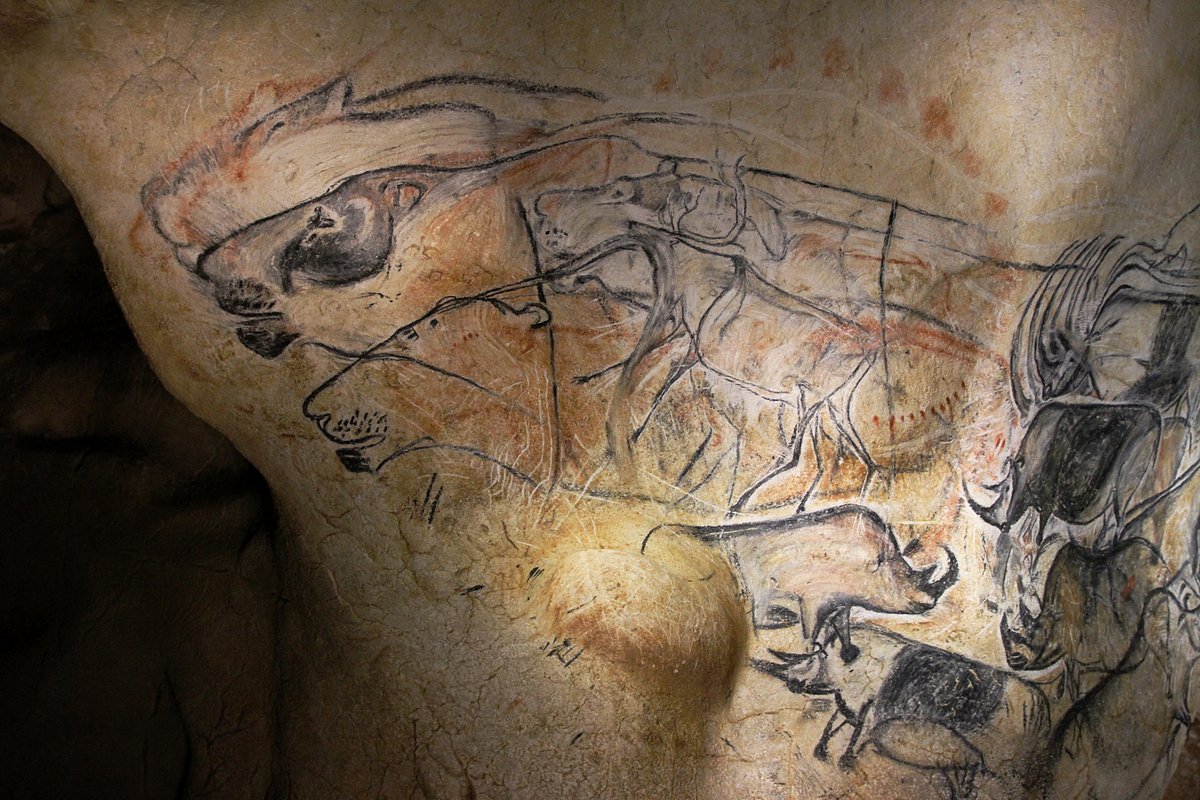
Cooper and colleagues propose a provocative hypothesis: the increase in UV-B and cosmic radiation would have driven Homo sapiens populations to take refuge increasingly in caves and caverns, protected by rock from the radiation at the surface. This increase in time spent underground would simultaneously explain the explosion of cave art -- with cave walls becoming the primary support for artistic expression -- and the more intensive use of deep caves not previously inhabited. The hypothesis is seductive, though it remains difficult to test directly in the archaeological record.
Furthermore, a night sky transformed by the collapse of the magnetic field would have been a radically new experience for prehistoric populations. With such a weakened magnetic field, northern lights would have been visible from across Europe, the Near East, and even North AfricaAfricaThe cradle of humankind: the continent where the first hominins appeared, then Homo sapiens around 300,000 years ago, before the expansion to the rest of the world.→ -- regions that never see them today. These unexplained luminous phenomena -- curtains of multicoloured light illuminating the night sky for entire nights -- may have had a considerable impact on the belief systems and ritual practices of these populations. Might we see here a possible origin of the cosmic symbolism that characterises the first artistic expressions of the Upper Paleolithic?
The extinction of Australian megafaunaMegafaunaThe very large animals (mammoths, giant ground sloths, etc.) of the Pleistocene, most of which became extinct at the end of the last ice age.→ and climate disruption
The Adams Event did not only affect Europe and the Near East. Cooper's team identified troubling temporal correlations in Australia. Between 40,000 and 42,000 years ago, the continent was experiencing a transition: its endemic large mammals -- marsupial megafauna including giant wombats (Diprotodon), marsupial lions (Thylacoleo), and giant birds (Genyornis) -- disappear from the fossil record around this period. These extinctions have long been attributed to hunting by the first humans arriving in Australia, or to climate change. The Adams Event offers a third, complementary hypothesis: the increase in UV-B radiation and atmospheric disruption would have weakened Australian ecosystems, making the most vulnerable species unable to resist the additional pressures of human hunting.
The climate models developed as part of the study also suggest that the weakening of the magnetic field modified global atmospheric circulation, altering monsoon patterns in South Asia and Africa, and influencing precipitation distribution in regions as distant as Amazonia. These climatic effects, distinct from the direct biological effects of UV, may have triggered food shortages and forced migrationsMigrationsLong-distance movements of populations; a major driver of human history (the exit from Africa, the peopling of continents, Neolithic and steppe expansions).→ of both animal and human populations, adding to the global stress of the period.
The limits of the hypothesis and scientific debates
The Adams Event generated considerable scientific enthusiasm, but also substantial methodological critiques. Several specialists have pointed out that the temporal correlation between the Laschamps excursion and the biological and cultural events of the period is not necessarily causal. Radiocarbon and potassium-argon dates from the end of the Middle Paleolithic and beginning of the Upper Paleolithic carry uncertainties that can reach 2,000 to 3,000 years -- sufficient for apparent "coincidences" to be less precise than they appear.
Other researchers have questioned the exact magnitude of the ozone reduction modelled by Cooper's team, arguing that the atmospheric models available cannot precisely quantify the effects of a geomagnetic excursion on stratospheric chemistry. Subsequent studies have refined these estimates and, while generally confirming the increase in cosmic radiation flux, they moderate the impact on the ozone layer.4
The Adams Event nonetheless remains one of the most stimulating hypotheses in palaeoclimatology and palaeoanthropologyPalaeoanthropologyThe science that studies human evolution from the fossil remains of hominins (bones, teeth, footprints) and their context, to reconstruct our biological origins.→ in recent years. Even if not all the proposed correlations are definitively established, it opens a new, interdisciplinary research framework connecting geophysics, climatology, evolutionary biology, and prehistoric archaeology. The Chaine des Puys -- that alignment of peaceful volcanoes in Auvergne -- turns out to preserve in its cooled lavas one of the most fascinating secrets of human prehistory.
Modern implications: if Laschamps were to recur today
The Laschamps excursion is not merely a distant historical episode: it serves as a warning for the present and future. The Earth's magnetic field has been weakening for at least two centuries, at a rate faster than models had predicted. The South Atlantic Anomaly -- a vast region where the field is particularly weak -- is expanding and deepening. Some geophysicists suggest we may be at the beginning of a new excursion, or even a full reversal, on geological timescales of a few thousand years.
If an event similar to Laschamps were to recur in the current context, the consequences would be of an entirely different character than those faced by Paleolithic hominins. Satellites -- the constellation providing GPS navigation, communications networks, and weather forecasting -- would be particularly vulnerable to energetic particles penetrating the atmosphere without magnetic protection. Widespread power outages due to magnetic field fluctuations, overloads of electrical grids, and disruptions to navigation systems would profoundly affect our technological societies. The study of past excursions like Laschamps is therefore of interest not only for palaeoanthropology, but also in a concretely practical sense for preparing for future geomagnetic hazards.
No comments yet. Be the first.