An ancestor without a face
There exists, in the deep past of our species, a figure whose existence we know of without ever having seen its face. No skull has been attributed to it, no jaw, no identifiable fragment of skeleton. It left behind no signed tool, no recognisable burialBurialThe intentional deposition of a body, sometimes with offerings; a marker of symbolic behaviour.→, not the slightest material trace that archaeologists could lay on a laboratory bench. And yet it is there, undeniably present, written in full letters in the DNADNAThe molecule carrying genetic information, used to reconstruct kinship between species.→Ancient DNAGenetic material preserved in old remains, often degraded, sequenced with cutting-edge techniques.→ of tens of millions of human beings living today in West Africa. Geneticists call it a "ghost" lineage. The word captures well the paradoxical nature of the discovery, an archaicArchaicRefers to an ancient, now-extinct human population or form (Neanderthals, Denisovans, ghost lineages), as opposed to anatomically modern humans.→ human population whose contribution to our genetic heritage can be measured without our being able, as yet, to name it, date it precisely or picture it.
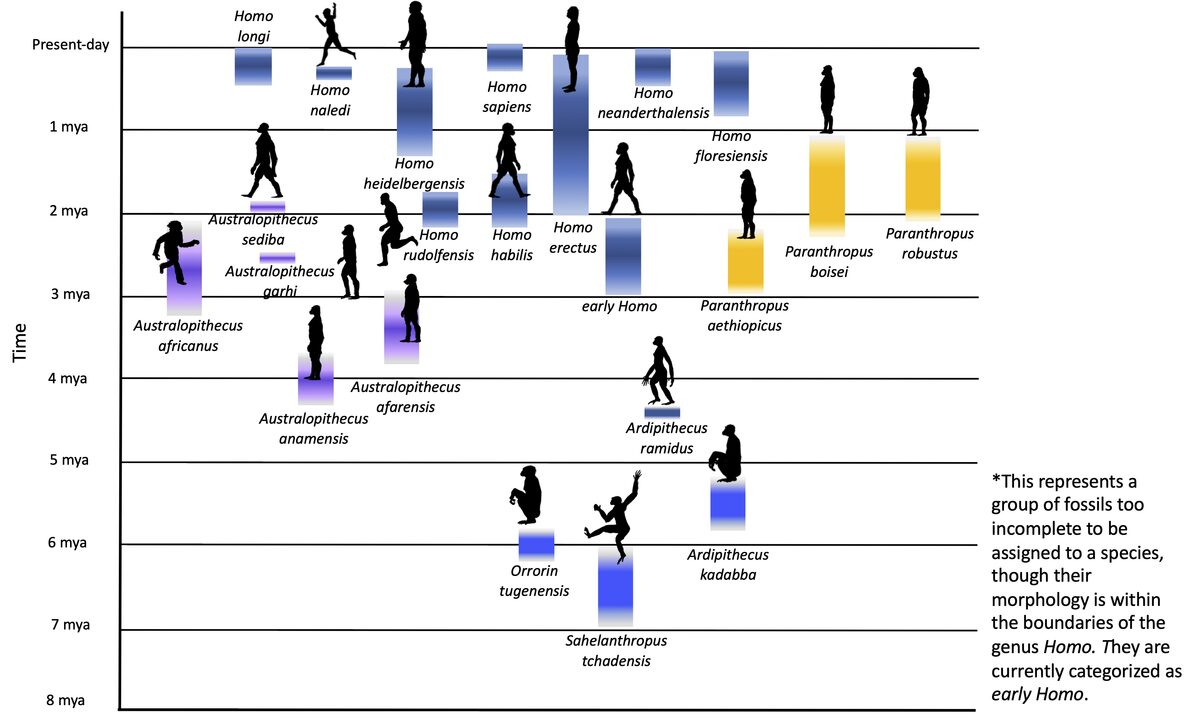
This ghost lineageGhost lineageAn ancient human population known only by the trace it left in the genomes of present-day populations, without any confirming fossil.→ is no marginal curiosity. According to work published in 2020 by geneticists Arun Durvasula and Sriram Sankararaman in the journal Science Advances, the Yoruba and Esan populations of Nigeria, along with the Mende of Sierra Leone, carry between 2 and 19 percent of ancestry inherited from an archaic population that matches no known fossil #s2. In other words, a far from negligible fraction of their genetic heritage would come from an ancient admixture between the ancestors of Homo sapiensHomo sapiensThe present-day human species, which emerged in Africa around 300,000 years ago, the only surviving human lineage after the extinction of NeanderthalsNeanderthalsA fossil humanity of Eurasia, robust and cold-adapted, extinct around 40,000 years before present.→ and Denisovans.→ and another African homininHomininMember of the subtribe Hominina, comprising the human lineage (Homo, Australopithecus, Paranthropus…) but excluding orangutans and gibbons. The term progressively replaces "hominid" in its narrow sense.→, a distinct human form, now vanished, of which we know almost nothing. The news, relayed in France by Science et Vie, is enough to unsettle the story we tellTellAn artificial mound formed by the accumulation of successive layers of settlement remains at the same spot, typical of the Near East. Each destruction-rebuilding event adds a stratum.→ ourselves about our origins #s1.
For this ghost lineage does not come alone. It is part of a broader scientific movement that, for the past fifteen years or so, has been calling into question the simple, almost textbook, picture of a humanity born from a single point and a single ancestral population. In its place, palaeogeneticsPalaeogeneticsThe study of ancient DNA extracted from remains (bones, teeth, sediments, walls) to reconstruct the past of populations.→ is drawing a bushier tableau, that of an Africa crossed by several weakly separated populations, exchanging genes irregularly over hundreds of thousands of years. A model of "deep structure", or of a "structured stemstemThe narrowed base of a point, used to haft it onto a shaft or handle.→", which the work of Aaron Ragsdale and his colleagues, published in Nature in 2023, formalised in a particularly convincing way #s3. This article sets out to untangle these results with the caution they demand, for what is at stake here is neither fossils nor certainties, but statistical models applied to genomes, and the way they are redrawing, very gradually, the story of how we came into the world.
What is a "ghost" lineage?
The term may sound theatrical, yet it in fact designates a perfectly well defined technical concept. A ghost lineage is an ancient population whose existence is inferred from its genetic signature, without any physical remains to embody it. In population genetics, one also speaks of a "ghost" population when a statistical model needs to posit the existence of an ancestral group, unsampled and often extinct, in order to account for the diversity observed in present-day genomes. The lineage is therefore not observed directly, it is reconstructed, deduced, just as one deduces the presence of an invisible planet from the disturbances it imprints on the orbit of a star.
This approach is nothing unusual in the life sciences. The whole of population genetics rests on the idea that contemporary genomes retain the memory of their history. Every episode of separation between groups, every demographic bottleneckBottleneckA sharp, temporary reduction in a population's size that lastingly impoverishes its genetic diversity.→, every episode of admixtureHybridisationCrossing between two distinct species or lineages, such as Homo sapiens and Neanderthals, leaving a trace in the genome.→ leaves a measurable statistical imprint in the distribution of genetic variation. When this imprint cannot be explained by any of the known populations, whether living or fossil, researchers are led to posit the existence of an additional source, a "missing" contributor. That contributor is the ghost. It is not a gratuitous invention, but the name given to an empty slot that the model requires in order to balance its books.
A telling comparison with astronomy can be drawn out. When nineteenth-century astronomers observed irregularities in the orbit of Uranus, they posited the existence of a still invisible planet to account for them, even before observing it. That planet, Neptune, was then indeed detected through a telescope, at the very place predicted by calculation. The ghost lineages of genetics proceed from a kindred logic, except that the ghost, for now, has not been observed at the end of any instrument. The prediction exists, direct confirmation is missing. The whole difficulty, and the whole fruitfulness, of the concept lies in this gap between what the model requires and what observation confirms.
It must be stressed from the outset what this implies, and what it does not. A ghost lineage is an object of statistical nature. Its existence is inferred with a certain degree of confidence, and the 2 to 19 percent range of ancestry measured in West African populations itself reflects the uncertainty of the estimate, which varies according to populations, methods and model assumptions. To say that a ghost "existed" means that the genetic data are explained far better if one assumes it existed than if one assumes the opposite. That is not the same thing as having exhumed its skeleton. This distinction, seemingly technical, is in reality at the heart of all the caution that must accompany this file.
The concept of a ghost lineage established itself as palaeogeneticsPalaeogeneticsThe study of ancient DNA extracted from remains (bones, teeth, sediments, walls) to reconstruct the past of populations.→ grew in power. As long as one compared only living populations with one another, these ghosts remained hard to distinguish from other explanations. But once the genomes of extinct hominins, such as Neanderthals and then Denisovans, could be sequenced, researchers gained fixed points of comparison, concrete landmarks that suddenly made certain ghosts visible. It is precisely the story of these two archaic cousins that paved the way for the discovery of the African ghost.
The Neanderthal and Denisovan precedent
To understand why geneticists take seriously the idea of a non-fossilised African archaic population, one must return to what remains one of the great scientific revolutions of the early twenty-first century, the sequencing of the DNA of our vanished cousins. In 2010, the team of Svante Pääbo, a future Nobel laureate, published a first version of the NeanderthalHomininA member of the human lineage in the broad sense, including modern humans, their ancestors and related great apesgreat apesThe family of great apes (Hominidae) comprising orangutans, gorillas, chimpanzees, bonobos and humans.→.→ genome from bones tens of thousands of years old. The result was resounding, present-day human populations outside Africa carry on average about 2 percent Neanderthal DNA. Proof was thereby established that our Homo sapiensHomo sapiensThe present-day human species, which emerged in Africa around 300,000 years ago, the only surviving human lineage after the extinction of Neanderthals and Denisovans.→ ancestors, on leaving Africa, had bred with the Neanderthals they encountered in Eurasia.
That same year, the story took an even more spectacular turn. From a mere fragment of a finger bone found in Denisova Cave, in Siberia, DNA revealed the existence of a hitherto entirely unknown human population, the DenisovansDenisovanAn extinct human population, cousin of the Neanderthals, identified in 2010 from the DNA of remains in Denisova Cave (Siberia).→. Remarkably, this population was at first defined solely by its genetics, before anyone knew what it looked like. The Denisovans were, in a sense, a first ghost, a population identified by its DNA well before being associated with anatomical traits. It was subsequently shown that populations of Oceania, notably in Papua New Guinea, carry several percent of Denisovan ancestry, likewise inherited from ancient admixtures.
These two discoveries transformed the way we think about our origins. They established three things now taken as settled. First, Homo sapiensHomo sapiensThe present-day human species, which emerged in Africa around 300,000 years ago, the only surviving human lineage after the extinction of Neanderthals and Denisovans.→ did not evolve in isolation, it coexisted and mixed with other human forms. Second, these admixtures left lasting, measurable traces in our genomes, that is, introgressionIntrogressionThe lasting transfer of DNA segments from one population or species into another through repeated interbreedingInterbreedingGenetic mixing between human populations or species; between Neanderthals and Homo sapiens it left 1 to 2% of Neanderthal DNA in non-Africans.→, detectable in genomes long afterwards.→ in the strict sense. Third, genetics can reveal the existence of populations that archaeology had failed to recognise. The Denisovan case in particular served as a decisive demonstration, it is possible to attest a human population from its DNA alone, ahead of any consensus on its fossils.
It is worth noting too that these discoveries opened an entirely new methodological field. In a few years, palaeogeneticsPalaeogeneticsThe study of ancient DNA extracted from remains (bones, teeth, sediments, walls) to reconstruct the past of populations.→ moved from the status of an emerging discipline to that of a pillar of palaeoanthropologyPalaeoanthropologyThe science that studies human evolution from the fossil remains of hominins (bones, teeth, footprints) and their context, to reconstruct our biological origins.→, able to date population separations, quantify gene flow and even pinpoint the precise segments of our chromosomes inherited from one archaic ancestor or another. This growth in the power of the tools explains why it became conceivable, towards the end of the 2010s, to set out in search of an African ghost, an undertaking that would have seemed futile a decade earlier. As the methods sharpened, researchers were able to tackle signals fainter, older and harder to isolate than the relatively clear ones of Neanderthal introgression.
One considerable difference nonetheless separates these cases from the one that concerns us. For both Neanderthals and Denisovans, researchers had a reference genome extracted from real bones. They could therefore compare the DNA of living populations directly with that of the archaic hominin and measure the inherited proportion. In the case of the West African ghost, this reference is lacking. There is, for now, no ancient African archaic genome of comparable quality, largely because the hot and humid climateClimateThe long-term average atmospheric conditions of a region; its variations (glaciations, aridifications) shaped migrations, agriculture and the collapse of prehistoric societies.→ of many African regions destroys ancient DNA far faster than the cold caves of Siberia or Europe. Detecting the African ghost therefore required a different, more indirect method, and it is here that the work becomes especially delicate.
The DNA of West African populations
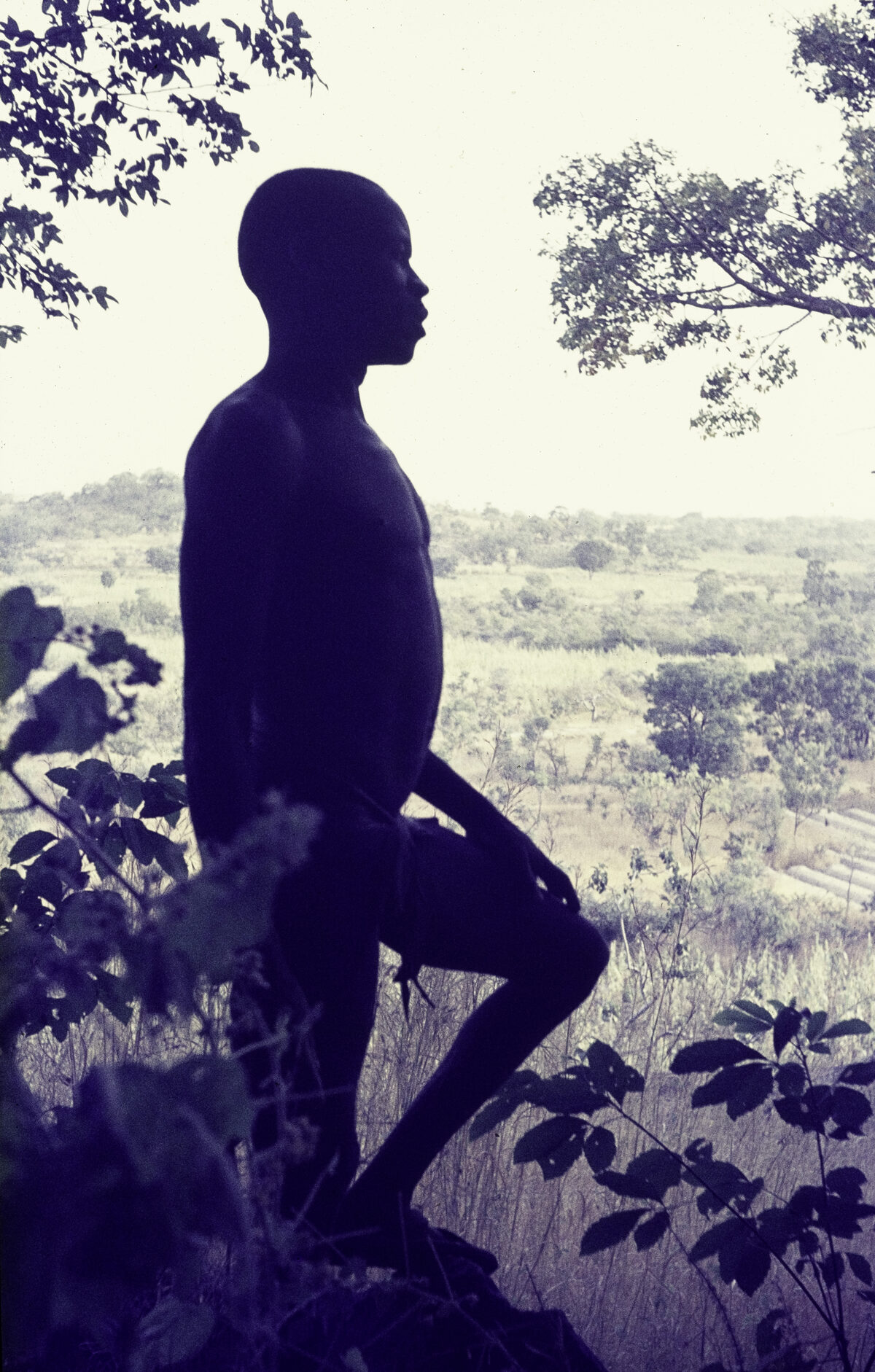
The results at the heart of this file come from a study published in 2020 in Science Advances by Arun Durvasula and Sriram Sankararaman, two researchers at the University of California, Los Angeles #s2. Their analysis draws on genomes from the large international "1000 Genomes" project, which sequenced individuals from many populations around the world. Among them are three particularly well sampled West AfricanAfricaThe cradle of humankind: the continent where the first hominins appeared, then Homo sapiens around 300,000 years ago, before the expansion to the rest of the world.→ populations, the Yoruba and Esan of Nigeria and the Mende of Sierra Leone. It is these populations that, on analysis, reveal the clearest signature of an unexpected archaic contributor.
The figure most often cited, and taken up by Science et Vie, is that of an archaic ancestry ranging between 2 and 19 percent depending on the populations and the models retained #s1. This wide range deserves to be understood for what it is. It does not mean that the contribution varies abruptly from one individual to the next, but that the estimate of that contribution depends on the assumptions introduced into the model, on the calibration of demographic parameters and on the way the reference population is defined. According to the best fit retained by the authors, a substantial part of the ancestry of these populations, on the order of several percent at least, comes from a lineage that would have diverged from the common stem even before the separation between the ancestors of Neanderthals and those of Homo sapiens.
This last point is crucial and worth dwelling on. If the model is correct, the African ghost would not be a close cousin, but a very ancient lineage, separated from ours since a remote period, perhaps several hundred thousand years before the admixture. The authors estimate that the introgression, that is, the mixing episode itself, would be relatively recent on the scale of this history, situated perhaps within the last tens of thousands of years before our era, even though these dates remain surrounded by considerable uncertainty. In other words, a human population of a very archaic kind would have survived in Africa until a late date, late enough at any rate to cross paths with the direct ancestors of present-day West Africans.
It should be stressed that these results are consistent with earlier, more fragmentary work that had already detected anomalous "archaic segments" in African genomes. As early as the mid-2010s, several teams had noticed that certain regions of the genome of sub-Saharan populations showed an unusual divergence, hard to explain by the known history of Homo sapiens alone. The 2020 study gave these observations a more systematic methodological framework and a quantified estimate. It did not invent the ghost, it gave it statistical substance. It remains to be understood how one can claim to detect such a ghost without ever having its reference genome.
How to detect a ghost without a fossil
It is here that the approach becomes at once the most fascinating and the most demanding in caution. Detecting an archaic introgressionIntrogressionThe lasting transfer of DNA segments from one population or species into another through repeated interbreeding, detectable in genomes long afterwards.→ when one possesses the archaic genome, as for Neanderthals, is almost like running a paternity test, one compares and measures. Detecting an introgression when the source is a ghost, without a reference genome, is a far subtler exercise, that of guessing the shape of a missing piece from the hole it leaves in the puzzle.
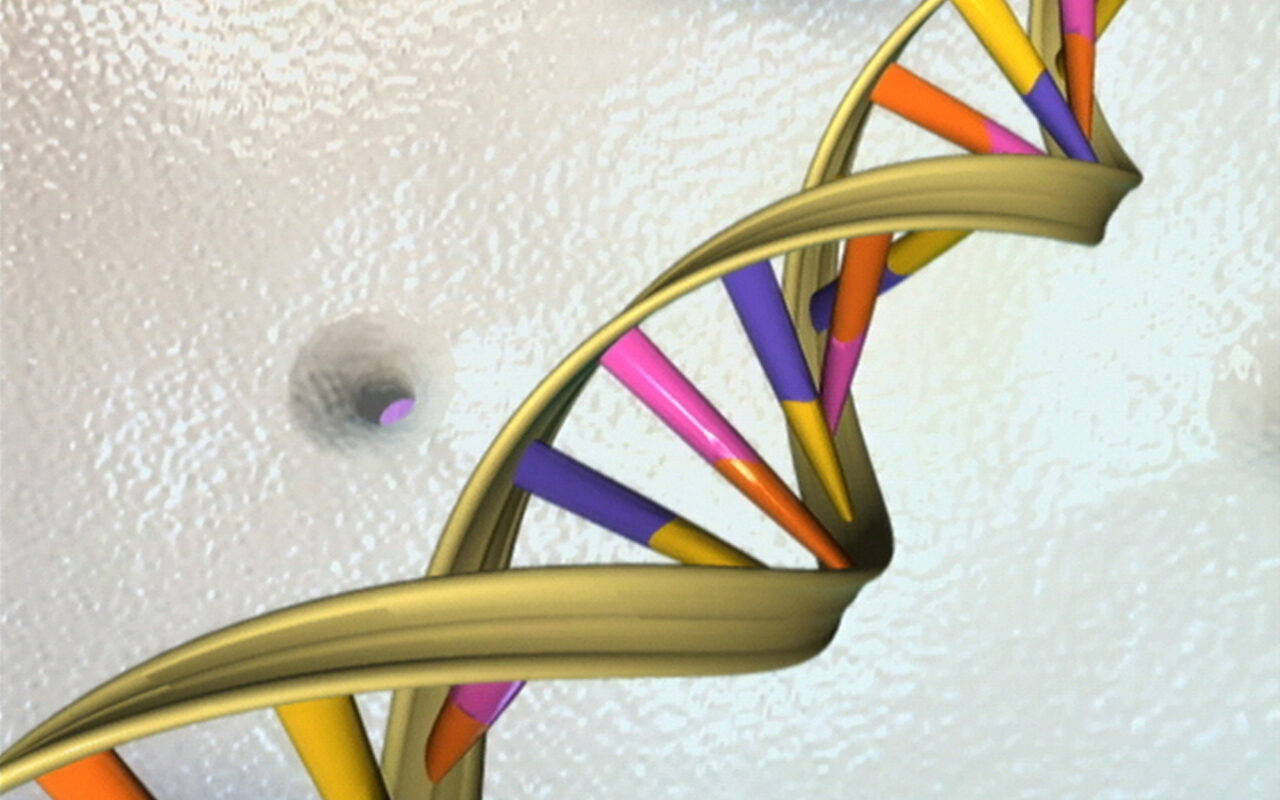
The method employed by Durvasula and Sankararaman rests on analysing the distribution of genetic variation along the chromosomes. When a segment of DNA comes from a highly divergent population, it carries an unusual accumulation of differences, and it tends to appear as blocks of a certain length, because the genetic reshuffling that cuts the chromosomes at each generation has not yet had time to fragment them completely. By modelling what the expected genetic diversity should be under various demographic scenarios, the researchers look for the one that best reproduces the real data. The winning scenario, in their study, is the one that includes a contribution from a deeply divergent archaic population, not represented among the known samples.
In concrete terms, the authors compare the performance of several competing models. Some assume a simple history, with no archaic admixture. Others introduce one or more ghost populations with varying divergence dates and mixture rates. By statistically assessing which of these models best accounts for the fine structure of West African genomes, they find that scenarios featuring a ghost introgression win out by a wide margin. It is this statistical superiority, and not a direct observation, that grounds the conclusion. The ghost is the best candidate, the one that explains the most anomalies with the fewest artifices.
It is worth clarifying what the expression "deeply divergent population" means in this context. The earlier two lineages separated, the more time has acted to accumulate independent genetic differences between them. A segment inherited from a very anciently separated lineage therefore carries an unusual density of rare or unexpected variants, a kind of signature of antiquity. It is this density anomaly, detectable statistically along the chromosomes, that betrays the presence of the ghost. The reasoning nonetheless assumes that one can correctly model the rate at which mutations accumulate and the rate at which recombination fragments the segments, two parameters that are not known with absolute precision and whose uncertainties feed into the final estimate.
Such an approach has its strengths and weaknesses, which must be named honestly. Its strength is that it can reveal events documented by no fossil, opening a window onto whole swathes of human history otherwise inaccessible. Its weakness is that it remains dependent on the model's assumptions. A signal attributed to a ghost could, in principle, reflect another poorly accounted for phenomenon, a complex population structure, variations in the mutation or recombination rate, or particular demographic episodes. The authors took pains to rule out these alternative explanations, and their result is robust in the statistical sense, but no result of this kind carries the probative force of a bone held in the hand. It is an inference, a robust one, but an inference.
The African "structured stem"
The discovery of the West African ghost takes on its full meaning when placed in the broader framework that emerged in 2023 with the study by Aaron Ragsdale and his colleagues, published in Nature under a programmatic title, "A weakly structured stem for human origins in Africa" #s3. This study does not speak directly of the Nigerian ghost, but it proposes the general model in which such ghosts become natural, even expected. It constitutes, in a sense, the theoretical backdrop of the scene.
Ragsdale and his co-authors analysed the genomes of present-day African populations, paying particular attention to groups such as the Nama of southern Africa, as well as West and East African populations, and to Eurasian and Neanderthal genomes serving as points of comparison. They tested many competing demographic models to determine which best explained the observed genetic diversity. Their conclusion is that the best model is not that of a single ancestral population splitting cleanly, but that of a set of several ancestral populations, weakly separated from one another, connected by continuous gene flow over hundreds of thousands of years.
This is the idea of population structurePopulation structureThe organisation of a species into partly isolated subgroups that exchange genes irregularly; the 'structured stem' model describes the origin of Homo sapiens this way.→, or of a "structured stem". Instead of imagining a single ancestral point from which all human populations would descend through successive branchings, one imagines a network of ancestral groups that diverge slowly, come back together, exchange genes, separate again, over immense time scales. These ancestral populations are never completely isolated, but never completely merged either. Ragsdale's model suggests that at least two or three of these stem branches, each contributing variably to present-day populations, are needed to explain the data. The separation between them would be ancient, possibly reaching back a million years or more, but tenuous, sustained by recurrent admixture.
This model has an important consequence for the way African genetic diversity is read. The greater variability of African genomes, long interpreted as merely reflecting the antiquity of the continent's populations, is also explained, within the structured stem framework, by the prolonged coexistence of several stem branches that each retained a share of their own variation. Diversity is no longer only a matter of age, it becomes a matter of structure. Each present-day population appears as a mixture, in variable proportions, of these different deep components, which renders obsolete the idea of a single homogeneous ancestral African population from which all others would simply derive.
Within this framework, a ghost lineage is no longer an anomaly, it becomes a predictable consequence. If humanity emerged from a structured stem, then some of these stem branches could have remained relatively isolated for a time, accumulated genetic differences, and then mixed back in late with the lineage that gave rise to present-day West Africans. The ghost of Durvasula and Sankararaman could well be one of these branches, captured by another statistical tool and from another angle. The two studies, conducted independently, converge on a single vision, that of a deep, plural Africa, a mosaic of populations in constant interaction.
The end of the linear story of origins
To gauge what is at stake, one must recall the story that still prevailed until recently. For decades, the dominant model, that of the recent African origin of Homo sapiensHomo sapiensThe present-day human species, which emerged in Africa around 300,000 years ago, the only surviving human lineage after the extinction of Neanderthals and Denisovans.→, often summed up by the phrase Out of AfricaOut of AfricaThe dispersals of Homo sapiens out of Africa, including a major expansion c. 70,000 to 60,000 years ago and earlier exits.→, described our origins as a relatively linear process. A single ancestral population would have formed somewhere in Africa, around two to three hundred thousand years ago, before differentiating and then spreading across the continent and then the world. This model had the merit of simplicity and accounted for many data, notably the greater genetic diversity observed in Africa.
This linear picture is today called into question, not swept away, but deeply complicated. The accumulation of genetic data, but also new interpretations of the African fossil record, suggests that our species was not born in a single place and at a single moment. Palaeoanthropologists had in fact, as early as 2018, proposed the notion of a "pan-African origin", the idea that Homo sapiens would have emerged from a network of populations dispersed across the whole continent, rather than from a single cradle. The Jebel Irhoud fossils, in Morocco, dated to about three hundred thousand years, had already extended the geography of our origins northward and further back in time.
The structured stem model extends and refines this intuition by giving it a quantified genetic basis. It is no longer merely a matter of saying that Homo sapiens has scattered roots, but of showing, figures in hand, that the diversity of present-day genomes is better explained by a deep and lasting structure than by a single point of origin. What the ghost lineage and the structured stem tell together is the end of a certain way of drawing the human tree as a clean trunk from which well-ordered branches would spring. In its place comes the image of a bush, dense, with twigs that sometimes rejoin, a tangle in which the boundaries between populations are porous and shifting.
It is important, however, not to overinterpret this reversal. Deep structure models do not mean that the concept of an African origin is abandoned, quite the contrary, Africa remains the central home of our history. Nor do they mean that the earlier story was false, but that it was a simplification. Science does not here replace one truth with another, it refines an image, it increases its resolution. And a finer image is often a more complex one, harder to sum up in a sentence, which is the ordinary price of the advance of knowledge.
Who was this ghost?
The question everyone asks is of course that of the ghost's identity. Who was this African archaic population? What did it look like? When and where did it live? One must answer with the utmost candour, we do not know, and scientific honesty requires that this be stated clearly before evoking any hypotheses. What follows is not established knowledge, but a set of leads that researchers are exploring, awaiting confirmations that may never come in the hoped-for form.
A first hypothesis consists in searching among African fossils that are known but poorly classified. Africa has yielded, for the period running roughly from seven hundred thousand to thirty thousand years, human remains whose taxonomic attribution remains debated, forms sometimes described as archaic that do not fit conveniently into the usual boxes. Some researchers wonder whether the ghost might correspond to one of these morphologically archaic populations that persisted late, whose fossils would already exist in collections without anyone having been able, for lack of usable DNA, to link them to the genetic signature. Sites such as Iwo Eleru, in Nigeria, where remains showing archaic traits were found at a surprisingly recent date, are sometimes cited in this debate, with all the required caution.
A second hypothesis envisages an entirely unknown homininHomininA member of the human lineage in the broad sense, including modern humans, their ancestors and related great apes.→, a population with no identified fossil, vanished without leaving recognised bony traces. Given the scarcity of fossils for vast regions and long periods of Africa, and the difficulty of preserving remains in tropical settings, this scenario is by no means implausible. The ghost would then remain, perhaps for a long time, purely genetic, comparable to what the Denisovans would have been had Denisova Cave never been found. The parallel is instructive, it reminds us that the absence of a fossil is not the absence of a population, but only the absence of a discovery.
The question of timing also remains open. For the admixture to have left such a clear trace in present-day West African genomes, the ghost population must have survived late enough to cross paths with the direct ancestors of these populations. This implies the coexistence, on African soil and until a relatively recent date on the geological scale, of at least two distinct human forms, the Homo sapiens then taking shape and this residual archaic lineage. Such a scenario of prolonged coexistence is not absurd, it recalls the Eurasian situation where Homo sapiens, Neanderthals and Denisovans lived side by side, but it requires, for Africa, field evidence that is still largely lacking.
A third, more cautious lead still consists in asking whether the "ghost" is indeed a single, clearly delimited population, or whether it might rather be a convenient artefact summarising a more diffuse reality, namely the contribution of several weakly separated branches of the structured stem. On this reading, the ghost would not be a particular people, but the statistical shadow cast by the deep structure of African humanity as a whole. The two views are not entirely mutually exclusive, and it is possible that the truth lies somewhere between them. This is a fundamental uncertainty that only the accumulation of new data may, perhaps, resolve.
The limits and uncertainties
This file would be incomplete, and even dishonest, if it did not devote a whole section to what we do not know and to what could call these conclusions into question. Caution is not here a matter of stylistic precaution, it is constitutive of the very nature of this work, based on statistical models and not on direct observations.
The first limit is the absence of a reference genome. As long as no ancient African DNA has been extracted from fossils old enough and well enough preserved to embody the ghost, it will remain an inferred entity. Yet ancient DNA degrades fast in hot climates, and the oldest African genomes sequenced to date are far more recent than the period in which the ghost would have lived. This gap is not close to being filled, and it may never be, which would leave the ghost in a permanently intermediate status, between the attested and the hypothetical.
The second limit lies in the dependence on models. The estimates, including the famous 2 to 19 percent range, are model outputs, sensitive to the initial assumptions. A change in the way recombination, mutation rates, or the structure of reference populations is handled can alter the figures. Different teams, applying different methods, arrive at estimates that do not coincide exactly, which is normal, but which serves as a reminder that these values must not be taken for exact measurements. They indicate an order of magnitude and a direction, not a definitive count.
The third limit is conceptual. The boundary between "admixture with another species" and "gene exchange within a single structured species" is blurred, and partly a matter of convention. Depending on whether one favours the archaic introgression model, Neanderthal style, or the structured stem model, Ragsdale style, one does not tell quite the same story, even though one is perhaps describing the same genetic phenomenon. This ambiguity is not a passing flaw of current work, it reflects a real difficulty, that of imposing clear categories, species, population, admixture, on a biological continuum that itself knows no sharp boundaries.
Finally, one must beware of a narrative trap. The phrase "ghost lineage" is striking, almost novelistic, and it lends itself to all manner of overinterpretation. It would be wrong to conclude from it that a "lost species" has been "discovered", or that a missing link has been identified. Nothing of the sort. What has been demonstrated is a coherent, robust statistical signal, compatible with the existence of an archaic contribution, within the framework of a particular model. That is considerable in scientific terms, but one must resist the temptation to turn an inference into a certainty and a model into a creature.
What this changes for the story of Sapiens
What remains, once all these precautions are in place, of the announced upheaval? A great deal, in fact, provided it is formulated with precision. What this work modifies is not this or that detail of the timeline of our origins, but the very shape of the story we tell about them. We were accustomed to a story in the shape of an arrow, a starting point, a founding population, an expansion. We are discovering a story in the shape of a network, made of multiple branches, partial separations, reunions and mixtures.
For the human species, this means that admixture with other human forms is not the exception but the rule. After Neanderthals in Eurasia, after Denisovans in Asia and Oceania, here comes a third episode of mixing, this time within Africa itself and with a still anonymous population, to complete the picture. Homo sapiensHomo sapiensThe present-day human species, which emerged in Africa around 300,000 years ago, the only surviving human lineage after the extinction of Neanderthals and Denisovans.→ appears more and more as a composite species, whose genome is a mosaic inherited from several sources, a patchwork rather than a pure block. This idea, once marginal, is becoming a central framework of contemporary palaeoanthropology.
For Africa, these results carry particular weight. They remind us that the continent where our species has lived the longest is also the one that holds the greatest share of our genetic diversity and, no doubt, the greatest share of our still unknown history. The historical under-representation of African populations in genomic studies long biased our view, centred on the Eurasian heritages that were easier to document. The work on the West African ghost and on the structured stem is part of a necessary rebalancing, placing Africa not as a mere point of departure, but as the main and lasting stage of the human adventure.
This mosaic vision also invites a certain humility about the labels we use. Terms such as species, subspecies or population were forged to describe a living world observed at a given instant, whereas what genetics reveals is a history unfolding over hundreds of thousands of years, in which these categories blur and overlap. The West African ghost sits precisely on this fault line, an entity too divergent to be a mere neighbouring population, yet too integrated into our heritage to be treated as a wholly foreign species. Rather than a defect in our knowledge, this in-between status may be the most faithful expression of a biological reality that never had the tidy boundaries our classifications would like to impose on it.
There is, finally, in this story, a lesson about the way science advances. The African ghost was not found by digging in the earth, but by interrogating already sequenced genomes with new statistical methods. It illustrates a palaeoanthropology that is no longer content to read the ground, but that also reads the memory inscribed in the living. This complementarity between bone and gene, between fieldwork and algorithm, is perhaps the deepest transformation of the field, and the ghost is one of its most telling symbols.
Conclusion
At the end of this journey, the West African ghost lineage appears for what it truly is, neither a creature of fiction nor a certainty carved in stone, but a solid statistical inference, rich in meaning and heavy with consequences for our understanding of human origins. That 2 to 19 percent of the ancestry of the Yoruba, the Esan and the Mende may come from an archaic population unidentified by fossils is a strong hypothesis, supported by quality data and rigorous methods, but which remains, by nature, a model rather than a direct observation #s2.
What science invites us to retain is less the spectacular figure of the ghost than the change of framework it accompanies, the shift from a linear story of origins to a structured stem model, in which our species emerges from a network of weakly separated and durably connected populations #s3. This new paradigm, still under construction, does not close the debate, it opens it. It raises more questions than it answers, about the identity of the ghost, about the exact nature of the deep structure, about the very boundary between population and species.
This is perhaps the finest lesson of the discovery. Our origins are more complex, bushier and more interesting than the single-cradle picture led us to believe #s1. And there remains, hidden in the genomes of millions of the living, the trace of an ancestor without a face, of whom we know almost nothing, except that it existed, and that a part of it survives still within us. PrehistoryPrehistoryThe span of human history before the invention of writing, from the Palaeolithic to the Metal Ages, known mainly through material remains.→, it seems, has not finished surprising us, and it is by patiently crossing archaeology, palaeogeneticsPalaeogeneticsThe study of ancient DNA extracted from remains (bones, teeth, sediments, walls) to reconstruct the past of populations.→ and the caution of doubt that it will continue to reveal itself.
J'avais vu un truc là-dessus sur YouTube mais votre article donne vraiment plus de détails.
Je cherchais un site sérieux sur ce sujet depuis longtemps. Bien mieux que certaines vidéos YouTube.