When the first humans reached South America -- perhaps as early as 15,000 BC, perhaps much earlier -- they brought with them ancestral lithic knowledge that they rapidly adapted to the highly varied environments of the continent. From Peruvian coastal deserts to Patagonian steppes, Amazonian forests to Andean highlands, each environment nurtured specific toolmaking traditions. Their study allows us to trace population movements, cultural contacts, and the extraordinary adaptive capacity of the first South Americans.
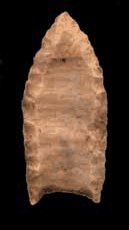
The best-known tradition is that of fishtail points (or Fell's Cave points), typical of the continent's southern cone. Dated to approximately 11,000 to 10,500 BC, they have been found from southern Brazil to Tierra del Fuego, including the key site of Cueva Fell (Chile). Their characteristic shape -- a notched base resembling a fish tail -- resembles the ClovisClovisA Palaeoindian culture of North America (c. 13,000 years ago), recognizable by its fluted stone points; long believed the oldest on the continent, no longer so.→ points of North America, suggesting either a cultural connection or convergent invention in response to the same needs: arming throwing weapons to hunt late Pleistocene megafaunaMegafaunaThe very large animals (mammoths, giant ground sloths, etc.) of the Pleistocene, most of which became extinct at the end of the last ice age.→.[1]
The Paijanian: Coastal Specialization
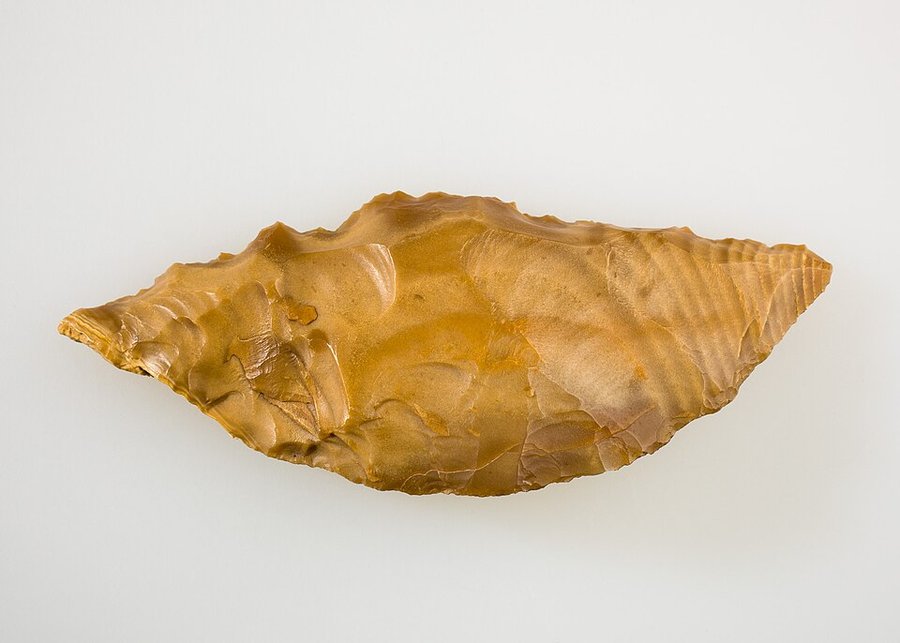
On the northern coast of Peru, between 11,000 and 7,000 BC, another singular lithic tradition developed: the Paijanian. Its large lanceolate points -- up to 25 cm -- were apparently used to hunt coastal animals and fish. The Paijanians left camps in the quebradas (ravines) near the ocean, where they transformed local chert nodules into specialized tools. This culture represents one of the earliest known adaptations to the marine environment in South America.
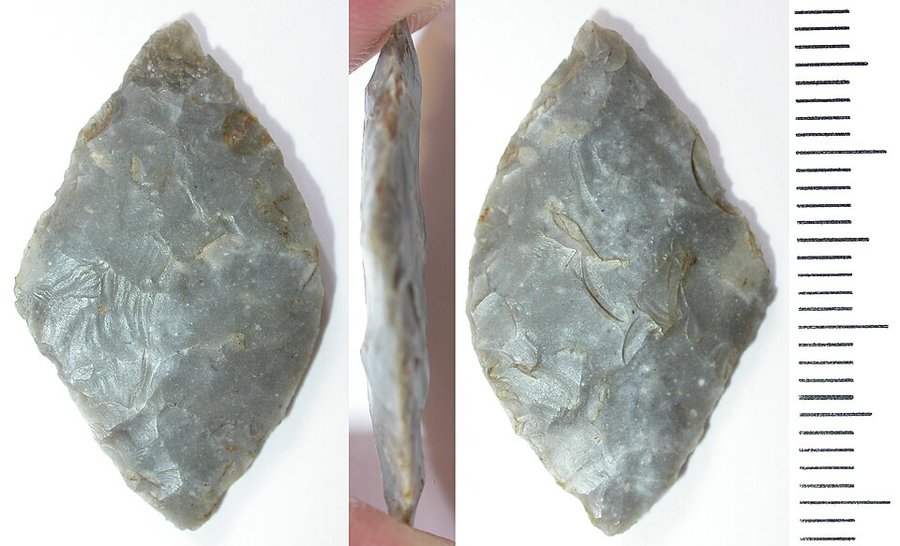
Other regional traditions have been defined by archaeologists: El Jobo (Venezuela, ~14,000-12,000 years ago) with its large lanceolate points; notched and stemmed tool industries of northeastern Brazil; pebble tool industries of the Monte Verdean tradition in Chile. This diversity illustrates that the peopling of South America was not a single event but a series of waves and internal colonizations.
Cueva de las Manos: Witness to These Peoples
These lithic hunters sometimes left spectacular artistic testimonies. Cueva de las Manos ("Cave of Hands") in Argentine Patagonia, dated to 9,000 to 13,000 years ago, contains over 800 hand stencils made by projecting colored pigments -- one of the most remarkable prehistoric art sites in the world, listed as a UNESCO World Heritage Site. Guanacos, the wild ancestors of llamas, also appear in large numbers on its walls.
The study of South American lithic traditions remains a work in progress. Each new excavation -- in Patagonia, Amazonia, or on the arid coasts of Peru -- brings its share of surprises. The transition from these Paleoindian cultures to the first agricultural societies, around 6,000 BC, constitutes one of the most fascinating chapters of human history in South America.
No comments yet. Be the first.