On 24 November 1974, on the scorched, eroded slopes of the Afar depression in Ethiopia, a young American palaeontologist named Donald Johanson spotted, barely protruding from the grey soil of a gully, the fragment of an elbow bone. A few hours later, together with his student Tom Gray, he was looking at the scattered remains of a skeleton more than three million years old. That evening, back at camp, a Beatles song played on a loop on a tape recorder, Lucy in the Sky with Diamonds, and the fossil received a nickname that would travel the world. Lucy had just been born a second time.
Catalogued under the austere code AL 288-1, Lucy is one of the most famous specimens in the entire history of palaeoanthropologyPalaeoanthropologyThe science that studies human evolution from the fossil remains of hominins (bones, teeth, footprints) and their context, to reconstruct our biological origins.→. Belonging to the species Australopithecus afarensis, she was, at the time of her discovery, the most complete and most ancient hominidHomininHomininMember of the subtribe Hominina, comprising the human lineage (Homo, Australopithecus, Paranthropus…) but excluding orangutans and gibbons. The term progressively replaces "hominid" in its narrow sense.→A member of the human lineage in the broad sense, including modern humans, their ancestors and related great apesgreat apesThe family of great apes (Hominidae) comprising orangutans, gorillas, chimpanzees, bonobos and humans.→.→ skeleton ever unearthed. Yet her fame does not rest on age or completeness alone: Lucy overturned the way scientists told the story of our origins. Before her, it was widely assumed that the human brain had grown first, and that upright walking had followed. Lucy demonstrated, bone in hand, exactly the opposite. This article retraces the discovery, anatomy and significance of a fossil that transformed a discipline and captured the public imagination.
Understanding Lucy also means understanding why a single skeleton could weigh so heavily in the history of ideas. A fossil is only as valuable as the questions it allows us to pose and to settle. Lucy, through her completeness, her antiquity and her unexpected anatomy, arrived at exactly the right moment to answer one of humanity's oldest questions about itself: what was it, first of all, that set us apart from other primates? The answer she provided, and the many further questions she raised, deserve to be unfolded section by section, from the geology of the Afar to the fossil's place in contemporary culture.
The setting: the Afar, an open-air laboratory
The Afar depression, in north-eastern Ethiopia, is one of the most inhospitable and most precious landscapes on the planet for anyone studying human origins. It is here that three tectonic plates slowly pull apart, tearing the Earth's crust at a triple junction that will, in millions of years, separate the Horn of AfricaAfricaThe cradle of humankind: the continent where the first hominins appeared, then Homo sapiens around 300,000 years ago, before the expansion to the rest of the world.→ from the rest of the continent. This intense geological activity has a spectacular side effect for researchers: through uplift and erosion, it exposes sedimentary layers laid down over millions of years, delivering to the surface fossils that more stable terrains would keep buried forever.
The Afar today is a desert of heat, basalt and salt, one of the lowest and hottest points on the globe. But more than three million years ago, the landscape was very different. Rivers wound through a mosaic of gallery forests, wooded grasslands and marshes bordering a large, shallow lake. It was in these lake and river sediments, rich in organic debris and regularly blanketed by volcanic ash, that the remains of an abundant fauna were preserved, antelopes, primitive elephants, hippopotamuses, crocodiles, and among them, those of Lucy.
Working in the Afar is no easy task. Temperatures frequently exceed forty degrees Celsius, drinking water must be carried in from afar, and field seasons unfold under extreme logistical conditions, sometimes against a backdrop of regional tensions. This indicates the degree of motivation and endurance required for fossil hunting in the region. Yet these hardships are the price of access to geological archives of unrivalled richness: almost nowhere else are the Pliocene layers so well exposed, so finely datable and so densely populated with hominin remains. The Afar offers, in a sense, an open window onto one of the most decisive chapters of our prehistory.
In the early 1970s, the site of Hadar drew the attention of an international team. The Franco-Ethiopian geologist Maurice Taieb, who had recognised the region's exceptional potential, founded the International Afar Research Expedition together with Donald Johanson and the anthropologist Yves Coppens. From the very first campaigns, Hadar yielded hominid fossils: in 1973, Johanson unearthed an articulated knee that already showed a decisive peculiarity, the characteristic angle of a biped's femur. The team knew it was sitting on a major deposit. The autumn 1974 field season would exceed all expectations.
The strength of the Hadar deposit also lies in its chronological precision. The volcanic eruptions that dusted the region with ash left clear temporal markers, sandwiched between the river deposits. Each tephra layer functions as a time-stamped page, allowing fossils to be placed not in a vague "very long ago" but within a bracket of a few tens of thousands of years. This exceptional resolution is what made it possible, as early as the 1970s, to state with confidence that Lucy was more than three million years old, and to compare her age with that of other discoveries made elsewhere in Africa.
The discovery of 24 November 1974
That Sunday morning, Johanson hesitated to go out. The heat was crushing, field notebooks were piling up, and he could have stayed at camp updating his records. But a hunch pushed him to accompany Tom Gray to a locality named Afar Locality 288, to check a sector that had already been surveyed. On the way back, as they returned to the vehicle under a blazing sun, Johanson noticed a bone fragment half-buried in the slope of a small gully. His trained eye immediately recognised a piece of ulna, a forearm bone, clearly too slender and too curved to belong to an ordinary ape.
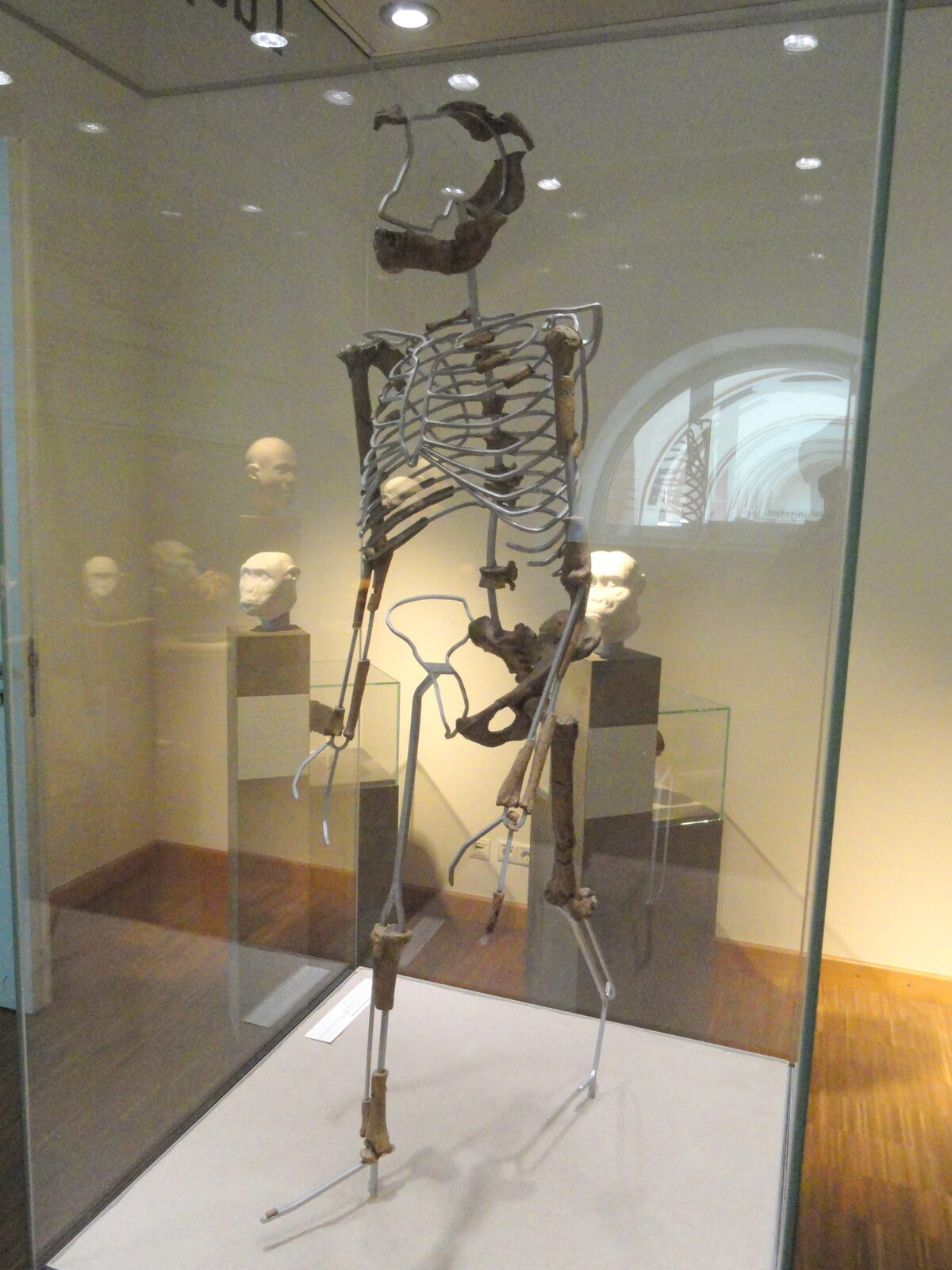
Looking up, the two men saw further fragments: a piece of occiput, a femur, ribs, vertebrae, parts of the pelvis, a mandible. All seemed to belong to a single individual, an extraordinarily rare situation, since hominid fossils almost always come as isolated teeth or splinters. The likelihood that so many bones of one skeleton had survived erosion, scavenger dispersal and flooding was minute. Johanson and Gray returned to camp barely able to contain their excitement.
The episode has become one of the most often retold in all of palaeoanthropology, to the point of taking on an almost legendary quality. Johanson himself has recounted it many times, stressing the element of luck that so often presides over great field discoveries: without his hunch to go prospecting that day, without the chance of a glance cast in the right place at the right moment, the skeleton might have stayed buried, or crumbled under seasonal rains and trampling. The science of human origins advances in this way, at the crossroads of rigorous preparation and a fortunate concurrence of circumstances.
At camp that evening, the euphoria did not subside. The tape recorder played Lucy in the Sky with Diamonds on a loop, and when someone suggested that the skeleton should stop being referred to by its catalogue number and be given a name instead, the choice was obvious: it would be Lucy.
The excavation itself occupied the team for three weeks. On their knees, methodically sieving every shovelful of sediment from the slope, the researchers recovered in total several hundred fragments corresponding to dozens of distinct bones. No anatomical duplication appeared: no two left femurs, no two jaws, proof that this was indeed a single individual. The modest size and the morphology of the pelvis quickly pointed to the hypothesis of an adult female of small stature.
The environments in which Lucy lived were not the arid savanna sometimes imagined. Analyses of the sediments, fossil pollen and associated animal remains depict instead a mosaic landscape, alternating light woodland, wet meadows, gallery forests along watercourses and stretches of grass. This variety of habitats probably favoured a species able to exploit several environments at once: walking on the ground to cross open spaces, climbing trees to feed, shelter or sleep. Lucy's anatomical versatility thus reads as an adaptation to a world that was itself composite, neither fully forested nor fully open.
The skeleton: 40% of one individual, an anatomical treasure
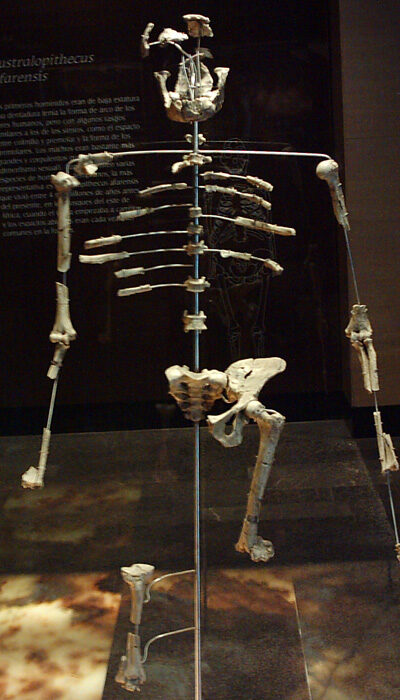
What makes Lucy an extraordinary specimen is her completeness. With roughly forty per cent of the skeleton preserved, she offered researchers a coherent overview of a single body, where most australopithecinesAustralopithecineA genus of bipedal hominins from Africa (c. 4.2–1.9 Ma) with a brain still close to that of great apes (400–550 cm³) but walking upright. Lucy (<em>Au. afarensis</em>) is the most famous specimen.→ were known only from scattered fragments belonging to different individuals. Having the skull, spine, pelvis and limbs of one and the same individual makes it possible to reason about real proportions, about the articulation of segments, about posture, data that cannot be reliably reconstructed from mismatched bones.
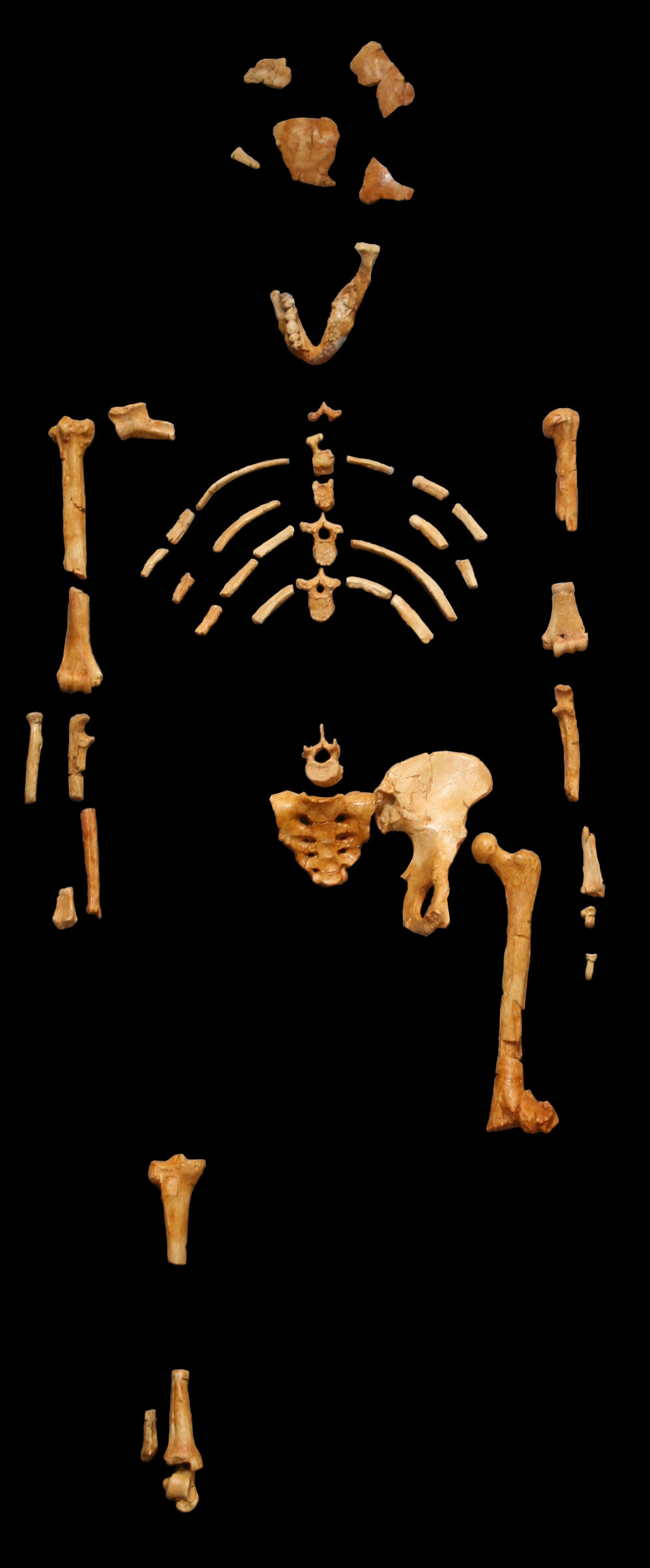
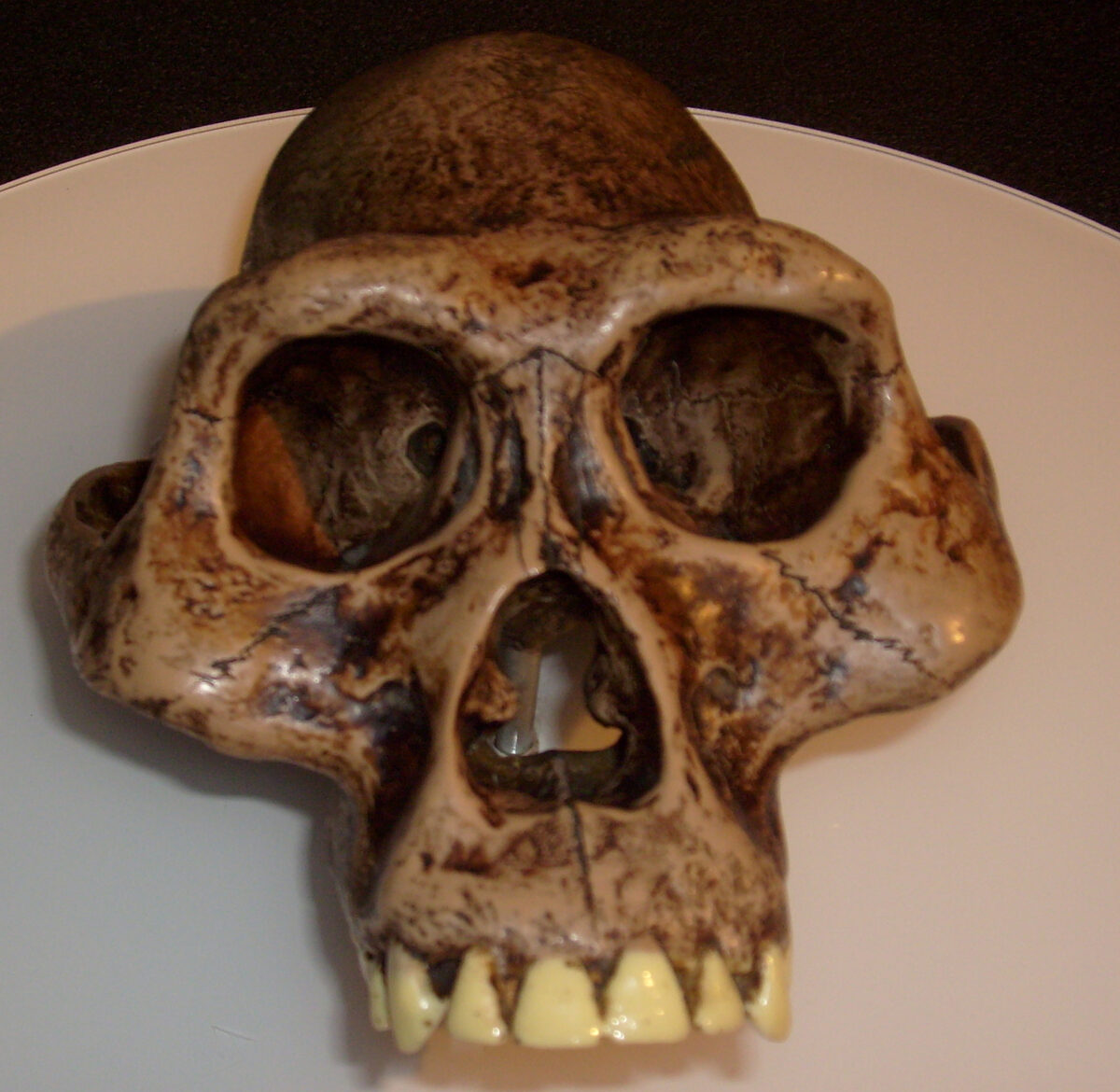
Lucy was small: about 1.05 to 1.10 metres tall, with an estimated mass between 25 and 30 kilograms. Her composite morphology is striking from the outset. The skull, of which only fragments were found, housed a brain of reduced capacity, on the order of 380 to 430 cubic centimetres, barely more than that of a modern chimpanzee, and roughly a third of the present-day human brain. The face was prognathic, that is, projecting forward, with robust brow ridges and powerful jaws. In her upper body, Lucy still resembled a great ape: relatively long arms, slightly curved fingers, a shoulder blade oriented as in climbing species, suggesting that she had not fully abandoned the trees.
But it is the lower body that tells an entirely different story. Lucy's pelvis is wide and short, flared at the sides, radically different from the narrow, elongated pelvis of African apes. The femur slants obliquely from the hip towards the knee, forming the famous valgus angle that brings the knees and feet beneath the body's centre of gravity, a mechanical arrangement indispensable for walking upright. The knee itself shows the configuration of a weight-bearing joint designed to support the body's mass in a vertical stance. This combination of an archaicArchaicRefers to an ancient, now-extinct human population or form (Neanderthals, Denisovans, ghost lineages), as opposed to anatomically modern humans.→ upper body and a lower body already deeply remodelled for bipedalism defines what palaeoanthropologists call a mosaic morphologyMosaic morphologyThe combination, in a single organism, of primitive and derived anatomical traits, as if the body assembled parts of different ages.→, in which ancestral and derived traits coexist in a single organism s2.
The differential preservation of Lucy's bones is explained by the fossilisation conditions of the Afar. Quickly covered by fine sediments at the edge of a body of water, the body escaped complete destruction by scavengers and dispersal by currents. Mineralised over the millennia, the bones were then slowly brought back towards the surface by erosion, until they cropped out precisely at the moment when a team was looking for them. This chain of events, each link improbable, explains the rarity of such complete specimens and the priceless value of Lucy as an anatomical document.
Over the decades, the accumulation of other Australopithecus afarensis fossils at Hadar and elsewhere has made it possible to place Lucy within the variability of her species. We now know of larger individuals, presumably males, whose height could reach 1.50 metres, suggesting marked sexual dimorphism, closer to that of gorillas than of modern humans. Lucy's small size is therefore not that of the whole species, but that of a female individual within a population of contrasting builds. This diversity has, moreover, fuelled some of the taxonomic debates discussed below.
Why "Lucy"? Dinkinesh, "you are marvellous"
The nickname "Lucy" has entered everyday language to the point of eclipsing the scientific code AL 288-1. Its origin, as we have seen, lies in the Beatles song that was playing at camp on the evening of the discovery. The anecdote helped to humanise the fossil and make it familiar to the public: it was easier to grow attached to "Lucy" than to an alphanumeric combination. This informal baptism doubtless played a significant role in the specimen's worldwide fame, lending it an almost novelistic personality.
It is worth stressing how far the nickname borrowed from a popular song helped abolish the distance between a lay public and an otherwise austere scientific object. By giving the fossil a first name, the team conferred upon it, almost in spite of itself, the status of a character: people speak of "Lucy's life", of "Lucy's death", as they would of a singular being. This personalisation, sometimes criticised for its anthropomorphism, has unquestionably served the spread of knowledge, turning an austere AL 288-1 into a universal ambassador of our distant origins.
In Ethiopia, however, the fossil bears another name, charged with another resonance. It is called Dinkinesh, an Amharic word meaning "you are marvellous" or "you are astonishing". This name, expressing national pride in a heritage recognised as one of the country's most precious, reminds us that Lucy is not only a Western icon of science: she belongs first to the land that preserved her for more than three million years. The original skeleton is today kept at the National Museum of Ethiopia in Addis Ababa, and is generally not on public display, it is highly faithful casts that circulate in the world's museums and are presented to visitors s3.
This double naming, Western and Ethiopian, says something about the history of palaeoanthropology itself, long conducted by foreign teams on African ground. Today, the prominence of vernacular names such as Dinkinesh or Selam marks the growing recognition of the central place of African countries and researchers in the study of their own origins.
It also bears emphasising that the importance of vernacular names such as Dinkinesh signals a wider shift in the discipline. For most of the twentieth century, the fossils of Africa were named, studied and curated largely by researchers from elsewhere. The growing prominence of Ethiopian scholars, of national institutions in Addis Ababa, and of names rooted in local languages reflects a rebalancing in which the countries that hold these remains are increasingly the principal narrators of their own deep past.
Dating: about 3.2 million years, in the heart of the Pliocene
Establishing Lucy's age with precision was essential to gauge the significance of the discovery. The fossil itself cannot be dated directly by classical radiometric methods, but its stratigraphicStratigraphyThe study of the superimposed layers (strata) of an archaeological site; each layer corresponds to a phase of occupation and yields a relative chronology.→ position allows it indirectly. The Hadar sediments are interspersed with layers of volcanic ash, tephrasTephraA generic term for all the solid fragments (ash, lapilli, pumice, blocks) ejected into the air by a volcanic eruption. Tephra layers serve as precise chronological markers (tephrochronology) across vast regions.→, deposited by episodic eruptions. These ashes contain crystals whose age can be measured through the radioactive decay of potassium into argon. By dating the tuff layers above and below the level that yielded Lucy, geologists were able to bracket the skeleton's age.
The analyses converge on a date of about 3.2 million years. This places Lucy squarely in the middle of the PliocenePlioceneA geological epoch spanning roughly 5.3 to 2.6 million years ago, the last subdivision of the Neogene. It was during the Pliocene, in an East Africa undergoing cooling and forest fragmentation, that the first fully bipedal australopithecines such as Lucy (~3.2 Ma) evolved.→, the geological epoch spanning roughly 5.3 to 2.6 million years before present. The Pliocene is a pivotal period: the global climateClimateThe long-term average atmospheric conditions of a region; its variations (glaciations, aridifications) shaped migrations, agriculture and the collapse of prehistoric societies.→ slowly cools, the tropical forests of East Africa fragment and retreat in favour of more open environments, mosaics of light woodland and grassy savanna. It is precisely in this context of changing landscapes that the australopithecines flourished, these fully bipedal hominins still endowed with a small brain and, it seems, capable of climbing.
The species Australopithecus afarensis, to which Lucy belongs, is today documented over a remarkably long time span, from about 3.9 to 2.9 million years, and across several sites in East Africa, from northern Ethiopia to Tanzania. This persistence over nearly a million years testifies to a durable evolutionary success, and makes the species a serious candidate for the role of ancestor, or close relative of an ancestor, of later lineages s2.
Bipedalism: Lucy's great lesson
If one had to retain a single thing about Lucy, it would be this: she walked upright. The demonstration rested not on supposition but on a convergence of anatomical arguments difficult to refute. The first clue lies in the pelvis. In great apes, the iliac bone is high, flat and oriented backwards, suited to a quadrupedal posture. In Lucy, as in humans, the ilium is short, wide and curved towards the sides, forming a basin that supports the viscera in a vertical position and offers anchoring points for the gluteal muscles that stabilise the trunk during walking.
The second clue is the angle of the femur. In Lucy, the femur does not descend straight from the hip but converges inwards, placing the knee and foot under the body's axis. This arrangement, called knee valgus, allows walking without excessive swaying by alternately shifting the body's weight onto a single leg at each step. It is found in all humans and absent in apes, which move on the ground with a rolling, energy-costly gait. Lucy's knee, moreover, shows the articular surfaces of a load-bearing limb, designed to transmit the body's weight vertically s1.
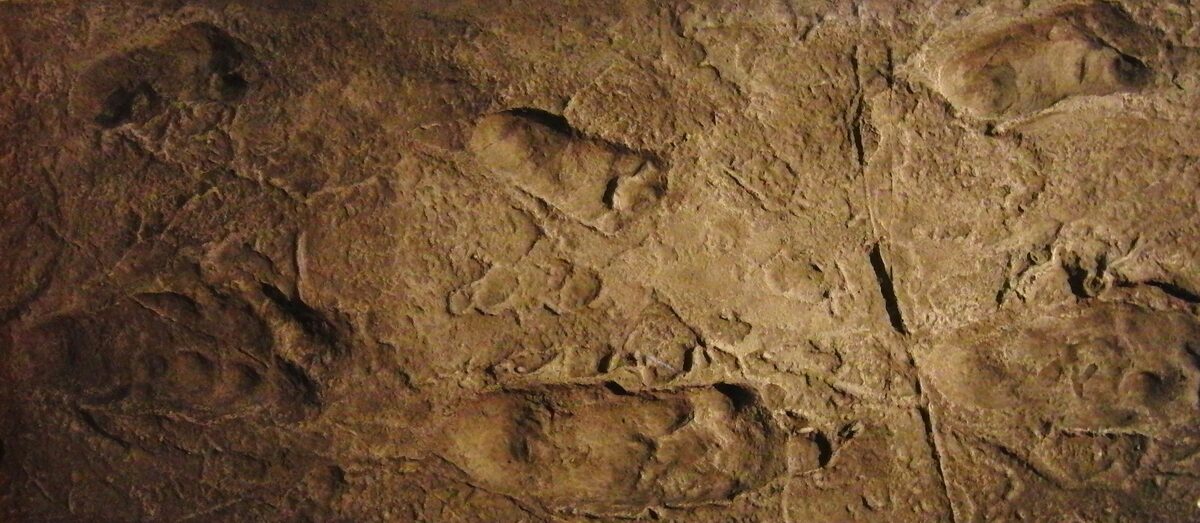
A third argument, independent of Lucy's own bones, spectacularly confirmed the picture. In 1976, at Laetoli in Tanzania, more than 1,500 kilometres south of Hadar, Mary Leakey's team uncovered a trail of footprints fossilised in a hardened layer of volcanic ash, dated to about 3.6 million years. These tracks, left by at least two or three individuals walking side by side, show an arched sole, a big toe aligned with the foot's axis, not splayed like a grasping thumb, and a heel-to-toe succession typically human. Now, at that time, the only known hominin in the region was precisely Australopithecus afarensis. The Laetoli footprints thus offer a direct, almost cinematic image of the walk of Lucy's species, etched into the mud of a Pliocene morning.
It is worth measuring the strength of this body of evidence. No single trait would suffice to carry conviction: a curved femur could be explained otherwise, an isolated vertebra would invite interpretation. It is the convergence of independent signals, pelvis, femur, knee, position of the foramen magnum, and soon footprints, that makes the conclusion irrefutable. In comparative anatomy, this cross-checking logic is the norm: a fossil is not read as an unambiguous text, but dozens of observations are combined until a single hypothesis withstands scrutiny. For Lucy, that hypothesis is one of habitual bipedal walking, even though she retained climbing abilities.
The foramen magnumForamen magnumThe opening at the base of the skull through which the spinal cord connects to the brain. Its position (rear → forward) is a bipedalism indicator: placed beneath the skull in bipeds, at the rear in quadrupeds.→, the opening through which the spinal cord joins the brain, completes the demonstration: positioned forward, beneath the skull, as in bipeds, and not towards the rear as in quadrupeds. Everything, from the top of the skull to the sole of the foot, pointed to the same conclusion: Lucy and her kind walked on two legs long before their brains had begun to enlarge.
One measures the solidity of this body of evidence better by recalling that no isolated trait would settle the matter on its own: a curved femur might be explained otherwise, an isolated vertebra would lend itself to interpretation. In comparative anatomy, it is the crossing of dozens of independent observations that builds certainty, and on every count Lucy's lower skeleton points in the same direction. This is why, despite her tiny brain and ape-like face, palaeontologists were able to declare without hesitation that they were looking at a creature that habitually stood and walked on two legs.
The theoretical upheaval: bipedalism before the big brain
To grasp the shock wave caused by Lucy, one must recall which narrative dominated human origins before 1974. For much of the twentieth century, a tenacious idea held that it was intelligence, and therefore the large brain, that had made us human, and that other traits, including upright walking, had flowed from it. This conception drew support from the famous Piltdown Man hoax, unveiled early in the century and then exposed in 1953: this forgery combined a large human braincase with an ape's jaw, suggesting exactly the expected sequence, a brain first, the rest afterwards.
Lucy overturned this scheme decisively. Here was a being with a brain barely larger than a chimpanzee's, with a still strongly ape-like face, but whose pelvis and legs unambiguously proclaimed an upright stance. The conclusion was inescapable: in the human lineage, bipedalism preceded brain expansion by several million years. BipedalismBipedalismA mode of locomotion on two hind limbs, the defining trait of the human lineage, appearing over 7 million years ago. Visible in the anatomy of the pelvis, femur and foramen magnum.→ was not the consequence of intelligence, but a founding trait, appearing very early and independently, perhaps in response to ecological pressures linked to the retreat of forests and the need to move efficiently through open environments.
One appreciates better, in hindsight, how far the Piltdown affair had shaped minds. For forty years, this forgery lent credit to the "brain first" idea and helped relegate African discoveries, such as the Taung Child described by Raymond Dart in 1924, whose small brain and signs of bipedalism fit poorly with the dominant narrative, to the background. Lucy definitively shifted the discipline's centre of gravity towards Africa and towards the whole body, rather than the skull alone, as the key to reading our origins. In this sense she also rehabilitated, decades later, the intuition of pioneers whom their own age had refused to hear.
This reversal had profound consequences for the way of thinking about human evolution. It invited researchers to look for the drivers of bipedalism elsewhere than in the brain: energy savings on long journeys, freeing of the hands to carry food or young, better thermal regulation under a savanna sun, the ability to see further over tall grasses. None of these hypotheses commands absolute consensus, but all now start from a fact secured thanks to Lucy: we first stood upright, and only much later, with the genus Homo, did the brain begin its spectacular growth.
Beyond science, this new narrative carries a philosophical weight. It dislodges the brain from its pedestal as the founding organ of humanity and tells a humbler, more earthbound story, in which the human begins with a way of setting foot upon the ground. Lucy thus changed not only the content of textbooks but also our very idea of what first distinguished us from our cousins who stayed in the trees.
Beyond this central lesson lies a broader point about how a single skeleton can reorganise an entire field. Lucy did not merely add a data point; she forced researchers to reverse the order of their reasoning, to start from the body rather than the head, and to treat the savanna and the forest edge, not the council fire or the toolmaker's bench, as the cradle of our distinctive gait. Every later discovery has been interpreted, in part, against the template she provided.
Lucy in the human tree: ancestor or cousin?
A delicate question remains, often misunderstood by the public: is Lucy our direct ancestor? The honest answer is that no one can assert it with certainty. Australopithecus afarensis occupies a central and early position in the hominin tree, at a time when several lineages were beginning to diverge. The species displays a combination of traits that makes it compatible with the status of common ancestor of the later australopithecines, the robust Paranthropus and the genus Homo. But "compatible with" is not "demonstrated as".
The problem lies in the bushy nature of evolution. The human tree is not a linear ladder rising neatly from ape to human, but a dense bush in which several species coexist at each period, many of them lateral branches that died out without descendants. Australopithecus afarensis could be our direct ancestor; it could also be a very close cousin of that ancestor, a parallel species sprung from a slightly older common stock. Distinguishing between these scenarios, from fragmentary fossils and a few hundred millennia of uncertainty, often exceeds what the data allow us to decide.
The debate has grown still more complex with the recognition of other contemporary or neighbouring species. Kenyanthropus platyops, dated to the same interval, or older forms such as Australopithecus anamensis, from which afarensis may descend, have fuelled discussions about the real number of lineages present in East Africa during the Pliocene. Some researchers see afarensis as a single, variable species whose differences between individuals chiefly reflect strong sexual dimorphism; others suspect that several species hide under the label. These disagreements, far from anecdotal, touch the very heart of the systematics of human origins s2.
This search for the direct ancestor raises a question of method as much as of fact. In palaeontology, demonstrating descent in the strict sense is almost impossible: one cannot follow a lineage generation after generation over millions of years. What researchers establish are probable kinship relations, founded on shared derived characters and on chronological and geographical coherence. To say that afarensis is "ancestral" to Homo then means that it lies on, or very close to, the line leading to us, without our being able to rule out that a sister species, still unknown or poorly dated, in fact occupies that position. This caution is not an admission of weakness, but the mark of a science aware of its limits.
What is firmly established, on the other hand, is that Lucy sits very close to the base of our branch, at a decisive moment when bipedalism was already acquired and the brain had not yet enlarged. Whether she is our forebear in a direct line or a great-aunt of evolution, she shows us what the stage our true ancestors passed through looked like, in broad strokes. It is in this sense that she remains a cornerstone, even when her exact filiation stays under discussion.
Beyond Lucy: Laetoli, Selam, Ardi and Little Foot
Lucy is not an isolated fossil: she belongs to a constellation of discoveries that, together, sketch the picture of the earliest times of bipedalism. The Laetoli footprints, already mentioned, are its most immediate complement. Where Lucy yields the skeleton, Laetoli yields the movement: the living trace of feet pressing down, heel then toes, into fresh ash set by the rain. Anatomy and behaviour answer and confirm each other.
In 2000, the team of Zeresenay Alemseged unearthed, at the site of Dikika not far from Hadar, another Australopithecus afarensis skeleton of exceptional quality. This time it was a child of about three years, who died some 3.3 million years ago, nicknamed Selam, "peace" in Amharic, and often called the "Lucy's baby". Its preservation is extraordinary: the skull, the trunk, and even small fragile bones such as the hyoid and the shoulder blade, rarely preserved, are available. Selam confirms the species' mosaic: already bipedal legs, but a shoulder girdle and fingers still adapted to climbing, arguing for a life partly spent in the trees, perhaps for sleeping or escaping predators.
Older still, the skeleton of Ardipithecus ramidus, nicknamed Ardi, dated to about 4.4 million years and described in detail in 2009 after years of study, broadens the perspective towards the very roots of bipedalism. Ardi had a still-divergent, grasping big toe, and probably moved through the trees with cautious walking along the branches, while also practising a form of bipedalism on the ground. Ardi suggests that the transition to an upright stance was gradual, and that it did not necessarily emerge in the open savanna but possibly in still-wooded environments, qualifying the classic scenarios.
Finally, in South Africa, the skeleton known as Little Foot, attributed to the genus Australopithecus and patiently freed from the hard rock of the Sterkfontein caves over more than twenty years, offers another remarkably complete skeleton, perhaps even older than Lucy according to some datings. Little Foot reminds us that the australopithecine adventure does not unfold only in East Africa: southern Africa has yielded, ever since Raymond Dart's work on the Taung Child in 1924, hominins just as decisive. Together, Lucy, Selam, Ardi and Little Foot make up a gallery of portraits that, from 4.4 to under 3 million years, document the invention and refinement of upright walking.
These successive discoveries have profoundly altered the way we conceive the diversity of the earliest hominins. Far from a linear, solitary progression, what emerges is a teeming coexistence of species, each exploring in its own way the possibilities of a bipedalism still associated with a partly arboreal life. Lucy, Selam, Ardi and Little Foot do not succeed one another along a single line: they are distributed in time and space as so many variations on one theme, the gradual conquest of an upright stance over several million years.
The cultural and scientific legacy
Few fossils have achieved a fame comparable to Lucy's. Her name has become a universal shorthand for "our ancestor", appearing in school textbooks, documentaries, songs and the broadest popular culture. This renown has had a concrete effect on the discipline: it has made palaeoanthropology a visible science, capable of arousing public enthusiasm and, in turn, of mobilising funding and vocations. Before Lucy, the study of human origins remained largely confined to academic circles; after her, it entered the great collective narrative.
This popularity also had its shadows and controversies. In the 2000s, the original skeleton went on an exhibition tour of the United States, a decision hailed by some as a chance to share a universal heritage, criticised by others as a needless risk to an irreplaceable object. The episode reminded everyone that Lucy is not only a scientific object, but also an Ethiopian national symbol and a common good of humanity, whose preservation entails a particular responsibility.
On the scientific front, Lucy's legacy keeps renewing itself. Three-dimensional imaging techniques, analysis of bone microstructure and biomechanical modelling have made it possible to revisit the old skeleton with fresh questions. In 2016, a study of the fractures observed on her bones even proposed that Lucy died from the consequences of a fall, perhaps from a tree, a contested hypothesis, but one revealing the capacity of a forty-year-old fossil to nourish cutting-edge research. Far from being a closed case, Lucy remains an active object of study, questioned by each generation with the tools of its time.
Lucy has finally shaped a certain image of the fossil hunter and of fieldwork: the patience of hours spent scanning the ground, the lucky chance of a fragment cropping out, the fragility of a heritage exposed to erosion and time. She gave a face, or rather a skeleton, to the idea that our origins are inscribed, somewhere, in the soil of Africa, and that sometimes an attentive glance on a Sunday in November is enough to bring them to light.
Conclusion
Half a century after her discovery, Lucy has lost none of her importance. She remains one of the most studied, most exhibited and most beloved fossils of human prehistoryPrehistoryThe span of human history before the invention of writingWritingA system of conventional signs used to fix language or information durably; its appearance (c. 3300 BC) marks, by convention, the end of prehistory.→, from the PalaeolithicPalaeolithicThe oldest and longest period of prehistory (c. 3.3 Ma–12,000 BC), defined by chipped stone tools and a hunter-gatherer way of life.→ to the Metal Ages, known mainly through material remains.→. Her major contribution can be stated in a single sentence: she proved that our ancestors walked upright long before they thought big, overturning the old prejudice that made the brain the prime mover of becoming human. In this she not only enriched knowledge but reconfigured the very narrative of our origins.
Beyond this central lesson, Lucy embodies a way of working: that of a science advancing through fragments, reconstructing bodies and behaviours from a handful of scattered bones, and able to acknowledge its uncertainties, about her exact filiation, about the number of contemporary lineages, about the deep reasons for bipedalism. Surrounded by Selam, Ardi, Little Foot and the Laetoli footprints, she is no longer a solitary figure but the most famous member of an extended family of Pliocene hominins. Dinkinesh, "the marvellous one", thus continues to speak to us, three million years after her last steps, of what it means, in the end, to become human.
On a passé toute une soirée à parler de ça en famille. Merci pour ce moment !
Super article, j'aurais aimé avoir ça pour mes partiels du S1. Je le garde pour le S2.
Ces formes géométriques préhistoriques reviennent régulièrement dans mon travail graphique. Ce site les documente parfaitement.
Lucy est l'une des premières notions que j'enseigne en début d'année en SVT. Elle est parfaite pour aborder les critères de définition de la lignée humaine, en particulier la bipédie. Mais j'essaie aussi de faire comprendre à mes élèves que Lucy n'était pas un ancetre direct de l'homme mais appartient à un groupe riche en espèces dont une seule a donné le genre Homo.
Lucy reste l'un des fossiles les plus importants jamais découverts, même si elle a été rejointe depuis par de nombreux autres Australopithèques. Sa découverte par Donald Johanson en 1974 a définitivement ancré l'Ethiopie comme berceau de l'humanité et montré que la bipédie précédait l'augmentation du volume cérébral. Un moment fondateur pour la paléoanthropologie moderne.