Some objects seem to have fallen out of another age. The Antikythera mechanism is one of them. Recovered from the sea in 1901, this handful of salt-eaten bronze wheels took almost a century to surrender its secret, that of an astronomical calculator able to predict the positions of the Sun, the Moon and the planets, to follow the rhythm of eclipsesEclipseThe passing of one celestial body into the shadow of another, for instance the Moon hiding the Sun or the Earth casting its shadow on the Moon.→ and to mark out the great appointments of the Greek calendar. Built around 100 to 150 years before our era, it remains the most sophisticated technical object to have reached us from Antiquity. No mechanism of such refinement would reappear in Europe before the astronomical clocks of the Middle Ages, nearly a thousand years later. This is the story of a discovery that overturned our idea of the technical genius of the Ancients.
A find at the bottom of the Aegean
In the spring of 1900, a group of Greek sponge divers on their way to the coast of Tunisia sheltered from a storm near the small island of Antikythera, a rock lost between Crete and the Peloponnese. Sounding the seabed, one of them surfaced in a panic, describing a heap of human bodies on the sand. They were in fact statues of bronze and marble, scattered across the deck of a ship that had sunk somewhere in the first century before our era. The wreck lay at about forty metres deep, an extreme limit for the divers of the time, equipped with heavy copper helmets and rubberised canvas suits.
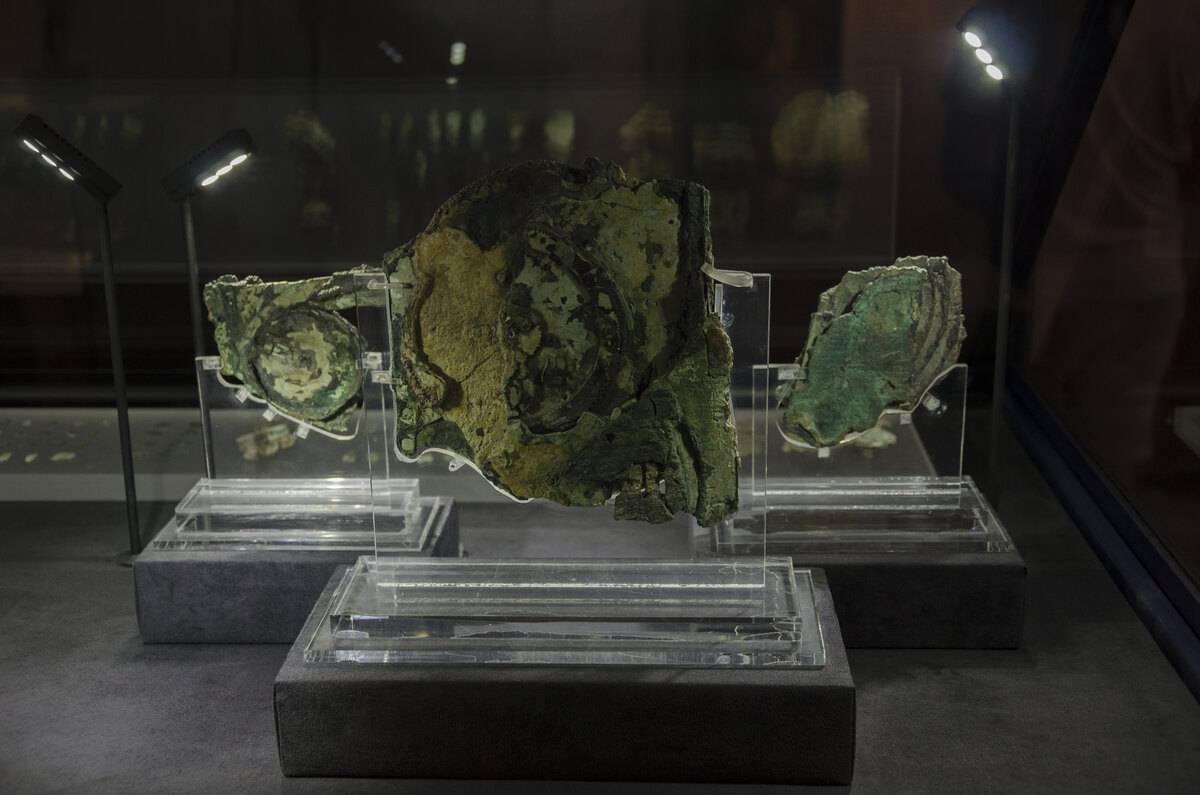
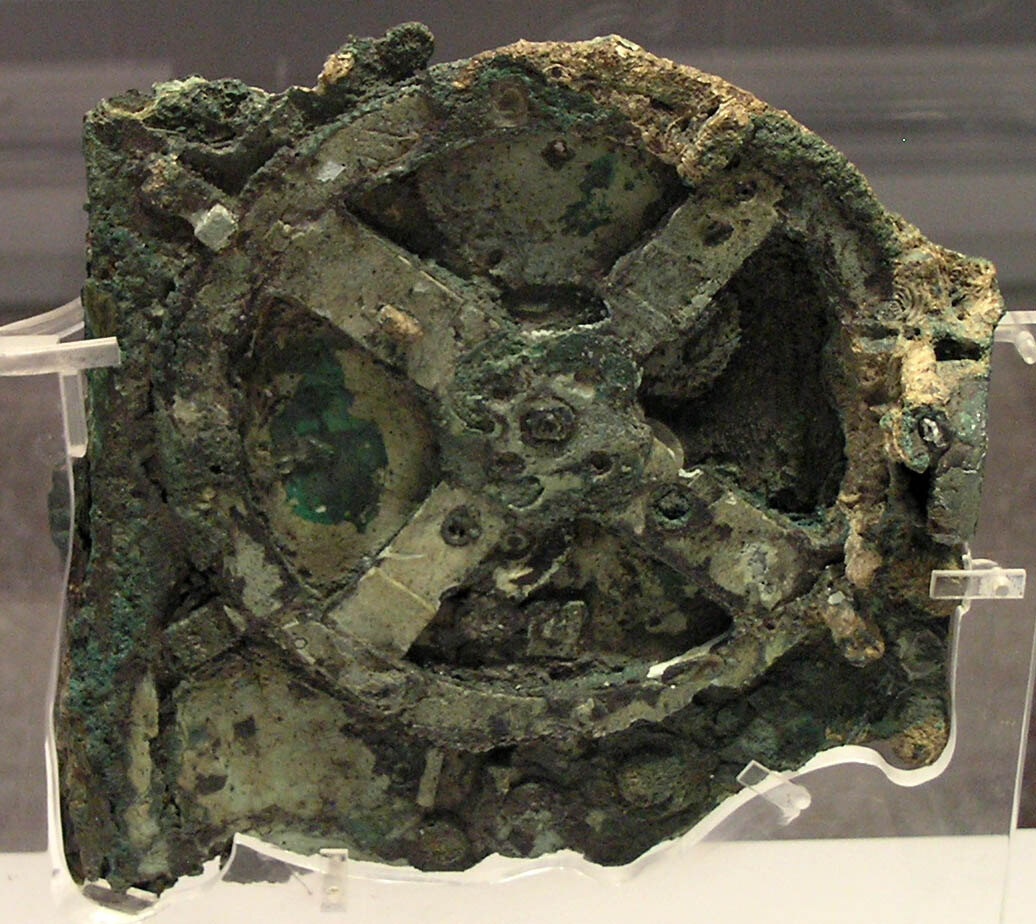
Under the authority of the Greek government and the national navy, the salvage campaigns continued through 1901. They brought up a considerable treasure, life-size bronze statues, marbles, luxury glassware, jewellery, coins and amphorae, a cargo no doubt bound for a wealthy Roman buyer. One diver lost his life and two others were left paralysed, victims of the decompression accidents that were then poorly understood. Among the haul, a corroded lump of bronze covered in calcareous deposits went almost unnoticed. Deposited at the Athens museum, it began to crack as it dried. It was in May 1902 that the archaeologist Valerios Stais spotted, in one of the breaks, the clear imprint of a toothed wheel. The object was not part of a statue but a mechanism, and no one at the time could imagine what it contained.
A lump of bronze that hid gearwork
What Stais had before him was only a fraction of the original machine. Time and the sea had done their work. Today the object is split into 82 fragments, three main pieces and a handful of legible portions, the rest being a multitude of tiny scraps. It is estimated that only about a third of the original mechanism has survived. Even so, researchers have identified some thirty surviving toothed wheels, hand-cut from a bronze alloy, some no larger than a coin, with teeth carved one by one.
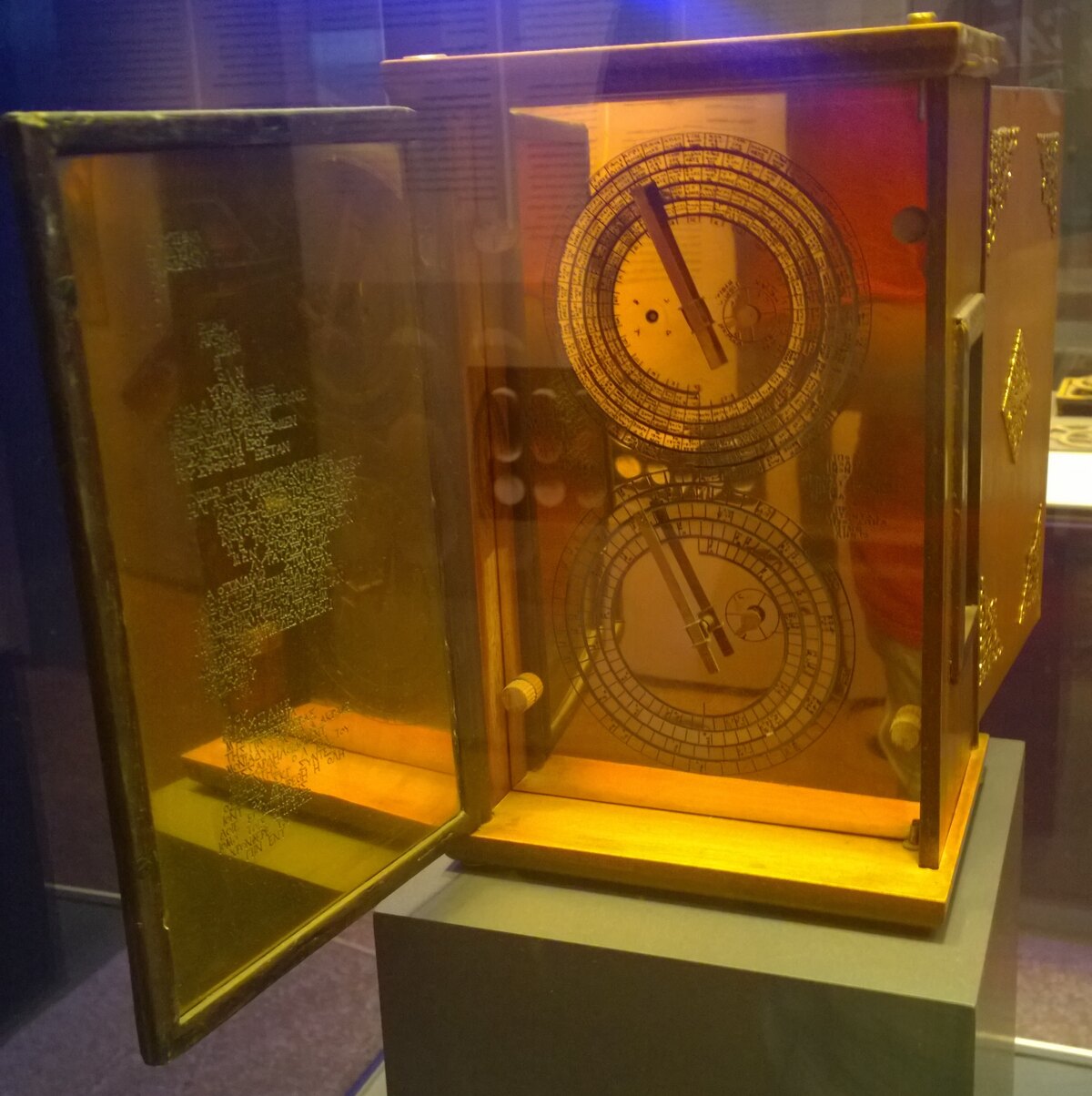
The whole originally fitted inside a wooden case about the size of a large shoebox, fitted with bronze doors covered in inscriptions, a kind of engraved instruction manual. On the front face a large dial displayed the position of the Sun and the Moon in the zodiac and the calendar of the year. At the back, two large spiral dials and several subsidiary dials delivered further astronomical information. A side crank, now lost, allowed the whole gear train to be turned. By winding this crank forward or backward, the user travelled through time, running the state of the sky back or forward to a chosen date. It was, quite literally, a machine for calculating the heavens, driven by hand.
Reading the invisible, X-rays and tomography
For decades, understanding how the machine worked was a near impossible task. The fragments were too fragile to open, and their wheels, welded together by corrosion, remained invisible to the naked eye. The first serious hypotheses came from the historian of science Derek de Solla Price, who published a study based on radiographs in 1974. He glimpsed a calculating mechanism linked to the lunar cycle, but his model remained incomplete and at times mistaken.
The great turning point came in 2005. An international team, the Antikythera Mechanism Research Project, applied to the fragments a specially built X-ray tomography machine, capable of reconstructing the interior of the metal in three dimensions, layer by layer. In parallel, a surface imaging technique brought out the slightest relief of the inscriptions. The results were spectacular. Researchers counted the teeth of each wheel, mapped the interlocking gears and revealed thousands of Greek characters, unread for two thousand years. This engraved text, a true manual, describes the functions of the dials and confirms the astronomical purpose of the device. It even mentions the planets and their movements. Thanks to these data, the publications that followed, notably in the journal Nature in 2006 and then 2008, at last reconstructed the internal logic of the machine.
A clock of the sky, Sun, Moon and eclipses
The heart of the machine is a model of the sky reduced to a piece of mechanics. Turning the crank drives a main wheel that represents the solar year. From there, a cascade of gears passes the motion on to the various indicators. The cleverest concerns the Moon. The Greeks knew that our satellite does not move at a constant speed, speeding up and then slowing down over the course of its orbit. To reproduce this play, the designers devised a device of two wheels mounted slightly off-centre, linked by a small pin sliding in a slot. This arrangement, of remarkable elegance, simulates the variable speed of the Moon, a theoretical feat probably inherited from the astronomer Hipparchus.
At the back, the large upper dial unwinds a five-turn spiral that embodies the Metonic cycleMetonic cycleA period of 19 years after which the phases of the Moon fall again on the same dates of the solar calendar.→, that period of 19 years after which the phases of the Moon fall again on the same calendar dates. A small subsidiary dial refines the count further with the Callippic cycle, 76 years long, that is four Metonic cycles minus one day. But the most impressive function is read on the lower dial, arranged according to the Saros cycleSaros cycleA period of 223 lunar months, about 18 years, after which eclipses recur in an almost identical configuration.→. This cycle of 223 lunar months, about 18 years, governs the return of eclipses, because after this span the Sun, the Moon and the Earth come back into an almost identical configuration. On the spiral, small engraved symbols, the glyphs, indicate the month when a solar or lunar eclipse is expected, sometimes even the approximate hour and the predicted colour. The machine did not merely measure time, it announced the great celestial spectacles.
The planets and the reconstructed cosmos
For a long time the front face of the machine remained a riddle. The inscriptions spoke of the five planets known to the Ancients, Mercury, Venus, Mars, Jupiter and Saturn, but the corresponding gears had vanished. A planetary display was suspected without anyone knowing how it worked. It was in 2021 that a team from University College London, led by Tony Freeth, published in Scientific Reports a full reconstruction of what it calls the model of the cosmos, the Greek representation of the order of the world.
The riddle hinged on two numbers found in the X-rays of the front cover, 462 and 442. These values match precisely the cycles of Venus and Saturn, the periods after which these planets return to the same relative position in the sky. Now, seen from Earth, the planets sometimes appear to slow down and then reverse their path among the stars, a retrograde motion that only long cycles allow one to predict. Drawing on a mathematical method described by the philosopher Parmenides, the researchers not only explained the origin of these numbers but also recovered the cycles of the other planets, where the evidence was missing. Their model proposes an ingenious system of nested tubes turning marker beads on concentric rings, each one representing a heavenly body. According to Tony Freeth, this reconstruction is the first to respect both all the physical traces and the text engraved on the machine. It blends Babylonian astronomy, mathematics inherited from Plato's Academy and Greek theories of the motion of the stars, a genuine intellectual tour de force.
Calendars, Games and the life of the city
The Antikythera mechanism was not only an instrument for astronomers. It also reached into the social and religious life of the Greek world. The large rear dial carried, month after month, the names of a lunisolar calendar whose twelve months have been identified. To general surprise, these names are not those of Athens but belong to the family of Corinthian calendars, in use at Corinth and its colonies, notably in north-western Greece and at Syracuse. This geographical clue still feeds hypotheses today about the place of manufacture or destination of the object.
More astonishing still, a small subsidiary dial displayed a four-year cycle devoted to the Panhellenic Games. On it have been deciphered the names of the great sacred competitions, Olympia, but also Nemea, the Isthmus of Corinth, Delphi for the Pythian Games, and a lesser competition. In a Greek world fractured into rival cities, the count of the olympiads served as a common reference for dating events, a kind of civilisational clock. That this reckoning should appear on an astronomical instrument shows how far, for the Greeks, the motion of the stars, the rhythm of the religious calendar and the organisation of the great festivals formed a coherent whole. The machine was at once an almanac, a pocket planetarium and a calendar of sacred appointments.
Who built the Antikythera mechanism
There remains the question that fascinates most, that of the maker. No signature appears on the object, and the debate stays open. The dating itself has been refined through the study of the eclipses engraved on the Saros dial, which seem to be calculated from a reference date placed in 205 before our era. This anchor has led some researchers to trace the design of the device further back than had been thought, even if the making of the surviving fragment belongs rather to the second or first century before our era.
Three great names keep coming up. Hipparchus of Nicaea, active on Rhodes around the second century before our era, is a prime candidate, because his theory of lunar motion matches exactly the pin-and-slot mechanism of the machine. Posidonius, the Stoic philosopher who ran a school on Rhodes, is another suspect, all the more so as the Roman orator Cicero describes a similar device, able to reproduce the movements of the Sun, the Moon and the planets, attributed to that same Posidonius. Finally the name of Archimedes of Syracuse hangs over the affair, for ancient sources credit him with building mechanical spheres representing the sky. He lived too early, however, dying in 212 before our era, to be the direct author of the surviving fragment, even if his legacy may have inspired the craftsmen. Many specialists today lean toward Rhodes, a great centre of astronomy and engineering in the Hellenistic period, as the likely birthplace of the machine, doubtless the fruit of a collective tradition rather than of a single genius.
Whoever its inventor, the Antikythera mechanism overturns the picture we once had of ancient technology. It proves that the Greeks mastered a precision engineering that was thought to belong only to the clockmakers of the Renaissance. A knowledge that seems to have been lost, before being reborn a thousand years later under other skies. Now kept at the National Archaeological Museum of Athens, this bronze relic continues to yield its secrets, scan after scan, and to remind us that the past sometimes holds treasures of intelligence we never suspected.
Le lien entre site, contexte géographique et époque est exactement ce que je cherche avant une visite.