At the foot of the Greater Caucasus range, where the last steppes of southern Russia run up against the first mountain foothills, an Early Bronze Age society left behind, nearly five thousand seven hundred years ago, one of the most spectacular treasures of all Eurasian prehistoryPrehistoryThe span of human history before the invention of writingWritingA system of conventional signs used to fix language or information durably; its appearance (c. 3300 BC) marks, by convention, the end of prehistory.→, from the PalaeolithicPalaeolithicThe oldest and longest period of prehistory (c. 3.3 Ma–12,000 BC), defined by chipped stone tools and a hunter-gatherer way of life.→ to the Metal Ages, known mainly through material remains.→. It is known as the Maykop culture, named after a town in the Republic of Adygea near which a vast burialBurialThe intentional deposition of a body, sometimes with offerings; a marker of symbolic behaviour.→ mound laden with gold, silver and semi-precious stones was excavated in 1897. Dated approximately from 3700 to 3000 BCE, this culture occupies a singular place: it lies at the crossroads of three worlds, the Pontic steppes to the north, the highlands of the Caucasus in the centre, and the urbanised Near EastNear EastA region of western Asia (Levant, Mesopotamia, Anatolia, Iran), cradle of the Neolithic revolution, agriculture, the first cities and writing.→ to the south, and it seems to have captured, redistributed and transformed influences drawn from each of them.
The great Maykop kurgan, with its deceased lying on his side, covered with gold foil and surrounded by precious vessels and small bull figurines, immediately captured the imagination. As early as the end of the nineteenth century, it revealed the existence of a fabulously wealthy elite at the very moment when, further south, the first cities of Mesopotamia were being born. How could a society without writing, settled on the northern fringe of the Caucasus, have accumulated so much precious metal and mastered such refined techniques of goldsmithingGoldsmithingThe art of working precious metals (gold, silver) into jewellery, vessels and ornaments; the Maikop kurgans are among the earliest evidence of elite goldsmithing.→? The answer engages the whole history of the first long-distance exchange networks, the birth of metallurgyMetallurgyThe techniques of extracting and working metals (copper, bronze, gold); its rise in the Eneolithic and Bronze Age transformed tools, weapons and social hierarchies.→ and the emergence of social hierarchies at the dawn of the age of metals.
This dossier sets out to reopen the investigation from the beginning: the Caucasian backdrop in the Bronze Age, the discovery of the kurgan and its extraordinary grave goods, the early metallurgical workshops, the social function of burial mounds and their elites, the trade routes that linked the Caucasus to the distant cities of Uruk, and finally the still-lively debates over Maykop's place in the great history of the steppes and their migrationsMigrationsLong-distance movements of populations; a major driver of human history (the exit from Africa, the peopling of continents, Neolithic and steppe expansions).→.
The North Caucasus in the Bronze Age
The North Caucasus forms a striking transition between two geographical worlds. To the south rises the barrier of the Greater Caucasus, whose peaks exceed five thousand metres and remain snow-capped for much of the year. To the north open the plains and steppes that stretch, without any real obstacle, as far as the Volga and beyond. Between the two, a band of rolling foothills, watered by rivers descending from the mountains, the Kuban, the Belaya, the Laba, offers fertile soils, abundant pastures and direct access to the mineral resources of the heights. It was in this privileged corridor that the Maykop culture developed.
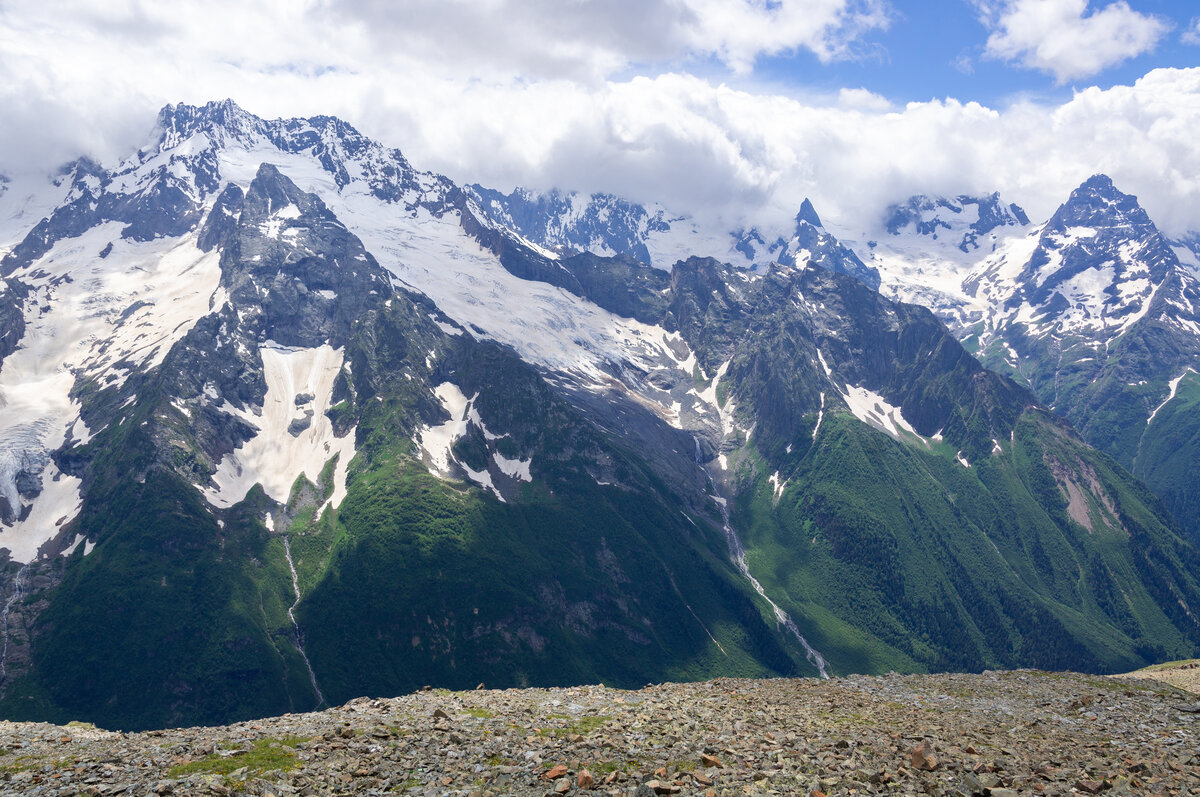
In the fourth millennium BCE, this region underwent a profound transformation. The end of the NeolithicNeolithicThe "New Stone Age": a period marked by farming, herding, settlement and pottery, from around 10,000 BC.→ and the transition to the EneolithicEneolithicThe "Stone-and-Copper Age": a transition between the Neolithic and the Bronze Age (c. 5000–3000 BC in south-eastern Europe), marked by the first copper objects, large farming settlements and, in places, the rise of fortified sites. Broadly synonymous with ChalcolithicChalcolithicThe "Copper Age": a transition between the Neolithic and the Bronze Age, marked by the first copper objects (Ötzi's era).→.→, that intermediate age when copper appears alongside stone, saw the rise of increasingly complex agropastoral communities. Animal husbandry, especially of cattle and sheep, took on growing importance, favoured by the vast pastures of the piedmont. The presence of the horse, whose exact role for this period remains debated, and the appearance of wheeled vehicles testify to increased mobility. Populations were no longer tied solely to their fields: they moved, exchanged, and practised transhumance.
Above all, the Caucasus offered a decisive asset: its mineral resources. Copper, arsenic, antimony, silver, gold, lead, the lodes of the mountains provided a rare and coveted raw material. To this were added obsidian, semi-precious stones such as turquoise and carnelian, and precious woods. This geological wealth made the Caucasus, from the fourth millennium onwards, one of the great metallurgical centres of the Old World. Maykop was not an isolated apparition: it belongs to a regional ferment in which several cultural groups, from the southern Caucasus to Transcaucasia, were simultaneously experimenting with metalworking.
The climateClimateThe long-term average atmospheric conditions of a region; its variations (glaciations, aridifications) shaped migrations, agriculture and the collapse of prehistoric societies.→ of the period, somewhat warmer and wetter than in later phases, favoured a mosaic of environments: deciduous forests on the slopes, lush meadows in the valleys, grassy steppes toward the north. This ecological diversity allowed agricultureAgricultureThe cultivation of plants and production of food by working the soil, which emerged in the Neolithic in the Near East and independently elsewhere; it radically transformed human societies.→, extensive herding and the exploitation of wild resources to be combined. The Maykop villages, often set on terraces overlooking the rivers, gathered wattle-and-daub houses on wooden frames, sometimes surrounded by ditches. Grinding stones, flintFlintA hard, brittle siliceous rock, knapped by prehistoric people to produce blades, points and sharp tools.→ and bone tools, and of course characteristic ceramics have been found there, fine-walled and often globular in profile, made without the wheel yet with remarkable care.
One must picture a territory that was not a closed frontier but a permeable contact zone. The passes of the Caucasus, despite their harshness, were passable in the warm season and connected the northern piedmont to the valleys of Transcaucasia and, beyond, to the plateaus of eastern Anatolia and north-western Iran. To the north, no barrier separated the piedmont from the immense steppes that opened up as far as the Sea of Azov and the lower Don. This twofold openness, mountainous to the south, steppic to the north, placed the Maykop culture in a crossroads situation that largely explains its singular destiny. The people who settled there knew how to exploit this position to become intermediaries between very different worlds.
The agropastoral society of Maykop rested on a subtle balance between settlement and mobility. Permanent villages housed an organised domestic life, with their granaries, hearths and workshops, but part of the population must have followed the herds in their seasonal movements, from the winter pastures of the plain to the summer uplands. This pastoral mobility, still poorly documented, doubtless facilitated the circulation of goods and ideas over long distances. In some respects it brings Maykop closer to neighbouring steppeSteppeA vast semi-arid, treeless grassland of Eurasia, suited to nomadic herding and the horse; a corridor for the movement of peoples and technologies in later prehistory.→ societies, while distinguishing it through the rootedness of its villages and the richness of its material culture.
The Discovery of the Maykop Kurgan
The history of the Maykop culture truly begins in 1897, when the Russian archaeologist Nikolai Veselovsky undertook the excavation of an imposing burial mound on the outskirts of the town of Maykop, in the North Caucasus. The mound, nearly eleven metres high, had dominated the landscape for millennia. Veselovsky, who had made a speciality of exploring the great tumuliTumulusA mound of earth or stones covering one or more burials; it often capped a dolmenDolmenA megalithic funerary structure made of one or more capstones resting on vertical uprights, often topped by an earth tumulus. From Breton dol (table) and men (stone).→'s chamber in the Neolithic.→ of the steppes, did not suspect that he was about to uncover one of the richest funerary assemblages ever found in this part of the world.
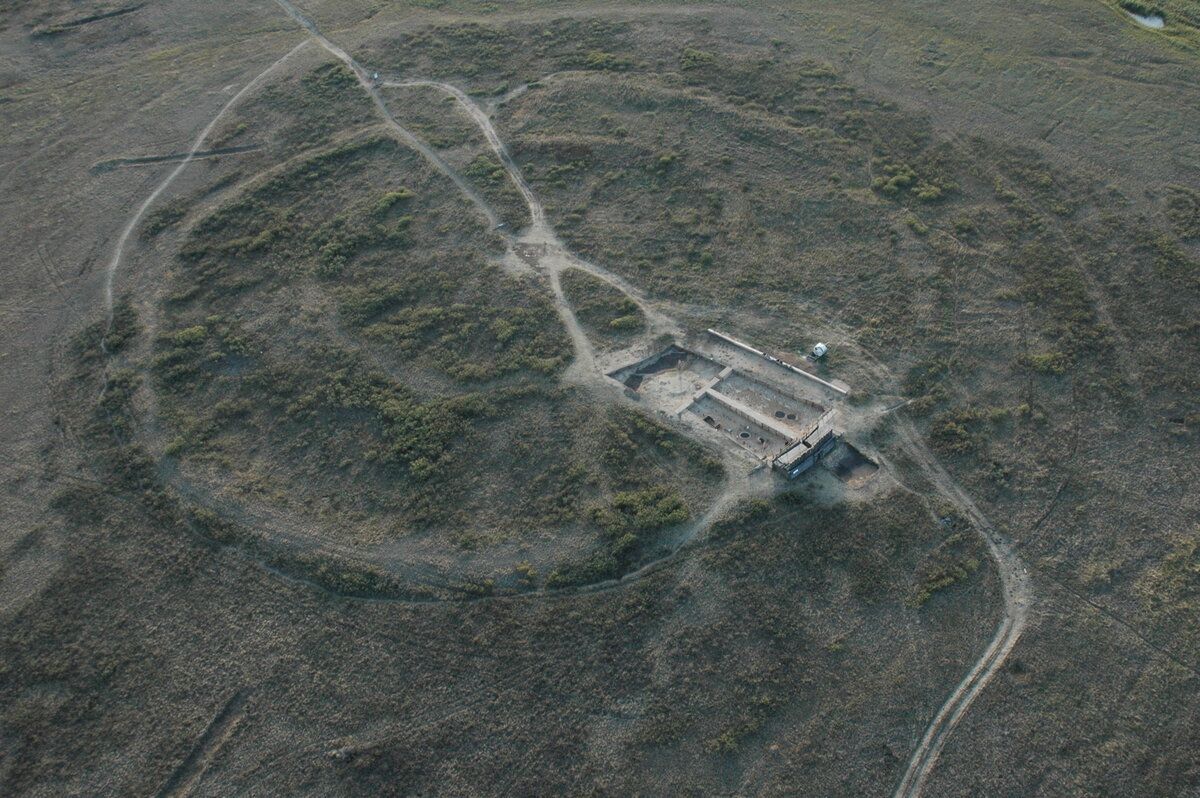
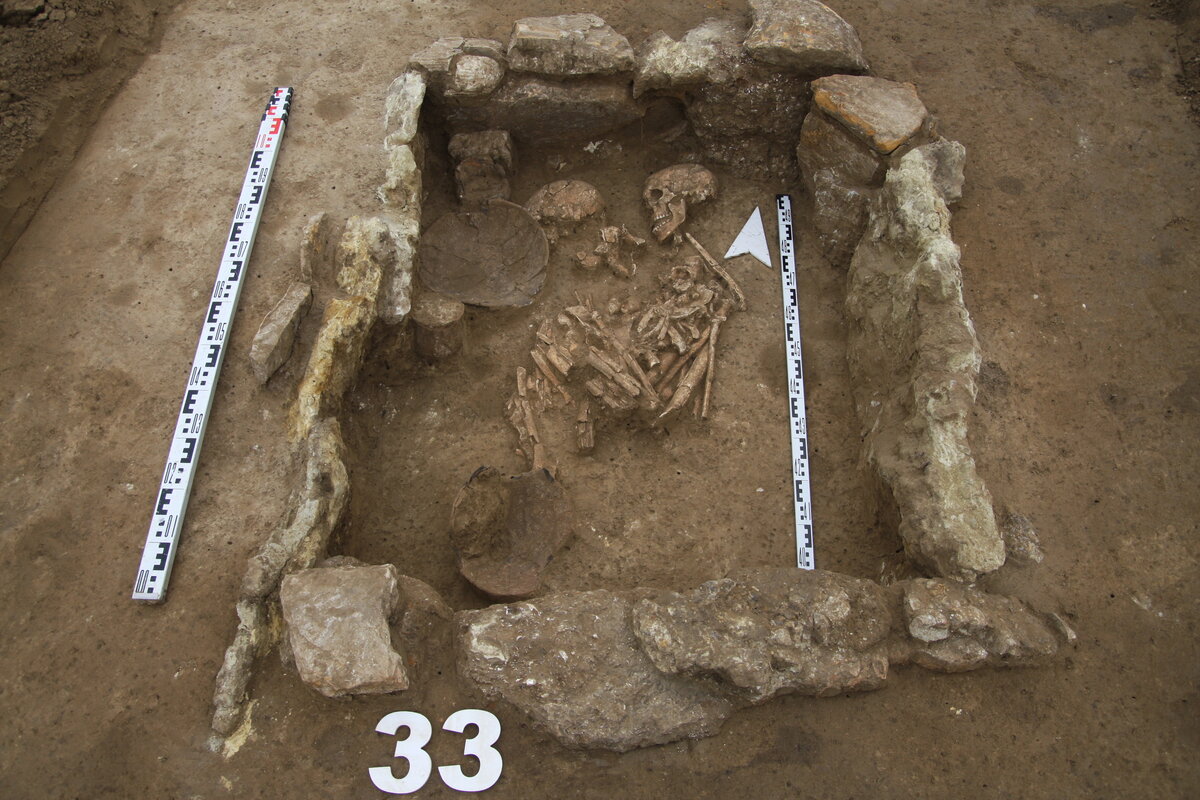
Beneath the mass of earth, the archaeologist discovered a vast rectangular pit, carefully arranged and divided into several compartments by wooden partitions. The main compartment held the burial of an evidently important figure, laid on his side in a contracted position, knees drawn toward the chest, in keeping with a funerary practice widespread across the steppes. The body rested on a bed of red ochreOchreA red or yellow mineral pigment (iron oxides), used from prehistory for adornment, funerary rites and art.→, that mineral pigment laden with symbolism, present in countless prehistoric burials across Eurasia. Around him, and upon him, accumulated grave goods of astonishing opulence.
The deceased had been literally adorned with gold. Hundreds of plaques and rings of the precious metal, originally sewn onto a garment or shroud now lost, enveloped him. Some of these appliqués depicted lions and bulls, cut from thin gold foil. Beside him lay metal vessels, weapons, tools, and small animal figurines. The two other compartments of the pit each contained a second, more modest burial, perhaps that of sacrificed individuals or close relations accompanying the master into death. Social hierarchy was inscribed in the very organisation of the tomb.
Nikolai Veselovsky was at the time one of the leading figures of Russian kurgan archaeology. Commissioned by the Imperial Archaeological Commission, he had already opened numerous burial mounds in the south of the Empire and possessed solid experience of this type of monument. His reputation earned him the call to the great Maykop mound, whose dimensions promised an important discovery. The excavation, carried out over a few weeks, yielded far beyond all expectation: the quantity and quality of the precious metal objects surpassed anything previously known for this region and period.
The pit's layout, with its compartments and wooden partitions, points to a carefully planned burial, prepared in advance for a person whose death the community evidently treated as an event of the first magnitude. Such elaborate funerary architecture, combined with the sheer mass of the overlying mound, implies coordinated labour and a shared sense of the deceased's importance.
The 1897 excavation was conducted according to the methods of its time, which did not allow the precise recording that contemporary archaeology dreams of. Much contextual information was lost, and the exact dating of the monument was long debated. Nonetheless, the great Maykop kurgan became, from the moment of its discovery, a reference landmark. The grave goods were transferred to the Hermitage Museum in Saint Petersburg, where they are still preserved and displayed today, making this assemblage one of the jewels of the institution's archaeological collections, according to the museum [[#s3]].
The Treasure: Gold, Silver and Bulls
The Maykop treasure owes its fame to the quality and diversity of its precious metal objects. Foremost among them are several vessels, two of gold and several of silver, which rank among the oldest testimonies to such accomplished goldsmithing in this region. These vessels are not mere containers: they are ceremonial pieces, doubtless intended for libations or rituals, and their presence in the tomb signalled the exceptional rank of the deceased.
Two silver vessels in particular have drawn the attention of specialists. Their surfaces are decorated with engraved scenes of remarkable refinement. One of them displays a frieze of animals, bears, horses, wild boars, birds, and a stylised landscape in which a mountain range traversed by rivers has sometimes been recognised, perhaps a depiction of the Caucasus itself. Though this reading remains hypothetical, it nonetheless illustrates the figurative ambition of these craftsmen, capable of composing true miniature tableaux on metal. These motifs find echoes in the iconography of the contemporary Near East, which has nourished the idea of an artistic dialogue between the Caucasus and the first urban civilisations of the south.
The fabrication technique of these vessels deserves a pause. The silver vessels were produced by hammering and repoussé, from a sheet of metal worked cold and then annealed to restore its malleability. The animal and landscape motifs were traced with the burin and the punch, sometimes highlighted. This work presupposes not only technical mastery but also a genuine iconographic programme, an intention to represent an ordered world, peopled with animals and structured by reliefs. Far from being mere ornament, these decorations tellTellAn artificial mound formed by the accumulation of successive layers of settlement remains at the same spot, typical of the Near East. Each destruction-rebuilding event adds a stratum.→ us something of the worldview of their patrons, and their sophistication places the Maykop workshops among the most advanced of their time.
The bull figurines constitute another emblematic element of the treasure. Cast in gold and silver, these small animal statuettes were threaded onto metal rods that probably formed the frame of a canopy, that is, a baldachin spread above the deceased or carried during the funerary ceremonies. The image of the bull, a symbol of strength, fertility and power, recurs in the first hierarchical societies of Eurasia and the Near East. Its presence at Maykop links this culture to a vast shared symbolic repertoire, in which the animal embodies sovereign might.
The canopy itself, reconstructed from the rods and figurines recovered, is one of the most evocative elements of the assemblage. A baldachin carried above an individual is, in many ancient cultures, an attribute of sovereignty, a mark of distinction setting the one it shelters above the common run. That care was taken to equip the Maykop deceased with such an object, adorned with bulls of gold and silver, speaks volumes about the conception of power that prevailed in this society. The master of the kurgan was not merely rich: he was invested with an authority that the funerary staging meant to perpetuate into the afterlife.
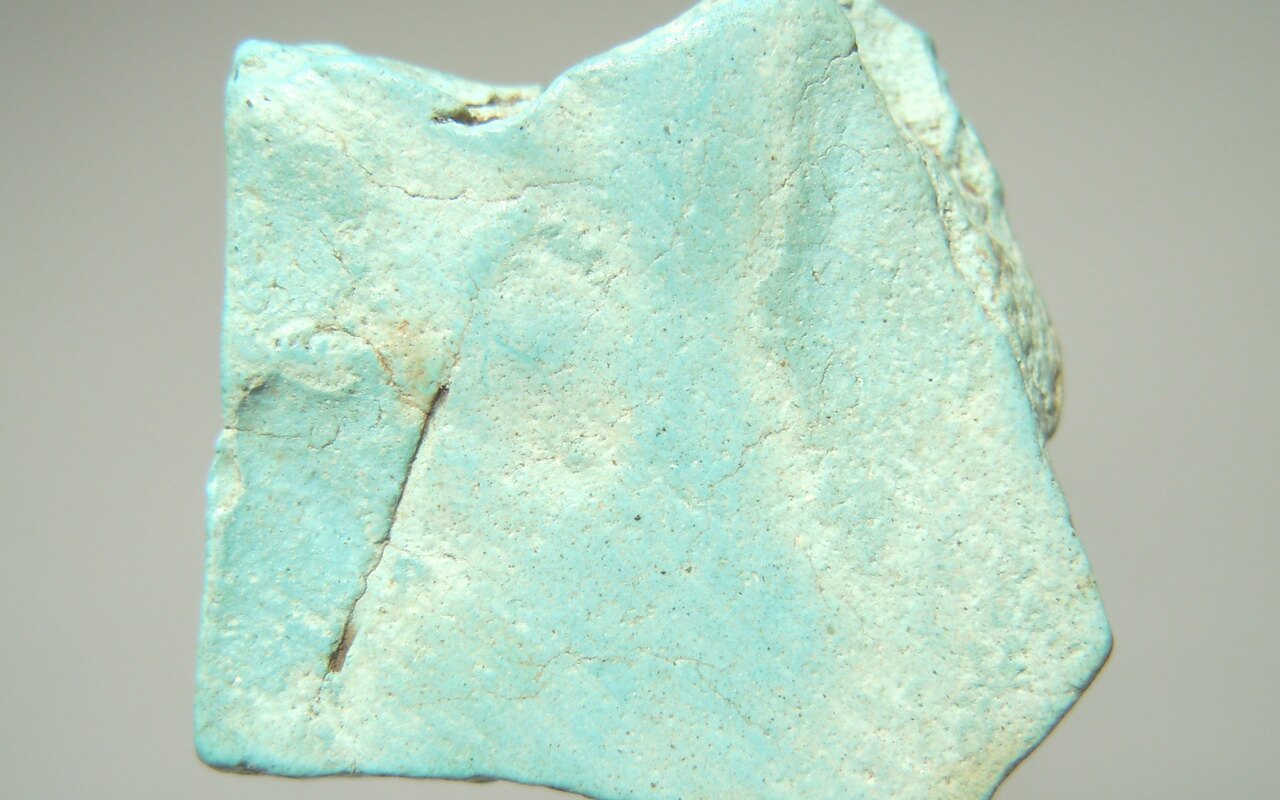
To these masterpieces were added a profusion of other objects: beads of carnelian, turquoise and gold, rings, ceremonial plaques, weapons of arsenical copper, including axes and daggers, as well as tools. The diversity of materials, gold and silver among the metals, turquoise perhaps from afar, carnelian of southern origin, attests to the breadth of the contacts enjoyed by the Maykop elite. The treasure is not merely a testimony to wealth: it is a condensation of networks, a map of the connections that irrigated the Caucasus in the fourth millennium. The Encyclopaedia Britannica indeed underlines the exceptional precocity and quality of this prestige metallurgy [[#s2]].
Early Metallurgy
Mastery of metal is doubtless the most decisive contribution of the Maykop culture to the technical history of Eurasia. The craftsmen of this culture did not content themselves with hammering native copper, as the earlier Eneolithic communities had done. They knew how to smelt ore, cast it in moulds, and above all alloy it. Most of their copper objects in fact contain arsenic, which yields an arsenical bronze harder and easier to cast than pure copper. This is a crucial step in the history of bronze metallurgyBronze AgeA protohistoric period following the Neolithic, defined by bronze metallurgy (a copper-tin alloy) and the rise of the first cities and states; in Egypt it corresponds to the age of the first pyramids.→.
The Caucasus offered a decisive geological advantage: the coexistence, in the same regions, of copper ores and arsenical ores. The metallurgists of Maykop knew how to exploit this proximity to produce high-performing alloys. Chemical analyses of the objects reveal genuine experimentation, with arsenic contents varying according to the intended use, more for weapons that had to be resistant, less for purely ornamental pieces. This modulation of recipes betrays an empirical yet already sophisticated know-how, transmitted and perfected over generations.
Working gold and silver belonged to another level of virtuosity. Beating gold into thin sheets, cutting it into appliqués, hammering it into vessels, raising motifs from the reverse of the metal, engraving animal friezes, all these operations required specialised tools and considerable manual skill. The silver vessels of Maykop, in particular, rank among the first great achievements of toreutics, the art of repoussé and chased metal, in all of western Eurasia. It has sometimes been suggested that some of these pieces were imported or made by craftsmen trained in the workshops of the Near East, but the question remains open.
This early metallurgy was not a mere technical refinement: it had profound social consequences. The production of metal required access to the deposits, mastery of complex processes, and control over the circulation of raw material and finished objects. All of this favoured the emergence of specialists, but also of groups able to capture and redistribute metallic wealth. Metal became an instrument of power as much as a tool or an ornament. In the great kurgan, the accumulation of gold and bronze around a single individual illustrates to a dizzying degree this new economy of prestige, in which control of metal nourished the authority of the elites.
The stakes become clearer when one recalls that in the fourth millennium, metal remained a rare and difficult material to produce. Each object represented a long chain of operations: prospecting for deposits, extracting ore, transport, smelting in rudimentary furnaces, alloying, casting or hammering, finishing. At each stage, specialised knowledge and intense labour were required. To possess metal, and still more gold and silver, therefore meant commanding all or part of this chain, or holding the means of exchange to acquire it. In this context, the goldsmithing of Maykop is not merely an art: it is the material expression of a power capable of mobilising resources, skills and networks on an unprecedented scale.
Kurgans and Funerary Elites
The kurganKurganA burial mound of the Eurasian steppes, of earth and stone over a timber chamber holding a high-status individual and grave goods.→ is doubtless the most visible marker of the Maykop culture in the landscape. These earthen mounds, sometimes girdled by a cromlech of standing stones, rose above the most important burials and remained visible from afar. Building a kurgan represented a considerable collective investment: the pit had to be dug, the chamber arranged, the grave goods assembled, and then the mound raised by transporting enormous quantities of earth. Such an effort made sense only to honour individuals of exceptional rank.
The Maykop tomb illustrates this elite logic in dazzling fashion. The central deceased, wrapped in gold and surrounded by treasures, belonged to a narrow group that concentrated wealth, power and prestige. The secondary burials placed in the neighbouring compartments, poorer in grave goods, underline his status by contrast. Everything in the arrangement of the burial proclaims a hierarchy: the central position, the abundance of offerings, the quality of the objects, the use of rare materials. Death, far from abolishing social distinctions, stages them and makes them enduring.
This phenomenon is not unique to Maykop. In the neighbouring Pontic steppes, other cultures of the same period or slightly later also raised kurgans for their most eminent dead. The burial mound becomes, across this whole space, the common language of funerary power. But Maykop stands out for the extraordinary wealth of its most opulent tombs, which far surpass, in quantity of precious metal, what contemporary steppe burials yield. This extreme concentration of wealth raises the question of the exact nature of the society that produced it.
Beyond the great kurgan, more recent excavations have brought to light many other Maykop culture burials, sometimes forming true necropolisesNecropolisA large organised burial ground, a "city of the dead", often spanning several periods.→. Not all are so sumptuous, far from it. The majority of tombs contain modest grave goods: a few vessels, simple ornaments, sometimes a tool or a weapon. This gradation of funerary wealth sketches a social pyramid, with a narrow elite at the top and a broader population at the base. It is one of the clearest signs of an already strongly differentiated society, in which status was transmitted and displayed at the moment of death.
Exchange Networks: Steppes, Near East, Uruk
The wealth of Maykop cannot be explained without a dense network of exchanges linking the Caucasus to sometimes very distant regions. The materials found in the tombs, turquoise, carnelian, lapis lazuli in some cases, various metals, do not all come from the immediate surroundings. Some of these raw materials must have been carried over hundreds of kilometres, which presupposes organised trade routes and intermediaries able to keep them moving. The Maykop culture thus appears as a node of connections on a continental scale.
To the south, the links with the Near Eastern world are particularly striking. In the fourth millennium, lower Mesopotamia experienced the rise of the Uruk civilisation, the first great urban culture in history, whose influence radiated over vast territories, as far as upper Mesopotamia, Anatolia and Iran. Several features of the Maykop culture evoke this southern world: certain decorative motifs, vessel forms, the use of cylinder seals or decorated beads in some contexts, and perhaps metallurgical techniques. These convergences have led many researchers to posit direct or indirect contacts between the Caucasus and the Uruk sphere.
The expansion of Uruk is one of the most striking phenomena of the fourth millennium. From lower Mesopotamia, trading posts and settlements bearing the Urukean culture spread northward, along the Euphrates and the Tigris, as far as the borders of Anatolia. This movement, often interpreted as a quest for raw materials absent from the alluvial plains of the south, metals, wood, stone, may have brought into contact, directly or through relays, the merchants of the south and the societies of the Caucasus. The Maykop culture, rich in metals, lay precisely at the northern extremity of these supply routes. It is not impossible that it constituted one of the distant suppliers of the booming Mesopotamian cities.
Yet contact does not mean dependence. Maykop adopted what suited it and reworked the rest in its own idiom, retaining a material culture and a funerary repertoire that remain unmistakably Caucasian. The southern echoes visible in its art and its objects testify less to imitation than to a confident appropriation, the mark of a society secure enough in its own identity to borrow without dissolving into its powerful neighbours.
The exact nature of these contacts remains debated. Were they commercial exchanges of prestige goods, the Caucasus perhaps exporting metal, silver or other resources southward in return for manufactured products and technical ideas? Or must one imagine movements of people, itinerant craftsmen, merchants, even small settled groups? The two hypotheses are not mutually exclusive. What is certain is that Maykop did not live in isolation: it took part in a vast system of interactions that, in the fourth millennium, connected the cities of the south with the societies of the Caucasus and the steppes.
What goods precisely circulated, and in which direction, remains difficult to establish with certainty. Metal, silver in particular, may have moved south, while manufactured products, textiles, prestige objects and above all know-how travelled along the routes. The presence, in the Maykop tombs, of raw materials of diverse origins sketches a surprisingly broad geography of exchange for the period. Far from the image of a compartmentalised prehistoric world, it reveals a fourth millennium already crossed by commercial currents, in which objects and ideas spanned hundreds of kilometres to link societies that, in appearance, everything separated.
To the north and east, the links with the Pontic steppes were just as essential. The funerary practices of Maykop, contracted position, use of ochre, erection of kurgans, belong to a shared steppe tradition. Caucasian metal objects spread northward, where they were sought after. In return, the steppes perhaps supplied animals and techniques of mobility, and took part in the circulation of raw materials. Maykop functioned as an interface, a point of passage between the urban world of the south and the pastoral world of the north, capturing the flows and redistributing them. This intermediary position largely explains its prosperity.
In this light, Maykop is best understood not as a peripheral curiosity but as a hinge of the fourth-millennium world, a place where the metallurgical wealth of the mountains, the commercial energy of the southern cities and the mobility of the northern herders met and amplified one another. Its prosperity was less a matter of local resources alone than of its ability to stand at the meeting point of currents that, without it, might never have connected.
Maykop and the Question of the Steppes
Maykop's place in the great history of the Eurasian steppes is one of the most debated problems of recent prehistory. The North Caucasus lies at the edge of the steppe domain, where, in the fourth and third millennia, the mobile pastoral cultures took shape that would play a major role in the later peopling of Europe and Asia. Did the Maykop culture take part in these dynamics, and in what way?
Part of the debate concerns the relations between Maykop and the so-called Yamnaya, or Pit Grave, culture, which flourished a little later in the Pontic and Caspian steppes and which many researchers associate with the spread of the Indo-European languages. Maykop partly precedes Yamnaya and is contemporary with it in certain phases. The two cultures share the use of the kurgan and certain funerary practices, which suggests exchanges and perhaps reciprocal influences. Yet Maykop stands out clearly through its metallic wealth, its southern links and its own Caucasian component. It is not a mere steppe variant.
This singularity long nourished contrasting interpretations. Some researchers saw in Maykop a Near Eastern vanguard implanted north of the Caucasus, others a purely local creation brilliantly enriched by trade. The truth doubtless lies between these two poles. What is certain is that Maykop can be reduced neither to the steppe model nor to the Mesopotamian model: it constitutes an original formation whose identity rests precisely on its capacity for synthesis. It is this fertile and unstable in-between position that makes it such a rich object of study for understanding the dynamics of the Early Bronze Age.
Archaeogenetic studies conducted in recent years have shed new light, without closing the debates. They show that the Bronze Age Caucasus populations possessed a genetic heritage distinct from that of the more northern steppes, with a component of their own linked to Caucasian and Near Eastern populations. This Caucasian ancestry is found, blended, in the genetic make-up of later steppe populations. The Caucasus, and with it the Maykop sphere, thus appears as one of the sources that contributed to forming the genetic profile of the great pastoral cultures of the Bronze Age.
There remains the more delicate question of whether Maykop directly took part in the migrations that transformed Europe and Asia in the third millennium. On this point, caution is in order. Maykop seems rather to have been a centre of innovation and a partner in exchange than an agent of great migrations. Its influence spread through contacts, trade and the transmission of techniques, more than through massive movements of population. It nonetheless played a catalytic role, introducing into the steppe world goods, know-how and perhaps social models drawn from the south.
Chronology and Debates
The dating of the Maykop culture was long uncertain, and it continues to be the subject of discussion. The first estimates, based on typological comparisons with the Near East, placed the phenomenon around the first half of the third millennium. The radiocarbon dates obtained more recently led to an ageing of the culture, now most often situated between roughly 3700 and 3000 BCE, that is, at the hinge of the late Eneolithic and the Early Bronze Age.
This chronological revision has important consequences. It makes Maykop one of the earliest metallurgical cultures in the region, contemporary with the rise of Uruk and prior to many steppe developments. It strengthens the idea of a pioneering Caucasus, ahead of its northern neighbours in the mastery of metal and in social organisation. But the precision of the dates remains limited by the old excavation conditions, notably for the great kurgan itself, whose context was not recorded with the desirable rigour in 1897.
Specialists generally distinguish several phases within the Maykop culture, as well as regional groups and related cultures, such as the Novosvobodnaya, sometimes regarded as a late variant or a distinct horizon. The relations between these various assemblages, their relative chronology and their cultural significance are the subject of vigorous debate. The terminology itself varies according to scholarly schools, some preferring to speak of a Maykop-Novosvobodnaya community to underline the links between these groups. These apparently technical questions in fact engage our understanding of the cultural dynamics of the Caucasus in the Early Bronze Age.
Modern scientific methods have profoundly renewed the study of the culture. To radiocarbon dating have been added isotopic analyses, which allow the origin of metals and raw materials to be traced, and genetic research on human remains, which sheds light on kinship ties and population movements. Each of these approaches contributes its stone to the edifice, but none suffices on its own. The reconstruction of Maykop's history proceeds by cross-checking, confronting the data of classical archaeology, chemistry and biology. It is from this dialogue between disciplines that a more precise, yet always revisable, image of this enigmatic culture gradually emerges.
Another debate concerns the very origin of the culture. Was it born locally, through the evolution of the Eneolithic communities of the Caucasus, or did it result from an external contribution, coming from the Near East, that introduced techniques and social models? Current research tends to favour a nuanced answer: Maykop would be the product of an original synthesis, rooted in the Caucasian substratum but profoundly stimulated by contacts with the south. It is this capacity to integrate and transform diverse influences that, according to the reference sources, makes for the whole originality of the culture [[#s1]].
The Legacy of Maykop
What legacy did the Maykop culture leave? In the short term, its influence can be measured in the diffusion of metallurgical techniques and prestige objects toward neighbouring regions. Arsenical bronzes, vessel forms, certain decorative motifs are found beyond the Maykop territory alone, a sign of a real radiance. The cultures that succeed it in the North Caucasus, in the Middle Bronze Age, partly inherit this metallurgical know-how and this kurgan tradition, which they continue and transform.
In the longer term, Maykop's contribution lies in the role of conduit that the Caucasus played between the urbanised south and the steppe north. By capturing the innovations of the Near East and rediffusing them, the Maykop sphere helped to spread into the steppe area techniques, goods and ideas that weighed on later developments. Metallurgy in particular spread from these Caucasian centres toward the vast expanses of the steppes, where it would undergo a spectacular development in the Bronze Age.
Maykop's legacy is also museal and symbolic. The treasure preserved at the Hermitage has become an emblem of Caucasian and Russian prehistory, studied and displayed for more than a century. The engraved silver vessels, the bull figurines, the gold appliqués rank among the masterpieces of Bronze Age art. They embody, for the general public as for researchers, the memory of a brilliant and enigmatic society whose echo crosses the millennia.
Finally, Maykop holds a prominent place in contemporary scientific debates on the origins of complex societies, on the birth of hierarchies and on the first great Eurasian exchange networks. Each new excavation, each genetic or isotopic analysis enriches, and sometimes overturns, the picture we form of this culture. Far from being a closed file, Maykop remains a living field of research, at the crossroads of archaeology, ancient metallurgy and the history of human settlement.
Conclusion
The Maykop culture fascinates because it brings together, in a single place and a single moment, several of the great questions of recent prehistory: the birth of metallurgy, the emergence of elites, the appearance of long-distance exchange networks, the dialogue between the first cities and the societies of the margins. The great kurgan excavated by Veselovsky in 1897, with its deceased covered in gold and surrounded by precious vessels and bull figurines, remains the dazzling symbol of this North Caucasus society that attained, more than five thousand years ago, a remarkable degree of wealth and refinement.
Situated at the crossroads of the steppes, the Caucasus and the Near East, Maykop knew how to make the most of its interface position to capture the resources, techniques and ideas of neighbouring worlds and to fuse them into an original synthesis. Its early metallurgy, its refined goldsmithing and its monumental tombs testify to an already strongly hierarchical social organisation, in which control of metal and the staging of death consecrated the power of an elite.
The debates over its chronology, its origins and its role in the great history of the steppes are far from settled, and the progress of archaeogenetics and of dating methods promises many more surprises. But already the Maykop culture stands out as one of the essential chapters of the dawn of the age of metals in Eurasia, a moment when, at the foot of the Caucasus, a society without writing invented part of the languages of power and wealth that would lastingly mark the history of the Old World. The great kurgan and its treasure remain, in this respect, an irreplaceable testimony, and the Hermitage continues to ensure their conservation and study for the generations to come.
Article bien calibré pour un public non-spécialiste. La complexité n'est pas escamotée.