A 67,800-Year-Old Hand Print: The World's Oldest Dated Cave Painting
In a limestone cave called Liang Metanduno, nestled on the island of Muna off the southeastern coast of Sulawesi, researchers have uncovered a discovery that fundamentally reshapes the history of human art. A negative hand stencil painted in red ochreOchreA red or yellow mineral pigment (iron oxides), used from prehistory for adornment, funerary rites and art.→, whose fingers were carefully modified to resemble claws, has been dated to at least 67,800 years ago, making it the world's oldest scientifically dated cave painting. The study, published in January 2026 in the journal Nature and led by an international team headed by Adhi Agus Oktaviana (BRIN, Indonesia), Adam Brumm and Maxime Aubert (Griffith University, Australia), marks a watershed moment in our understanding of the origins of human symbolic creativity.
The technique used by the prehistoric artist is that of the negative hand stencil: the palm placed flat against the rock wall, the pigment - most likely a mixture of ochre and saliva - was blown or sprayed around the hand, leaving after its removal a perfectly outlined silhouette on the rock. What distinguishes this work from thousands of other hand stencilshand stencilsHandprints made by blowing pigment around a hand pressed against the wall.→ known worldwide is the deliberate modification of the fingertips: the artist reworked the ends to thin and elongate them, giving them the unmistakably intentional appearance of animal claws. This morphological detail is far from trivial: similar claw-shaped representations have been found in several other islands in the region, suggesting the existence of a coherent and shared artistic tradition across the Indonesian archipelago tens of thousands of years ago.
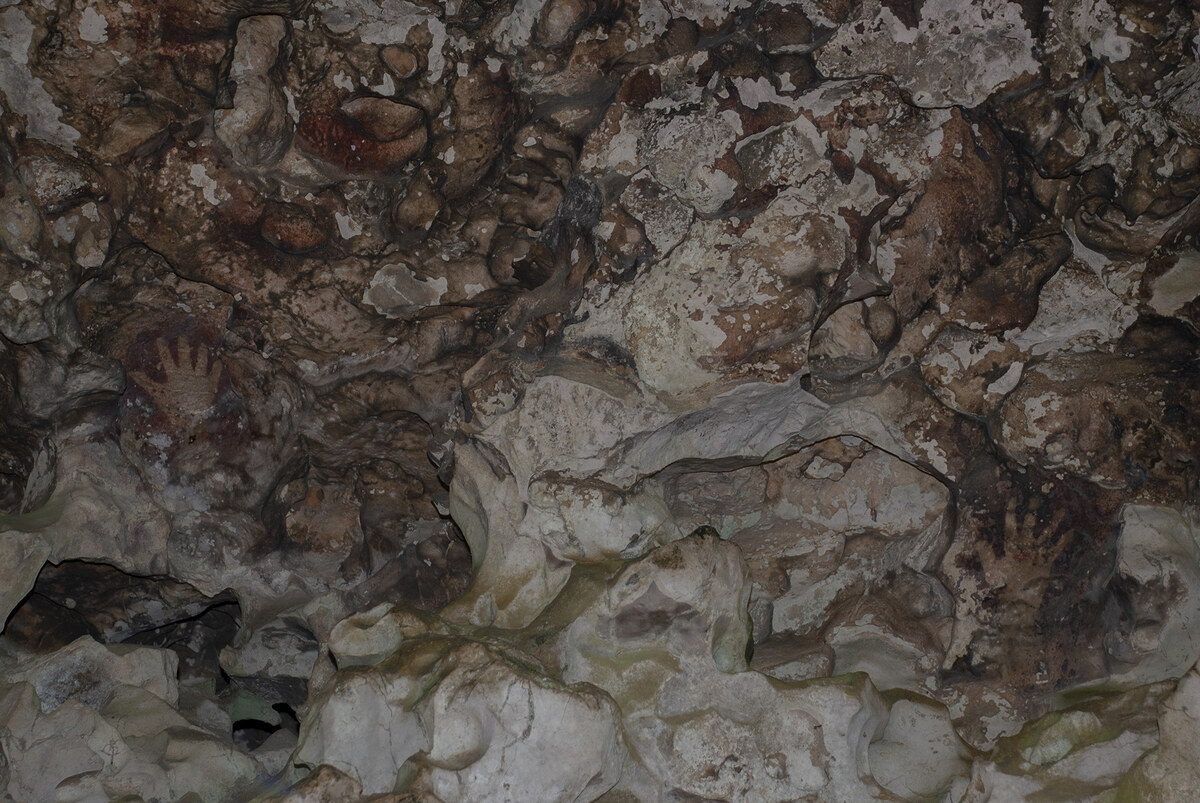
Uranium-Thorium Datinguranium-thorium datingDating method measuring, in calcite, the ratio of uranium to the thorium produced by its decay, effective up to nearly 500,000 years.→ That Pushes the Limits of Human Art
The date of 67,800 years was obtained using the uranium-thorium (U-Th) method, applied to thin calcitecalciteCrystalline form of calcium carbonate that makes up cave concretions (stalactites, stalagmites, flowstone).→ crusts that had naturally formed over the painting. This technique, widely used over the past decade to date Sulawesi cave art, analyzes the radioactive decay of uranium into thorium in calcium carbonates: the measured ratio yields an absolute minimum age for the underlying painting. Results published in Nature indicate a minimum age of 67,800 years, approximately 16,000 years more than the previous world record - a narrative painting depicting a pig and humans dated to 51,200 years, discovered in 2024 in another Sulawesi cave.
It is worth noting an important scientific nuance raised by several specialists, including geochemist Georges Sauvet: the U-Th method, when applied to calcite crusts in karstKarstA limestone landscape shaped by rock dissolution, rich in caves and passages; its sediments can preserve bone and DNA over long timespans.→ environments, sometimes tends to produce overestimated ages. The cause lies in the open-system behavior of calcite, which can incorporate or lose uranium after formation, distorting the age calculation (cf. Pons-Branchu et al., 2020, Journal of Archaeological Science). This caveat does not necessarily invalidate the exceptional antiquity of the work, but calls for caution and underscores the need for complementary dating by other methods. The study authors themselves acknowledge these limitations and present the 67,800-year figure as a strictly guaranteed minimum age.
Sulawesi: A World Laboratory for Prehistoric Art
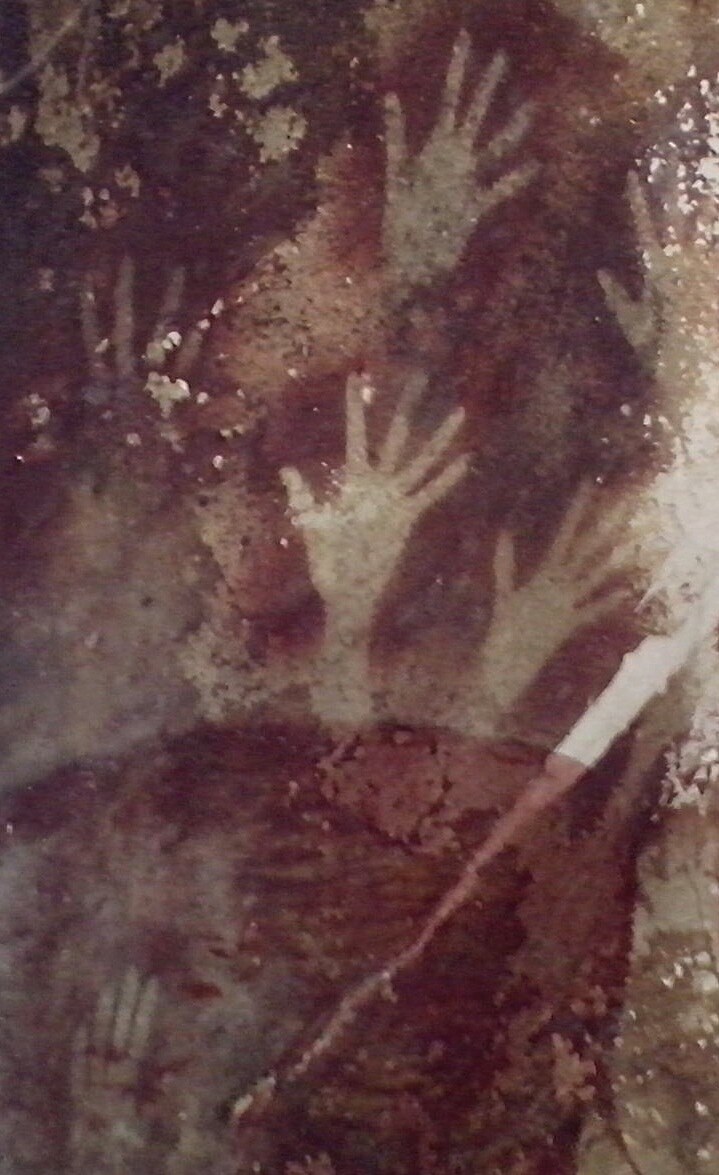
The discovery at Liang Metanduno cave is not an isolated event: it forms part of a series of extraordinary revelations that have made Sulawesi one of the most important places in the world for the study of ancient cave art. In 2014, an international team had already stunned the scientific community by dating hand stencils and warty pig representations (Sus celebensis) in the Maros-Pangkep caves to over 40,000 years, challenging the then-dominant idea of a purely European "creative explosion." In 2019, a composite hunting scene showing half-human, half-animal figures (therianthropes) hunting wild animals was dated to 44,000 years, becoming the oldest known narrative scene. In 2024, a panel depicting a pig flanked by two human figures pushed the record back again to 51,200 years.
Liang Metanduno cave presents an additional fascinating characteristic: other paintings, much more recent - some dated to around 20,000 years ago - adorn the same panel as the clawed hand. The cave was therefore an active site of artistic expression for at least 35,000 consecutive years, attesting to a cultural continuity and persistent symbolic value attached to this site across many generations of prehistoric artists.
Major Implications for the Peopling of Australia
The implications of this discovery extend well beyond the history of art. Until now, the best-established archaeological and genetic data placed the arrival of the first Homo sapiensHomo sapiensThe present-day human species, which emerged in Africa around 300,000 years ago, the only surviving human lineage after the extinction of Neanderthals and Denisovans.→ on SahulSahulThe continent formed during the ice ages by the union of Australia, New Guinea and Tasmania when sea levels were low.→ - the continental shelf uniting Australia, New Guinea, and Tasmania - around 50,000 years ago. Yet if humans were producing elaborate symbolic art in Sulawesi at least 67,800 years ago, it means they were established in this region some 15,000 to 20,000 years earlier than previously thought, already possessing all the cognitive and symbolic capacities associated with modern human behavior.
As Professor Maxime Aubert stated in an interview with BBC News: "This suggests that humans possessed this capacity for a very long time, at least since leaving AfricaAfricaThe cradle of humankind: the continent where the first hominins appeared, then Homo sapiens around 300,000 years ago, before the expansion to the rest of the world.→, but probably before that." His colleague Adhi Agus Oktaviana concurs: "It is very likely that the people who made these paintings in Sulawesi were part of a larger population that would later expand across the region and eventually reach Australia." These statements cast new light on the controversial archaeological evidence for human presence in northern Australia around 65,000 years ago, which may now prove considerably more plausible than previously assumed.
No comments yet. Be the first.