In West AfricaAfricaThe cradle of humankind: the continent where the first hominins appeared, then Homo sapiens around 300,000 years ago, before the expansion to the rest of the world.→, between the River Senegal to the north and the River Gambia to the south, the Sudanian savanna conceals one of the largest concentrations of megalithic monuments on the planet. Across a band roughly 100 kilometres wide and some 350 kilometres long, archaeologists have recorded more than a thousand circles of standing stones, together with thousands of tumuli and burialBurialThe intentional deposition of a body, sometimes with offerings; a marker of symbolic behaviour.→ mounds. The fullest surveys speak of nearly 29,000 blocks, 17,000 monuments and 2,000 distinct sites, figures that convey the sheer scale of the phenomenon.6
These megalithsMegalithA large stone raised or assembled by humans (menhirMenhirA stone erected vertically by humans, standing alone or in rows (alignments), emblem of the Breton Neolithic megalithic tradition. From Breton men (stone) and hir (long).→, dolmenDolmenA megalithic funerary structure made of one or more capstones resting on vertical uprights, often topped by an earth tumulus. From Breton dol (table) and men (stone).→, stone circleStone circleA Neolithic or Bronze Age monument of standing stones set in a ring, often ritual or astronomical in purpose.→), typical of the NeolithicNeolithicThe "New Stone Age": a period marked by farming, herding, settlement and pottery, from around 10,000 BC.→ and Bronze AgeBronze AgePeriod of late prehistory marked by bronze metallurgy and the rise of maritime trade, beginning in the Near East around 3300 BCE.→.→ are neither temples nor astronomical observatories but monumental graves. The stones surround and mark burials, within a sacred landscape that local communities went on respecting long after the rites that shaped it had been abandoned. In 2006, UNESCO inscribed four representative groups on the World Heritage List: Sine Ngayène and Wanar in Senegal, Wassu and Kerbatch in the Gambia. Between them they bring together 93 circles and numerous associated tumuli, the densest heart of a tradition that lasted more than fifteen centuries.1
A megalithic landscape without equal
Senegambia's singularity lies first in its density. Nowhere else in the world is there such an accumulation of stone circles across a continuous territory. The monuments line the watercourses, above all the tributaries of the River Gambia, where the lateriteLateriteA red iron-rich rock of tropical soils, soft when quarried and hardening in the air.→ soil crops out and provides the raw material. This distribution follows geology as much as hydrography: the builders set their cemeteries where stone was available and where water made the land livable.1
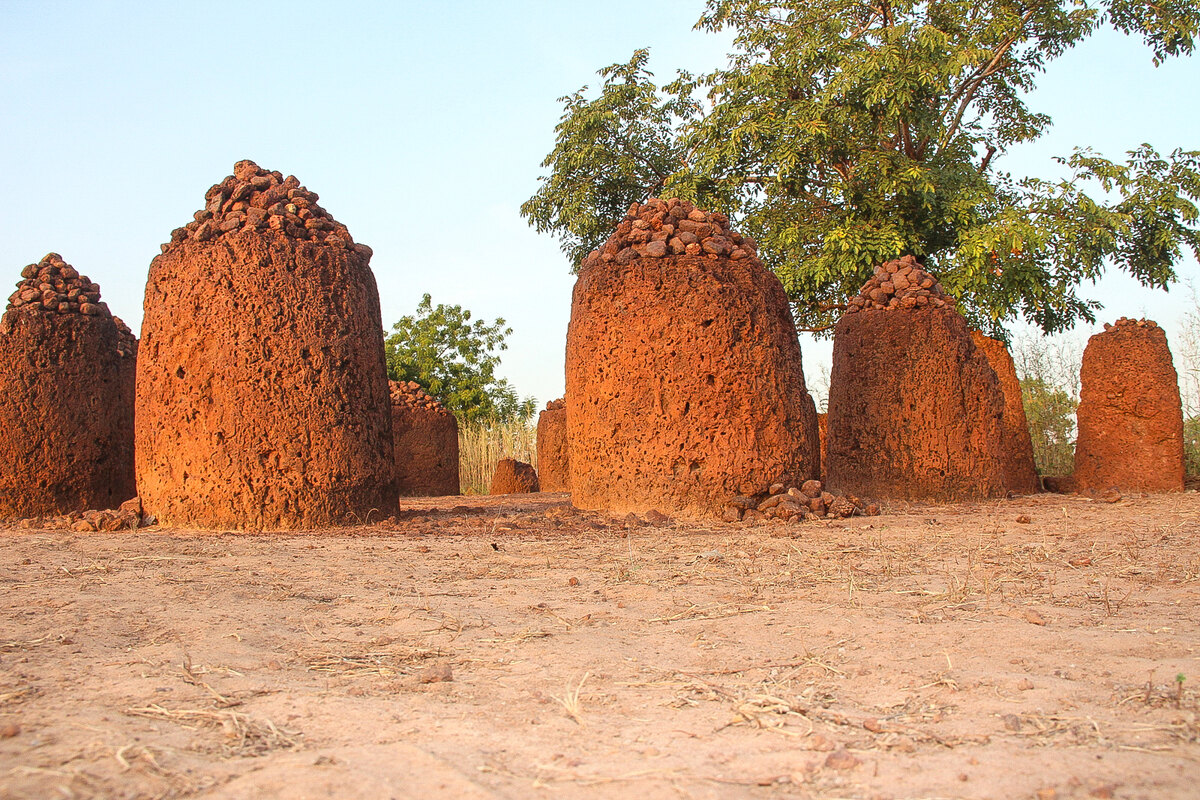
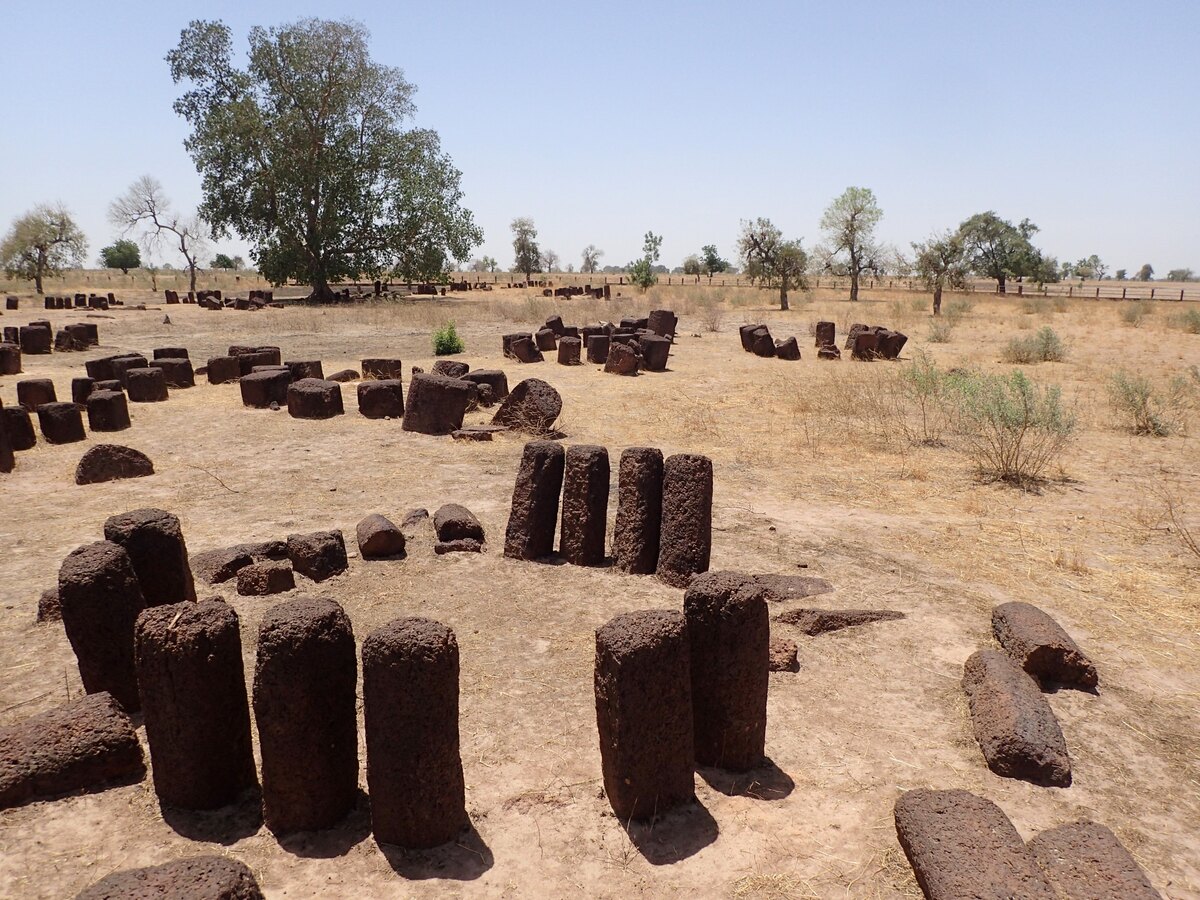
The monoliths take several forms. Most are grouped in regular circles, sometimes in concentric double circles. Others stand in isolation, usually to the east of the circles, in rows that researchers call frontal stonesFrontal stoneA monolith standing on its own, often to the east of a circle, outside the main ring.→. When two parallel rows of frontal stones answer each other, they are known as lyre-stones, a rare and striking arrangement. Each circle measures on average four to six metres across and holds between eight and fourteen pillars, around two metres tall.1
This vocabulary of forms is no mere detail. It reflects a funerary grammar shared over hundreds of kilometres and handed down across generations. The regularity of the circles, the consistency of their dimensions, the recurrence of frontal stones oriented toward the rising sun all betray precise rules, observed from one site to the next. For UNESCO, this coherence, together with the geographical sweep and the finesse of execution, makes the Senegambian ensemble a unique manifestation of megalithic construction and funerary practice, unmatched in scale and complexity.1
Four sites, a thousand monuments
The four groups inscribed in 2006 each present a particular face of this tradition. Sine Ngayène, in Senegal, is the largest: fifty-two circles, including one double circle, and no fewer than 1,102 carved stones. Around a central Y-shaped axis, a double circle named Diallombère occupies the point where three branches converge, once ringed by hundreds of tumuli now levelled by erosion. One kilometre to the east, outside the inscribed zone, lies the quarry from which the monoliths were extracted, and from which the source of around 150 stones can still be traced.1
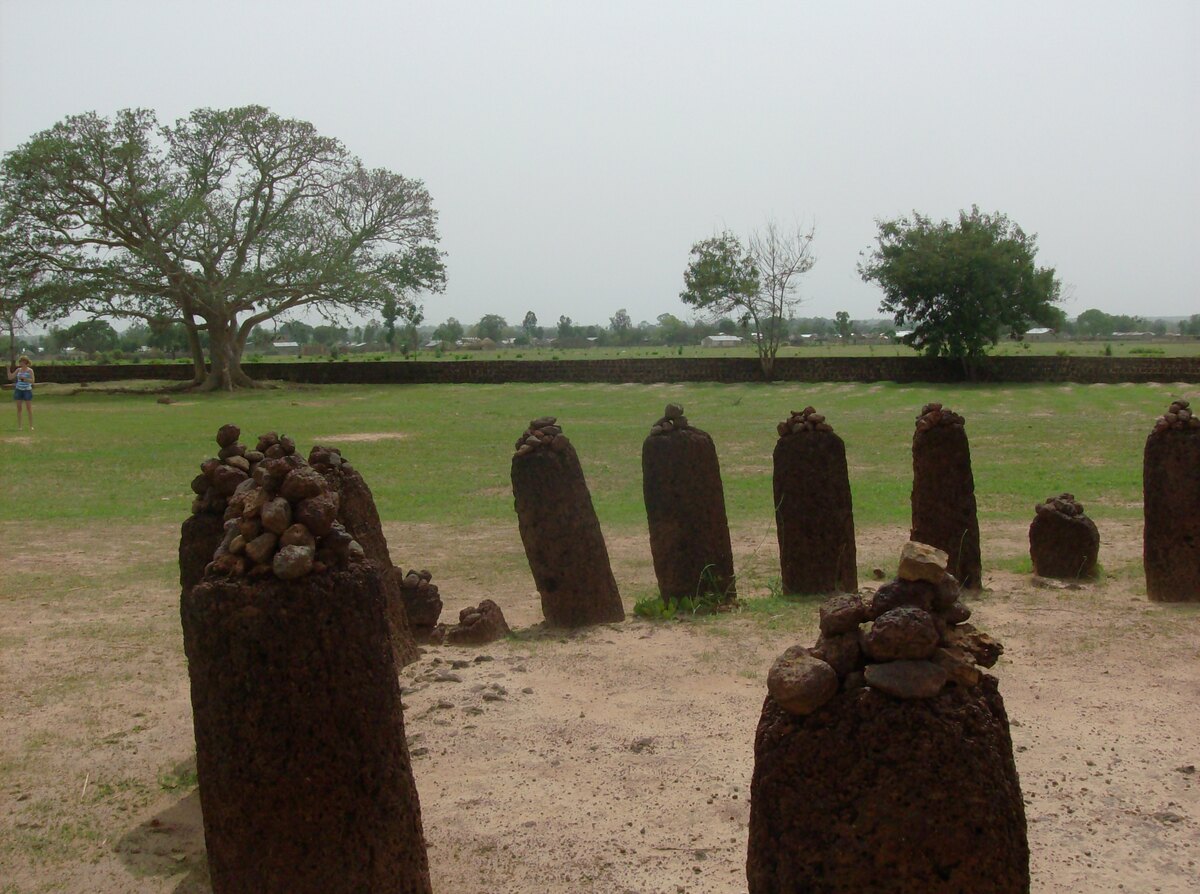
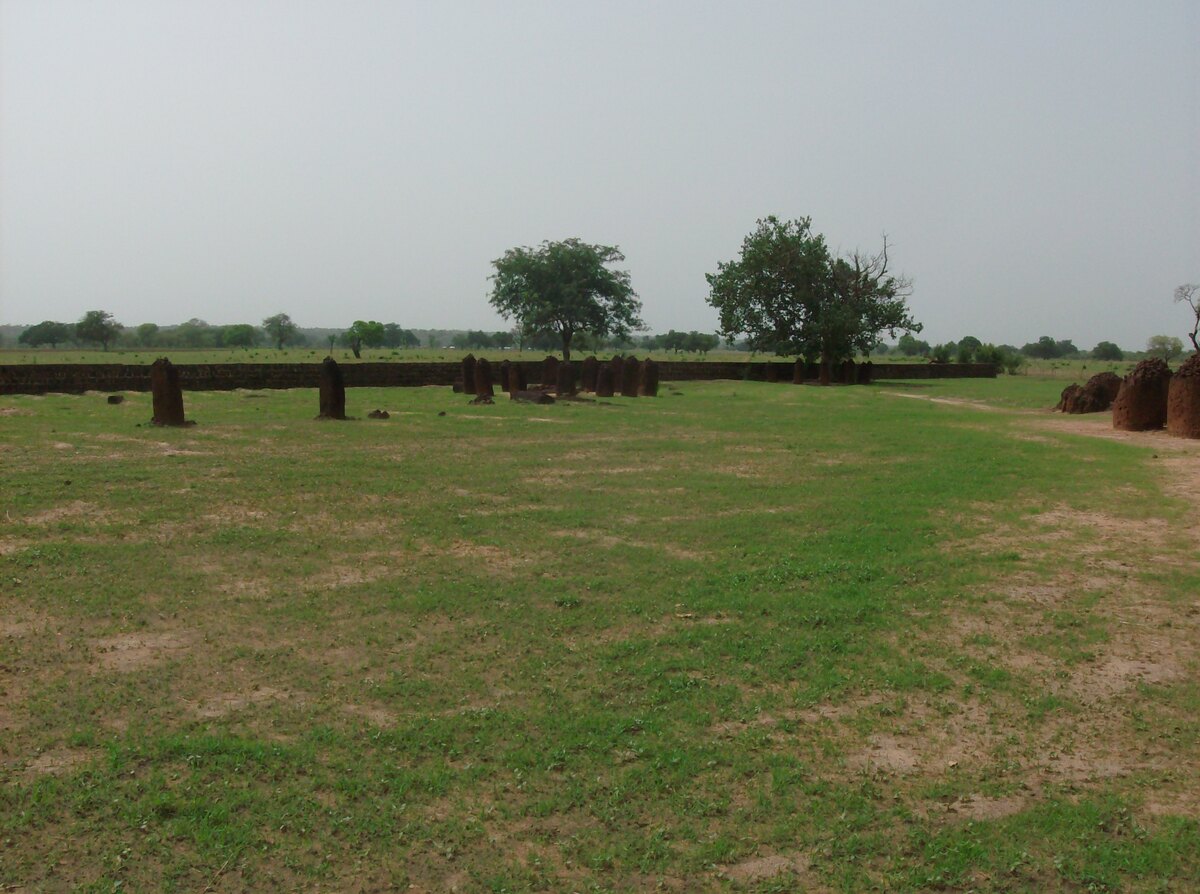
Wanar, also in Senegal, counts twenty-one circles including one double circle, and concentrates on its own about a third of all the lyre-stones known in Senegambia. It was here that the team of Luc Laporte and Hamady Bocoum carried out decisive excavations from 2008 onward. On the Gambian side, Wassu aligns eleven circles and their frontal stones and holds the height record, with a pillar of 2.59 metres. The Wassu tumuli, excavated during the Anglo-Gambian campaigns of 1964 and 1965, yielded burials dated between 927 and 1305 CE. Kerbatch, finally, lines up nine circles, including a double circle, and possesses the region's only bifid stone, a V-shaped stone restored after being found broken and toppled.1
Around the monuments themselves, surveys have revealed an inhabited landscape. The Sine Ngayène Archaeological Project, launched in 2002, identified not only quarries and iron-smelting sites but also the remains of hundreds of houses contemporary with the circles, clustered in groups of two to five, with house floors and pottery sherds. These clues sketch a network of small communities, linked yet independent, for which the megalithic cemeteries may have served as gathering places, unifying sites at the heart of a fragmented territory.3
The scholarly study of these monuments is an old one. As early as the colonial period, administrators such as Richmond Palmer removed finds, part of which still rests in the British Museum. The first methodical excavations date to the Anglo-Gambian campaigns of 1964 and 1965, conducted at Wassu and Kerbatch, which restored the toppled bifid stone among other things. A 1982 inventory already recorded 1,145 sites. But it was at the turn of the 2000s, with the Sine Ngayène Archaeological Project and then the Wanar excavations, that research changed scale, combining radiocarbon dating, stratigraphic excavation and ethnographic comparison to pull the circles out of legend and return them to history.4
Laterite quarries and iron tools
Laterite is an iron-rich rock, red and hard, that hardens in the air once extracted from still-moist ground. The Senegambian builders had an intimate knowledge of it. They knew how to spot workable beds, select sound blocks and detach them without splitting them, a technical feat that every observer underlines. The stones were extracted with iron tools, then shaped into almost identical pillars, cylindrical or polygonal, around two metres tall and weighing up to seven tons.1
This mastery places the circles squarely in the West African Iron AgeIron AgeThe last period of protohistory (from c. 1200 BC in Europe and the Near East), marked by iron metallurgy and the first kingdoms.→, not in some distant Neolithic. MetallurgyMetallurgyThe techniques of extracting and working metals (copper, bronze, gold); its rise in the Eneolithic and Bronze Age transformed tools, weapons and social hierarchies.→ was a prerequisite here: without metal blades and wedges, it was impossible to cleanly work so hard a rock. The iron-smelting sites found near Sine Ngayène confirm that the communities raising the stones also mastered metal production, in an economy where farming, forge and stonework answered one another. Senegambian protohistoryProtohistoryThe transitional period between prehistoryPrehistoryThe span of human history before the invention of writing, from the Palaeolithic to the Metal Ages, known mainly through material remains.→ and history, covering societies without their own writingWritingA system of conventional signs used to fix language or information durably; its appearance (c. 3300 BC) marks, by convention, the end of prehistory.→ but known through external texts.→ thus appears as a technically advanced society, able to mobilise a large and coordinated workforce.6
For the effort was considerable. Extracting, transporting and then raising a monolith of several tons demanded hands, time and a solid social organization. The finishing of the stones, many of which have a carefully rounded or knob-shaped top, testifies to an aesthetic as much as a technical demand. For UNESCO, these finely carved individual stones bear witness to an exact and experienced technique and contribute to the imposing, ordered size of the groups, enough on their own to justify the first criterion for World Heritage inscription, that of a masterpiece of human creative genius.1
Beneath the circles, the dead
The excavations have settled a long-debated question: the circles are indeed funerary monuments. Beneath and around the stones, archaeologists have uncovered burials, pottery sherds, spearheads and ornaments of iron and copper. Better still, recent work has shown that, at several sites, the grave came before the circle: the dead were buried first, and the stones were raised afterward to mark and honour them.4
The case of Sine Ngayène is illuminating. The study of the central double circle by Augustin Holl, Hamady Bocoum, Stephen Dueppen and Daphne Gallagher reconstructed a funerary history in four successive cycles, spread from about 700 to 1350 CE. At the deepest level, a large oblong pit held a secondary burial, a cluster of bones accompanied by five iron spearheads and a copper bracelet. Over the centuries, further pits were stacked above, then deposits of selected bones, skulls and long bones, and finally offerings of pottery. The monument gradually shifted from a place of selective burial to a public ritual space.3
At Wanar, the 2008 excavations distinguished two types of grave, wide pits sealed by a mound and deep burials with narrow mouths, and above all revealed traces of perishable materials, brick and plaster, pointing to funerary houses built at the moment of burial. Archaeologists there proposed a three-stage sequence: cutting the graves and performing funerary rites, then raising the stones around the mounds, and finally setting up the frontal stones and depositing ceramics.4 The secondary burialsSecondary burialThe burial of bones moved after an initial decomposition, rather than of a whole body.→, the selected bones and the prestige goods, turquoise beads and copper rings, betray at once a meticulous ritual care and long-distance exchange.3
The builders: Serer, Soos and ancestral memory
Who raised these thousands of stones? The question remains open, and it is a delicate one, for no present-day group explicitly claims these monuments in its oral traditions. Researchers therefore compare the ancient practices with living customs. And the resemblances are striking with several West African societies, foremost the Serer, but also the Bassari and the Konyagui, who keep up related funerary usages and stone architectures.5
The link with the Serer is the most often invoked. The Senegalese historian and anthropologist Cheikh Anta Diop saw in this people the builders of the megaliths, which he tied to a vast Sahelian tradition. Wolof and Fula oral traditions likewise attribute the circles to the Serer. The Serer, for their part, trace them to the Soos, the men of the beginnings, earlier occupants of the region whose exact identity remains debated. Some historians see in them Mande-speaking populations who came from the Wagadu Empire to flee drought at the end of the first millennium, assimilated or displaced when the Serer arrived from the north and adopted their funerary customs. Notably, the Serer went on using funerary houses similar to those documented at Wanar until recent times.6
Another line of argument, developed in particular by Luc Laporte, stresses the parallels with the Bassari, who still bury their notables in necropolises of stone funerary huts, with construction techniques, burial chambers and commemoration practices very close to those of the circles. Laporte also warns against the temptation, among some contemporary elites, to proclaim this or that ethnic group the sole heir of the builders, in disregard of the complexity of the evidence.5 The old colonial hypothesis of craftsmen from Carthage or the Garamantian world is now abandoned.
What the excavations establish with certainty, however, is the African rootedness and the long duration of the phenomenon. From the 3rd century BCE to the 16th century, for more than fifteen hundred years, communities of farmers and metalworkers buried their dead, raised stones and tended cemeteries that became sacred landscapes. The Senegambian circles are not the relics of a lost civilization sprung from nowhere, but the monumental testimony of prosperous, hierarchical and lasting West African societies, whose descendants still live along the River Gambia.5
Today this heritage is both protected and alive. In the Gambia, Wassu and Kerbatch fall under the National Centre for Arts and Culture, while in Senegal, Sine Ngayène and Wanar are overseen by the Directorate of Cultural Heritage. The sites are fenced, staffed with caretakers, and fitted with interpretation centres and small museums built in the style of traditional round houses. Above all, the beliefs that riverside communities still attach to the stones help to conserve them: the monoliths are not inert ruins but spiritual landmarks, respected and sometimes feared. The zone is moreover linked to the Kankurang, a Manding initiatory rite inscribed on the Representative List of the Intangible Cultural Heritage of Humanity, proof that Senegambia remains a hearthhearthA combustion structure set on the ground, evidence of the mastery of fire and a marker of how a prehistoric dwelling was organised.→ of traditions rooted in the long term.1
For African prehistory, these circles carry real weight. For a long time, megalithism was presented as a European affair, from Carnac to Stonehenge, and African monuments were assumed to need inspirers from elsewhere. The work of Holl, Bocoum, Laporte and their teams has overturned that view: Senegambia produced, on its own and over more than a millennium, one of the largest megalithic ensembles in the world, carried by iron metallurgy and by a complex social organization. To recognise these thousands of stones for what they are, the monumental graves of African builders, is to restore to West Africa a major and too-long-neglected share of universal history.5
No comments yet. Be the first.