Between 10,000 and 3,300 BCE, humanity accomplished the most profound transformation in its history since the emergence of language: it shifted from the status of nomadic predator, living from hunting and gathering for two million years, to that of sedentary producer, cultivating plants, herding animals, building permanent villages and accumulating surpluses. This upheaval, which Australian archaeologist Vere Gordon Childe dubbed the "Neolithic RevolutionNeolithic revolutionThe shift from hunter-gatherer societies to farming and settled life (c. 10,000 BCE in the Near East), giving rise to villages and then cities.→" in 1936, was neither sudden nor universal, but it shaped the deep architecture of all subsequent civilisations. Göbekli Tepe, Jericho, Çatalhöyük, the megaliths of Carnac and Stonehenge: this period saw the birth of a social and symbolic complexity that directly prefigured writingWritingA system of conventional signs used to fix language or information durably; its appearance (c. 3300 BC) marks, by convention, the end of prehistory.→, the state and the city.1
The MesolithicMesolithicThe period between the Palaeolithic and the Neolithic (c. 10,000–6,000 BC in Europe), still based on hunting and gathering.→: the last hunter-gatherersHunter-gatherersA way of life based on hunting, fishing and gathering wild resources, without farming or herding; it dominated almost the whole of human history.→
The Mesolithic (approximately 10,000 to 5,000 BCE in western Europe, with significant regional variations) designates the transitional period between the Upper PalaeolithicUpper PalaeolithicThe final phase of the Palaeolithic (c. 45,000 to 10,000 years ago), marked by Homo sapiens in Europe, art, ornaments and a succession of cultures (Aurignacian, Gravettian, Solutrean, Magdalenian).→ and the NeolithicNeolithicThe "New Stone Age": a period marked by farming, herding, settlement and pottery, from around 10,000 BC.→. It is not defined by a major technological innovation, but by the adaptation of hunter-gatherer populations to the new ecological conditions arising from deglaciation: disappearance of cold steppes and large migratory herds, development of temperate forests, rising sea levels, proliferation of wetlands and aquatic resources.2
The Mesolithic lithic industry is characterised by the miniaturisation of tools: geometric microliths (triangles, trapezoids, lunates) serve as armatures for composite arrows or harpoons. Mesolithic sites reveal intensive exploitation of coastal and riverine environments: shell middens (kjökkenmöddinger) of Scandinavia and the Iberian peninsula, fishermen's camps on the banks of Alpine lakes, shellfish exploitation on the Atlantic coasts. The site of Star Carr (Yorkshire, England), dated to approximately 9,000 BCE, testifies to a seasonal camp of hunters exploiting deer, wild boar and waterfowl, who made ornaments from perforated bones and wore headdresses of deer antler for probable ritual use.3
Lepenski Vir (Serbia, 6,500 to 5,500 BCE) illustrates the social complexity that Mesolithic hunter-gatherers could achieve in favourable environments. This permanent fishing village on the banks of the Danube Gorge comprises trapezoidal houses with hardened limestone floors organised around a central hearth, and sandstone statues representing hybrid human-fish beings -- an iconography unique in the world. Burials, arranged under the floors of houses, testify to an ancestor cult. This site demonstrates that sedentarism and symbolic complexity do not necessarily imply agricultureAgricultureThe cultivation of plants and production of food by working the soil, which emerged in the Neolithic in the Near East and independently elsewhere; it radically transformed human societies.→.4
The NatufianNatufianA culture of semi-sedentary hunter-gatherers of the Levant (c. 12,500-9,500 BC) harvesting wild cereals and building the first round houses; it prepares the Neolithic.→ and the dawn of agriculture in the Near EastNear EastA region of western Asia (Levant, Mesopotamia, Anatolia, Iran), cradle of the Neolithic revolution, agriculture, the first cities and writing.→
The "agricultural revolution" did not spring up from nowhere. It was preceded, in the Near East, by a long phase of pre-adaptation during which sophisticated hunter-gatherers developed an increasingly intense relationship with certain plants and animals. The Natufian culture (15,000 to 11,500 BCE), identified on the basis of excavations in the LevantLevantA region of the eastern Mediterranean Near East (Israel, Lebanon, Syria, Jordan), a major crossroads of the first human migrations out of Africa.→ (present-day Israel, Palestine, Lebanon, Jordan, Syria), represents the key stage of this transition.5
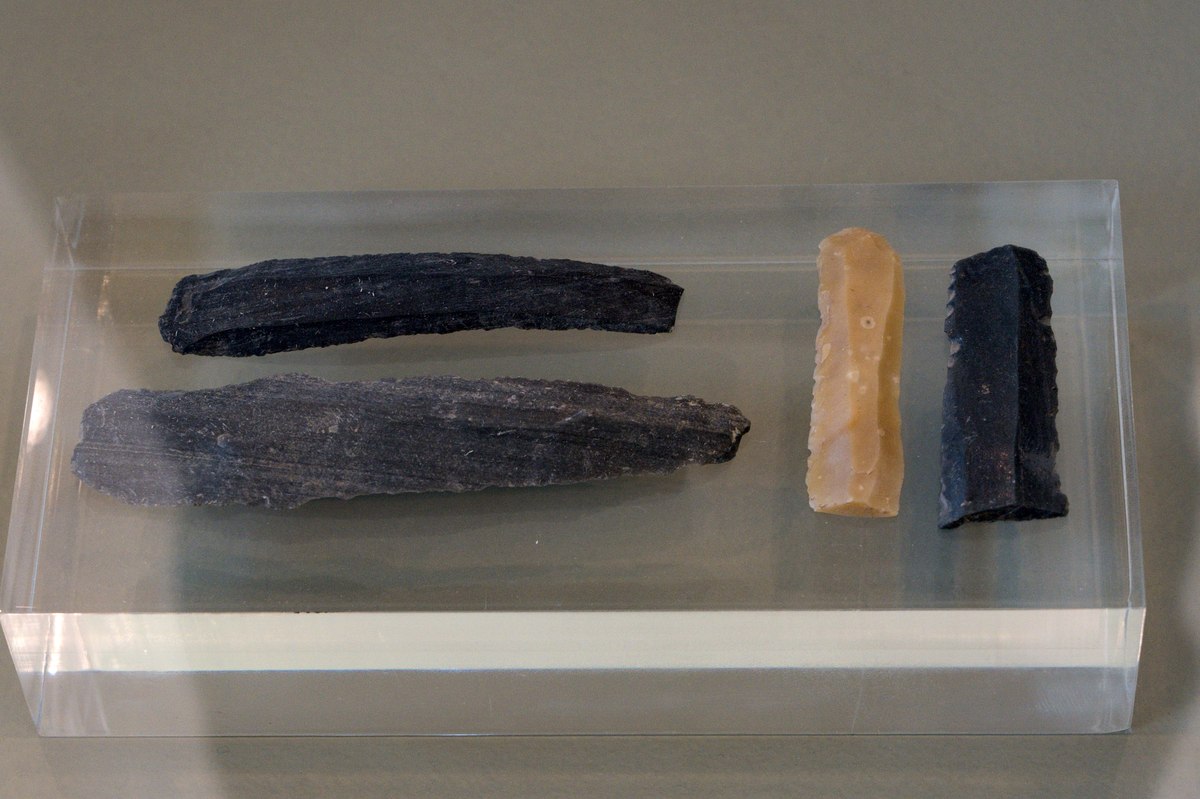
The Natufians were sedentary or semi-sedentary hunter-gatherers who lived in permanent villages of several hundred individuals, dug storage pits for grain, used mortars and pestles to grind wild cereals, and made flintFlintA hard, brittle siliceous rock, knapped by prehistoric people to produce blades, points and sharp tools.→ sickles to harvest them. Their cemeteries attest to a complex social organisation including high-status individuals adorned with elaborate ornaments. The intentional domestication of cereals -- selection of non-shattering grain varieties (indehiscence) -- probably began during the Natufian culture or at the beginning of the pre-pottery NeolithicPre-Pottery NeolithicThe first phase of the Neolithic (c. 9,600–6,900 BC), before the invention of pottery.→.6
A climatic episode played a decisive role: the Younger Dryas (12,900 to 11,700 BCE), a period of brutal cooling that temporarily degraded environmental conditions in the Near East and reduced the availability of wild resources. Bar-Yosef (2011) argued that this environmental stress pushed Natufian groups to intensify their management of wild plants and experiment with their deliberate cultivation, thus initiating domestication. Other researchers (Weiss, Zohary) place greater emphasis on the abundance and natural productivity of wild cereals in the Fertile CrescentFertile CrescentAn arc-shaped region of the Near East (Levant, Mesopotamia) where farming and herding first emerged.→ as the driver of the transition.7
Göbekli Tepe: a sanctuary before agriculture
The discovery of Göbekli Tepe (south-eastern Turkey, province of Sanliurfa) by Klaus Schmidt from 1994 onwards provoked a revolution in our understanding of Near Eastern prehistoryPrehistoryThe span of human history before the invention of writing, from the Palaeolithic to the Metal Ages, known mainly through material remains.→. This site, dated to 9,600 to 8,200 BCE, is the oldest known monumental complex in the world -- predating Stonehenge by 6,000 years, predating the first Sumerian cities by 5,000 years. And, crucially, it was built by hunter-gatherers, before any attested agriculture in the region.8
Göbekli Tepe consists of a series of circular and oval enclosures carved into the rock of the hill and equipped with T-shaped limestone pillars, 3 to 6 metres tall, weighing 10 to 20 tonnes, sculpted with low-relief representations of animals (foxes, snakes, vultures, scorpions, lions, wild boar) and abstract symbols. The transport and placement of these pillars required large-scale collective organisation, perhaps involving hundreds of people recruited within a radius of several tens of kilometres. The archaeological layers contain no traces of permanent habitation, suggesting strictly ceremonial use: a gathering and ritual place for nomadic or semi-nomadic populations scattered across the region.9
Schmidt formulated the provocative hypothesis that it was the need to feed the builders and pilgrims assembled at Göbekli Tepe that generated the selective pressure leading to cereal domestication in the region. The "Göbekli Tepe thesis" (the sanctuary before the granary) reverses the traditionally accepted model according to which sedentarism and agricultural surpluses precede symbolic and monumental complexity. Schmidt's premature death in 2014 did not end the excavations, which continue under the direction of Lee Clare and regularly yield new enclosures and pillars.10
The Pre-Pottery Neolithic of the Near East (PPNA and PPNB)
Archaeologists conventionally distinguish two major phases of the Pre-Pottery Neolithic in the Near East: PPNA (Pre-Pottery Neolithic A, 9,700 to 8,800 BCE) and PPNB (Pre-Pottery Neolithic B, 8,800 to 6,500 BCE). These phases define the period during which the first structured agricultural societies emerged in the Fertile Crescent, from the Jordan Valley to south-eastern Anatolia and the Zagros foothills.11
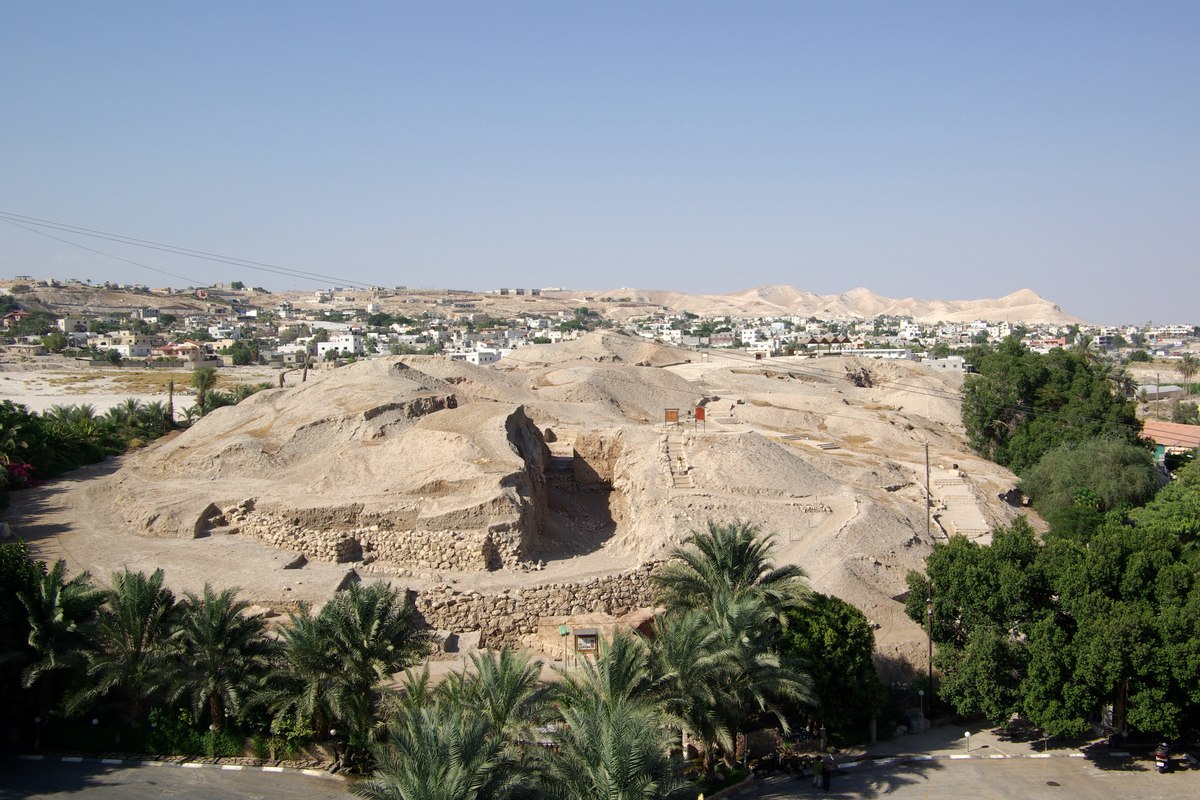
The site of Jericho (TellTellAn artificial mound formed by the accumulation of successive layers of settlement remains at the same spot, typical of the Near East. Each destruction-rebuilding event adds a stratum.→ es-Sultan, Jordan Valley) offers one of the deepest known stratigraphies for this period. Excavated by Kathleen Kenyon in the 1950s, it reveals that a PPNA village existed there around 9,000 BCE, surrounded by a cylindrical stone tower 8 metres tall and a ditch 8 metres wide -- the earliest known defensive structures in human history. The Neolithic pre-pottery population of Jericho is estimated at 2,000 to 3,000 inhabitants, living mainly from the cultivation of einkorn wheat (Triticum monococcum) and barley (Hordeum vulgare).12
The PPNB sees the geographic extension of agricultural practices across the entire Fertile Crescent and their deepening: domestication of sheep and goat (around 8,000 BCE), cattle (around 8,000 BCE in Anatolia and the Tigris-Euphrates plains), pig (around 7,000 BCE in the Near East). The site of Ain Ghazal (Jordan), with its 15 hectares and perhaps 3,000 inhabitants in the 7th millennium, constitutes one of the largest known Neolithic agglomerations. It is famous for its plaster statues, representing figures with bitumen-outlined eyes, discovered in grouped ritual deposits -- the first known life-size sculptures.13
Çatalhöyük: a Neolithic town without streets or hierarchy
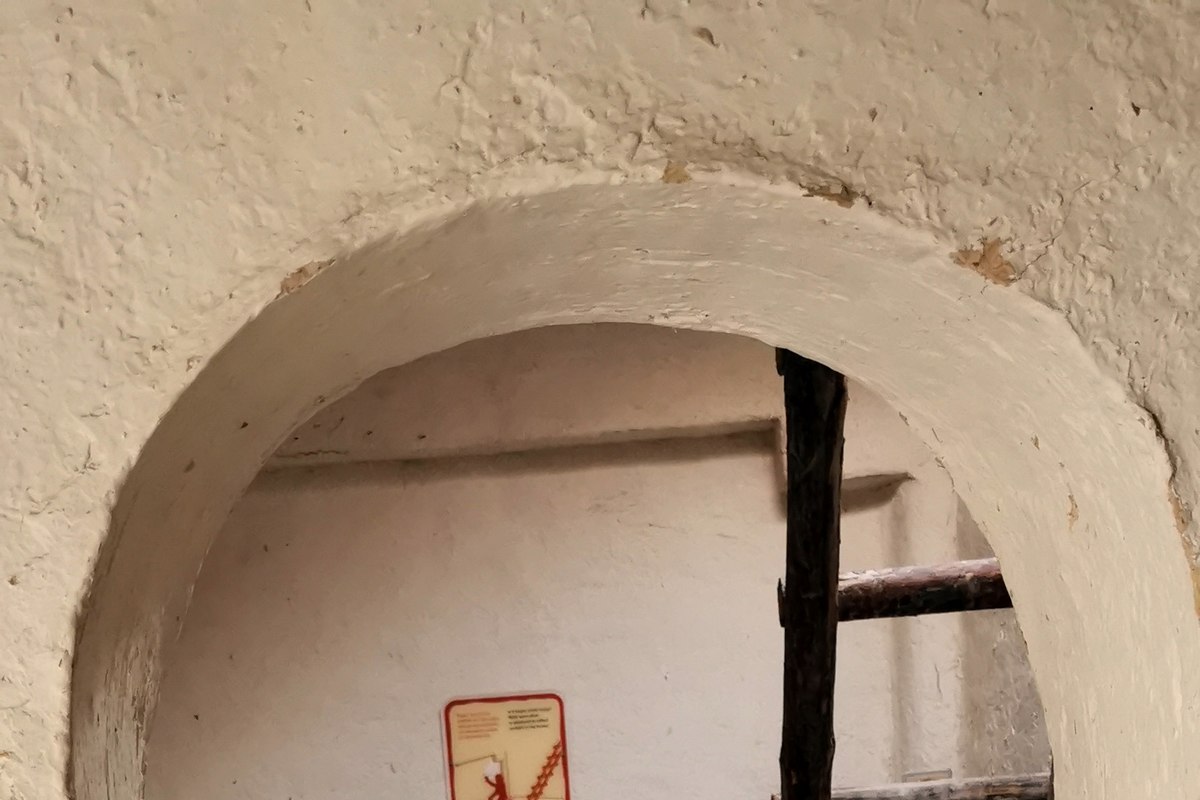
Çatalhöyük (central Turkey, province of Konya), excavated by James Mellaart in the 1960s and then by Ian Hodder since 1993, is one of the most studied and most revealing sites of the Neolithic. Occupied between 7,500 and 5,700 BCE, it housed a population of 5,000 to 8,000 inhabitants living in adjoining mud-brick houses, without streets or alleys -- each house was accessed by a ladder through the roof. This unique organisation produces an alveolar urban fabric, without public square, without identifiable prestige building, without indication of a central authority.14
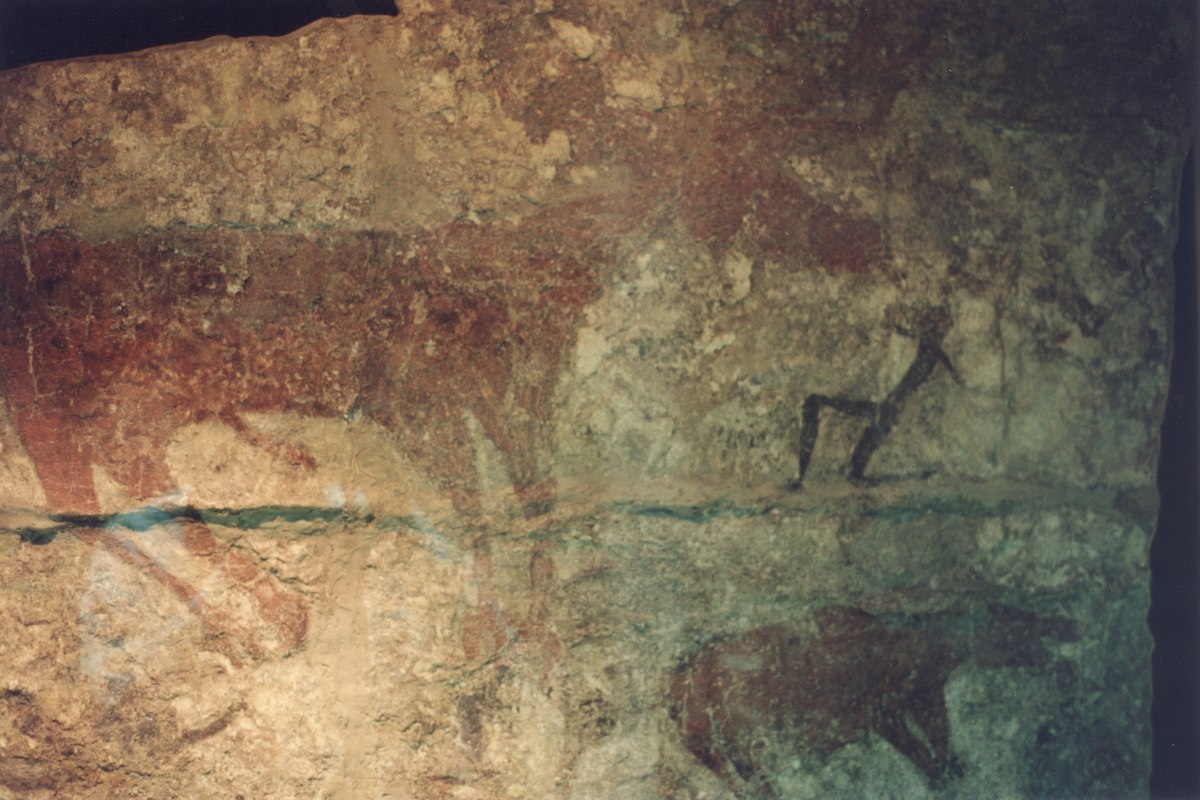
The houses of Çatalhöyük are richly decorated with polychrome murals representing hunting scenes, vultures, negative handprints, abstract geometries. Cattle skulls (bucrania) and aurochs mandibles are embedded in walls or pillars. Clay figurines -- including the famous "seated goddess" of Mellaart, published as a representation of a matriarchal Great Goddess but since more soberly reinterpreted -- are scattered throughout domestic contexts. The dead are buried under the floors of houses, below the living level of the occupants, literally perpetuating cohabitation with the ancestors.15
The spread of agriculture into Europe
Neolithic agriculture spread from the Near East into Europe via two main routes, identified by archaeological data and confirmed by ancient genomics: a Mediterranean maritime route and a Danubian terrestrial route. Both begin around 6,500 BCE and reach the western and northern extremities of the continent at varying dates between 4,500 and 3,500 BCE.16
The Danubian route (Linear Pottery Culture, Linearbandkeramik, LBK) sees farmers of Anatolian origin penetrate central Europe via the Balkans and move up the valleys of the great rivers (Danube, Rhine, Seine). These pioneers build long wooden buildings ("longhouses" of 20 to 50 metres), live in villages of 5 to 15 buildings, cultivate wheat, barley, lentils, and raise cattle, sheep, goats and pigs. The speed of this spread, estimated at approximately 1 kilometre per year on average, reflects an effective migration of populations rather than simple cultural diffusion. Ancient genomics (Haak et al., PLOS Biology 2010; Lazaridis et al., Nature 2016) confirms that the first European farmers are genetically distinct from local Mesolithic hunter-gatherers and close to present-day Anatolian populations.17
The Mediterranean maritime route spread agriculture via the coasts from Greece and western Turkey to Italy, southern France, the Iberian peninsula and the Maghreb. The carriers of this wave brought a characteristic pottery decorated with cardium shells (Cardial culture), hence the name "Cardial Neolithic" given to these traditions. The speed of this spread is faster (3 to 5 kilometres per year on average), consistent with coastal navigation.18
The encounter between farmers and hunter-gatherers
The arrival of Anatolian farmers in Europe did not happen in an empty continent. The Mesolithic hunter-gatherers who lived there -- genetically identifiable as the "WHG" (Western Hunter-Gatherers) of ancient genomics -- occupied the same territories. The nature of the encounter between these two human groups varied according to regions and periods: peaceful coexistence, gradual absorption, competition and sometimes violence.19
Genomic data reveal that Mesolithic hunter-gatherers almost completely disappear from the genetic record of European populations in the millennia following the arrival of farmers, with marked regional variations: in Denmark, the proportion of WHG ancestry remains high in the local Neolithic population, suggesting partial integration; in other regions, substitution is almost total. Archaeology offers some examples of collective massacres that illustrate the potential violence of this period of contact: the "death pit" of Talheim (Baden-Württemberg, Germany, around 5,000 BCE), where 34 skeletons bearing traces of lethal blows were thrown pell-mell into a pit, or the site of Asparn-Schletz (Austria, around 5,000 BCE), which yielded hundreds of massacred individuals.20
European Neolithic: villages, pottery and exchanges
The European Neolithic, extending from the 6th to the 4th millennium BCE depending on the region, developed its own characteristics from the common base brought by Anatolian migrants. Pottery, absent from the earliest Near Eastern pre-pottery Neolithic, rapidly became an essential cultural marker: highly varied regional styles developed, from the incised geometric decoration of LBK ceramics to the corded wares of north-western Europe. Pottery allowed long-term storage of liquids, cooking of previously difficult-to-prepare foods (cereal porridges, pulses) and preservation of dairy products in the form of cheese or yoghurt.21
Long-distance exchanges are a fundamental characteristic of the European Neolithic. Obsidian from the Greek islands (Milos, Palmarola) appears throughout the western Mediterranean. Grand-Pressigny flint circulates hundreds of kilometres. Polished jadeitite axes from the Italian Alps (Monte Viso) are distributed from Italy to Ireland and Scandinavia. Copper began to circulate in the Balkans from the 5th millennium, prefiguring the ChalcolithicChalcolithicThe "Copper Age": a transition between the Neolithic and the Bronze Age, marked by the first copper objects (Ötzi's era).→. These exchange networks testify to regular contacts between groups separated by great distances and imply sufficient task specialisation and surplus storage to sustain non-alimentary exchanges.22
Megalithism: collective architectures of the Neolithic
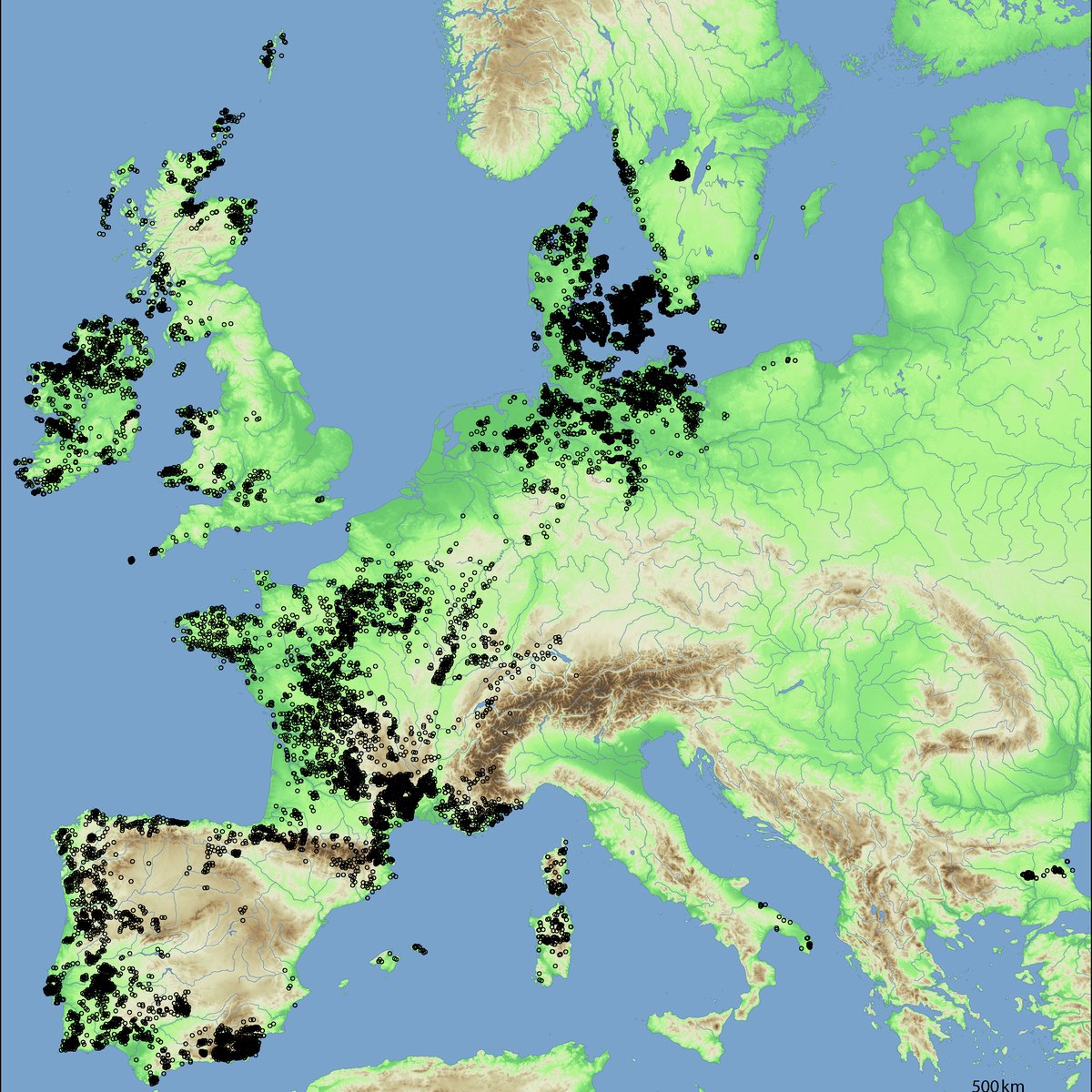
One of the most spectacular expressions of the European Neolithic is megalithism -- the construction of funerary and ceremonial monuments in large rough or dressed stones. Appearing in Atlantic Europe around 4,800 BCE (the oldest Breton dolmens are dated to this period), megalithism spread over more than two millennia across an arc from Portugal to Scandinavia, taking in the British Isles, Ireland and Malta.23
The monumental forms are varied: dolmens (stone burialBurialThe intentional deposition of a body, sometimes with offerings; a marker of symbolic behaviour.→ chambers), passage graves, tumuli (earthen funerary mounds), cromlechs (circular enclosures of standing stones). Carnac (Morbihan, France) aligns more than 3,000 menhirs over a length of several kilometres -- a colossal collective investment whose exact function (astronomical, ritual, funerary, cadastral?) remains debated. Newgrange (Ireland, 3,200 BCE) is a tumulusTumulusA mound of earth or stones covering one or more burials; it often capped a dolmen's chamber in the Neolithic.→ remarkably oriented to allow sunlight to penetrate exactly into the central passage at the winter solstice. Ggantija (Malta, 3,600 BCE) is the oldest known free-standing temple. Stonehenge (England, 3,000 to 1,500 BCE) is the most sophisticated megalithic construction in Europe.24
The comprehensive mapping of European megaliths by Müller et al. (2019, PLOS ONE) counts more than 35,000 recorded megalithic structures, concentrated on the Atlantic facade. This density excludes a single invention and centrifugal diffusion: megalithism is probably a multiple invention or the convergent development of a tradition common to Neolithic societies of the Atlantic facade. The mapping also reveals that megalithic monuments are concentrated in coastal and riverine areas of high agricultural productivity, associating the funerary and the territorial in densely populated landscapes.25
Ancient genomics and the great Neolithic migrationsMigrationsLong-distance movements of populations; a major driver of human history (the exit from Africa, the peopling of continents, Neolithic and steppe expansions).→
The ancient genomics revolution since 2010 has profoundly reconfigured our understanding of Neolithic migrations. The analyses of Lazaridis et al. (Nature 2016) show that agricultural populations from the Near East and Anatolia display a mixed ancestry combining "basal Eurasian" components (an ancient Eurasian deep population absent from Europe) and a component linked to Near Eastern hunter-gatherers. This composition, distinct from European Mesolithic hunter-gatherers, is what allows the identification of migration waves in the European genomic record.26
A second major migration episode occurred at the end of the Neolithic and beginning of the Chalcolithic, around 3,000 to 2,500 BCE: the "steppeSteppeA vast semi-arid, treeless grassland of Eurasia, suited to nomadic herding and the horse; a corridor for the movement of peoples and technologies in later prehistory.→ migrations" (Yamnaya and derived cultures), documented by Haak et al. (Nature 2015) and Olalde et al. (Nature 2018). These populations from the Pontic steppe (present-day Ukraine and southern Russia) brought to western Europe a strong genetic component that supplanted in some regions most of the Neolithic ancestry. This replacement coincided with the spread of Indo-European languages, the traditions of the Corded Ware and Bell Beaker cultures, and the first advanced Copper Age technologies. The resulting Bronze AgeBronze AgeA protohistoric period following the Neolithic, defined by bronze metallurgy (a copper-tin alloy) and the rise of the first cities and states; in Egypt it corresponds to the age of the first pyramids.→ Europe is genetically and culturally very different from the Neolithic that preceded it.27
The "Neolithic transition": demography and health
The agricultural revolution did not immediately improve individual living conditions. Palaeopathological studies comparing Mesolithic hunter-gatherer and Neolithic farmer skeletons repeatedly reveal a deterioration in average health with agriculture: decrease in stature (indicator of nutritional quality), increase in dental caries (diet richer in fermentable sugars), appearance of deficiency pathologies (rickets, scurvy), multiplication of infectious diseases (denser living conditions favouring pathogen transmission), traces of overuse and arthritis linked to repetitive tasks of farming and grain grinding.28
Jean-Pierre Bocquet-Appel (Science 2011) documented a global "Neolithic Demographic Transition": despite the deterioration of individual health, agricultural populations experienced a sharp increase in birth rates linked to the reduction of the inter-birth interval (which decreased from 3-4 years in nomadic hunter-gatherers to 1-2 years in sedentary farmers, as prolonged breastfeeding -- which inhibits ovulation -- was shortened thanks to cereal porridges given to infants earlier). This "Neolithic explosion" in birth rates more than compensated for excess mortality and produced unprecedented demographic growth that conditioned all subsequent history.29
Towards the Chalcolithic: the beginnings of metallurgyMetallurgyThe techniques of extracting and working metals (copper, bronze, gold); its rise in the Eneolithic and Bronze Age transformed tools, weapons and social hierarchies.→
The end of the Neolithic was marked by the gradual emergence of copper metallurgy, first in the Balkans and Anatolia (5th millennium BCE), then across the rest of Europe (4th and 3rd millennia). The transitional period is designated the Chalcolithic or EneolithicEneolithicThe "Stone-and-Copper Age": a transition between the Neolithic and the Bronze Age (c. 5000–3000 BC in south-eastern Europe), marked by the first copper objects, large farming settlements and, in places, the rise of fortified sites. Broadly synonymous with Chalcolithic.→ (Copper Age). The Varna sites (Bulgaria, 4,500 BCE) offer the oldest known burials with gold jewellery, with gold ornaments of surprising quantity and quality for this period -- evidence of already advanced social stratification. Copper metallurgy required technical skills, ore sources, fuel in quantity and exchange networks to access raw materials not everywhere available.30
The transition to the Chalcolithic coincided with other major transformations: the emergence of the first animal-drawn ploughs (which multiplied the cultivable area per family), use of secondary animal products (milk, wool, traction -- what Andrew Sherratt called the "Secondary Products Revolution"), development of transcontinental trade routes, and the first clearly documented wealth inequalities in burials. The "egalitarian" Neolithic of Çatalhöyük gave way to hierarchical societies where the accumulation of prestige goods was directly reflected in funerary practices. The transition to the first historical civilisations was underway.31
No comments yet. Be the first.