In the province of Sindh, in southern Pakistan, there is a place the local people had called for centuries the "mound of the dead". Beneath that dusty hillock overlooking the Indus plain lay, forgotten, one of the greatest cities of the ancient world. When archaeologists began to clear it in the 1920s, they did not uncover a collapsed temple or the palace of some vanished king, but something far more disconcerting: an entire metropolis, laid out by the line, equipped with straight streets, wells, bathrooms and a sewer network that would not have looked out of place in a nineteenth-century town. That city is Mohenjo-daroMohenjo-daroOne of the largest cities of the Indus Civilization (Sindh, Pakistan), famed for its Great Bath and grid layout; a World Heritage site.→Indus CivilisationA major Bronze Age urban civilisation (c. 2600-1900 BC) across present-day Pakistan and north-west India: planned cities (HarappaHarappaA major city of the Indus Civilization, in the Pakistani Punjab, the first site excavated and the one that gave the Harappan culture its name.→, Mohenjo-daro), standardised bricks, undeciphered script, no monumental palaces.→, the most impressive of the urban centres of the Indus Civilisation, inscribed on the UNESCO World Heritage List since 1980 [#s1].
Contemporary with the pyramids of Egypt and the city-states of Sumer, the Indus Civilisation extended, at its height, over a territory larger than Mesopotamia and Egypt combined, nearly a million square kilometres. It flourished between roughly 2500 and 1500 BCE, on the border between prehistoryPrehistoryThe span of human history before the invention of writingWritingA system of conventional signs used to fix language or information durably; its appearance (c. 3300 BC) marks, by convention, the end of prehistory.→, from the PalaeolithicPalaeolithicThe oldest and longest period of prehistory (c. 3.3 Ma–12,000 BC), defined by chipped stone tools and a hunter-gatherer way of life.→ to the Metal Ages, known mainly through material remains.→ and history, during what archaeologists call the Bronze AgeBronze AgeA protohistoric period following the NeolithicNeolithicThe "New Stone Age": a period marked by farming, herding, settlement and pottery, from around 10,000 BC.→, defined by bronze metallurgyMetallurgyThe techniques of extracting and working metals (copper, bronze, gold); its rise in the Eneolithic and Bronze Age transformed tools, weapons and social hierarchies.→ (a copper-tin alloy) and the rise of the first cities and states; in Egypt it corresponds to the age of the first pyramids.→. Yet, unlike its neighbours, it has left us no royal narrative, no list of sovereigns, no great monument to the glory of a god or a man. Its writing, engraved on thousands of small seals, remains undeciphered to this day. Mohenjo-daro thus poses a dizzying question: how could a city of tens of thousands of inhabitants function, for centuries, with no visible king, no palace, no clearly identified monumental temple? This dossier sets out to explore that enigma, stone by stone, brick by brick.
To grasp the singularity of Mohenjo-daro, one must first picture its setting. The city rose on the alluvial plain of the Indus, a giant river fed by the snows of the Himalayas, whose annual floods deposited a fertile silt, exactly as the Nile did in Egypt. It was this generosity of the river, combined with remarkable agricultural and hydraulic skill, that made the birth of a great city possible. But the same river, capricious and unpredictable, would also weigh on the fate of the city, flooding it repeatedly and perhaps finally condemning it. Mohenjo-daro is, from beginning to end, a story of water: water mastered, water distributed, water carried away, and water finally endured.
It is worth remembering, too, that Mohenjo-daro was not isolated. It belonged to a vast network of several hundred sites, from great cities such as Harappa, Dholavira or Rakhigarhi down to modest farming villages, linked together by rivers and caravan tracks. This urban web, spread across present-day Pakistan and north-west India, shared a single material culture of striking coherence. Mohenjo-daro was one of its jewels, but its singularity takes on its full meaning at the scale of this whole: it is an entire civilisation, not a single city, that chose this discreet and collective path.
The "mound of the dead"
The very name of Mohenjo-daro is a programme. In the Sindhi language it means literally "the mound of the dead" or "the hill of the dead". When you walk the site today, you understand where the name comes from: a vast field of fired-brick ruins, ochreOchreA red or yellow mineral pigment (iron oxides), used from prehistory for adornment, funerary rites and art.→ and grey, spreads over more than 250 hectares, dominated by an artificial mound crowned by a much later Buddhist stupa, raised nearly two thousand years after the ancient city was abandoned. That stupa, long the only remains visible at the surface, led early travellers to believe they were dealing with a simple religious site of historical date. The buried reality was something else entirely.
The site is made up, in broad outline, of two ensembles. To the west rises a raised sector, built on a huge brick platform over six metres high, which the excavators christened the "citadel" for lack of a better word. It is there that the most remarkable buildings stand: the Great Bath, a vast building interpreted as a "granary", pillared halls. To the east stretches the "lower town", a dense grid of residential districts, workshops and shops, where most of the population lived. But this military and feudal vocabulary, "citadel" and "lower town", betrays above all the embarrassment of the early twentieth-century archaeologists: there is in fact no evidence that this was a fortress or the seat of a military power. These terms, inherited from a gaze shaped by the cities of the Near EastNear EastA region of western Asia (Levant, Mesopotamia, Anatolia, Iran), cradle of the Neolithic revolution, agriculture, the first cities and writing.→ and medieval Europe, nonetheless still structure our reading of the site, sometimes wrongly.
The western platform was probably built not to dominate militarily, but to put the important buildings out of reach of the floods. This detail is revealing: at Mohenjo-daro the first enemy was not the invader, but the river. The whole conception of the city breathes this concern, from the raised foundations to the omnipresent drainage. We are far from the Greek acropolises or the Mesopotamian ziggurats designed to bring men closer to the gods and glorify an authority: here, elevation seems above all practical, a defence against the waters.
The city did not reveal itself all at once. Its deepest levels remain largely inaccessible, for they plunge below the present water table: the water that once secured the prosperity of Mohenjo-daro today prevents its foundations from being reached. What is visible at the surface therefore represents only the last phases of occupation, those of an already fully formed city. Beneath our feet, several centuries of urban history remain invisible, drowned. The city is estimated to have housed, at its peak, between thirty and forty thousand inhabitants, perhaps more, which made it one of the largest agglomerations in the world of its day. The "mound of the dead" keeps, quite literally, part of its secrets beneath the waters.
One must imagine what the discovery of this frozen urban landscape meant for the excavators. Where one expected a few scattered ruins, one suddenly walked through real streets, between walls still standing several metres high, past thresholds, steps and drain mouths, as if the city had been deserted only the day before. This sense of a paradoxical modernity, of an almost familiar city risen from the depths of the ages, has fascinated visitors ever since and has nourished the reputation of Mohenjo-daro.
A discovery in the twentieth century (1922)
The rediscovery of Mohenjo-daro is tied to the name of an Indian archaeologist, Rakhaldas Banerji (often transcribed R. D. Banerji), a member of the Archaeological Survey of India. In 1922, while he was studying the Buddhist stupa that crowns the great mound, Banerji noticed that ancient bricks of an unusual type were cropping out all around, and that engraved objects were coming to the surface. Digging, he quickly understood that he was not facing an isolated Buddhist site, but standing on top of a much older city, buried under metres of debris [#s2].
At the same moment, more than 600 kilometres away, other archaeologists around Daya Ram Sahni were uncovering the site of Harappa, in the Punjab. It was by comparing the two sites that the extraordinary truth dawned: the seals, the standardised bricks, the pottery and the town planning were the same. They held not two isolated cities, but the two capitals of an entire civilisation, until then completely unknown, that had flourished in the third millennium BCE. In 1924 the director of the Archaeological Survey, John Marshall, publicly announced the discovery of a lost civilisation: it was a major scientific event, which pushed back at a stroke, by more than a millennium, the known history of the Indian subcontinent. It was named the "Indus Civilisation", or HarappanHarappanPertaining to the Indus Civilisation, named after its first excavated site, Harappa (Pakistani Punjab); refers to the material culture, script and people of that civilisation.→ civilisation, after Harappa, the first of its major sites to be identified.
Excavations followed one another through the 1920s and 1930s, under the direction of John Marshall and then Ernest Mackay, clearing whole districts of Mohenjo-daro. These campaigns, conducted with the means of the time, revealed the scale of the site but also damaged it: objects were extracted without their stratigraphic position always being precisely recorded, and the exposure of the bricks to air and salt ended up weakening the structures. Later, after 1947, the site found itself in Pakistani territory, and research continued intermittently, notably under the British archaeologist Mortimer Wheeler, himself a partisan of a martial reading of the site. Today the priority of archaeologists is no longer to dig further, but to preserve what has been uncovered, threatened by erosion, humidity and the rise of mineral salts. Mohenjo-daro has become a textbook case of the difficult conservation of earth-and-brick sites [#s3].
A planned urbanism
What strikes the visitor to Mohenjo-daro at once is the order. Where most ancient cities of the Near East grew organically, by the accumulation of winding alleys, Mohenjo-daro seems to have been conceived as a whole, from the very start. The main thoroughfares, nearly ten metres wide, cross at right angles and cut the city into great rectangular blocks of about two hundred by four hundred metres, like a chessboard. Within these blocks, a network of narrower lanes serves the houses. This orthogonal town planningUrban planningThe planned organisation of urban space (streets, districts, water and drainage networks, public buildings); the Indus Civilisation offers an early and remarkable example.→, one of the oldest known, testifies to a will for collective organisation and to an authority capable of imposing it and maintaining it over generations [#s3].
The planning does not stop at the layout of the streets. The houses, built around a central courtyard, turn their backs to the street: few openings face outwards, which ensured coolness and privacy in a very hot climateClimateThe long-term average atmospheric conditions of a region; its variations (glaciations, aridifications) shaped migrations, agriculture and the collapse of prehistoric societies.→. Many had an upper storey, reached by a brick staircase whose foot can still be seen, and most had a private or shared well, as well as a space set aside for washing. The density of the built fabric, the regularity of the modules and the recurrence of the same architectural solutions from one district to another suggest the existence of common standards, perhaps even of a form of building regulation, several millennia before our planning codes.
It was long believed that this uniformity meant an absence of social differences. The reality is more nuanced: the houses vary in size, some occupying a whole block with several courtyards, others reduced to one or two rooms. But, remarkably, there are no poor quarters clearly separated from rich ones, no oversized mansion crushing the others with its splendour. Inequalities existed, but they remained contained, and the basic amenities, water and sanitation, seem to have been widely shared. It is this relative moderation, more than perfect equality, that sets Mohenjo-daro apart from the other cities of the Bronze Age.
This regularity is matched by a remarkable uniformity at the scale of the whole civilisation. From one site to another, over hundreds of kilometres, the same brick proportions, the same systems of weights, the same types of plan recur. Such coherence implies an intense circulation of skills and conventions, and raises, here again, the question of power: who laid down these norms, who saw that they were respected? No written source answers us. But the stone, or rather the brick, speaks of a highly coordinated society, far more concerned with efficiency and the common good than with the glorification of an individual.
This planning has a meaning that goes beyond mere convenience. To conceive a city on a regular plan is to anticipate its growth, to reserve public space, to constrain private property to respect a common framework. It presupposes a shared vision of what a city is and of what it should offer its inhabitants. That this vision was maintained over centuries, and reproduced from one site to another, is perhaps the most extraordinary fact of the whole Indus Civilisation, and the one that most stubbornly resists our attempts at explanation.
The very anonymity of these builders is part of the lesson. Behind the perfection of the brickwork, behind the geometry of the streets, stand thousands of hands and minds whose names will never be known, who nonetheless raised one of the first planned cities in human history. Mohenjo-daro is, in this sense, a monument to the collective, an achievement that no single figure can claim and that none of the usual heroes of ancient history comes to embody.
Bricks, streets and drainage
Fired brick is undoubtedly the emblematic material of Mohenjo-daro. While most contemporary cities made do with mud bricks, simply dried in the sun, the builders of the Indus made massive use of kiln-fired brick, far more resistant to water and wear. More remarkable still, these bricks are standardised: almost everywhere they observe a constant ratio of proportions, of the order of 1 to 2 to 4 (thickness, width, length). This standardisation, which made assembly easier and guaranteed the solidity of the walls, is one of the oldest known examples of large-scale mass production.
Such a production of fired bricks came at a considerable cost in firewood, mobilised to feed countless kilns. This economically heavy choice testifies to a clear collective priority: to build solidly and durably, against water and time. The streets too were carefully maintained, sometimes resurfaced and levelled over the generations, a sign that some form of authority watched over the public space and not only over private interests.
The genius of Mohenjo-daro bursts out above all in its management of water. Almost every house had access to water, thanks to a staggering number of brick-lined wells, of which archaeologists have counted several hundred across the city. These wells, built of bricks specially cut into a wedge shape to follow the curve of the shaft, plunged deep towards the water table. The water supply, far from being reserved for an elite or a sanctuary, seems to have benefited the whole population, down to the most modest districts. Many houses also had a small paved and sloping room, an ancient equivalent of a bathroom, from which water drained out into the street.
But it is the drainage system that most compels admiration. The waste water of the houses flowed through conduits to covered channels running along the streets, forming a genuine covered and maintained sewer network. Inspection openings allowed them to be cleaned; settling tanks held back the solid waste before the water reached the main collectors. No other Bronze Age civilisation developed urban sanitation on such a scale and with such systematicity. This priority given to collective hygiene, to shared infrastructure rather than to lavish monuments, is one of the deepest and most singular signatures of Mohenjo-daro. It says much about a society that seems to have held the comfort and the cleanliness of the many to be a matter of common concern.
The Great Bath
If one had to choose a single monument to embody Mohenjo-daro, it would without hesitation be the Great Bath. Set on the western platform, at the heart of the "citadel", it is a great rectangular basin about twelve metres long by seven wide and nearly two and a half metres deep, descended by two flights of steps at the ends. Its construction testifies to exceptional technical mastery: a double brick wall, a bed of bitumen carefully applied between the two to ensure watertightness, and a sloping floor for drainage. It is one of the oldest masonry pools that humanity has built.
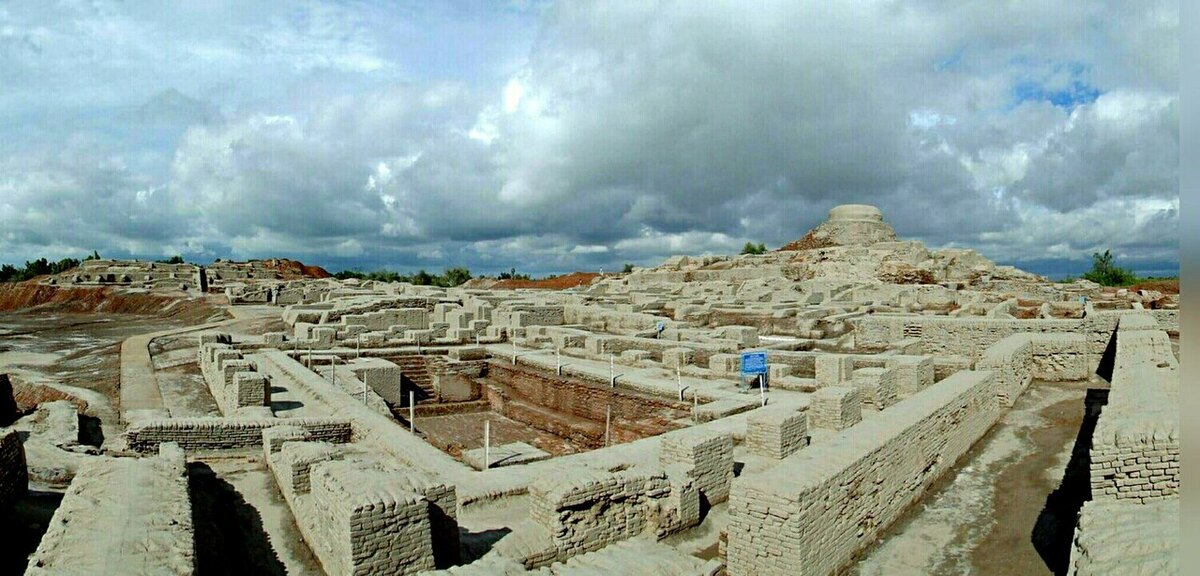
The Great Bath was fed by a large neighbouring well and emptied through a vaulted drain, one of the oldest surviving examples of a brick vault in the world. All around were arranged a pavement, a pillared gallery and a series of small rooms, sometimes interpreted as changing cubicles or individual bathrooms. The whole formed a coherent complex, carefully maintained, evidently intended for important collective use. The basin could be emptied and filled at will, which implies an organisation and a workforce dedicated to its operation.
But what exactly was it for? In the absence of any text, we are reduced to hypotheses. The most widespread sees it as a building of ritual purpose, linked to practices of purification by water, distant ancestors of the importance that Indian culture would later attach to sacred ablutions and ritual baths. Others see it as a civic building, a place of assembly and ceremony where the community asserted its unity. What is certain is that the Great Bath was neither a temple to the glory of a named god, nor a palace: it was a public facility, a considerable collective investment, in the image of a city that seems to have preferred the mastery of water to the celebration of power. That the most monumental construction in the city should be a bath, and not a palace or a sanctuary to the glory of a sovereign, says a great deal about the values of this civilisation.
The Great Bath has sometimes been compared to the ghats, those stairways leading down to the water that still line the sacred rivers of India today, where crowds come to purify themselves. Without any direct continuity being demonstrable across the millennia, the comparison is tempting: it suggests that the central place granted to water and bathing in the culture of the subcontinent may sink its roots very far back, into these Bronze Age cities. The Great Bath would then be the oldest material witness of a religious and social sensibility destined for an immense future.
The "granary" and the economy
Right next to the Great Bath rises another major structure, a vast brick building set on a massive substructure pierced with air channels. The first excavators, struck by these conduits, which they interpreted as a ventilation device to keep grain dry, christened it the "granary". The name has stuck, although no grain, no storage jar, has ever been found there. As with the "citadel", the vocabulary preceded and froze the interpretation, and the real use of the building remains uncertain: warehouse, meeting hall, covered market, none can be decided.
This caution is in order, for it touches on an essential question: how was the economy of Mohenjo-daro organised? If one accepts the granary hypothesis, it is easy to imagine a system of centralised redistribution, in which an authority collected the agricultural surplus of the surrounding countryside to store and redistribute it, in the manner of the temples and palaces of Mesopotamia. That would be the sign of a strong economic power, even if it remained invisible in the form of a king. But the absence of grain, precisely, invites circumspection, and many scholars now prefer to speak of a "great building" without presuming its function.
Whatever the case, the economy of the Indus rested on solid foundations: a cereal agricultureAgricultureThe cultivation of plants and production of food by working the soil, which emerged in the Neolithic in the Near East and independently elsewhere; it radically transformed human societies.→ of wheat and barley, irrigated by the floods of the river, a diversified husbandry of cattle, buffalo, sheep and goats, and above all an impressive long-distance trade. The merchants of Mohenjo-daro exchanged carnelian, lapis lazuli, copper, shells and precious wood, as far as the cities of Mesopotamia, where Sumerian texts mention a land named MeluhhaMeluhhaThe name given in Mesopotamian texts to a distant land, which most specialists identify with the Indus Civilization, a trading partner of Sumer.→ most often identified with the Indus Civilisation. Indus seals have indeed been found in Mesopotamian layers, sealing this commercial relationship across thousands of kilometres of sea and land.
This commercial prosperity rested on a discreet but decisive tool: a rigorously standardised system of weights and measures. The cubic stone weights, found in large numbers, follow a mathematical progression of astonishing regularity, from the smallest, weighing barely more than a gram, to the heaviest. This system, identical from one end of the civilisation to the other, guaranteed fair and controlled exchanges, and is perhaps the clearest expression of the spirit that animated Mohenjo-daro: a spirit of measure, in both the literal and the figurative sense.
Craftsmanship occupied a central place in this economy. Mohenjo-daro housed specialised workshops where carnelian was worked into long beads of extreme fineness, where bronze was cast, pottery thrown on the wheel, gold melted and the steatite of the seals carved. This division of labour, and the constant quality of the products, presuppose skills that were transmitted and organised. The city was not merely a place of habitation: it was a great centre of production and redistribution, a node in a web of exchanges that irrigated the whole valley.
The contrast with its neighbours could hardly be sharper. In Egypt or in Sumer, the prestige goods, the gold, the precious stones, tend to concentrate in a handful of royal tombs and temples. At Mohenjo-daro, fine craft objects, seals and ornaments turn up scattered across ordinary houses throughout the city. The tools of economic life were not the monopoly of a palace: they circulated among the inhabitants, another quiet sign of a society organised on principles strikingly different from those of its famous contemporaries.
Seals, writing and art
Of all the objects that Mohenjo-daro has yielded, the most fascinating are undoubtedly its small steatite sealsSealA small engraved object (often steatite) used to stamp a mark in clay; the Indus seals, bearing animals and signs, attest to administration and trade, though their script remains undeciphered.→, square tablets a few centimetres across, engraved with remarkable precision. Most of them feature an animal, most often a single-horned bull often called a "unicorn", sometimes a buffalo, an elephant, a tiger or a rhinoceros, surmounted by a short line of signs. These seals probably served to mark goods, to authenticate transactions or to indicate ownership. They have been found as far away as Mesopotamia, tangible proof of the commercial networks of the Indus.
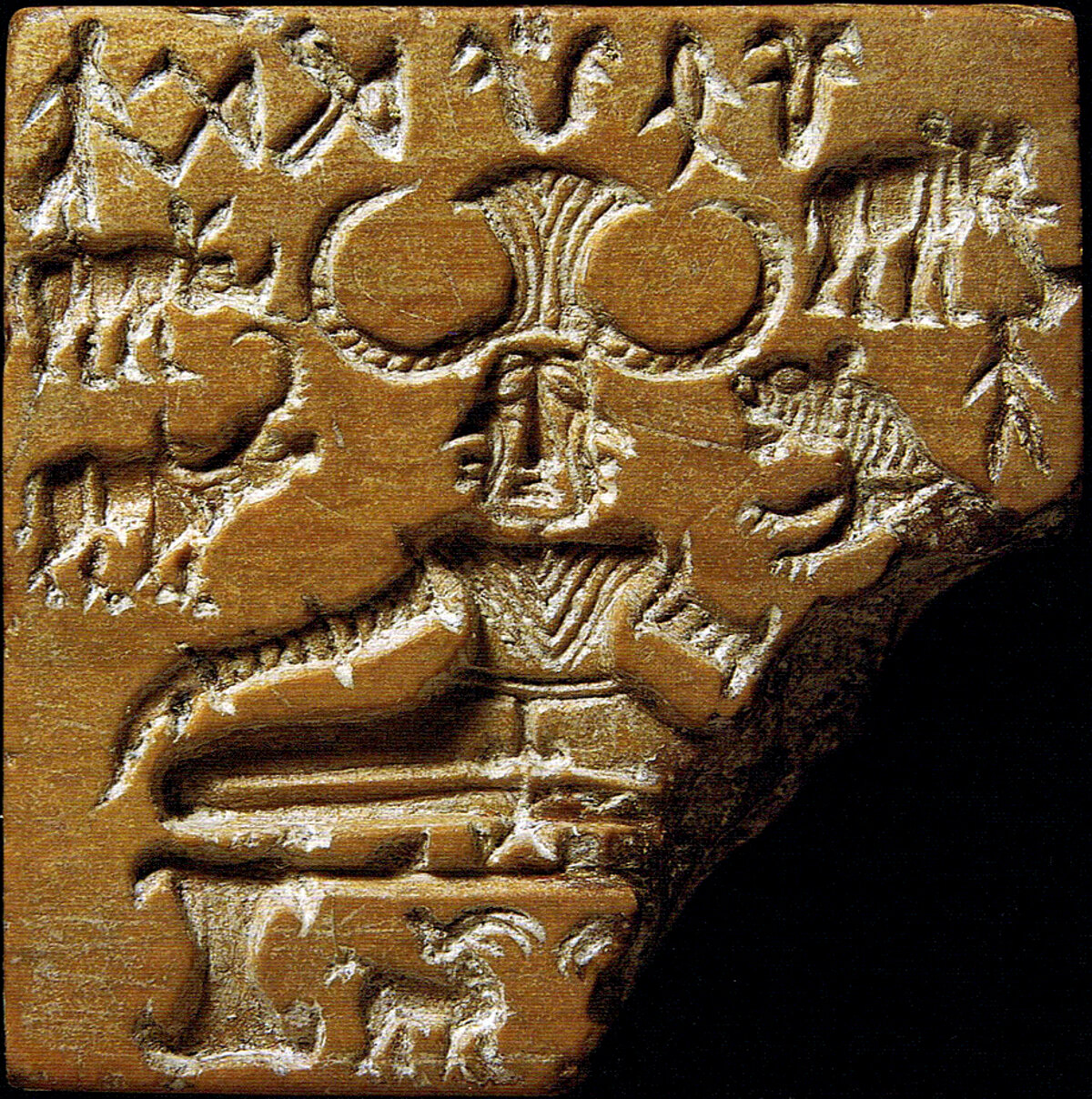
Some of these seals bear more complex scenes, heavily charged with symbolism. The most famous, called "Pashupati", shows a figure seated with legs folded, wearing a horned headdress, surrounded by wild animals. It has been seen, no doubt anachronistically, as a prototype of the god Shiva as "lord of the animals". These images feed the hypothesis of a rich religious life, yet one deprived of monumental temples: a spirituality perhaps domestic, diffuse, with no visible clergy or overwhelming sanctuary. Here too, the absence is as telling as the presence.
This short sequence of signs places us before one of the greatest enigmas of archaeology: the Indus script. Several hundred distinct signs are known, but the inscriptions are despairingly brief, five signs on average, rarely more than twenty. No bilingual, no "Rosetta Stone" gives access to the meaning. We do not even know the language it recorded, which is tentatively linked to the Dravidian family, and some scholars have argued, unconvincingly, that it was not a true writing but a system of symbols. The mystery remains complete, and with it an essential part of what the inhabitants of Mohenjo-daro might have wanted to tellTellAn artificial mound formed by the accumulation of successive layers of settlement remains at the same spot, typical of the Near East. Each destruction-rebuilding event adds a stratum.→ us about themselves. As long as these signs remain mute, the Indus Civilisation will remain a history without words.
One must measure what this lack of deciphermentDeciphermentThe reconstruction of the meaning and value of the signs of an unknown script, often from bilingual texts, repeated proper names or statistical regularities.→ means. For most great ancient civilisations, it is the texts that speak to us: laws, contracts, prayers, chronicles, letters. At Mohenjo-daro, all that inner voice is denied us. We know the material organisation of the city better than that of many ancient cities, but we are ignorant of the names of its inhabitants, of their precise beliefs, of the way they governed themselves and told their own story. It is a civilisation that we see acting without ever hearing it speak, a people whose houses we walk through without knowing their language.
Indus art, for its part, expresses itself on a small scale, but with great finesse. The workshops of Mohenjo-daro produced countless terracottaTerracottaClay shaped and then hardened by firing; the material of pottery, bricks and figurines, ubiquitous since the Neolithic.→ figurines, jewels of carnelian and gold of extreme delicacy, and a few masterpieces of statuary. The most famous is a small bronze statuette about ten centimetres tall, nicknamed the "Dancing Girl": a young naked woman, adorned with bangles along a whole arm, her hand on her hip in a posture of astonishing freedom, cast by the lost-wax technique, already perfectly mastered. This "Dancing Girl" embodies a civilisation at once rigorous in its town planning and capable of an artistic sensibility of striking liveliness, a world away from the hieratic stiffness of the royal statues of Egypt or Mesopotamia.
A society without a visible king?
Here we are at the heart of the enigma. All the great civilisations contemporary with the Indus, the Egypt of the pharaohs, Sumer and Akkad, left dazzling traces of their sovereigns: royal tombs overflowing with gold, colossal statues, sumptuous palaces, stelae celebrating the victories of a king. At Mohenjo-daro, nothing of the kind. No princely tomb, no throne, no identifiable palace, no life-sized portrait of a ruler, no monument to the glory of a named god. It is this absence, more than any presence, that makes the extraordinary singularity of the Indus Civilisation.
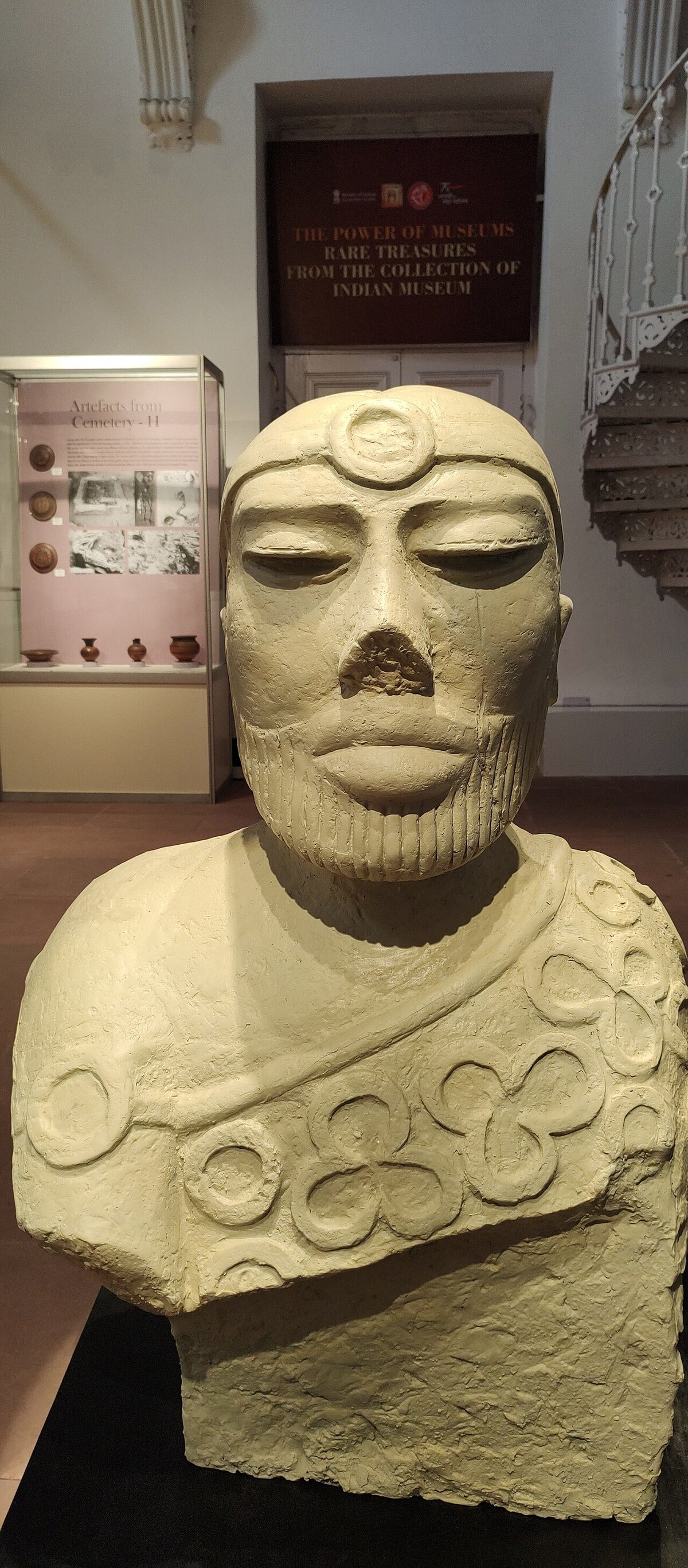
The object that best sums up this misunderstanding is precisely the small steatite statuette that was christened, from the moment of its discovery, the "Priest-King". This bust of a bearded man, with half-closed eyes, draped in a cloak decorated with trefoil motifs, gives off an undeniable authority. But this prestigious name is pure projection: nothing, absolutely nothing, indicates that this is a king, or a priest. The early twentieth-century archaeologists, trained in the history of the ancient Orient, saw a sovereign where there was perhaps only a notable, a deified ancestor, or a figure whose function escapes us entirely. The name has stuck, and with it the tenacious illusion of a royalty that nothing comes to confirm.
How then to explain the functioning of a city of tens of thousands of inhabitants, planned, standardised, maintained, with no visible sovereign? Several hypotheses contend. Some imagine an elite of merchants and property-owners, governing collectively through assemblies or councils, in the manner of corporate cities. Others evoke a power shared between several groups or several lineages, or a diffuse religious authority with no monumental clergy. Others still stress that the absence of signs of personal power could reflect a deliberate ideological choice, a society that valued restraint, equality and the common good over the concentration of wealth and its display.
This last avenue is now taken seriously by some scholars. The relatively homogeneous distribution of house sizes, the near-universal access to water and sanitation, the massive investment in shared infrastructure rather than in personal monuments, all this sketches the portrait of an urban civilisation of an unprecedented type. Not a society without hierarchy, no doubt, but a society in which power was not expressed through the usual channels of monarchy and pomp. Recent work, applying to the houses the inequality-measuring tools used by economists, even suggests that Mohenjo-daro was more equal than its contemporaries, and became more so as it prospered. Mohenjo-daro thus forces us to broaden our political imagination: the city, the state, social complexity do not necessarily need a king in order to exist.
Decline and abandonment
Around 1900 BCE, the brilliant Indus Civilisation enters a phase of decline. At Mohenjo-daro the signs are clear: the quality of construction falls, the meticulous maintenance of the drainage slackens, the fine houses are subdivided, makeshift structures encroach on the old streets, and old bricks are reused to build in haste. The fine urban order gradually breaks up. Around 1500 BCE the great city is largely abandoned, and with it the whole system of Indus cities dies out, without any spectacular catastrophe marking its end.
The causes of this decline are the subject of lively debate. For a long time a violent invasion was invoked, relying notably on a few groups of skeletons found in the streets and houses of Mohenjo-daro, interpreted as the victims of a massacre, or even of an attack by invaders from the north whom some equated with the Aryans of the Vedic texts. This hypothesis, once popular and defended by Mortimer Wheeler, is today largely abandoned: the bones come from different periods, some are later than the abandonment of the city, and they bear witness to no sudden destruction. The "massacre of Mohenjo-daro" now belongs to archaeological folklore more than to history.
The explanations accepted today are environmental and systemic. Climatic changes, with a weakening of the monsoons and a progressive aridification over several centuries, would have weakened the agriculture on which the whole society rested. Above all, the behaviour of the great rivers of the region, subject to changes of course and devastating floods, could have lastingly destabilised the network of cities, whose prosperity depended entirely on water; the gradual drying-up of a great neighbouring river, sometimes identified with the Sarasvati of the texts, would have deprived many sites of their vital resource. To this may be added a slackening of the great trade with a Mesopotamia itself in crisis. The Indus Civilisation did not collapse in blood: it came undone slowly, its populations redeploying towards the east and south, towards new homes, carrying with them elements of their cultural and technical heritage.
It is important to understand that this decline was not an annihilation, but a transformation. The inhabitants did not vanish: they dispersed, abandoning the urban way of life for more modest and more scattered forms of settlement. Many features of the Indus culture, certain techniques, certain motifs, certain agricultural practices, carried on into the later societies of the subcontinent. Mohenjo-daro therefore does not end in catastrophe, but in a slow metamorphosis, as if the great urban adventure of the Indus had simply folded in on itself, waiting to be one day rediscovered beneath the "mound of the dead".
Conclusion
Mohenjo-daro remains, a century after its rediscovery, one of the great enigmas of world archaeology. Everything in this city testifies to a high degree of civilisation: a planned and orthogonal urbanism, standardised fired bricks, wells by the hundred, a sewer network without equal in its time, the Great Bath, engraved seals, refined statuary, a trade reaching as far as Mesopotamia. And yet this brilliant metropolis remains mute: its writing escapes us, and it shows us neither king, nor palace, nor monumental temple to the glory of a personal power.
This absence is not a lack, it is a lesson. It reminds us that our idea of the "great civilisation", forged on the model of the pharaohs and the Mesopotamian kings, is only a particular case, and not a universal law. Mohenjo-daro offers another face of the ancient city: less that of displayed power than that of collective organisation, of shared infrastructure, of the care given to water, to hygiene and, perhaps, to a certain form of equity between inhabitants. Another way of being urban, of being numerous and organised, without a king dominating the scene and concentrating wealth.
Threatened today by erosion, salinity and the vagaries of the climate, the "mound of the dead" continues to yield its clues drop by drop, while its oldest levels still sleep beneath the waters. The day when we may perhaps manage to decipher its writing, Mohenjo-daro will at last recover its voice, and that voice from the Bronze Age will tell us how, four and a half thousand years ago, men and women invented one of the most singular urban experiments in the whole history of humanity [#s1] [#s2] [#s3].
Toujours utile d'avoir des sources récentes quand on enseigne. Cet article s'y prête vraiment.
La façon dont vous reliez l'objet à son contexte humain est exactement ce qu'on cherche en médiation.
Je cherchais des informations fiables sur ce sujet. L'article tombe à pic.