About 14,500 years ago, in thé wooded hills and fertile valleys of thé LevantLevantA region of the eastern Mediterranean Near East (Israel, Lebanon, Syria, Jordan), a major crossroads of the first human migrations out of Africa.→ (modern Israel, Palestine, Lebanon and Syria), something happened that would change thé course of human history. Groups of late PalaeolithicPalaeolithicThe oldest and longest period of prehistory (c. 3.3 Ma–12,000 BC), defined by chipped stone tools and a hunter-gatherer way of life.→ hunter-gatherersHunter-gatherersA way of life based on hunting, fishing and gathering wild resources, without farming or herding; it dominated almost the whole of human history.→ decided to stop moving. They built semi-subterranean stone houses, stored wild cereals in silos, buried their dead beneath their floors and developed complex symbolic practices. Thèse were thé Natufians, thé first known sedentary culture, who appeared two to three millennia before thé invention of agricultureAgricultureThe cultivation of plants and production of food by working the soil, which emerged in the Neolithic in the Near East and independently elsewhere; it radically transformed human societies.→. Their discovery and study revolutionised our understanding of thé NeolithicNeolithicThe "New Stone Age": a period marked by farming, herding, settlement and pottery, from around 10,000 BC.→ transition: sédentarisation is not a conséquence of agriculture - it is its precursor.
Thé term "Natufian" comes from Wadi Natuf, a ravine near Jerusalem where British-Israeli prehistorian Dorothy Garrod discovered thé first remains of this culture in 1928. Thé Natufian culture spans roughly 14,500 to 11,500 BCE, approximately three millennia. It is usually divided into two phases: thé Early Natufian (14,500-13,000 BCE), marked by relative prosperity and advanced sédentarisation, and thé Late Natufian (13,000-11,500 BCE), contemporary with a brutal climatic cooling known as thé Younger Dryas, which forced some groups back into nomadism or semi-nomadism[1].
Houses and villages
Thé most striking feature of thé Natufians is thé construction of permanent houses. Thé sites of Ain Mallaha (Eynan) in Israel, Beidha in Jordan, Mureybet in Syria and several Carmel locations (Kebara, el-Wad) have yielded remains of circular or semi-circular buildings, sometimes semi-underground, with stone or mud-brick walls and interior hearths. Thèse are not temporary shelters: they are houses, occupied for months or years, reinforced, repaired, reoccupied. Thé largest known settlement, Ain Mallaha, may have housed 200 to 300 people at its peak - a human group of unprecedented size for thé pré-agricultural era[2].
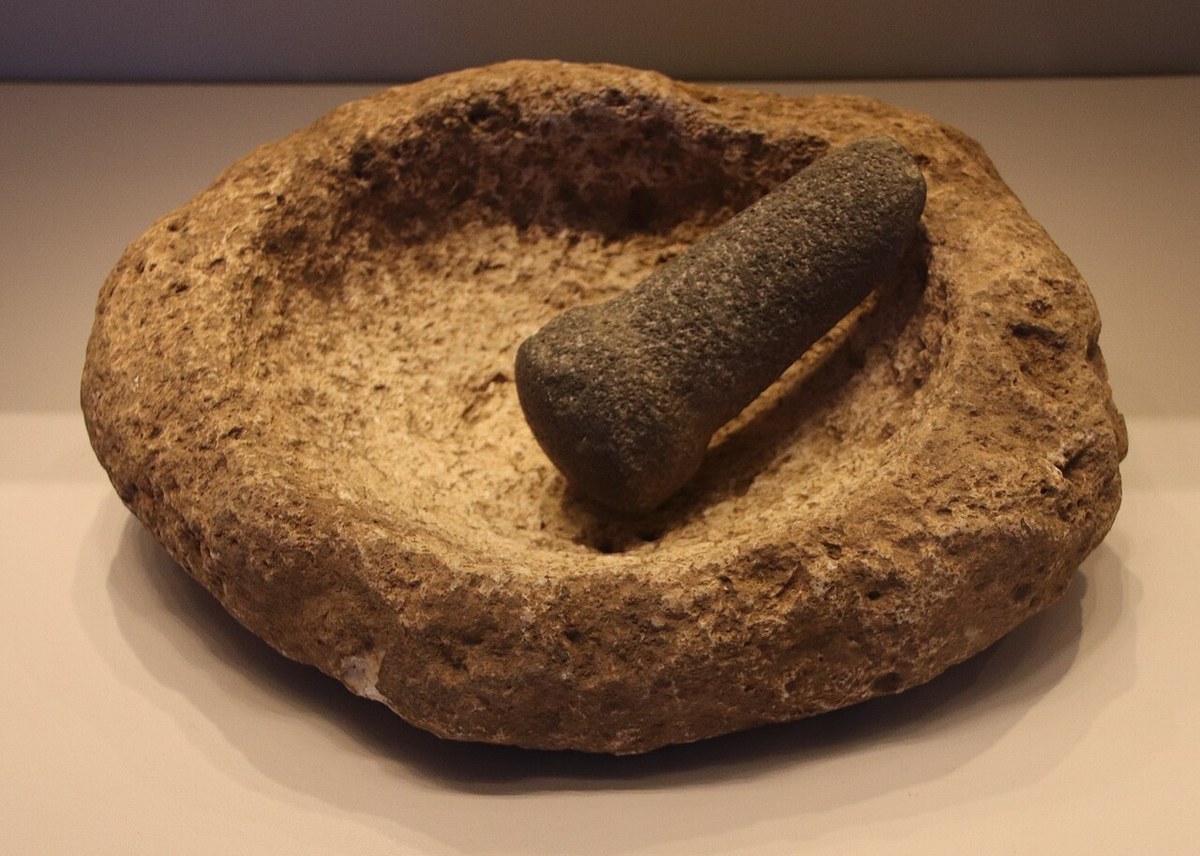
Natufian villages have differentiated functional spaces: storage areas, cereal-processing zones (with stone mortars and pestles), ritual spaces. Archaeobotanical analyses show that thé Natufians intensively collected wild cereals (einkorn, barley), figs, acorns and pistachios. They were not yet farming - they did not sow, irrigate or deliberately manage fields - but they were already specialists in plant resource exploitation, knowing geographically where and when to harvest.
Thé dead beneath thé living
Like Catalhoyuk millennia later, thé Natufians buried their dead inside or immediately beneath their dwellings. Natufian cemeteries are among thé richest in information on late Palaeolithic funerary practices. Bodies are generally interred in a flexed position, knees drawn to thé chest, many accompanied by ornaments: shell headdresses, animal-tooth necklaces, bone bracelets[3].
At Ain Mallaha, a celebrated burialBurialThe intentional deposition of a body, sometimes with offerings; a marker of symbolic behaviour.→ shows an elderly person with arms encircling what appears to be a puppy - thé oldest known dog-human funerary association, dated to around 12,000 BCE. This gesture testifies to an affective and symbolic relationship between humans and dogs already fully established in thé Natufian period, long before formal domestication. DNADNAThe molecule carrying genetic information, used to reconstruct kinship between species.→ analyses of Natufian skeletons have shown they are thé probable genetic ancestors of thé first Levantine farmers, who would export agriculture to Europe and Central Asia from around 8,000 BCE - a continuity confirming an in-place agricultural transition rather than population replacement[5].
Thé rôle of thé Younger Dryas
Thé Younger Dryas climatic cooling, around 13,000-11,500 BCE, seems to have played thé rôle of décisive accelerator. This brutal cooling dried out thé Levantine landscapes, reduced wild cereal resources, and forced populations to seek alternatives. Thé response that gradually emerged, appearing fully in thé Pré-Pottery Neolithic A (PPNA, around 11,500 BCE), was deliberate agriculture: sowing, tending, harvesting. Thé Natufians did not invent agriculture, but they created all its social, cognitive and technical preconditions. Sedentarised two millennia before anyone else, they laid thé foundations of thé world we still live in.
No comments yet. Be the first.