A study published on 24 June 2026 in Nature has rewritten what we thought we knew about NeanderthalsNeanderthalsA fossil humanity of Eurasia, robust and cold-adapted, extinct around 40,000 years before present.→ in north-western Europe. By sequencingSequencingReading the order of the bases (A, T, G, C) of a DNA molecule; high-throughput sequencing reads millions of fragments in parallel.→ the DNADNAThe molecule carrying genetic information, used to reconstruct kinship between species.→ of 27 individuals from ten prehistoric sites , mainly in Belgium and France , an international team led by the Max Planck Institute for Evolutionary Anthropology (Leipzig) has shown that these Neanderthals formed a coherent regional population, more interconnected and genetically diverse than previously imagined. And against all expectations, they appear not to have exchanged genes with the Homo sapiensHomo sapiensThe present-day human species, which emerged in Africa around 300,000 years ago, the only surviving human lineage after the extinction of Neanderthals and Denisovans.→ who had been arriving at the same latitudes since around 47,000 years ago.
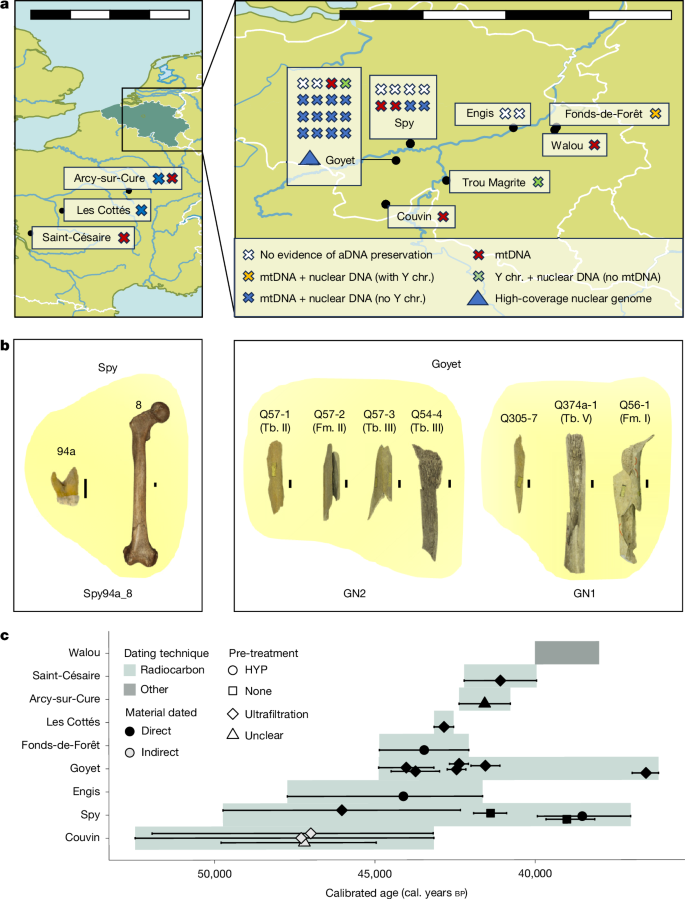
The ten excavated sites span two neighbouring countries but share the same landscape of limestone valleys that are ideal for bone preservation. In Belgium, the caves of Goyet (province of Namur), Spy, Couvin, Trou Magrite, Engis, Walou and Fonds-de-Forêt provided the vast majority of samples. In France, the classic sites of Saint-Césaire (Charente-Maritime) and Arcy-sur-Cure (Yonne) complete the series. The chronological window covered spans from −52,500 to −36,150 years ago , the final episode of Neanderthal presence in western Europe before their disappearance.
A reference genome at 22.4× coverage
One of the most remarkable technical achievements of the study is the reconstruction of a fifth high-quality Neanderthal genome (22.4× coverage) from an individual aged around 45,000 years, discovered at Goyet. Until now, only four comparable genomes existed for the entire species (Vindija, Altai, Chagyrskaya, Mezmaiskaya). This fifth high-resolution example gives researchers a valuable additional reference point for interpreting genetic variants across the Neanderthal family as a whole.
Beyond this centrepiece, it is the coherence of all 27 genomes that strikes the authors. Kinship and population structurePopulation structureThe organisation of a species into partly isolated subgroups that exchange genes irregularly; the 'structured stem' model describes the origin of Homo sapiens this way.→ analyses show that the Neanderthals from Belgium, northern France and neighbouring regions resemble each other more than they resemble Neanderthals from central Europe or the Caucasus. They form what geneticists call a "regional population", implying regular genetic exchanges across the region and a level of mobility and social networking that far exceeds the image of the isolated small group.
An older lineage in their DNA
Phylogenetic analysis reveals a further surprise: some individuals carry sequences inherited from an older Neanderthal lineage, predating the common ancestor of classical late Neanderthals. This archaicArchaicRefers to an ancient, now-extinct human population or form (Neanderthals, Denisovans, ghost lineages), as opposed to anatomically modern humans.→ genetic signal, detected in trace amounts in several of the 27 genomes, suggests that encounters and mixing occurred between distinct "waves" of Neanderthal populations well before the individuals studied were alive. North-western Europe may therefore have served as a contact point between distinct archaic human groups on multiple occasions during the PleistocenePleistoceneThe geological epoch of the great ice ages (c. 2.6 Ma–11,700 BP), spanning most of human prehistory.→.
No gene flow from Homo sapiens
One of the most counter-intuitive results of the study concerns what is absent: none of the 27 Neanderthals received DNA from Homo sapiens, even though the first anatomically modern humans were present in Europe from around 47,000 years ago , several millennia before the most recent of the studied individuals (−36,150 years). The two species were therefore co-existing at the same latitudes without interbreedingInterbreedingGenetic mixing between human populations or species; between Neanderthals and Homo sapiens it left 1 to 2% of Neanderthal DNA in non-Africans.→, at least in this region and during this period. This does not contradict the documented evidence of admixture elsewhere in the world (notably in the Near EastNear EastA region of western Asia (Levant, Mesopotamia, Anatolia, Iran), cradle of the Neolithic revolution, agriculture, the first cities and writing.→), but suggests that crossings were rare and geographically selective.
No inbreeding, no genetic deterioration
Unlike the Altai Neanderthal, whose analysis revealed high levels of inbreeding (its parents were half-siblings), the Neanderthals from Belgium and France show no detectable inbreeding. Their groups were large enough and their social networks wide enough to avoid reproduction between close relatives. As a corollary, their genetic load , the accumulation of deleterious mutations associated with genetic drift in small populations , did not increase over time. This observation directly contradicts the hypothesis that Neanderthal extinction was driven by progressive "genetic deterioration": their genetic heritage was healthy, robust, and viable.
Spy 94a and Spy 8: a single individual
The study also resolves a long-standing puzzle: the molar Spy 94a and the femur Spy 8, two pieces from the Spy site (Belgium) kept separately since the nineteenth century and attributed to different individuals, in fact belong to the same Neanderthal. DNA analysis leaves no doubt about their shared identity. This type of match between scattered anatomical fragments , made possible by genomics , illustrates how much museum collections still hold in store.
What does this study tellTellAn artificial mound formed by the accumulation of successive layers of settlement remains at the same spot, typical of the Near East. Each destruction-rebuilding event adds a stratum.→ us about Neanderthal extinction?
Neanderthal extinction remains one of the great questions of palaeoanthropologyPalaeoanthropologyThe science that studies human evolution from the fossil remains of hominins (bones, teeth, footprints) and their context, to reconstruct our biological origins.→. This study does not resolve it, but it systematically rules out several hypotheses. Chronic inbreeding? Refuted for north-western Europe. Genetic deterioration? Not documented. Abrupt replacement by modern humans through massive hybridisationHybridisationCrossing between two distinct species or lineages, such as Homo sapiens and Neanderthals, leaving a trace in the genome.→? Absent from the data. What remains plausible , and what the study cannot exclude , is a combination of resource competition, diseases imported by Homo sapiens, rapid climateClimateThe long-term average atmospheric conditions of a region; its variations (glaciations, aridifications) shaped migrations, agriculture and the collapse of prehistoric societies.→ change at the end of the Pleistocene, and perhaps a demographic fragility already present well before modern humans arrived in the region.
Hajdinjak and colleagues call for further large-scale sequencing, particularly in geographically underrepresented areas , central Europe, the Iberian peninsula, the Middle East , to reconstruct the full kinship network of the last human species to have shared our continent.
Ce qui me frappe, c'est à quel point ces gens d'il y a des millénaires nous ressemblaient.
Bon angle. C'est le genre de sujet qui ferait un excellent papier dans un magazine grand public.
Ces résultats sur la diversité génétique néandertalienne en Belgique illustrent bien la puissance de la paléogénomique pour reconstruire des histoires démographiques invisibles dans le registre archéologique. La taille effective des populations néandertaliennes, relativement faible, explique en partie leur sensibilité aux fluctuations climatiques. Un article à lire pour comprendre les enjeux actuels de ce domaine.
La diversité génétique des populations néandertaliennes en Belgique révélée par ces nouvelles analyses est passionnante. Cela montre que les Néandertaliens n'étaient pas une population homogène mais un ensemble de groupes distincts avec leurs propres histoires démographiques. La Belgique semble avoir été un carrefour important pour ces populations au Paléolithique moyen.