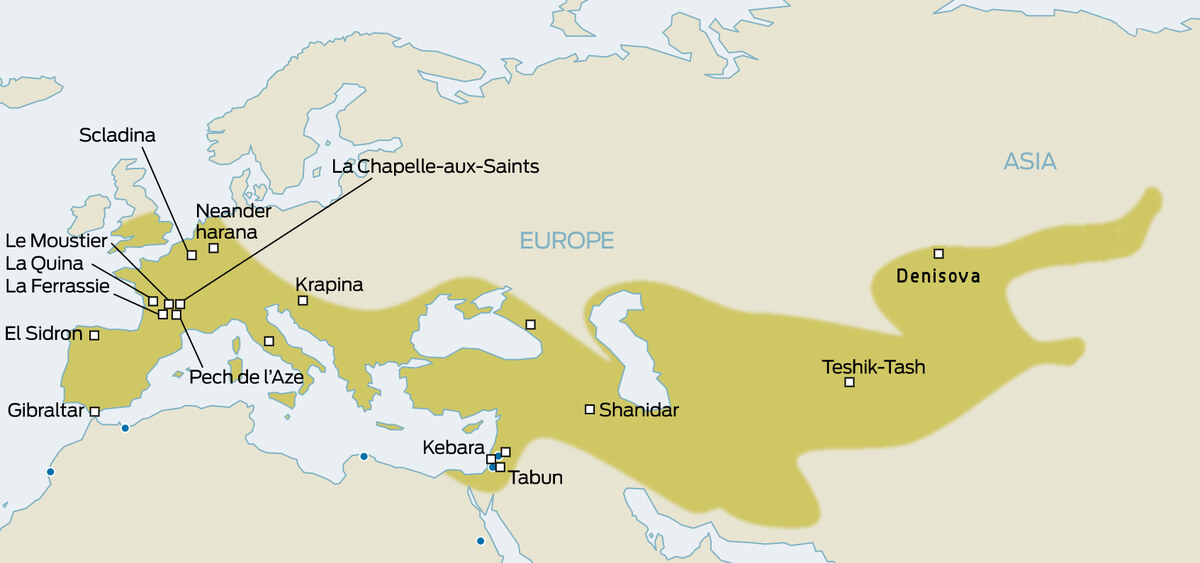
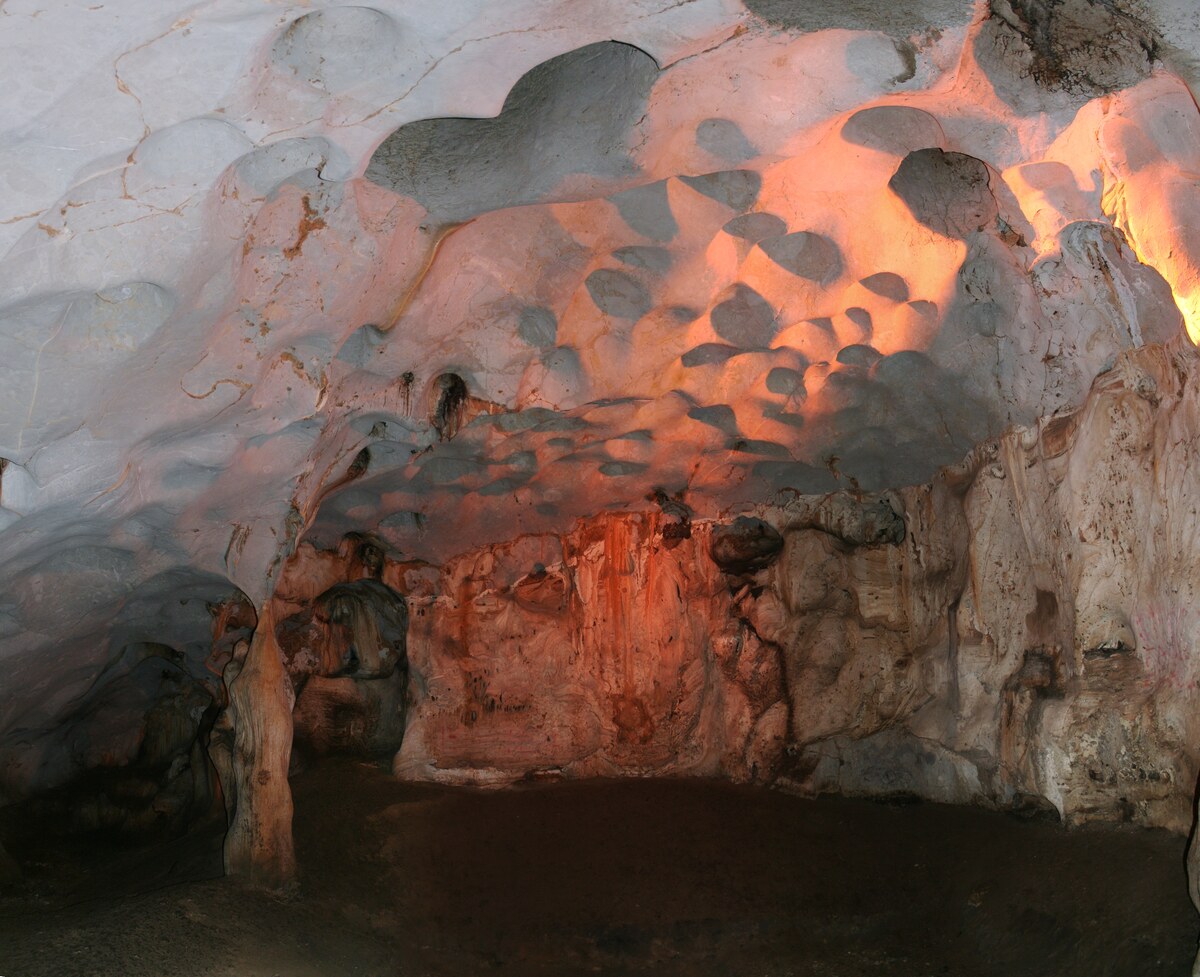
Around 59,000 years ago, two distinct human species shared the same territories in Anatolia. Middle and early Upper PalaeolithicPalaeolithicThe oldest and longest period of prehistoryPrehistoryThe span of human history before the invention of writing, from the Palaeolithic to the Metal Ages, known mainly through material remains.→ (c. 3.3 Ma–12,000 BC), defined by chipped stone tools and a hunter-gatherer way of life.→ layers overlap in the stratigraphic deposits of Karain Cave, near Antalya in southern Turkey. Recent analyses of this exceptional archaeological complex confirm that NeanderthalsNeanderthalsA fossil humanity of Eurasia, robust and cold-adapted, extinct around 40,000 years before present.→ and Homo sapiensHomo sapiensThe present-day human species, which emerged in Africa around 300,000 years ago, the only surviving human lineage after the extinction of Neanderthals and Denisovans.→ not only coexisted in the same region, but may have used the same shelters at close intervals. This discovery redraws the geographic and temporal framework of their encounter in the Near EastNear EastA region of western Asia (Levant, Mesopotamia, Anatolia, Iran), cradle of the Neolithic revolution, agriculture, the first cities and writing.→.1
Karain Cave is one of the longest continuously occupied prehistoric sites in the world. Excavated since the 1940s, its seven chambers contain archaeological deposits spanning more than 500,000 years of human history, from the Lower PalaeolithicLower PalaeolithicFirst and longest period of prehistory, marked by the earliest knapped stone tools and the first hominins outside Africa.→ through the ChalcolithicChalcolithicThe "Copper Age": a transition between the Neolithic and the Bronze Age, marked by the first copper objects (Ötzi's era).→. Its geographic position is strategic: at the crossroads of routes connecting East AfricaAfricaThe cradle of humankind: the continent where the first hominins appeared, then Homo sapiens around 300,000 years ago, before the expansion to the rest of the world.→, the LevantLevantA region of the eastern Mediterranean Near East (Israel, Lebanon, Syria, Jordan), a major crossroads of the first human migrations out of Africa.→, and Europe, southern Anatolia has always been a natural corridor for human migrationsMigrationsLong-distance movements of populations; a major driver of human history (the exit from Africa, the peopling of continents, Neolithic and steppe expansions).→.
Karain Cave: Crossroads of Two Humanities
The layers dated to approximately 59,000 years BP reveal a technological transition of remarkable clarity. Below Upper PalaeolithicUpper PalaeolithicThe final phase of the Palaeolithic (c. 45,000 to 10,000 years ago), marked by Homo sapiens in Europe, art, ornaments and a succession of cultures (Aurignacian, Gravettian, Solutrean, Magdalenian).→ assemblages - regular blades, foliate points, and personal ornaments - lie classic MousterianMousterianThe stone-tool industry typical of Neanderthals, based on the Levallois flaking technique.→ assemblages: large retouched flakes, scrapers, and denticulates, traditionally associated with Neanderthal populations. The superposition of these two industries in stratigraphically close layers indicates either alternating occupation or a phase of direct contact between the two groups.2
Analysis of the associated fauna provides complementary insight. Faunal remains from transitional levels show similar prey species exploited by both industries: deer, aurochs, and equids dominate. Butchery techniques, readable through cut marks on bones, show subtle differences between Mousterian and Upper Palaeolithic levels. These nuances suggest distinct cultural habits but shared resources.
The precise dating of this transition required the combined use of thermoluminescence on heated flints and accelerator mass spectrometry. Results converge on a temporal window of 59,000 to 57,000 years BP, corresponding to the period when the first anatomically modern human populations attested outside Africa were beginning to move northwest from the Levant.
Tools and Behaviors in Transition
One of the central questions raised by Karain is whether the two groups exchanged technical knowledge. The lithic assemblage from the transitional levels shows several hybrid characteristics. Blades produced by soft direct percussion, typical of the Upper Palaeolithic, appear in levels otherwise dominated by Mousterian flakes. Conversely, some scrapers show careful retouch that exceeds the usual standards of the regional Mousterian industry.3
This technological hybridization is observed at other regional sites: Ksar Akil in Lebanon, Üçagizli on the Turkish coast, Bacho Kiro in Bulgaria. Together, these sites map a contact network between the two humanities that persisted over several millennia. At Karain, the density of remains in the transitional layers is particularly high, suggesting intensive use of the site during this critical period.
Isotopic analysis of animal bones from both types of levels indicates that occupation seasons varied. Mousterian levels are more commonly associated with winter and spring occupations, while Upper Palaeolithic levels suggest summer occupations. This seasonal complementarity could explain why the two groups may never have been in direct contact within the cave, each exploiting the territory at different times of year.
What Karain Reveals About the Neanderthal Disappearance
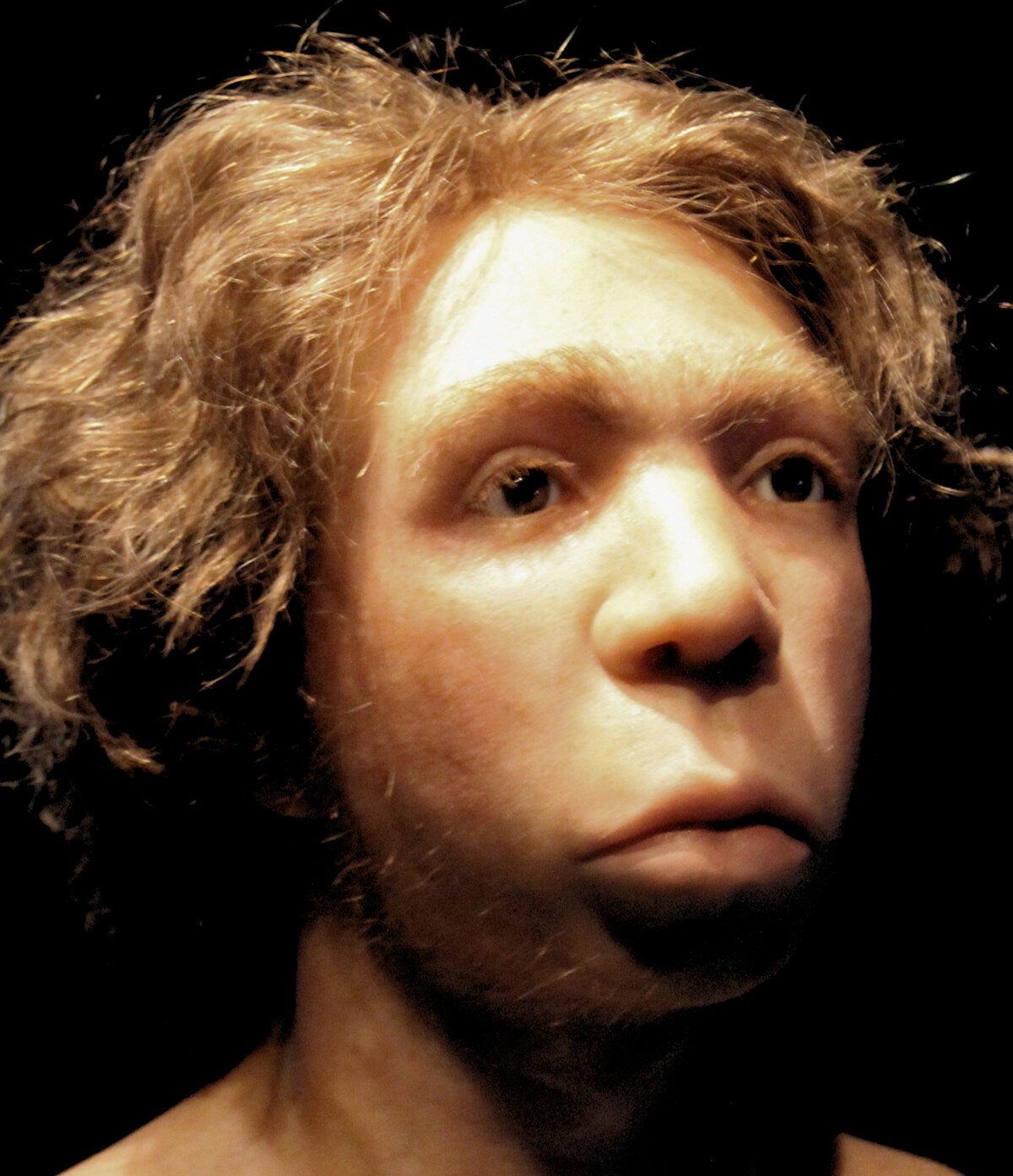
Genomic studies have established that non-African modern humans carry between 1 and 4% Neanderthal DNADNAThe molecule carrying genetic information, used to reconstruct kinship between species.→, a legacy of interbreedingInterbreedingGenetic mixing between human populations or species; between Neanderthals and Homo sapiens it left 1 to 2% of Neanderthal DNA in non-Africans.→ that occurred approximately 50,000 to 60,000 years ago. The Anatolian corridor is among the most probable geographic zones for these introgressionIntrogressionThe lasting transfer of DNA segments from one population or species into another through repeated interbreeding, detectable in genomes long afterwards.→ events. Karain, by its position and datings, falls precisely within this critical temporal window.4
Did the disappearance of Neanderthals, complete in Europe by 40,000 years BP, involve peaceful interactions, competition, or gradual population mixing? Karain's data suggests a relatively long cohabitation spanning several millennia, during which both groups exploited the same territories without one brutally eliminating the other. This model agrees with genetic estimates that argue for limited but real interbreeding.
Karain Cave is not an isolated case: it is part of a set of Anatolian sites that transform our understanding of the meeting between the two humanities. Far from being a rapid and violent replacement, the transition from NeanderthalNeanderthalsA fossil humanity of Eurasia, robust and cold-adapted, extinct around 40,000 years before present.→ to Homo sapiens in Turkey appears as a gradual process, marked by cultural and perhaps genetic exchanges, that unfolded over millennia before one species finally disappeared.
No comments yet. Be the first.