At six months old, a Neanderthal baby already had the size and mass of a 13-month-old modern human. That is the conclusion of a study published in April 2026 in Current Biology, following the most thorough analysis ever conducted of the most complete Neanderthal infant skeleton ever found: Amud 7, discovered in Amud Cave in northern Israel near the Sea of Galilee, and dated to between 51,000 and 56,000 years ago.
Amud 7: A Paradox Between Teeth and Bones
The Amud 7 skeleton comprises 111 bone fragments , skull, limbs, ribs, clavicle. A complete digital 3D reconstruction allowed Ella Been, professor at Ono Academic College in Israel, and her team to estimate the infant's height, weight, and brain volume with precision.
To determine the age at death, researchers first turned to the teeth: microscopic growth lines in the dental enamel and the stage of jaw eruption place the child at 5.5 to 6 months old. Two milk incisors had just begun to emerge. But the bones tellTellAn artificial mound formed by the accumulation of successive layers of settlement remains at the same spot, typical of the Near East. Each destruction-rebuilding event adds a stratum.→ a different story.
The lengths of the limbs , humerus, femur, tibia , match those of a modern Homo sapiensHomo sapiensThe present-day human species, which emerged in Africa around 300,000 years ago, the only surviving human lineage after the extinction of Neanderthals and Denisovans.→ child aged 12 to 14 months. The upper arm aligns with 13.7 months. The estimated height ranges from 70.3 to 78.6 centimetres , that of a walking toddler, not a newborn. The endocranial volume, estimated at nearly 880 cc, also matches that of an older modern child.
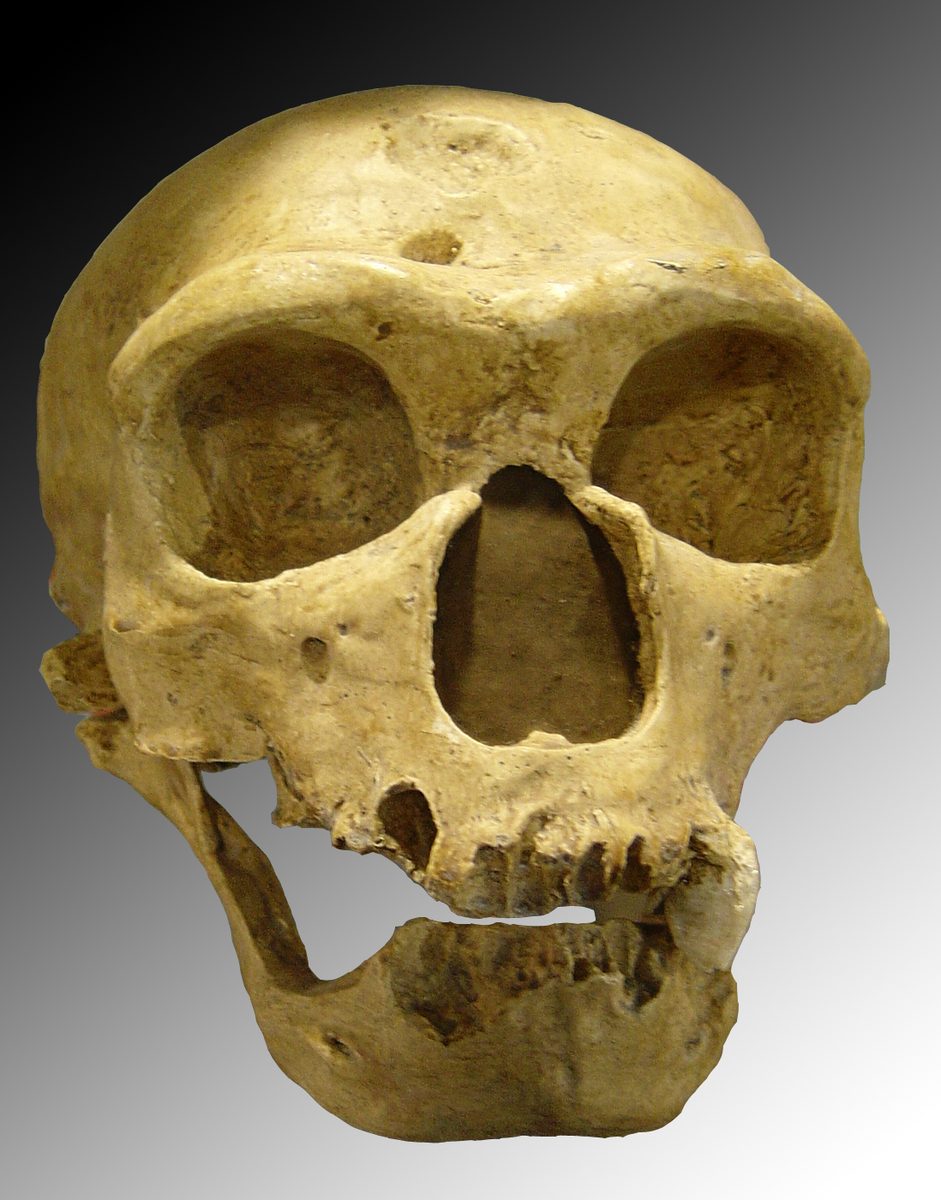
This gap between dental age (6 months) and skeletal age (12, 14 months) lies at the heart of the discovery. In Homo sapiens, teeth and skeleton progress in parallel during infancy. In Amud 7, the body raced several lengths ahead of the teeth. "In the first few years of life, from birth through early childhood, NeanderthalsNeanderthalsA fossil humanity of Eurasia, robust and cold-adapted, extinct around 40,000 years before present.→ grew faster than modern humans," summarises Ella Been.
A Pattern Confirmed Across Three Individuals
To confirm that Amud 7 is not an isolated case, the team compared it with two other well-documented Neanderthal infants. Dederiyeh 1, found in Syria, was two years old at death and shows the same mismatch between dental development and body size. Roc de Marsal, in the Dordogne, was three years old and confirms the same profile. Three individuals, three different sites, same finding.
"Seeing the same pattern in three different Neanderthal infants shows that this is not accidental," Been told New Scientist. Not a genetic quirk, not an individual anomaly: a species-wide biological strategy.
Researchers identified three growth stages in Neanderthal children. As newborns, teeth and body develop in synchrony , as in Homo sapiens. As infants (Amud 7's stage), body and brain accelerate sharply, outpacing the teeth. Then, from around age seven, both species return to similar rhythms. As adults, Neanderthals reach a stature close to ours , "though they were on the short side," Been notes.
Why Grow So Fast?
The answer is climatic and energetic. Neanderthals lived in Eurasia under punishing glacial conditions. Rapidly developing a larger, more robust body offered a decisive thermal advantage: a smaller relative body surface area, better heat retention, and physical independence achieved sooner. Every winter spent less fully dependent on adults increased the chances of survival.
Homo sapiens, by contrast, evolved near the African equator, in more stable and resource-rich environments. It could afford a longer, more vulnerable childhood , in exchange for a brain given more time to build itself.
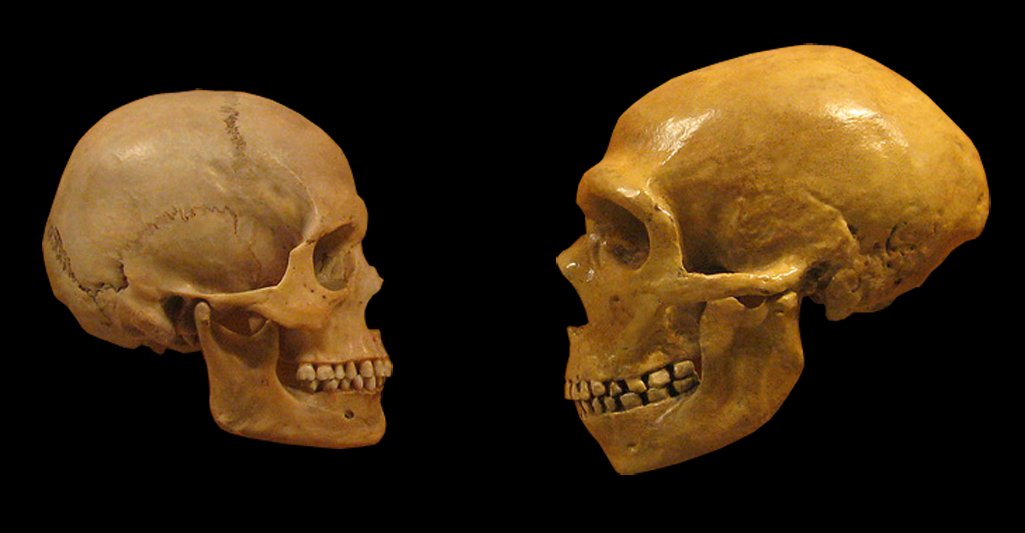
This growth race carried an enormous energetic cost. Building thick bones and a rapidly expanding brain simultaneously requires considerable caloric intake. A 2020 study of Neanderthal milk teeth from Italy showed that weaning , the introduction of solid foods , began around five to six months, exactly as in Homo sapiens. This is no coincidence: in both species, it is the energy demands of the growing brain that trigger early dietary diversification.
So Similar… Yet So Different
Neanderthals share approximately 99.7% of their total DNADNAThe molecule carrying genetic information, used to reconstruct kinship between species.→ with Homo sapiens. Humans of non-African descent even carry 1 to 4% Neanderthal DNA from past hybridisationHybridisationCrossing between two distinct species or lineages, such as Homo sapiens and Neanderthals, leaving a trace in the genome.→. So why such a different growth pattern?
The answer likely does not lie in a radically distinct genetic blueprint, but in the regulation of shared genes: how and when those shared genes are switched on during development. Neanderthals would have set their "growth programme" to an accelerated mode from the first months of life, through differences in gene expression , not in the genes themselves.
It is also possible to flip the question: what if it is Homo sapiens that grows abnormally slowly? Humans spend almost twice as long in childhood and adolescence as our closest living relatives , chimpanzees and gorillas. Our prolonged, vulnerable, energetically costly childhood is an exception in the primate world. The Neanderthal childhood may simply have been closer to the rule.
What This Changes
The discovery of Amud 7 recalibrates our understanding of the difference between the two species. It shows that Neanderthals and Homo sapiens diverged not only in their adult morphology, but from the very first months of life , in their very strategy for becoming adults. And it underlines, once again, the intelligence of this adaptation: in a glacial world, growing fast was not a luxury. It was a necessity.
Sources: Been E. et al. (2026), Rapid growth in a Neandertal infant from Amud Cave in Israel, Current Biology, doi:10.1016/j.cub.2026.03.054 · Archaeology News · ZME Science
Je reviens souvent ici avant de traiter un sujet scientifique. Fiable et bien écrit.
Les études de croissance à partir des stries d'émail dentaire ont révolutionné notre compréhension du développement des hominines. Le cas d'Amud 7 est particulièrement instructif car cet enfant de moins d'un an presentait déjà une dentition en bon état d'avancement. Comparer ces rythmes entre espèces nous informe sur leurs stratégies d'histoire de vie respective.
L'enfant d'Amud 7 est un des rares squelettes néandertaliens aussi complets découverts. Les analyses de la croissance dentaire de cet individu ont montré des rythmes de développement similaires à ceux des humains modernes, contrairement à ce qu'on pensait auparavant. Cela renforce l'idée que la durée de l'enfance néandertalienne était proche de la notre, avec tout ce que cela implique pour la transmission culturelle.