Around five thousand years ago, on the desert plateaus bordering the Nile, human communities began stacking stone with an ambition that still defies comprehension. Between the end of the predynasticPredynasticThe period of Egypt before unification (c. 3100 BCE) and the First Dynasty, marked by the Naqada cultures and the gradual emergence of the state.→ period and the first centuries of the Old KingdomOld KingdomThe first great period of unified pharaonic Egypt (c. 2700-2200 BC, 3rd-6th Dynasties), the golden age of the great pyramids and of a strongly centralised state.→, Egypt moved from low, sand-covered graves to the artificial mountains of Giza. A necropolis five millennia old, burials aligned along the margins of the river, and the most recent research into a dried-up branch of the Nile now paint a far more precise picture than before: that of a people who knew how to organise labour, transport blocks weighing several tonnes, and build for eternity, without slaves and without extraterrestrials.
This article offers a journey into this decisive transition of late prehistoryPrehistoryThe span of human history before the invention of writingWritingA system of conventional signs used to fix language or information durably; its appearance (c. 3300 BC) marks, by convention, the end of prehistory.→, from the PalaeolithicPalaeolithicThe oldest and longest period of prehistory (c. 3.3 Ma–12,000 BC), defined by chipped stone tools and a hunter-gatherer way of life.→ to the Metal Ages, known mainly through material remains.→ and Egyptian protohistoryProtohistoryThe transitional period between prehistory and history, covering societies without their own writing but known through external texts.→. We will begin with the humble ancestors of the pyramids, the bench-shaped tombs of Saqqara, then follow the invention of the step pyramidStep pyramidEgypt's first great stone monument, raised for King Djoser at Saqqara by Imhotep (Third Dynasty), by stacking diminishing mastabas.→ and the birth of the giants of Giza. We will pause on a necropolisNecropolisA large organised burialBurialThe intentional deposition of a body, sometimes with offerings; a marker of symbolic behaviour.→ ground, a "city of the dead", often spanning several periods.→ roughly 5,000 years old whose clues illuminate construction techniques, on the discovery of an ancient branch of the Nile, the so-called "Ahramat" branch, that served as a river highway to carry materials, and on the great questions that still drive archaeology: how were the blocks moved, how did the ramps rise, who made up the immense workforce of the building sites.
The origins of the pyramids: mastabas, Saqqara and Djoser
Before the pyramid came the mound. In predynastic times, the Egyptians buried their dead in simple pits dug into the desert sand. The dryness and heat naturally desiccated the bodies, and it has long been thought that, on seeing these preserved remains, the ancient Egyptians forged their conviction of a possible survival beyond death. As elites grew wealthier, burials became more elaborate: the walls were lined with brick, chambers were added for offerings, and the whole was then capped with a rectangular superstructure.
This superstructure bears a name that has become famous: the mastabaMastabaAn early Egyptian flat-roofed tomb with sloping sides, the architectural ancestor of the pyramid.→. The term comes from Arabic and means "bench", for these low tombs with flat roofs and sloping sides recalled the earthen benches found outside the houses of modern Egyptian villages. Beneath the mastaba, a shaft descended toward the burial chamber; above it, the mass of mud brick, and later of stone, signalled to the world of the living the wealth and rank of the deceased. The mastaba is the direct architectural ancestor of the pyramid: it already contains its fundamental idea, that of a massive volume protecting and glorifying an underground grave.
It is at Saqqara, the great necropolis of Memphis, that the decisive act unfolds. Around 2,700 BC, under the reign of the pharaohPharaohThe title of the ruler of ancient Egypt, regarded as a living god guaranteeing cosmic order (Maat), supreme head of state, army and worship.→ Djoser of the Third Dynasty, an architect of genius named Imhotep conceived a revolutionary idea: to stack mastabas one upon another, in decreasing tiers. Instead of a single bench, six superimposed mastabas rose toward the sky over some sixty metres. The step pyramid of Djoser was born. For the first time in the history of humanity, a monument built entirely of dressed stone rose to such a height. Imhotep, later deified, remains one of the rare architects of antiquity whose name has come down to us.
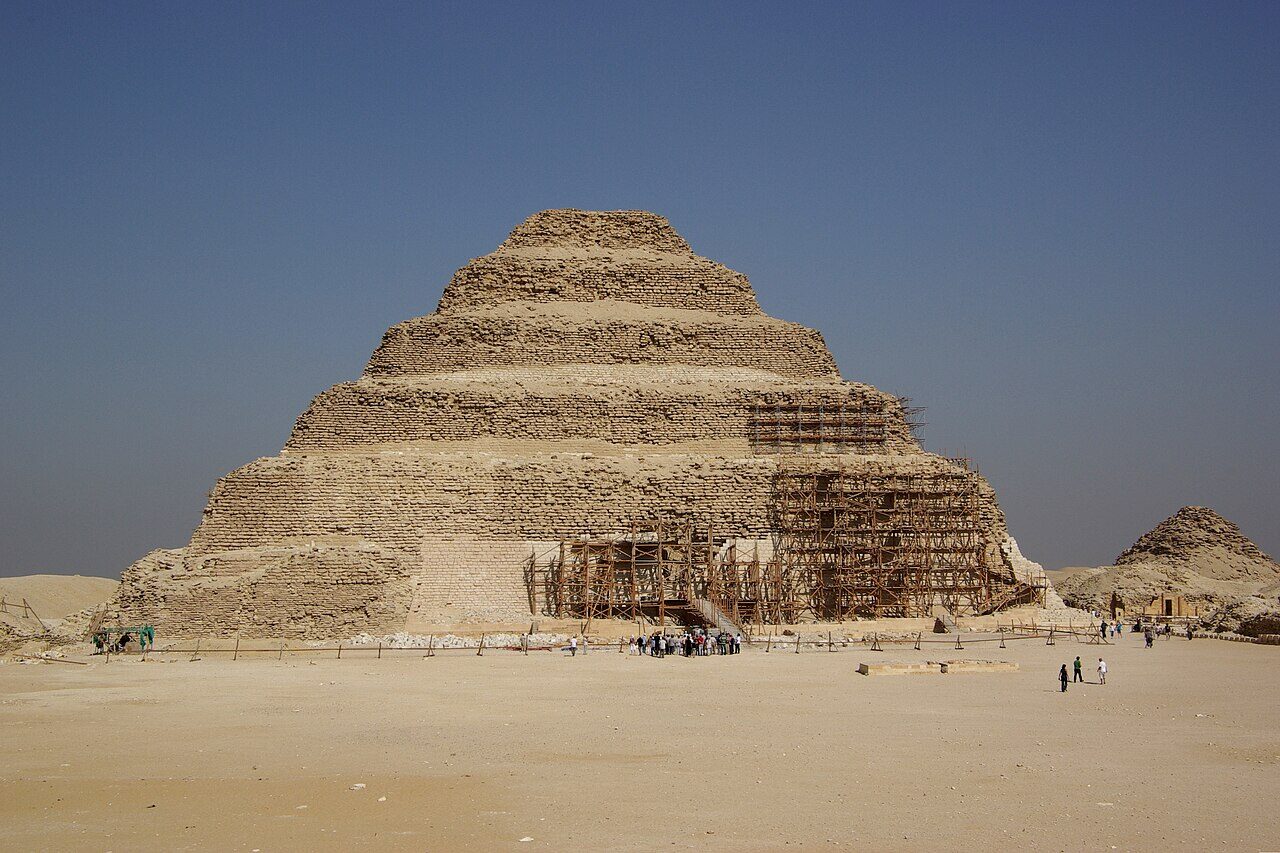
The Djoser complex is not limited to the pyramid. All around it stretches a vast enclosure of white limestone, with courtyards, temples, chapels and false doors intended for the funerary cult. The whole reflects an already highly elaborate organisation: it required quarries, stonecutters, haulers, architects and scribes to keep the accounts. The step pyramid is not only a technical feat; it is the sign of a state capable of mobilising considerable human and material resources. After Djoser, the pharaohs sought to perfect the form. At Meidum, they tried to smooth the steps to obtain flat faces; at Dahshur, the pharaoh Sneferu had the bent pyramid built, whose angle changes halfway up, and then the red pyramid, the first monument with perfectly smooth faces. The way was open for Giza.
This progression, from sand graves to smooth pyramids, belongs to the long march that leads from the NeolithicNeolithicThe "New Stone Age": a period marked by farming, herding, settlement and pottery, from around 10,000 BC.→ to the Bronze AgeBronze AgeA protohistoric period following the Neolithic, defined by bronze metallurgyMetallurgyThe techniques of extracting and working metals (copper, bronze, gold); its rise in the Eneolithic and Bronze Age transformed tools, weapons and social hierarchies.→ (a copper-tin alloy) and the rise of the first cities and states; in Egypt it corresponds to the age of the first pyramids.→. The first pyramids belong to a world in which copper metallurgy is mastered, in which hieroglyphic writing develops, in which the pharaonic state consolidates. To understand the pyramids is therefore to understand the birth of an entire civilisation, at the hinge between the village societies of prehistory and the great states of history.
One must stress the slowness of this maturation. Between the first predynastic pits and the pyramid of Djoser, centuries elapse, punctuated by experiments, trial and error, and innovations passed from one building site to the next. The craftsmen of Saqqara did not invent the pyramid in a single stroke of genius: they inherited an accumulated body of know-how, that of the mastaba builders of the First and Second Dynasties, who already mastered mud brick, the drainage of underground chambers and the construction of imposing superstructures. Imhotep's novelty was to think of verticality, to conceive a monument that rises rather than spreads, and to replace perishable brick with eternal stone.
The choice of stone is no trivial matter. Working limestone demands tools, an organisation of quarries, a transport logistics and a considerable number of cutters. By shifting from the perishable to the mineral, the Egyptians expressed a clear intention: to defy time. The royal tomb was no longer merely to shelter a body, but to proclaim for millennia the greatness of the sovereign and the permanence of the order he embodied. This metaphysical ambition demanded unprecedented technical means, and it is this coupling of faith and engineering that gives the whole pyramid adventure its originality.
The 5,000-year-old necropolis and its clues
The necropolises of ancient Egypt are open-air archives. At Saqqara as at Giza, the thousands of tombs surrounding the pyramids deliver, grave after grave, the portrait of a hierarchical and industrious society. A necropolis roughly five thousand years old is not merely a cemetery: it is a planned "city of the dead", with its streets, its quarters, its differences of status inscribed in the size and wealth of the tombs. Recent excavations of these funerary complexes bring valuable information about how the pyramid sites were conceived and peopled.
Near the great pyramids, archaeologists have uncovered workers' cemeteries. These tombs, modest but carefully made, hold the remains of those who actually built the monuments. Their very presence, in the immediate vicinity of the royal tombs, constitutes a major clue: one would not have granted a dignified burial, within the sacred enclosure, to mere expendable slaves. The study of the skeletons tells of a life of toil, compressed vertebrae, worn joints, fractures treated and healed, but also of medical care, healed amputations, treatments that imply a social organisation attentive to its workforce.
The necropolises yield still further clues about construction techniques. The inscriptions and graffiti left by the work gangs, the quarry marks on the blocks, the fragments of tools, the fossilised ramps and the accumulated spoil are all pieces of evidence. In certain tombs of high officials, painted or carved scenes show the transport of colossal statues on sledges, men pouring water before the runner, foremen setting the rhythm of the effort. These images, forty-five centuries old, are technical documents of the first order: they show us the Egyptians themselves explaining how they moved enormous masses.
The necropolis thus functions as a laboratory. By cross-referencing the architecture of the tombs, the anthropology of the skeletons, the deposited objects and the carved texts, researchers gradually reconstruct the daily life of the building sites. They estimate the workforce, identify the trades, detect occupational pathologies, date the phases of construction. Far from the cliché of the whipped slave, it is the image of a rational, almost administrative organisation that emerges from the tombs.
One must also appreciate what an intact necropolis represents in terms of knowledge. Each tomb is a sealed time capsule: the funerary goods, the position of the body, the amulets, the offering vessels, everything is frozen at the moment of burial. By comparing hundreds of graves, archaeologists reconstruct the evolution of beliefs, of dress, of mummification techniques and of social hierarchies over several generations. The necropolis becomes a veritable census of the dead, which in turn illuminates the lives of the living.
It is worth recalling that these workers' cemeteries were themselves organised hierarchically. The supervisors and skilled artisans were buried in larger, better-built tombs, sometimes with miniature pyramids of their own, while the ordinary labourers received simpler graves grouped nearby. This stratification, mirrored in the very layout of the burial ground, confirms that the building sites were structured societies in miniature, with their chains of command, their specialists and their rank-and-file. The dead, in their arrangement, preserve the social order of the living.
The funerary clues about construction are sometimes unexpected. In certain tombs, wooden models have been found representing boats, workshops, granaries, miniature scenes of work intended to serve the deceased in the afterlife. These scale models are precious sources: they depict tools, gestures and workshop arrangements that the texts do not describe. Likewise, the stelae and biographies carved on the walls recall the titles and functions of the officials, "overseer of works", "director of quarries", "scribe of the census", who made up the management of the great building sites. A whole administration of construction can thus be reconstructed, tomb after tomb.
The lost branch of the Nile: the "Ahramat"
One of the most striking discoveries of recent years concerns not the pyramids themselves but the landscape that surrounded them. Today the great pyramids of Giza and the long line of monuments stretching south, as far as Lisht, stand at the edge of an arid desert, several kilometres from the present-day Nile. This situation has long puzzled scholars: why build so far from the river, when all the material had to come by water? The answer has just been provided by the study of an ancient branch of the Nile, now completely dried up and buried beneath fields and sand.
Researchers have reconstructed, using satellite imagery, ground-penetrating radar data and geological cores, the course of a vanished river branch. Tens of kilometres long and several hundred metres wide in places, this branch, named "Ahramat", an Arabic word meaning "pyramids", ran precisely along the string of major pyramid sites. Some thirty pyramids align along its former course. The coincidence is none: the river dictated the location of the building sites like a vital arteryNeolithicThe "New Stone Age": a period marked by farming, herding, settlement and pottery, from around 10,000 BC.→.
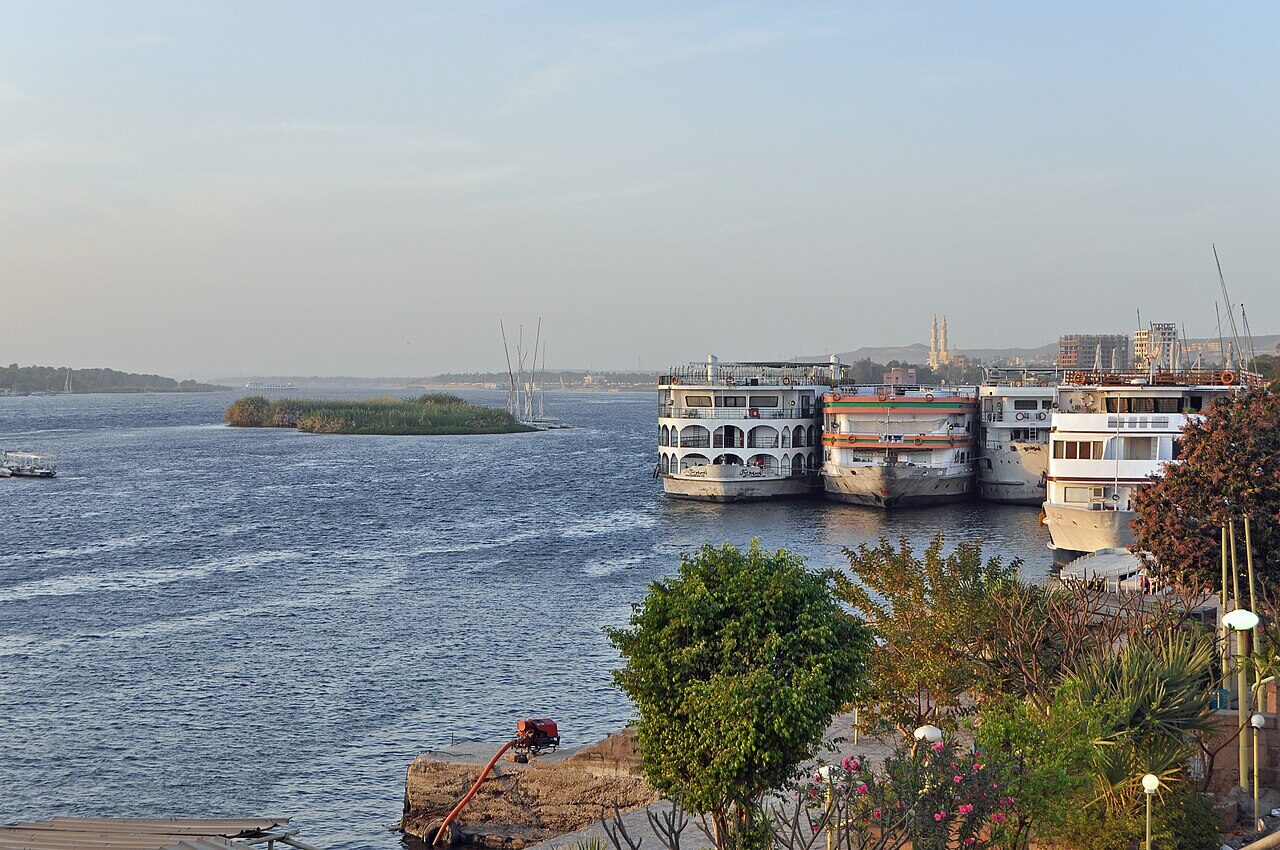
This discovery changes our view of pyramid logistics. The blocks of fine limestone extracted from the quarries of Tura, on the other bank, the pink granite brought from Aswan hundreds of kilometres to the south, the heaviest materials could be loaded onto barges and set down at the very foot of the building sites. Canals and basins linked the Ahramat branch to the funerary complexes, forming genuine temporary harbours. Once the pyramids were completed and the branch gradually dried up through climatic variation and the shifting of the river, these installations were abandoned and buried, until they disappeared from human memory.
The Ahramat branch illustrates an essential truth: the builders of the pyramids were above all extraordinary logisticians. They could rely only on human and animal strength, wood, rope, water and stone. But they knew how to exploit the geography of their country to the fullest, turning the Nile and its branches into a transport network of formidable efficiency. Without this waterway, the conveyance of millions of tonnes of material would have been quite simply impossible.
How could such a branch disappear? The Nile is not an immutable river. Over the millennia, its course shifted, its branches silted up, its flow varied with climatic fluctuations. The end of the humid period that had greened the Sahara, the gradual advance of the desert and the accumulation of sediment slowly condemned the Ahramat branch. Where a broad waterway lined with harbours once flowed, there now stretch cultivated fields and villages. The river withdrew eastward, carrying with it the memory of the artery that had made the pyramids possible.
This palaeogeographic reconstruction has considerable implications. It suggests that the location of each great funerary complex was chosen according to access to water, and not at random or for religious reasons alone. It also explains the presence, near several pyramids, of causeways climbing from the valley toward the plateau: these long processional ramps, whose function was both practical and ceremonial, started precisely from the valley temples situated at the edge of the ancient river, where the barges docked. The vanished geography restores meaning to structures that were observed without always being understood.
Transporting blocks weighing several tonnes
The Great Pyramid of Khufu contains, according to estimates, more than two million blocks, with an average weight of around two and a half tonnes, some reaching several dozen tonnes for the ceiling slabs of the king's chamber. Moving such masses, over distances ranging from a few metres to several hundred kilometres, posed formidable technical problems. Yet the Egyptians achieved it with means of disarming simplicity.
On water, transport relied on barges. Once extracted and roughly shaped, the block was hoisted onto a flat-bottomed vessel and then conveyed downstream or hauled from the banks. The annual floods of the Nile, which inundated a broad strip of the valley, temporarily brought the water closer to the quarries and the building sites, easing loading and unloading. It was probably during these periods of high water that most of the heavy transport was concentrated.
On land, the challenge was different. The blocks were lashed onto wooden sledges that teams of men pulled with ropes. A famous scene, painted in a tomb, shows dozens of workers hauling a colossal statue while a figure pours water onto the sand in front of the sledge. Long interpreted as a ritual gesture, this detail has yielded its secret thanks to modern physics: by wetting the sand in the right proportions, friction is considerably reduced. Damp sand forms capillary bridges between the grains, hardens the surface and prevents the runner from sinking. The effort needed to pull the sledge can thus be halved. What was taken for an offering to the gods was in reality a perfectly rational engineering technique.
The Egyptians also had levers, rollers and wooden cradles. Quarter-circle devices, fixed around a cubic block, may have allowed it to be tipped step by step, as one might roll a faceted wheel. Rope, plaited from plant fibres, played a central role: it linked the men to the load, transmitted the effort, allowed hoisting and mooring. Copper, still soft, served to shape the tools; wooden wedges swollen with water helped to split the rock in the quarries. The whole art consisted in multiplying human strength through ingenuity, in the absence of any machine to rely on.
The granite of Aswan poses a particularly spectacular case. This hard rock, prized for sarcophagi and load-bearing elements, was extracted more than eight hundred kilometres south of Giza. The blocks, sometimes colossal, were detached from the rock mass with great effort, using balls of dolerite harder still than the granite, with which the stone was hammered tirelessly. Once freed, they descended the Nile on barges, taking advantage of the natural current flowing northward. That such masses could travel intact over such distances speaks volumes about the nautical mastery of the Egyptians.
Shipbuilding was therefore a pillar of the pyramid enterprise. The Egyptians knew how to assemble large transport boats capable of bearing enormous loads without breaking. The discovery, at the foot of the Great Pyramid, of dismantled royal vessels carefully buried, attests to the importance of the boat in Nile civilisation, both for trade and war and for funerary beliefs. The river was not merely a transport route: it was the backbone of the whole country, the link that united the quarries, the building sites and the capitals.
Ramps and building sites: the hypotheses
If the horizontal transport of blocks is now well understood, the question of their elevation remains one of the most debated in archaeology. How does one raise stones weighing several tonnes to a height of one hundred and forty metres, at the summit of the Great Pyramid? No Egyptian text describes the method employed, and the building sites have left only fragmentary clues. Several hypotheses compete, each with its strengths and weaknesses.
The oldest and most intuitive is that of the straight ramp. A long slope of brick and spoil would have been built against one face of the pyramid, along which the blocks would have been pulled on sledges. The problem is geometric: to maintain a workable slope all the way to the summit, a straight ramp would have had to reach an inordinate length and a volume comparable to that of the pyramid itself. For the upper levels, this solution becomes unrealistic.
Hence the hypothesis of the wrapping, or helical, ramp, which would coil around the faces of the pyramid as it rises. More compact, it nonetheless raises other difficulties: it would mask the edges needed for geometric checks, and the corners would have been awkward to negotiate with heavy sledges. One variant proposes an internal ramp, hidden within the thickness of the masonry, whose trace some researchers believe they can detect in anomalies of density observed within the monument.
Other models combine ramp and levers. On the lower levels, a frontal ramp would have sufficed; higher up, the blocks would have been raised tier by tier with levers and rockers, by small teams. An important discovery in a quarry has reinforced this idea: a ramp system flanked by post-holes, which would have allowed the installation of hauling devices multiplying the traction. It is likely that no single method was used, but rather a combination of techniques adapted to each height and each type of block. The truth, as so often, doubtless lies in the diversity of solutions rather than in a miracle recipe.
It must be stressed that the difficulty lies not only in raising the blocks, but in setting them with extreme precision. The faces of the Great Pyramid show minute alignment deviations, and the orientation of the monument toward the cardinal points is remarkably exact. Such precision implies rigorous surveying, taut cords, water levels and astronomical sightings to fix north. The ramps therefore served not only for transport: they had to allow, at each course, verification of horizontality and alignment, lest fatal errors accumulate as the edifice rose.
Who built them: workers, not slaves
The image of thousands of slaves whipped under the sun, inherited from Greco-Roman antiquity and popularised by cinema, is today resolutely abandoned by Egyptologists. The discoveries of recent decades paint a quite different picture. The pyramids were built by a numerous, organised workforce, fed and housed by the state, composed largely of peasants performing a form of service, supplemented by permanent, highly skilled craftsmen.
Near Giza, excavations have revealed a veritable town of the builders: dormitories, workshops, bakeries and breweries capable of feeding thousands of people, silos, installations for salting fish and butchering meat. Analysis of the animal bones shows that the workers regularly consumed beef, an expensive meat: one did not feed slaves in this way, but workers one wished to keep vigorous and loyal. The inscriptions found on the blocks even deliver the names of the teams, organised into phyles and sections, sometimes given proud nicknames such as "the Friends of Khufu" or "the Drunkards of Menkaure".
The work was doubtless partly seasonal. During the flood, when the fields were inundated and agricultureAgricultureThe cultivation of plants and production of food by working the soil, which emerged in the Neolithic in the Near East and independently elsewhere; it radically transformed human societies.→ came to a halt, tens of thousands of peasants could be requisitioned for the building sites, in exchange for food, lodging and perhaps exemptions. This corvée, far from being perceived solely as a constraint, doubtless took part in a collective and religious project: to build the eternal dwelling of the pharaoh, guarantor of cosmic order, was an act of devotion as much as an obligation. Injured workers were treated, the dead decently buried in the shadow of the pyramids they had erected. All this composes the portrait of a society that exploited its workforce, certainly, but that also regarded it as a precious resource, not as a disposable herd.
The food logistics of these building sites was itself a feat. Feeding thousands of mouths daily implied a supply of grain, cattle, fish and beer of perfect regularity. The bakeries produced bread in series in large ceramic moulds, the breweries provided the beer that formed an essential part of the ration, and entire herds were driven in and slaughtered on the spot. This colossal commissariat could not have functioned without an administration able to plan, store and redistribute, which once again confirms the intimate link between the pyramid and the state.
As for the actual size of the workforce, it has long been overestimated. The ancient figures, which spoke of hundreds of thousands of men, were exaggerations. Modern estimates, based on the capacity of the installations and the length of the reigns, point rather to permanent teams of a few thousand skilled workers, reinforced seasonally by temporary labour. It is the efficiency of the organisation, far more than the raw number of workers, that explains the speed of construction. A pyramid was not raised by an undifferentiated crowd, but by a well-honed social machine, in which each had his place and his task.
What the predynastic transition teaches us
The pyramids did not arise from nowhere. They are the culmination of a long process rooted in the recent prehistory of the Nile valley. To understand the transition between the predynastic period and the Old Kingdom is to grasp how societies of farming villages transformed themselves, within a few centuries, into one of the first great centralised states in history.
During the fourth millennium BC, the communities of the Egyptian Neolithic experienced a spectacular acceleration. Agriculture irrigated by the floods produced surpluses, which fed craftsmen, priests and chiefs. Villages merged into towns, towns into rival kingdoms, along the river. Art grew refined, copper metallurgy spread, and above all, hieroglyphic writing appeared, an indispensable instrument of administration and memory. Around 3,100 BC, legend and archaeology converge on the unification of Upper and Lower Egypt under a single power.
This unification created the conditions for the great pyramid adventure. To mobilise tens of thousands of workers, a state is needed that can levy taxes, store grain, coordinate transport and keep accounts. To design monuments of astonishing geometric precision, schools of scribes and architects are needed, a technical tradition handed down from generation to generation. The pyramids are, in this sense, the monumental face of an administrative and political revolution. They speak less of the power of one man than of the capacity of a society to conceive and organise itself on a grand scale. The predynastic transition thus reminds us that the highest technical feats always rest on invisible foundations: agriculture, writing, hierarchy, faith.
This shift toward the state can be read even in the landscape. Before the pyramids, death was experienced in the discretion of individual pits; with them, it is displayed on the scale of the territory, visible for kilometres around. The pyramid is a political act as much as a religious one: it marks the ground, structures space, directs the gaze. It tells everyone, peasants, priests, merchants and travellers, that a power capable of raising mountains watches over the valley. In this, the funerary monument becomes an instrument of government, a way of making tangible an authority that, without it, would remain abstract.
Myths and realities
Few monuments have aroused as many fantasies as the pyramids. From antiquity to our own day, they have been ascribed supernatural origins, occult powers, architects come from the stars. It is fitting to put things in their proper place, for reality, more down to earth, is no less admirable.
First myth: the pyramids were built by slaves. We have seen that this was not so: the workers were labourers fed, housed, treated and buried with honour. Second myth: a lost knowledge, even an extraterrestrial intervention, was needed to erect such monuments. This idea, seductive to the imagination, insults human ingenuity. The Egyptians had everything required: a numerous workforce, a rigorous organisation, practical mathematics, a fine knowledge of materials and a river serving as a transport route. No element of the pyramids exceeds the capacities of a determined and patient Bronze Age civilisation.
Third myth: the pyramids conceal coded messages, prophecies or maps of the cosmos. While their astronomical orientation is real and reveals attentive observation of the sky, it stems from the solar and stellar religion of the Egyptians, not from some secret knowledge. Fourth myth: the pyramids were granaries, power stations or observatories. They were, unambiguously, royal tombs, as attested by the sarcophagi, the funerary texts and the whole religious apparatus that accompanies them. Dispelling these legends in no way diminishes the prestige of the builders: it heightens it, by restoring to human beings, and to them alone, the merit of a feat that spans the millennia.
More broadly, the persistent enthusiasm for these legends says much about our relationship with the past. We find it hard to believe that men without machines could accomplish such marvels, and we sometimes prefer to invoke the supernatural rather than acknowledge the patience, collective intelligence and endurance of our ancestors. Yet it is precisely this confidence in human capacities that should guide our gaze upon the pyramids. They are not the trace of a lost knowledge, but the summit of a knowledge built, transmitted and perfected from generation to generation, across building sites where error taught as much as success.
Recent contributions of archaeology
Egyptian archaeology has never been so dynamic. Far from the dusty image of excavations of old, it now mobilises an arsenal of technologies that profoundly renew our knowledge of the pyramids and their environment. The discovery of the Ahramat branch is its most striking example: without satellite remote sensing, ground-penetrating radar and sedimentary analyses, one could never have mapped a river buried under centuries of silt.
Other advances have come from within the monuments themselves. Campaigns of detection by muons, those cosmic particles capable of passing through stone, have made it possible to probe the mass of the Great Pyramid without drilling a single hole, revealing hitherto unknown cavities. These great voids, whose function remains debated, attest to the internal complexity of the edifice and feed new hypotheses about construction methods. Digital modelling, for its part, makes it possible to test in the laboratory the feasibility of the various ramps, to evaluate the efforts, to simulate the sliding of sledges on dampened sand.
The excavations of the workers' towns, the ancient harbours and the quarries continue meanwhile to deliver documentary treasures. The discovery of papyrus archives, among the oldest in the world, has revealed the logbook of a team leader charged with conveying the limestone of Tura to Giza: a direct testimony, written by a man who lived the building site from the inside. These documents confirm the existence of a river and of canals serving the pyramids, and offer a unique glimpse into the organisation of labour, the rations distributed, the rotation of teams. Cross-referenced with field data, they turn hypotheses into certainties and give a human face back to these titanic building sites.
These non-destructive methods are a small revolution. For centuries, exploring a monument meant piercing it, digging into it, sometimes mutilating it. Today, muon tomography, thermal imaging, georadar and photogrammetry make it possible to see through stone without damaging it. One can map cavities, measure densities, model in three dimensions an inaccessible chamber. This archaeology of non-intrusion preserves the heritage while multiplying the data, and opens the way to decades of future discoveries without a single block being moved.
Finally, biological anthropology, palaeopathologyPalaeopathologyThe study of diseases, injuries and trauma on ancient human or animal remains.→ and isotope analysis shed light on the concrete lives of the builders: their diet, their illnesses, their geographic origin, their life expectancy. Little by little, the pyramids cease to be pure enigmas and become documented files, where each new excavation adds its piece to the puzzle. The mystery does not vanish, but it shifts: it no longer concerns the very possibility of the feat, now well understood, but its thousand technical and human details.
Conclusion
Five thousand years ago, at the hinge of prehistory and history, a people settled on the banks of the Nile invented one of the most enduring forms ever conceived by humanity. From the humble mastabas of Saqqara to the mountains of Giza, by way of the step pyramid of Djoser, an entire civilisational trajectory was inscribed in stone. The millennia-old necropolises, the workers' cemeteries, the builders' towns and the papyrus archives tellTellAn artificial mound formed by the accumulation of successive layers of settlement remains at the same spot, typical of the Near East. Each destruction-rebuilding event adds a stratum.→ us, better than any legend, how these monuments truly came into being.
The discovery of the dried-up branch of the Nile, the Ahramat, has supplied the missing piece of the logistics: a vanished river, turned into a highway of stone, that finally explains why the pyramids stand where we find them. Transport on water and damp sand, ramps and levers, the organisation of a free and cherished workforce, all this composes the portrait of a patient and collective engineering. The pyramids are not the fruit of a miracle nor of an intervention from elsewhere: they are the proof, raised toward the sky, of what human beings can accomplish when they unite their strength, their knowledge and their faith. And that is doubtless their finest lesson, transmitted intact across five millennia.
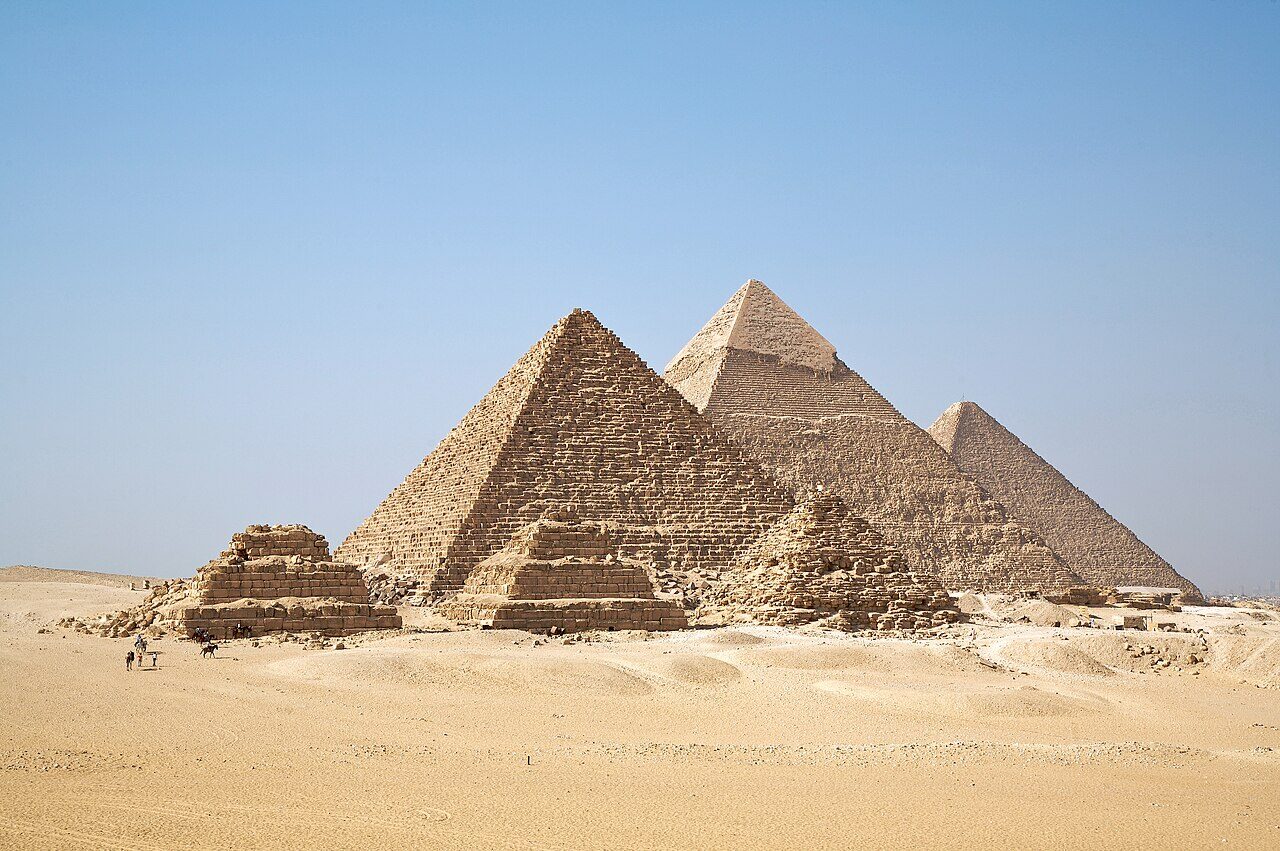
It is also worth remembering that the pyramids were never isolated objects. Each great pyramid stood at the heart of a vast complex: a valley temple by the water, a causeway climbing to the plateau, a mortuary temple against the eastern face, subsidiary pyramids for queens, boat pits, and the surrounding fields of mastabas for courtiers and officials. To grasp the pyramid is to grasp this entire ensemble, conceived as a single architectural and religious programme. The lone triangle of the popular imagination is, in reality, only the most visible element of a far richer composition.
Even today, before these giants of stone standing at the edge of the desert, the visitor feels a vertigo that has lost none of its force. But that vertigo can now be accompanied by understanding: behind each block one senses a team, a taut rope, a barge on the river, a foreman counting his men, a scribe lining up his figures. The pyramids cease to be objects fallen from the sky and become once more what they truly are, the admirable work of an organised and patient humanity, proud to build for the ages.
In the end, the pyramids endure not only as tombs of stone but as a message across time: that human beings, working together with patience and method, can shape the world to match their highest aspirations. Five thousand years on, that message has lost nothing of its power, and each new discovery only deepens our admiration for those who left it.
Ce site est la meilleure chose que mes enfants m'aient recommandée depuis longtemps.
Je vais recommander ce site à l'animateur de notre club histoire. C'est le niveau qu'on cherche.
Fascinant. Je travaille justement sur ce thème pour mon mémoire et cet article m'apporte un éclairage nouveau.
L'organisation des nécropoles égyptiennes en tant que système cohérent témoigne d'une administration et d'une planification urbaine très avancées. Les travaux de Mark Lehner sur la ville des constructeurs de pyramides ont montré l'existence d'infrastructures logistiques impressionnantes. Le concept de mégaprojet collectif apparait déjà pleinement réalisé dans l'Egypte de l'Ancien Empire.
La nécropole de Gizeh ne se limite pas aux trois grandes pyramides : c'est tout un complexe funéraire avec des dizaines de mastabas, temples et tombeaux de dignitaires. Les découvertes récentes dans les tombes des ouvriers des pyramides ont complètement changé notre regard sur la construction : il ne s'agissait pas d'esclaves mais de travailleurs spécialisés et bien nourris. L'Egypte ancienne mérite toujours qu'on la redécouvre.