Several meters below the surface of the Atlantic, off the Pointe du Raz and the island of Sein in Brittany, two-ton granite blocks lie in perfect alignment on the seafloor. They did not slip there by accident: they were placed there roughly 7,000 years ago, when this ocean floor was an inhabited shoreline. A study published in the International Journal of Nautical Archaeology presents the first findings from scientific diving campaigns conducted between 2022 and 2024 on these unprecedented submerged structures.1
A chance discovery during seafloor mapping
It all began in 2017, during a systematic acoustic seabed mapping survey off the Breton coast, conducted by teams from the University of Western Brittany and the CNRS. The sonar data revealed several linear anomalies on the ocean floor off Finistere. Among them, one structure stood out by its geometry: a continuous 120-meter alignment crossing a submerged depression corresponding to the former valley of a now-engulfed watercourse. The regularity of the feature and the absence of any plausible geological explanation immediately led researchers to consider a human origin.2
Scientific diving campaigns were organized from 2022 onward. Archaeologists descended to examine firsthand what the acoustic images could only suggest. What they found exceeded expectations: not one but several alignments of granite blocks, some reaching nearly two meters in height, arranged with a regularity that definitively rules out any natural formation. The ensemble forms a coherent system of built structures, dated by analysis of the encasing sediments and by stratigraphic comparison with known sea-level benchmarks.
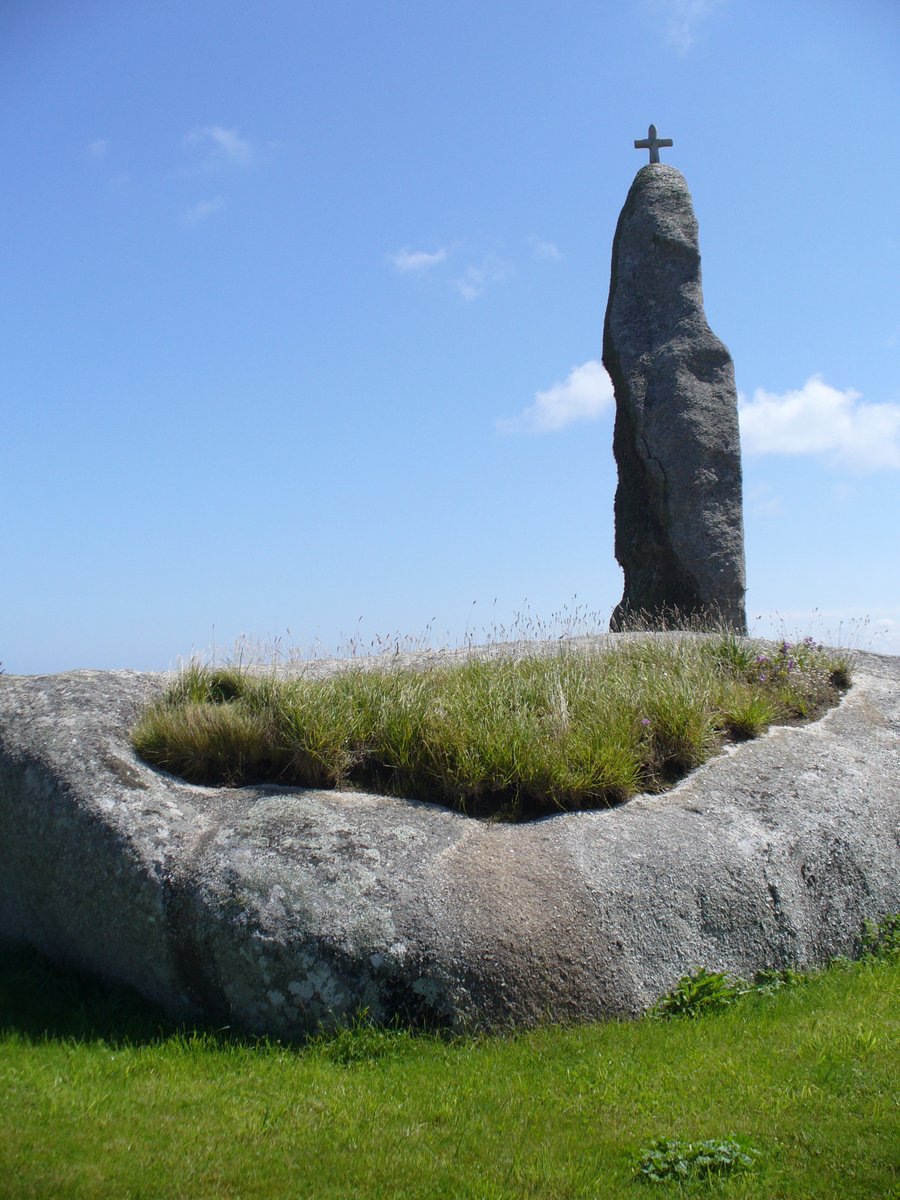
A colossal construction project on a shore that no longer exists
Radiocarbon and sediment dating places the construction of the walls between 5,800 and 5,300 BCE, in the Early Neolithic. At that time, Atlantic sea levels were still several meters lower than today. Postglacial deglaciation had been underway for millennia, but the ice sheets still retained vast volumes of water: the English Channel had only reached its present form a few centuries earlier, and the Breton coastline extended well beyond its current outline. The island of Sein itself was not yet an island but a promontory connecting a broad coastal plain now swallowed by the ocean.
It was builders settled on this vanished coastline who extracted, transported, and assembled these multi-ton blocks. Researchers emphasize the technical scale of the achievement: Armorican granite is hard and heavy; its extraction requires adapted tools, its displacement implies sledges, rollers, or rafts depending on the terrain. Building a 120-meter-long structure on a coastal substrate requires multi-season planning, a large coordinated workforce, and precise knowledge of the terrain and tides.3
Multiple functions for structures without parallel
In terms of dimensions and materials, these Breton walls have no equivalent among known Early Neolithic structures in France. The study proposes several functional interpretations, which are not mutually exclusive. The smaller structures - narrower, lower alignments - evoke fish traps, devices designed to retain fish at low tide. This type of installation is known in other prehistoric and historical contexts worldwide, notably on Scandinavian coasts.
The most imposing walls, by contrast, may have served a coastal protection function: rudimentary sea walls or breakwaters designed to stabilize estuarine banks, protect fishing or farming zones against marine erosion, or delimit communal spaces, plots, or landing areas. The study does not reach a definitive conclusion, due to insufficient preservation of organic remains that would allow reconstruction of these builders' ecological and economic context.4

Rethinking the social organization of Neolithic coastal communities
The discovery forces a reassessment of the sophistication of the human groups that inhabited European coasts at the beginning of the Neolithic. Large megalithic constructions - dolmens, menhirs, cairns - had tended to be associated with later phases, around 4,500 to 3,500 BCE. Finding a structure of this scale dating to 5,800 BCE pushes back by a century or more the capacity of these societies to mobilize significant collective resources for lasting building projects.
It also implies intimate knowledge of the shoreline and its dynamics. The builders knew where the fish schools ran, how currents shifted sediments, which zones were vulnerable to erosion. They built to last, in a coastal environment they had known and exploited for generations. The rising waters, gradual but inexorable, eventually covered their work - without erasing its trace, only rendering it invisible until our sonars came along.
The discovery resonates with striking local legend: the site lies near the island of Sein, associated since the Middle Ages with the legend of a sunken city, the Ker-Is of Breton tradition. While no direct link can be established between these Neolithic constructions and medieval myths, the discovery suggests that the memory of submerged lands may have survived through the centuries as oral narratives. Comparable structures have also been identified under the Baltic Sea off Germany and Scandinavia, confirming that stone building on Neolithic European coastlines was far more widespread than previously assumed.5
No comments yet. Be the first.