Between 6000 and 2500 BC, Europe changed its face. The farming way of life born in the Fertile CrescentFertile CrescentAn arc-shaped region of the Near East (Levant, Mesopotamia) where farming and herding first emerged.→ travelled up the Danube and along the Mediterranean shores, set up permanent villages, and then, on the Atlantic seaboard, gave rise to standing-stone monuments that still defy time: the Carnac alignments, dolmens, the circles of Stonehenge, the village of Skara Brae. This is the story of a double conquest, that of the fields and that of the memory of stone.
The Neolithisation of Europe was neither a single event nor a linear march. It resulted from the encounter, over several millennia, between communities of farmers arriving from the south-east and the MesolithicMesolithicThe period between the Palaeolithic and the Neolithic (c. 10,000–6,000 BC in Europe), still based on hunting and gathering.→ hunter-gatherer groups already settled there. Two great currents, springing from a common Balkan source, carried agricultureAgricultureThe cultivation of plants and production of food by working the soil, which emerged in the Neolithic in the Near East and independently elsewhere; it radically transformed human societies.→, stock-raising, pottery and sedentismSedentismThe shift from a nomadic life to lasting settlement in one place, a precondition for the rise of villages.→ to the very edges of the Atlantic and the North Sea [1]. In their wake, from the 5th millennium onward, a flowering of megalithic construction spread across western Europe, evidence of societies able to mobilise hundreds of people to raise blocks weighing several tonnes.
Two routes of Neolithisation
Around 6500-6000 BC, Europe's first farming communities were firmly established in the Balkans, direct heirs of the Anatolian peasantries. From there sprang two distinct currents, which most likely separated somewhere in the Balkan peninsula after a brief mixing with the last local hunter-gatherersHunter-gatherersA way of life based on hunting, fishing and gathering wild resources, without farming or herding; it dominated almost the whole of human history.→ [1].
This common origin can still be read in the genetics of present-day populations: ancient DNAAncient DNAGenetic material preserved in old remains, often degraded, sequenced with cutting-edge techniques.→ analyses confirm that a wave of farmers from Anatolia and the Balkans gradually replaced or absorbed Europe's hunter-gatherers without making them vanish entirely. Neolithisation was therefore both a diffusion of ideas and techniques, farming, herding, pottery, architecture, and a genuine movement of people, two processes long opposed by prehistorians and now reconciled by research.
The Danubian route: the Linear Pottery culture (LBK)
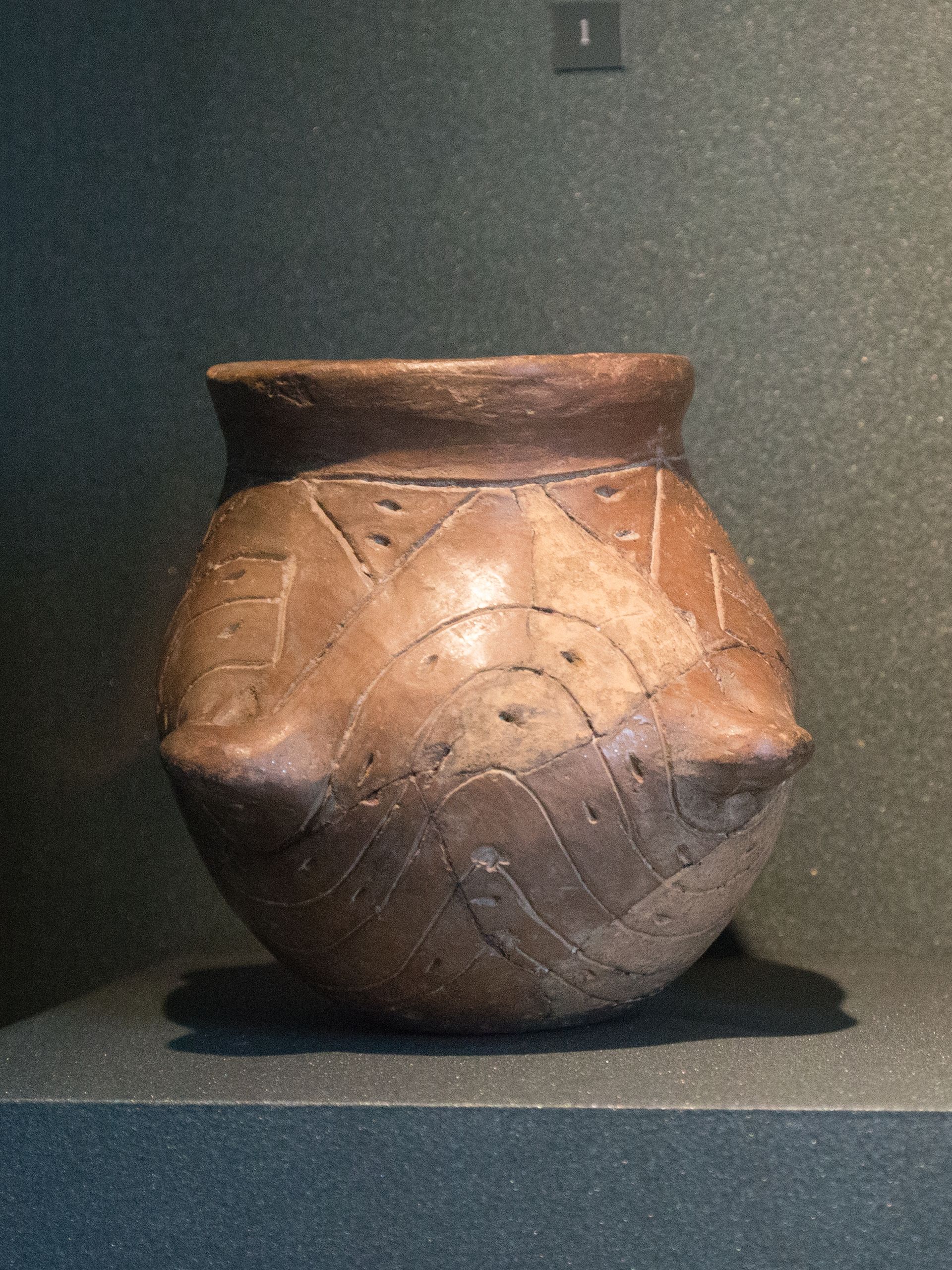
The first current, called Danubian or continental, originated in the plains of western Hungary and the middle Danube. There, around 5600-5500 BC, the Linear Pottery culture took shape, in German Linearbandkeramik (LBK), named after the incised bands that decorate its pots. Within only a few centuries these farmers spread to the north-west, following the fertile, easily worked loess soils that border the great rivers [1]. The LBK reached Slovakia, Bohemia, Germany, the Paris Basin, Belgium and the Netherlands, as well as Ukraine and Moldavia to the east. This strikingly rapid expansion created a vast, homogeneous cultural province in which the same longhouses, the same vessels and the same tools recur from one end to the other.
The Linear Pottery culture was not merely a pottery style: it was the very first Neolithic of central Europe, the matrix from which increasingly distinct regional cultures would later develop. LBK villages, often set on plateau edges overlooking a valley, grouped several longhouses that coexisted or succeeded one another over time. Stone tools, adzes, flintFlintA hard, brittle siliceous rock, knapped by prehistoric people to produce blades, points and sharp tools.→ blades, querns, travelled over long distances, a sign of active exchange between communities. Around 5000 BC the first LBK impetus faded and gave way to a profusion of daughter cultures, but the Danubian imprint would remain lastingly inscribed in the farming settlement of the continent.
The Mediterranean route: the Cardial culture
The second current, called Mediterranean, followed the coasts. Setting out from the Ionian Sea between 5800 and 5300 BC, it advanced step by step along shores, islands and coastal plains as far as Portugal [1]. It is recognised by its so-called Cardial pottery, decorated by pressing the edge of a cockle shell (cardium, a common mollusc) into the still-soft clay. The pace of this maritime diffusion, by coasting and short-range seafaring, attests to exchange networks and a mobility that scholars had not imagined to be so developed at this period.
The two currents eventually met in the heart of the continent. Around 5300 BC, at the cave of Planches-près-Arbois near Besançon, as at Le Brézet near Clermont-Ferrand, archaeology has revealed contacts between Cardial Neolithic groups from the south and LBK groups descending from central Europe [1]. The "Neolithic package", wheat, barley, sheep, goat, cattle, pig, pottery, the village, had thus encircled the continent with two arms that closed over present-day France.
The agricultural way of life did not advance at an even pace. It moved in surges, halting for centuries at certain frontiers before resuming, slowed where established hunter-gatherer communities were dense or where the climateClimateThe long-term average atmospheric conditions of a region; its variations (glaciations, aridifications) shaped migrations, agriculture and the collapse of prehistoric societies.→ and soils were less favourable. Lakes, marshes and mountain ranges channelled or diverted its progress, so that the map of early farming Europe is one of corridors and pauses rather than of a uniform tide. This irregular rhythm helps explain why the two great currents, Danubian and Mediterranean, kept distinct identities for so long before finally meeting.
The first farmers and their villages
Wherever sedentism took hold, the landscape was transformed. Communities chose their settlement sites according to access to fertile, easily cultivated land, and established themselves preferentially along watercourses [3]. The forest retreated under the polished-stone axe; people cleared, burned and sowed. The HoloceneHoloceneThe current geological epoch, begun about 11,700 years ago at the end of the last ice age; the setting of all post-glacial history.→, the milder climatic period that began around 9700 BC, offered favourable conditions for this pioneering agriculture.
The emblematic dwelling of the LBK is the longhouse. Built to the same model from one end of the Danubian province to the other, it could reach 45 metres in length, raised on a timber frame supported by posts set in the ground [3]. The interior was often divided into three parts: a front area perhaps serving as a granary to store the harvest, a central room sometimes preserving the remains of a hearth or oven, and a back room probably reserved for the inhabitants. These vast dwellings doubtless sheltered extended family groups. Several houses gathered together formed the first villages, the nuclei of an unprecedented collective life.
Building such a house represented a considerable investment in timber, labour and know-how. These buildings, exposed to damp and insects, had to be rebuilt every few decades, which explains the presence, on a single site, of many overlapping house plans. Around the dwellings stretched the fields, the pastures and the clay-extraction pits, which then served as rubbish dumps and today yield archaeologists a wealth of information on diet and craft. The village was not isolated: it was part of a land shaped by human hand, the first truly agricultural landscape in European history.
Daily life was reorganised around the farming cycle: ploughing, sowing, harvesting, threshing, grinding grain on saddle querns. The raising of sheep, goats, cattle and pigs provided meat, milk, wool and labour. Storing surpluses made it possible to face bad seasons but also introduced a logic of accumulation and, in time, of inequality. The Neolithic village was not merely a place to live: it was a new way of inscribing humankind in duration and in territory.
Pottery, the signature of cultures
Invented to cook, store and carry, pottery became the archaeological marker par excellence of the European Neolithic. Each great current had its own decorative grammar. In the north, Linear ware is distinguished by its fine bands incised in spirals, meanders and chevrons, sometimes enhanced with punctuated dots in the later phases. In the south, Cardial pottery bears the repeated impressions of the cockle shell, scattered across the whole body of the vessel.
Beyond aesthetics, these styles tellTellAn artificial mound formed by the accumulation of successive layers of settlement remains at the same spot, typical of the Near East. Each destruction-rebuilding event adds a stratum.→ of filiations, contacts and frontiers. Tracing the evolution of forms and decoration allows prehistorians to reconstruct routes of diffusion, rhythms of expansion and zones of encounter between traditions. The vessel is not merely a utensil: it is a document, a bearer of collective identity, handed down from generation to generation as both a skill and a sign of belonging.
The Atlantic megalithic phenomenon
From the middle of the 5th millennium, a monumental revolution spread along the Atlantic seaboard of Europe. Megalithism, from the Greek megas, large, and lithos, stone, denotes the art of raising enormous blocks, rough or barely dressed. In Europe these constructions span, for the most part, between 4500 and 1500 BC, covering the Late Neolithic and the Copper Age [2]. From the Iberian peninsula to Scandinavia, by way of Brittany, the British Isles and Ireland, these monuments trace a veritable Atlantic geography of stone.
Their appearance poses a riddle: why did farming societies still lacking writingWritingA system of conventional signs used to fix language or information durably; its appearance (c. 3300 BC) marks, by convention, the end of prehistory.→, metal and powerful draught animals devote so much effort to raising, transporting and assembling blocks sometimes weighing dozens of tonnes? The answers lie in the religious, the funerary and the political. The megalithMegalithA large stone raised or assembled by humans (menhir, dolmen, stone circle), typical of the Neolithic and Bronze Age.→ is at once tomb, sanctuary, territorial marker and an assertion of the cohesion of a group able to carry through such a collective undertaking.
Atlantic megalithism is not a single phenomenon but a mosaic of regional traditions spanning nearly three millennia. The first monumental tombs appear in Brittany and Portugal as early as the 5th millennium, before the impulse reached the British Isles, Ireland, Denmark and southern Scandinavia. This diffusion, long interpreted as the spread of a single megalithic religion from the East, is now understood as a series of inventions and borrowings along the Atlantic sea routes, carried by farming societies in search of lasting monuments.
Carnac and the great alignments
In Brittany, near the south coast of the Morbihan, the site of Carnac gathers the largest concentration of standing stones in the world: more than 3000 menhirs aligned over several kilometres, accompanied by dolmens and tumuli [2]. These alignments, whose main groups bear the names of Le Ménec, Kermario and Kerlescan, were raised by Neolithic farming communities between the 5th and 3rd millennia BC.
The ordering of these files of stones, sometimes arranged by decreasing height, has intrigued observers for centuries. Some menhirs are thought to have had an astronomical function, serving as markers or sightlines to follow the movements of the sun and moon [2]. Other hypotheses evoke processions, gathering places, territorial markers or memorials. Whatever their original meaning, these alignments imply planning, a considerable workforce and a will to inscribe the sacred lastingly in the landscape. The megaliths of Carnac and of the shores of the Morbihan are today inscribed on the World Heritage List.
To raise and align thousands of blocks, some of them weighing many tonnes, demanded levers, ropes, timber sledges and the coordinated effort of large groups over many seasons. The quarrying, transport and erection of the stones were themselves social events, occasions that bound scattered communities together. In this light the monuments are not only the product of a society but one of the very means by which that society produced and renewed itself, gathering, feasting and labouring around a shared and enduring work.
Dolmens and collective tombs
The dolmenDolmenA megalithic funerary structure made of one or more capstones resting on vertical uprights, often topped by an earth tumulus. From Breton dol (table) and men (stone).→ is the most widespread funerary expression of megalithism. It is a chamber, most often originally covered by a tumulusTumulusA mound of earth or stones covering one or more burials; it often capped a dolmen's chamber in the Neolithic.→ of earth or stones, designed to receive multiple burials [3]. Such structures appear in the Neolithic, when societies began to feel the need to mark the presence of the dead permanently in the landscape.
Megalithism thus inaugurated the age of collective tombs. In some chambers, up to several hundred dead were laid over the generations, their bones regularly rearranged: skulls stacked, bones sorted and grouped [3]. In the 5th millennium and during part of the 4th, individual and collective burials coexisted, before collective inhumation became dominant. The tomb was no longer a simple pit: it was a reused monument, a place of family or community memory, an anchor for the living around their ancestors.
Stonehenge and the stone circles
In southern England, on Salisbury Plain, Stonehenge embodies the apogee of insular megalithism. The monument was built in several phases. Around 3000 BC, a circular ditch bordered by a bank was first dug, in the bottom of which animal bones were placed [2]. Then, around 2500 BC, the stone heart took shape.
Two types of block make up the central circle. The great sarsens, each weighing several dozen tonnes, were brought from the Marlborough Downs, some 30 kilometres away, and raised in two concentric arrangements. Within, five trilithons, two upright stones capped by a horizontal lintel, form a horseshoe [2]. The smaller stones, the bluestones of spotted dolerite, come from the Preseli hills in south-west Wales, more than 200 kilometres away: an astonishing logistical feat, probably accomplished by water and then dragged overland [2]. Some researchers have seen in Stonehenge a symbol of unity, raised at a time when the Neolithic populations of insular Britain were experiencing a phase of cultural unification. The monument, aligned on the solstices, articulates the human, the stone and the sky.
Skara Brae, a village of stone
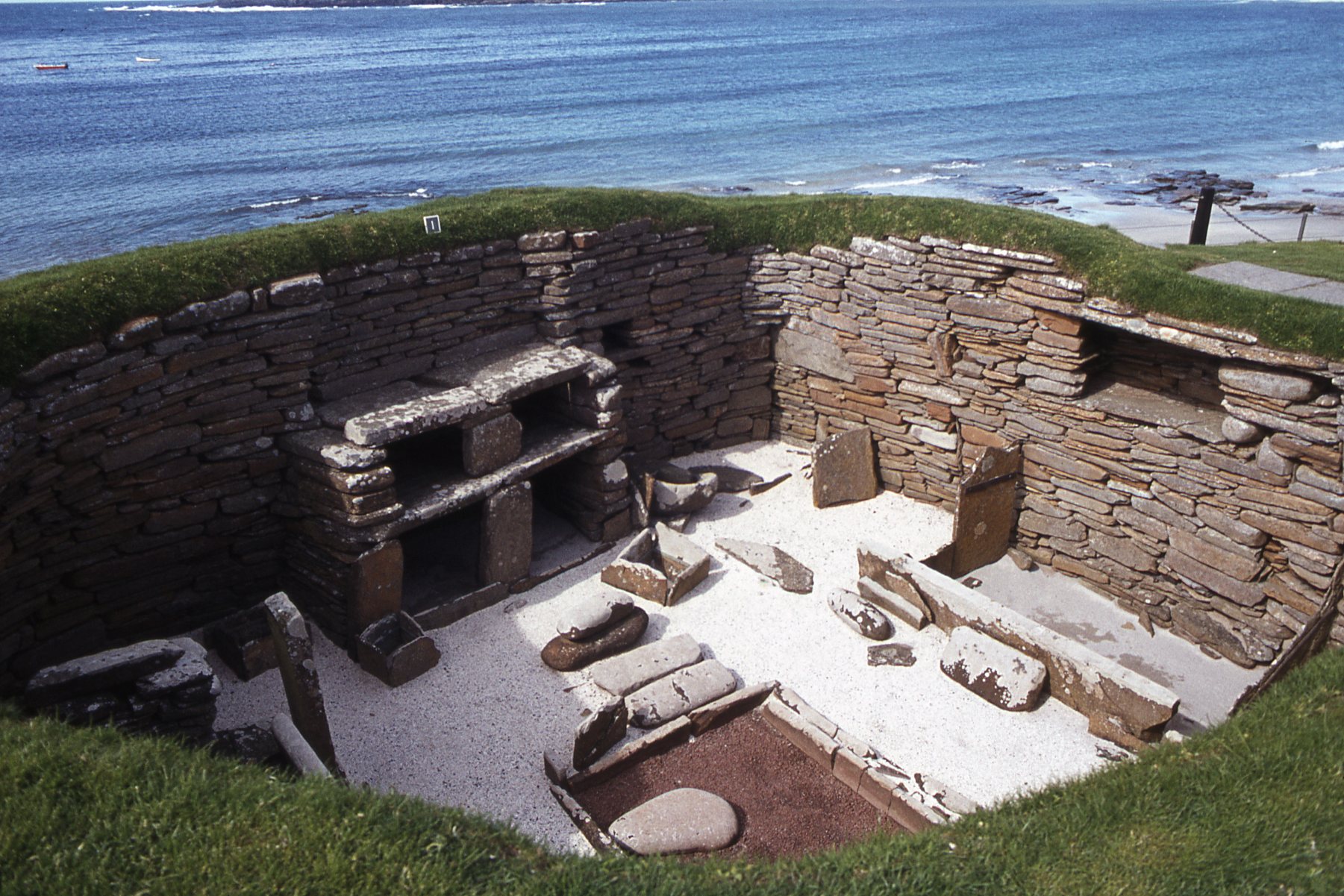
In Orkney, off the north of Scotland, the village of Skara Brae offers an exceptional window onto Neolithic daily life around 3000 BC [2]. Timber being scarce on these wind-battered islands, everything there was built and furnished in stone: the walls of the houses, but also the beds, hearths and "dressers", carved from the slab and preserved intact under the sand for millennia.
The site is part of the "Heart of Neolithic Orkney", a group that also brings together the chambered tomb of Maeshowe and the ceremonial circles of the Stones of Stenness and the Ring of Brodgar [2]. Skara Brae shows that the builders of megaliths were also ingenious villagers, capable of organising a comfortable dwelling, linked by covered passages, in a hostile environment. The contrast between the modesty of the village and the grandeur of the neighbouring circles illuminates the place of the collective and the sacred in these societies.
Social and religious transformations
Behind the stones and the sherds lies a profound mutation of societies. Sedentism, the storage of surpluses and the ownership of land gave rise to new hierarchies. The collective labour demanded by the great monuments implies an authority able to coordinate, feed and motivate hundreds of hands over long periods. Megalithism is, in this sense, as much a social fact as a religious one.
The relationship with the dead was radically transformed. By permanently marking the presence of ancestors in the landscape, collective tombs anchored communities to their territory and perhaps legitimised rights over land. The alignments and circles, oriented on the heavenly bodies, suggest an elaborate cosmology in which the cyclical time of seasons and solstices gave rhythm to social and ritual life. The burialBurialThe intentional deposition of a body, sometimes with offerings; a marker of symbolic behaviour.→ became a monument, the territory filled with meaning-laden markers, and collective memory turned to stone.
Conclusion
From the Linear Pottery longhouse to the circles of Stonehenge, from Cardial pots to the stone beds of Skara Brae, the European Neolithic was an adventure lasting several millennia. Two routes, one Danubian, the other Mediterranean, carried agriculture and sedentism from the Balkans to the shores of the Atlantic. Then, on this oceanic seaboard, farming societies raised stone monuments that still challenge our understanding. Carnac, the dolmens, Stonehenge and Orkney bear witness to a single impulse: to inscribe in the most lasting material of all the memory of ancestors, the order of the sky and the cohesion of the living. By domesticating plants, animals and stone, Neolithic Europe shaped a world whose heirs we still are.
The contribution of ancient DNA
For more than a century, prehistorians debated an apparently insoluble alternative: did the Neolithisation of Europe result from a diffusion of ideas, with local hunter-gatherers gradually adopting agriculture through contact and imitation, or from a migration of populations, with farmers from elsewhere replacing the natives? PalaeogeneticsPalaeogeneticsThe study of ancient DNA extracted from remains (bones, teeth, sediments, walls) to reconstruct the past of populations.→, by sequencingSequencingReading the order of the bases (A, T, G, C) of a DNA molecule; high-throughput sequencing reads millions of fragments in parallel.→ the DNADNAThe molecule carrying genetic information, used to reconstruct kinship between species.→ extracted from ancient bones, has settled the debate in favour of a nuanced compromise. The analyses converge: a wave of farmers from Anatolia and the Near EastNear EastA region of western Asia (Levant, Mesopotamia, Anatolia, Iran), cradle of the Neolithic revolution, agriculture, the first cities and writing.→ carried agriculture into the heart of the continent, largely replacing the Mesolithic hunter-gatherers of central and southern Europe, yet without erasing them entirely [1].
The first European farmers, whom geneticists designate by the acronym EEF, Early European Farmers, derive most of their ancestry from Anatolian hunter-gatherers, with modest contributions from the Iranian, Caucasian and Levantine worlds. It was their descendants who, from the Balkans, took the two great Danubian and Mediterranean routes described above. The "Neolithic package" did not therefore travel alone: it accompanied a real movement of men and women, whose genetic signature can still be read today in the hereditary makeup of Europeans.
The picture grows more complex as one moves north. Beyond the central Neolithic core, the admixture between farmers and hunter-gatherers was far more marked and spread over nearly three millennia. In central Poland, DNA sequences reveal recurrent admixture between farmers and hunter-gatherers, the latter remaining genetically distinct and coexisting with the farmers until around 4300 BC [1]. Far from a brutal and uniform replacement, Neolithisation thus appears as a regionally contrasted process, made of pioneer fronts, prolonged cohabitations and gradual absorptions.
A third actor enters the stage at the very end of the Neolithic. Around 3000 BC, groups from the Pontic-Caspian steppes, associated with the Yamnaya culture, surged westward. Mobile herders, probably riders and drivers of ox-carts, they brought a third genetic component, called "steppeSteppeA vast semi-arid, treeless grassland of Eurasia, suited to nomadic herding and the horse; a corridor for the movement of peoples and technologies in later prehistory.→", which overlaid the pre-existing substrate. Recent research estimates that the Yamnaya themselves derived a large part of their ancestry from a Caucasus and lower Volga population [1]. At the end of these movements, present-day Europeans appear as the product of the encounter of three great ancestries: the Mesolithic hunter-gatherers, the Anatolian Neolithic farmers, and the steppe pastoralists. The stone of the megaliths and the bones of the burials thus tell, in their own way, the same story as the genomes.
Chronology and maps of diffusion
Reconstructing the calendar of European Neolithisation requires cross-referencing hundreds of radiocarbon dates, calibrated and mapped. The picture that emerges is one of a progression by fronts, punctuated by accelerations and pauses. Around 6500-6000 BC, agriculture is firmly established in the Balkans, the European bridgehead of the Near Eastern Neolithic. From there the two currents set out: the Linear Pottery culture, formed around 5600-5500 BC on the middle Danube, and the Cardial, launched along the Ionian coasts between 5800 and 5300 BC [1].
The Danubian diffusion map traces a fan oriented towards the north-west, following the loess soils: in barely two or three centuries, the Linear Pottery culture reaches Germany, the Paris Basin, Belgium and the Netherlands. The Mediterranean map, for its part, follows a coastline, leaping from one coastal plain to the next, from island to island, as far as Portugal. The speed of these expansions, far from uniform, reveals rapid leaps followed by long plateaus, as if each new land had to be assimilated before the front resumed its march. Around 5300 BC, the two arms close upon present-day France, where Cardial and Linear Pottery peoples come into contact [1].
The second great map is that of megalithism. The first monumental tombs arise in Brittany and Portugal from the middle of the 5th millennium; the impulse then reaches the British Isles, Ireland, Denmark and southern Scandinavia. Most of the constructions are spread between 4500 and 1500 BC [2]. Placed side by side, these two geographies, that of the fields and that of the standing stones, show that Atlantic Europe was first conquered by agriculture, then monumentalised by farming societies now firmly rooted, for whom marking the territory with enduring stones became a major concern.
Passage tombs and megalithic art
Among the funerary monuments, the passage tomb holds an eminent place. It consists of a straight passage leading to a chamber, the whole buried beneath a cairnCairnA human-made mound of stones, often raised over a burial chamber (chambered cairn) or used as a marker; common across the British Isles from the Neolithic to the Iron Age.→ of stones. Two masterpieces, separated by a thousand years and a few hundred kilometres, illustrate its full power: Gavrinis in Brittany and Newgrange in Ireland.
On the islet of Gavrinis, in the Gulf of Morbihan, stands a passage tomb built around 4200-4000 BC [2]. Its inner slabs are almost entirely covered with carvings: zigzags, concentric arcs, herringbone motifs and finely drawn axes deploy one of the most extraordinary ensembles of megalithic art in Europe. Each stone of the passage bears its composition, like a book of stone whose language we have lost.
A thousand years later, around 3200 BC, the builders of the Boyne Valley in Ireland raised Newgrange [2]. The great cairn, girdled by ninety-seven kerbstones several of which are carved with spirals and lozenges, shelters a cruciform chamber at the end of a long passage. Its fame rests on an architectural marvel: on the morning of the winter solstice, a beam of sunlight enters through an opening contrived above the entrance and travels along the passage until it illuminates the burial chamber for a few minutes. The kinship of Gavrinis and Newgrange, the same cairns, the same passages, the same carved art, attests to close maritime links between the Neolithic communities of Brittany and Ireland, united by the Atlantic seaways [2].
Avebury and the great circles
If Stonehenge embodies the standing stone, Avebury, in Wiltshire, represents its excess. Built and altered over several centuries, between about 2850 and 2200 BC, this monument ranks among the largest and most complex of the Neolithic henges of Britain [2]. An immense circular ditch bordered by a bank encloses a space wide enough to contain an entire village today; within it unfold a great stone circleStone circleA Neolithic or Bronze Age monument of standing stones set in a ring, often ritual or astronomical in purpose.→ and two smaller circles, prolonged by long avenues marked out with megaliths.
Henges, those circular enclosures defined by a ditch and a bank, flourish in Britain between 3000 and 2000 BC, at the passage from the late Neolithic to the Bronze AgeBronze AgeA protohistoric period following the Neolithic, defined by bronze metallurgy (a copper-tin alloy) and the rise of the first cities and states; in Egypt it corresponds to the age of the first pyramids.→ [2]. Places of gathering, of ceremony and perhaps of exchange, they trace a sacred geography that the communities traversed to the rhythm of the seasons. Avebury, by its colossal dimensions and the length of its processional avenues, gives the measure of the ambition of these societies: to shape the landscape itself on the scale of the sacred.
Neolithic violence and massacres
The image of a peaceful Neolithic, wholly devoted to the plough and to the veneration of ancestors, has had its day. Several mass graves discovered in central Europe reveal a darker face of these first farming societies: collective violence. The most famous is the pit of Talheim, in south-west Germany, brought to light in 1983 and dated to around 5000 BC [3]. It contained, jumbled together, the bodies of thirty-four individuals, men, women and children, thrown without care into a common pit, many bearing the marks of fatal blows struck to the head with stone adzes and axes.
Talheim is not an isolated case. At Schletz-Asparn, in Austria, a Linear Pottery enclosure yielded the remains of at least sixty-seven people, all marked by multiple traumas, in a context evoking the annihilation of an entire community [3]. At Herxheim and at Schöneck-Kilianstädten, other bones bear the stigmata of the same brutality. The osteological analysis of these sites shows recurrent cranial lesions and, more rarely, arrow wounds, a sign that combat took place both at a distance and at close quarters [3]. These massacres, concentrated in the final phase of the Linear Pottery culture around 5000 BC, suggest a profound crisis: tensions over land, rivalries between communities, perhaps the consequence of a demographic and social collapse. The longhouse and the collective tomb thus stood alongside the pit of the slaughtered.
Economy, society and inequality
Agriculture and stock-rearing transform not only the landscape: they recast social organisation. The storage of surplus grain makes it possible to face famine, but also introduces a logic of accumulation. Whoever holds the reserves, the land, the livestock or the seed acquires a power that the mobility of hunter-gatherers forbade. Little by little, gaps of wealth and status widen, legible in the unequal furnishing of tombs: alongside sober burials, some yield ornaments, exotic stone blades, prestige objects that betray the emergence of elites.
The collective labour required by the great monuments confirms this structuring. To raise a menhirMenhirA stone erected vertically by humans, standing alone or in rows (alignments), emblem of the Breton Neolithic megalithic tradition. From Breton men (stone) and hir (long).→ of several dozen tonnes, to dig the ditch of a hengehengeA Neolithic circular enclosure bounded by a ditch and bank, often associated with standing stones.→, to erect a cairn presupposes an authority able to plan the worksite, to coordinate, to feed and to motivate hundreds of hands over long periods. Such undertakings are inconceivable without some form of command and without networks of exchange that circulated tools, raw materials and know-how over long distances. Neolithic society is no longer a juxtaposition of egalitarian bands: it is a world of hierarchical villages, linked to one another, where wealth, prestige and the sacred begin to concentrate.
The end of the Neolithic and the coming of metals
The great age of the standing stone does not die out abruptly, but dissolves into a new world. Around 2500 BC, an unprecedented ceramic style spreads across western Europe: the Bell Beaker, named for its beakers in the shape of an inverted bell. With it appear new funerary practices, new objects and, above all, the metallurgyMetallurgyThe techniques of extracting and working metals (copper, bronze, gold); its rise in the Eneolithic and Bronze Age transformed tools, weapons and social hierarchies.→ of copper and gold [2]. In the Avebury region as elsewhere, the dead are now buried accompanied by Bell Beaker pots, the sign of a cultural upheaval arriving from the continent.
This transition overlaps with the final phase of the great monuments: at Avebury, the henges and avenues are still in use when the first metalworkers arrive. The passage from the Neolithic to the Copper Age and then to the Bronze Age was therefore not a clean rupture but a long overlap, during which standing stones, Bell Beakers and the first metal objects coexisted. With metal open new hierarchies, new networks of exchange on a continental scale and, little by little, the eclipseEclipseThe passing of one celestial body into the shadow of another, for instance the Moon hiding the Sun or the Earth casting its shadow on the Moon.→ of the megalithic world. Stone gives way to copper, but the monuments of the ancestors remain standing in the landscape, mute witnesses of a bygone age.
The legacy of a world
What remains, today, of these founding millennia? Everything, or nearly so. The plants we cultivate, the animals we rear, the very idea of the village and of appropriated territory go back to this Neolithic revolutionNeolithic revolutionThe shift from hunter-gatherer societies to farming and settled life (c. 10,000 BCE in the Near East), giving rise to villages and then cities.→. The Danubian and Mediterranean routes traced an agricultural Europe whose lands, in places, still preserve the weave. The genomes of Europeans bear the indelible imprint of the Anatolian farmers, the last hunter-gatherers and the steppe pastoralists. And on the Atlantic seaboard, from Brittany to Orkney, the alignments, the dolmens and the stone circles continue to raise towards the sky the memory of a world that, by domesticating nature, also domesticated itself. The European Neolithic is not a closed chapter: it is the foundation on which rests, unbeknownst to us, a great part of what we are.
The "Neolithic package" and domestication
At the heart of the Neolithic revolution lies a coherent set of innovations that prehistorians call the Neolithic package. It combines the cultivation of cereals, emmer wheat, einkorn, barley, that of legumes such as the lentil and the pea, the rearing of sheep, goat, cattle and pig, pottery, polished-stone tools and sedentary settlement. This block of innovations, formed in the Near East during the preceding millennia, travels as a single whole when it reaches Europe: it is its very cohesion that explains the speed and homogeneity of the Danubian and Mediterranean diffusion.
The domestication of plants and animals was not an instantaneous act but a long process of selection. By sowing, harvesting and re-sowing year after year, the first farmers imperceptibly altered the makeup of the species: domestic cereals lost the ability to disperse their grains spontaneously, becoming dependent on the human hand to reproduce. Likewise, domestic livestock gradually became distinct from its wild ancestors in size, behaviour and docility. This coevolution henceforth bound the fate of humankind to that of the species it had subjugated: without farmers, domestic wheats would disappear, and without herds, Neolithic communities could not have subsisted. An irreversible alliance had been forged between humanity and the domesticated living world.
This grip on nature came at a cost. The analysis of Neolithic skeletons often reveals more fragile health than that of hunter-gatherers: caries due to a diet rich in carbohydrates, deficiencies linked to a less varied fare, diseases favoured by the promiscuity of humans and animals, by the density of villages and by sedentism. The agricultural revolution, which allowed far larger populations to live on the same territory, was not therefore, for each individual, an unshadowed progress. Yet it marks the tipping point from which humanity ceased to adapt to its environment and undertook, irreversibly, to transform it to its own profit.
Polished stone and new techniques
The very term Neolithic, the "age of new stone", refers first to a technical revolution: the polishing of stone. To knappingknappingThe set of operations for fracturing a stone block to extract flakes or blades.→ by percussion, which had dominated for hundreds of thousands of years, is now added the patient abrasion of one block against another rock, until a smooth and resistant cutting edge is obtained. The polished-stone axe becomes the emblematic tool of the period, indispensable for clearing the forests that covered Europe. Hafted in a wooden handle, it allowed trees to be felled, clearings to be opened and the land needed for cultivation to be won from the forest.
Certain rocks, prized for their quality, became the object of a veritable industry. Specialised deposits were exploited, flint mines were dug, blades were knapped and polished that then circulated over hundreds of kilometres, along exchange networks whose extent never ceases to surprise. Alpine jadeites, for example, were fashioned into prestige axes diffused throughout western Europe, from Italy to Brittany and the British Isles. These objects, too beautiful and too fragile for daily use, doubtless served as markers of status and ceremonial gifts. Polished stone was not only a tool: it was also the currency of esteem, a support of prestige and a social bond woven between distant communities.
To weaving and basketry are added other skills that transform material life. The working of wool and flax allows cloth to be produced; the quern, on which the grain is ground, becomes an essential piece of household furniture; pottery diversifies into forms suited to storage, cooking and serving. All these techniques, modest in appearance, trace a new regime of life in which the production, transformation and conservation of resources occupy a central place. The Neolithic hearth is a workshop as much as a place of life.
Cosmology, ancestors and the orientation of monuments
The great megalithic monuments can be fully understood only in the light of a cosmology of which we perceive only fragments. The recurrent orientation of many structures on the risings and settings of the sun at the solstices owes nothing to chance. At Newgrange, the beam of the winter solstice strikes the back of the chamber; at Stonehenge, the main axis aligns with the rising of the sun at the summer solstice and its setting at the winter solstice. These devices reveal a sustained attention to the annual cycle of the sun, and doubtless to the movements of the moon, whose mastery perhaps conferred a power on those who knew how to predict their return.
The relationship with the ancestors structures this thought. By laying their dead in chambers reused over generations, by regularly rearranging their bones, Neolithic communities maintained a living link with their dead. The collective tomb was not a place of forgetting but a focus of memory, an anchor where the living came to renew their belonging to a lineage and, perhaps, to found their rights over the land. To mark the landscape with enduring monuments was to inscribe in stone the continuity of the group beyond the death of its members.
This articulation of the cyclical time of the heavenly bodies and the long time of the generations traces a vision of the world in which the order of the sky and the order of men answered each other. The gatherings at the henges, the processions along the avenues, the ceremonies at the solstices gave rhythm to social life and bound together scattered communities. The sacred was not a separate sphere: it pervaded the territory, the calendar and memory, giving meaning to the collective effort deployed to raise these stones that twenty centuries have not sufficed to bring down.
Women, children and domestic life
Behind the great narratives of migrationsMigrationsLong-distance movements of populations; a major driver of human history (the exit from Africa, the peopling of continents, Neolithic and steppe expansions).→ and monuments, the ordinary life of Neolithic villages can be glimpsed through a thousand details. Rubbish pits, house floors, culinary remains and burials gradually yield the daily life of these societies. The division of tasks may be inferred through the wear of bones and teeth, occupational pathologies and grave goods. The grinding of grain, long and laborious, marked the bodies of those who devoted themselves to it; the working of earth, hides, fibres and clay filled whole days within the domestic community.
The Linear Pottery longhouse probably sheltered an extended family group, organised around several generations. The transmission of land, herds and skills across the descent lines introduced a new continuity, foreign to the mobile world of hunter-gatherers. Children there learned the gestures of agriculture, stock-rearing and craft, perpetuating a technical heritage constantly enriched. The human density of the village, the prolonged cohabitation and the proximity of livestock shaped an unprecedented way of life, made of close cooperation but also of tensions, which the mass graves of the Linear Pottery culture remind us could turn to tragedy.
Reading the Neolithic landscape today
The walker who today crosses the Breton moor, the plain of Salisbury or the islands of Orkney treads upon a palimpsest. Beneath the grass and the cultivated fields can be sensed the traces of vanished villages, levelled tombs, filled ditches that aerial archaeology and geophysical surveys gradually reveal. The menhirs still standing, the dolmens stripped of their tumulus, the raised stone circles are only the most visible vestiges of an infinitely denser Neolithic landscape, in which every height, every valley, every watercourse bore the imprint of an organised human presence.
Reconstructing this world today mobilises a cluster of disciplines: radiocarbon dating, the analysis of fossil pollens to retrace the retreat of the forest, the study of plant and animal remains, palaeogenetics, the modelling of diffusion routes. From this convergence is born an ever more precise and nuanced image of a plural Neolithic, made of pioneer fronts and long cohabitations, of peace and violence, of modest villages and grandiose monuments. The standing stones of Atlantic Europe, long silent, thus begin to speak again, and a whole swathe of our common prehistoryPrehistoryThe span of human history before the invention of writing, from the Palaeolithic to the Metal Ages, known mainly through material remains.→ rises once more from the ground.
Networks of exchange and the circulation of materials
Far from being isolated, Neolithic villages were inscribed in vast networks of exchange that circulated raw materials, finished objects and ideas over long distances. Quality flint, extracted from specialised deposits, sometimes travelled hundreds of kilometres; Alpine jadeite axes, fashioned in the Italian Alps, are found as far as Brittany, Ireland and the British Isles. Salt, marine shells and Mediterranean obsidian completed these flows. Tracing the provenance of materials allows archaeologists to reconstruct the weave of these exchanges and to measure the extent of the relations maintained between communities.
These networks transported not only goods: they conveyed styles, techniques, beliefs. The striking kinship between the carved art of Gavrinis and that of Newgrange, the sharing of ceramic forms over vast territories, the synchronous diffusion of funerary fashions bear witness to a circulation of cultural models along the maritime and river routes. The Neolithic world, despite the slowness of travel, was a connected world, traversed by reciprocal influences in which each innovation could spread from one region to another. It is in this connectivity that the coherence of the Atlantic megalithic phenomenon is partly rooted, from one shore of the ocean to the other, beyond the frontiers of languages and cultures now vanished.
At the end of this journey, the European Neolithic appears as a web of unsuspected richness, in which the history of techniques, that of populations and that of beliefs are knotted together. From the first longhouses of the Danube to the last circles raised on the Atlantic moor, from the inaugural sowings to the Bell Beakers heralding the age of metals, it is one and the same great transformation that unfolds over nearly four millennia. It made of hunters and gatherers farmers, builders and founders of lineages, and engraved in stone, for eternity or nearly so, the memory of their passage. To understand this age is to return to the source of our relationship with the land, the territory and memory, and to recognise, in these distant ancestors, the first architects of the world in which we still live.
From Mesolithic to Neolithic: a threshold crossed
To measure the scale of the Neolithic shift, it must be set within the long term. For tens of thousands of years, human societies had lived by hunting, fishing and gathering, following the rhythm of the seasons and the mobility of wild herds. The Mesolithic groups who peopled Europe at the beginning of the Holocene were skilled connoisseurs of their environment, exploiting the resources of forests, rivers and coasts with great finesse. Their way of life, long judged "archaicArchaicRefers to an ancient, now-extinct human population or form (Neanderthals, Denisovans, ghost lineages), as opposed to anatomically modern humans.→", appears today as a sophisticated and durable adaptation to post-glacial environments.
The arrival of agriculture did not instantly sweep away this world. Across vast territories, farmers and hunter-gatherers lived side by side, exchanged, sometimes mingled over centuries, as genetic analyses now attest. The Neolithic threshold was not a clean frontier but a zone of transition, shifting and negotiated, where two ways of inhabiting the world met. It is from this encounter, made of borrowings, resistances and fusions, that the agricultural face of Europe was born. The Neolithic was not merely the arrival of a new way of life: it was the profound and irreversible transformation of humanity's relationship with nature, whose consequences still unfold before our eyes.
Le côté humain de ces articles me touche. Derrière chaque découverte, il y a des vies.
Je cherchais des informations fiables sur ce sujet. L'article tombe à pic.
Fascinant. Je travaille justement sur ce thème pour mon mémoire et cet article m'apporte un éclairage nouveau.
En tant que breton passionné de mégalithes, cet article me rappelle que les bâtisseurs des grands monuments de l'Atlantique (dolmens, cairns, menhirs) étaient largement les descendants des migrants anatoliens néolithiques. Ces gens ont transformé le paysage de l'Europe de l'Ouest de manière irréversible. Nous vivons encore dans leur héritage architectural et symbolique.
La néolithisation de l'Europe est aujourd'hui beaucoup mieux comprise grâce à la paléogénomique. On sait maintenant qu'elle résulte de plusieurs processus : une migration de populations agricultrices depuis l'Anatolie, des mélanges avec les chasseurs-cueilleurs locaux, et une troisième vague de populations venues des steppes ponto-caspiennes à l'Age du Cuivre. Cette complexité démographique explique la diversité des cultures néolithiques européennes.