In the tin mines of the Jos Plateau in central Nigeria, workers regularly unearthed ceramic fragments and thought nothing of them. Then, in 1943, a sculpted head found by chance and stuck in a field as a scarecrow changed everything. Bernard Fagg, an archaeologist working for the British colonial administration, immediately recognized in this piece evidence of an unknown civilization. The investigation he launched would lead to one of the most important discoveries in the history of African archaeology: the Nok culture, whose terracottaTerracottaClay shaped and then hardened by firing; the material of pottery, bricks and figurines, ubiquitous since the Neolithic.→ sculptures constitute the oldest known sculptural tradition in sub-Saharan AfricaSub-Saharan AfricaThe part of Africa south of the Sahara; cradle of Homo sapiens, long thought hostile to ancient-DNA preservation because of heat.→.1
A chance find in the Jos mines
The Jos Plateau is rich in tin. The Royal Niger Company exploited it from the late 19th century onwards, and the mine galleries regularly brought up objects that some local inhabitants regarded as bad omens. In 1928, a small terracotta monkey head caught the attention of the mine director, Lieutenant-Colonel John Dent Young, who had it deposited at the Jos Museum. Fifteen years elapsed before a second object provoked a true awakening.
It was Bernard Fagg who grasped the significance of the 1943 discovery. The sculpted head shown to him by a miner resembled no known artistic tradition. Its style recalled that of the 1928 monkey head, but its expressive features and careful craftsmanship signalled the existence of an already highly developed society. The sculpture was named the Jemaa Head, after the village where it was unearthed. Fagg then systematically surveyed the region, interviewing miners, residents and local leaders, and eventually assembled nearly two hundred pieces sharing the same stylistic characteristics.2
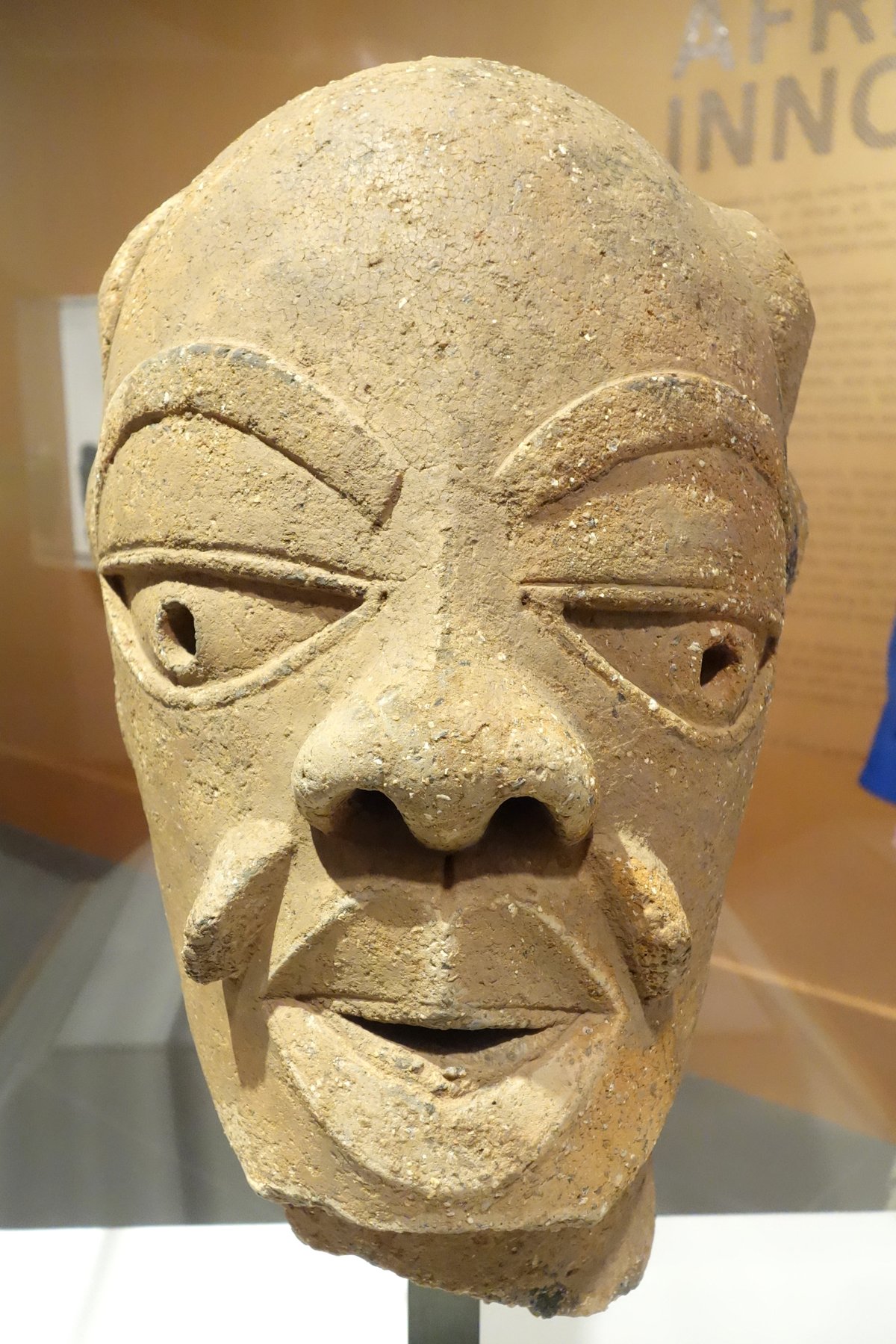
The antiquity of these objects quickly raised questions. Initial analyses of the sediment layers suggested a date around 500 BC, a result that shocked part of the academic community, which still tended to underestimate the complexity of ancient sub-Saharan African societies. Later advances in scientific dating would confirm and refine these estimates.
Dating results that overturned established certainties
Radiocarbon dating applied to organic material embedded in the terracottas, combined with thermoluminescence applied directly to the ceramics themselves, yielded consistent results: Nok sculptures span from roughly 440 BC to 200 AD. More recent work, notably that conducted by German archaeologist Peter Breunig and his team in the 2000s, has pushed the origins of this sculptural tradition back to the 9th century BC, approximately 2,800 years ago.3
These figures make the Nok terracottas the oldest documented sculptural tradition in sub-Saharan Africa, and one of the most remarkable in the ancient world. They mean that at the very time Thucydides was writingWritingA system of conventional signs used to fix language or information durably; its appearance (c. 3300 BC) marks, by convention, the end of prehistory.→ his History of the Peloponnesian War and Rome was launching its Punic Wars, craftsmen on the Jos Plateau had already mastered a sophisticated formal language, advanced ceramic skills and, in all likelihood, iron metallurgyMetallurgyThe techniques of extracting and working metals (copper, bronze, gold); its rise in the Eneolithic and Bronze Age transformed tools, weapons and social hierarchies.→. The Nok culture is not an isolated accident: it belongs to a deep, rich African history largely independent of Mediterranean influence.
Exceptional technical and artistic expertise
Nok sculptors had no potter's wheel. They built their forms by stacking coils of clay, smoothed the surfaces carefully, then pierced the eyes, nostrils, mouth and sometimes the ears. These openings served a dual purpose: enhancing the expressiveness of the faces and allowing air to circulate during firing, reducing the risk of cracking. Some pieces show traces of a slip, a thin layer of liquid clay applied before firing to smooth and unify the surface, often eroded over the millennia.
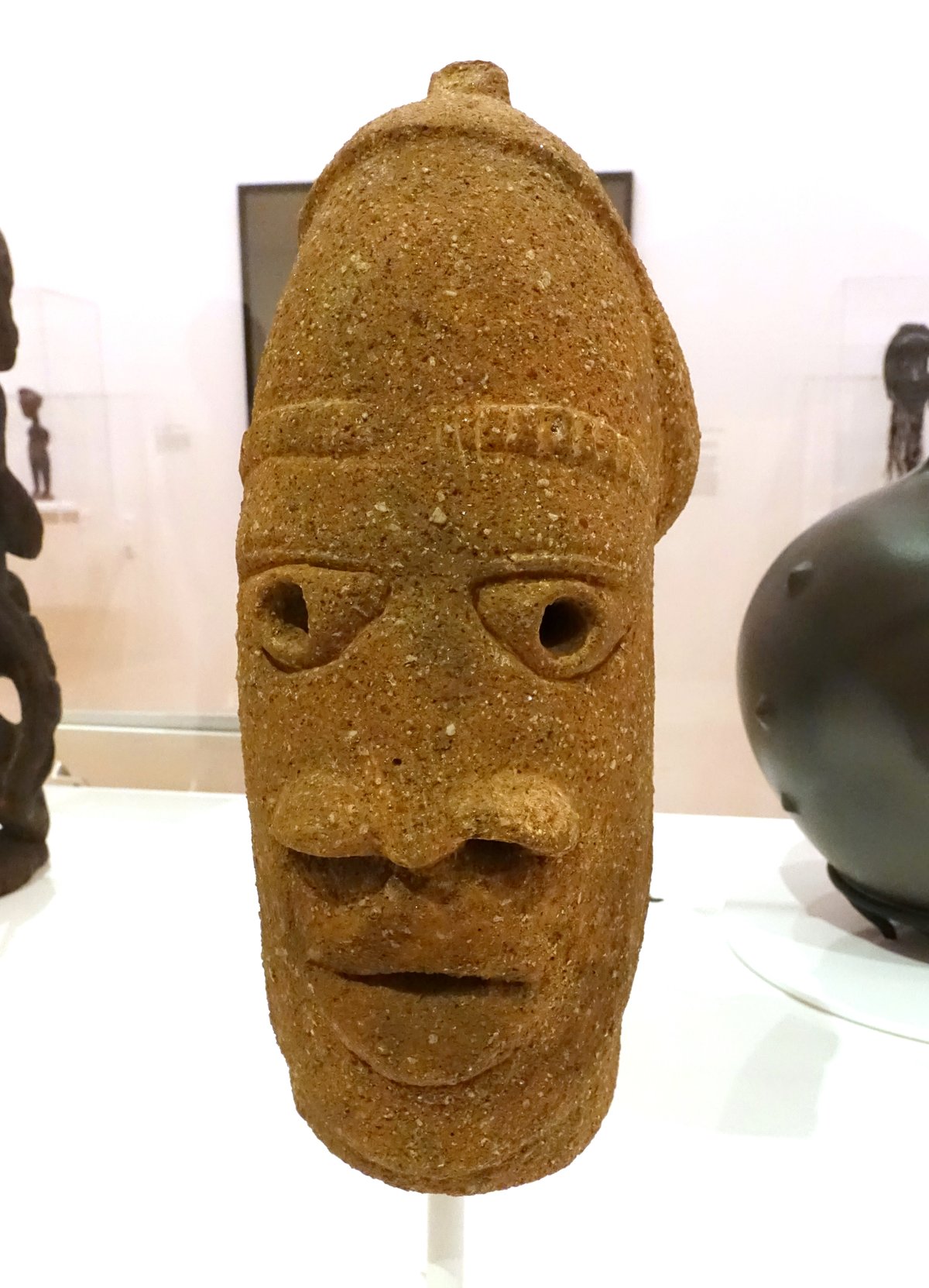
The works represent predominantly human figures, both men and women with bare torsos adorned with jewellery: heavy necklaces, bracelets, ankle ornaments. The hairstyles are particularly elaborate, with braids, buns, headbands, or perforations suggesting perhaps feathered adornments. Some figures sport a moustache or a chin beard. Formats range from a few centimetres to nearly 70 centimetres for the largest known pieces. While heads are the most common, busts, full figures and even groups have been recovered. Animals appear more rarely.
Researchers have identified several recurring stylistic markers in the faces: triangular eyes with lower eyelids mirroring the brow ridge shape, elongated heads with conical or cylindrical proportions, and a rare expressiveness that gives each piece a distinctive identity. Some faces even appear to represent pathological conditions, facial paralysis or elephantiasis, offering a unique glimpse into the health realities of ancient Nigeria.
Ritual functions still debated
Neither the patron nor the destination of these sculptures has been clearly established. Bernard Fagg initially suggested a link with rites connected to iron metallurgy, a central activity in Nok culture. Other hypotheses have been advanced: funerary use, crop protection, ancestor veneration, or the representation of chiefs or religious dignitaries. Peter Breunig and his team's observations added a decisive new element: assemblages of deliberately broken fragments buried before interment, sometimes associated with stone platforms and charcoal remains near burials. These findings point towards a funerary ceremonial function in which sculptures were ritually destroyed before being placed in the ground.4
What is known with certainty is that the Nok tradition flourished for more than a millennium before gradually declining around the 4th century BC and disappearing at the start of our era. Why it faded remains a mystery. The decline of the sculptural tradition does not necessarily mean the disappearance of the population: recent genetic research is examining possible links between the Nok and present-day populations of central Nigeria.
A heritage threatened by looting and forgery
When Bernard Fagg presented the Nok terracottas at the British Museum in 1947, their international reputation exploded. This fame came at a cost: demand from European and American collectors fuelled large-scale clandestine excavations. Hundreds of pieces were ripped from the ground without documentation, depriving science of the contextual information that gives them their full meaning. Compounding the looting, a forgery market of such scope has emerged that the authenticity of certain pieces, even those held in major museums, remains contested today.5
Significant efforts have been made to contain this destruction. Peter Breunig's team, in collaboration with Nigerian authorities, established a systematic programme of documentation and scientific excavation, producing the first serious reference corpus on Nok culture. This work culminated in the publication of the collective volume Nok: African Sculpture in Archaeological Context in 2014, which remains the definitive synthesis on the subject. Far from being anomalies, the Nok terracottas are now recognised as one of the most spectacular expressions of ancient human creativity on the African continent.
No comments yet. Be the first.