Contemporary with the pyramids of Egypt and the first Mesopotamian cities, the Norte Chico civilization (also known as Caral-Supe) flourished approximately 5,000 years ago on the north-central coast of Peru. It is currently the oldest known civilization in the New World and one of six independent cradles of social complexity in human history.1
A Long-Overlooked Discovery
Although the site of Caral has been known to archaeologists since the 19th century, its true antiquity long went unrecognized. The absence of pottery and easily datable objects led early researchers to underestimate its age. It was Peruvian archaeologist Ruth Shady Solís who, beginning in 1994, conducted systematic excavations and revealed through radiocarbon dating that Caral was occupied as early as 2,700 BCE, with activity at other sites in the complex dating back to 3,500 BCE.2
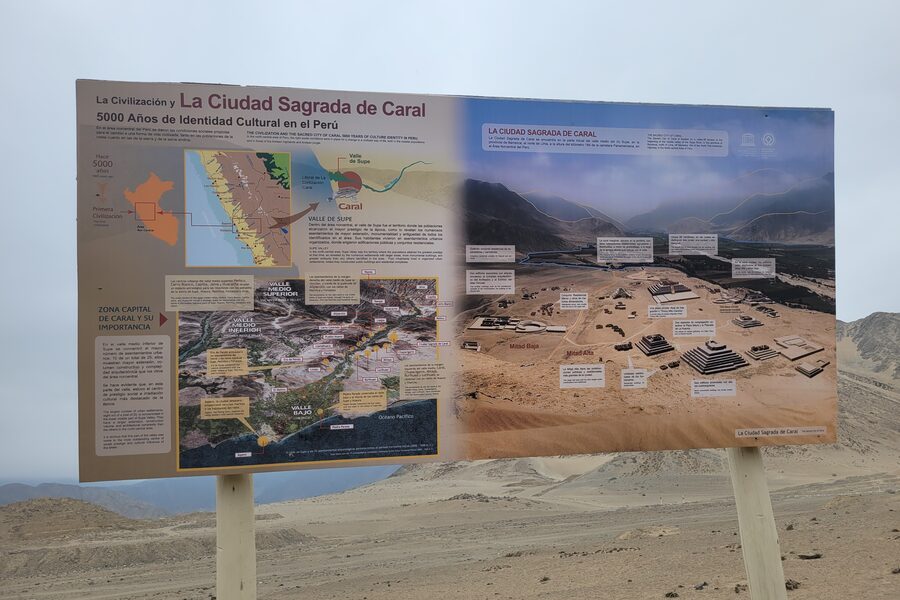
Norte Chico refers to a region of roughly 1,800 km2 encompassing four river valleys: the Huaura, Supe, Pativilca, and Fortaleza. At its peak, between 3,000 and 1,800 BCE, it contained approximately thirty major sites with tens of thousands of inhabitants. Caral, the principal city, may have housed more than 3,000 people within its urban perimeter alone.
Monumental Architecture without Pottery
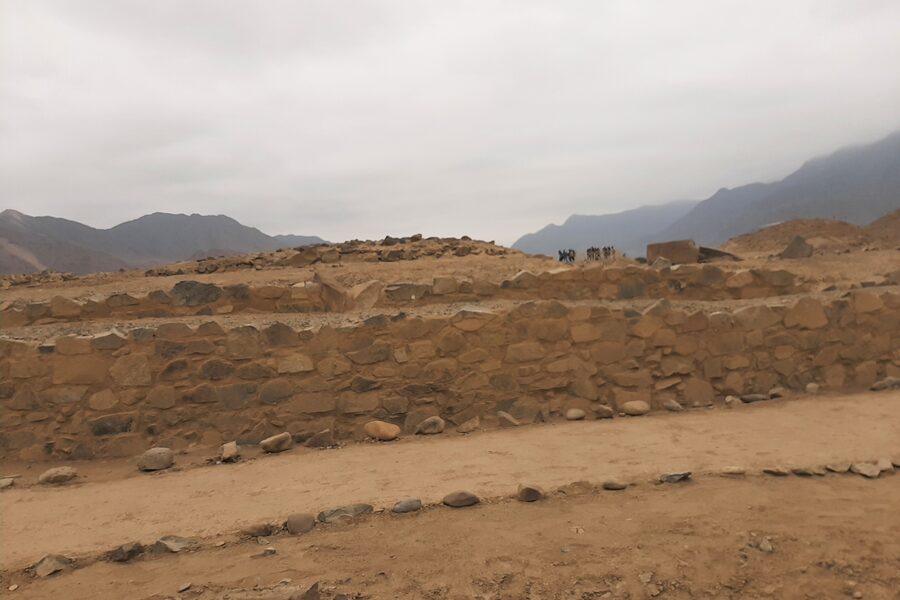
What strikes visitors at Caral is the monumentality of its constructions. The site includes six large platform pyramids, or huacas, the largest of which stands 18 metres tall and covers 160 metres per side. These structures were built using net bags filled with rocks, a simple but effective technique archaeologists call shicras.3
Caral also features sunken circular plazas, open-air amphitheatres likely used for ceremonial or musical gatherings. Thirty-two flutes made from bird and whale bones were recovered there, along with deer-bone horns, evidence of a rich ritual life. Remarkably, no pottery has been found at the site: Norte Chico is the only known complex civilization to have reached this level of organization without mastering ceramic art.
Excavations have also uncovered quipus, knotted cord devices characteristic of the Andes used to store and transmit information. Those found at Caral are the oldest ever discovered, suggesting that this recording system predated the Inca by thousands of years.
An Economy Built on Maritime and Agricultural Exchange
Norte Chico's economy rested on a remarkable balance between maritime and inland resources. Coastal populations fished anchovies and sardines in abundance, providing essential protein. Inland sites cultivated cotton on a large scale, not for food, but to make fishing nets, textiles, and rope to trade with coastal fishers.1
This complementarity between sea and land is thought to have been the economic engine that funded Norte Chico's monumental construction and fed its growing population. It represents a model of social organization built on cooperation and regional specialization rather than warfare and tribute.
No Evidence of War, Rich Evidence of Music
One of Norte Chico's most striking features is the near-total absence of warfare. No fortifications, weapons, or iconography of conflict have been identified across any of the sites in the complex. This stands in stark contrast to most other major ancient civilizations, where military domination typically played a central role in the consolidation of power.2
Inscribed as a UNESCO World Heritage Site in 2009, the Sacred City of Caral-Supe is now one of the most important archaeological sites in the Americas. It reminds us that social complexity can emerge through very different paths, and that civilization does not necessarily require warfare, writingWritingA system of conventional signs used to fix language or information durably; its appearance (c. 3300 BC) marks, by convention, the end of prehistory.→, or pottery.
La structure de vos articles est un modèle : accroche, développement, sources. Simple et efficace.
Deux mains, un outil, une intention. Depuis 2 millions d'années. Ce site me réconcilie avec mon métier.
Les migrations préhistoriques deviennent enfin lisibles quand on les relie à votre carte. Beau travail.