Along the tropical coasts of the Gulf of Mexico, between 1500 and 400 BCE, a civilization we call Olmec wrote the first chapters of Mesoamerican history. Before the Maya, before the Aztecs, before Teotihuacan, the Olmecs laid the religious, artistic, and political foundations on which all the great pre-Columbian cultures of Mexico would be built. Their designation as the "mother civilization" of Mesoamerica remains debated, but their pioneering role is indisputable.
Olmec Centers: San Lorenzo, La Venta, Tres Zapotes
Olmec civilization developed within the "Olmec heartland": a humid, hot coastal strip corresponding to the modern states of Veracruz and Tabasco. Three urban centers successively served as focal points of power.1
San Lorenzo was the first major center, active between 1500 and 900 BCE. This site, built atop an artificially elevated plateau rising several dozen meters, concentrated a powerful elite capable of mobilizing thousands of workers. It was at San Lorenzo that the oldest known colossal heads were carved.
La Venta succeeded it between 900 and 400 BCE. Located on a river island amid marshes, this site is famous for its 34-meter-tall pyramid and the monumental offerings buried within it: serpentine mosaics depicting jaguar masks, jade figurines, and ritual deposits of considerable value.
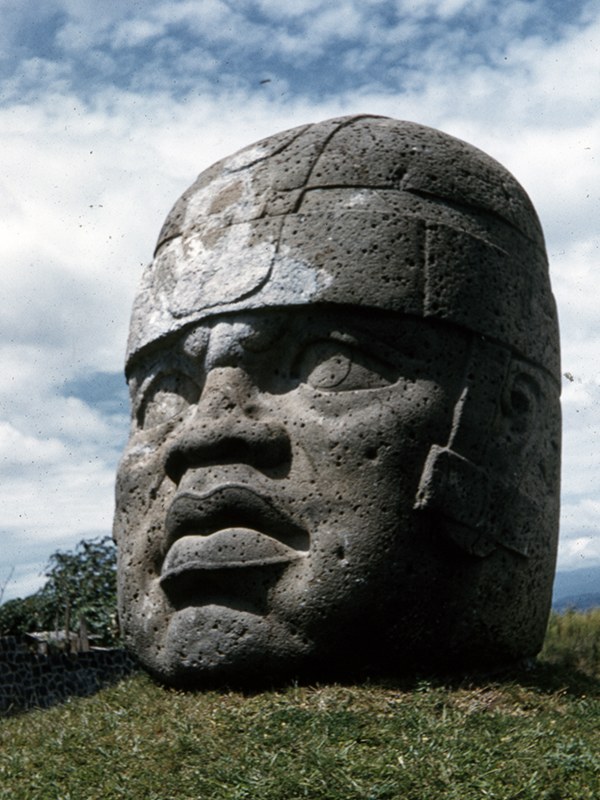
Colossal Heads: Portraits of Rulers
No Olmec object is more famous than the colossal heads. These monumental basalt sculptures, weighing between 6 and 40 tons and reaching 3.4 meters in height, depict human faces with individualized features wearing a characteristic helmet. Seventeen have been identified to date, distributed among San Lorenzo (10), La Venta (4), Tres Zapotes (2), and San Martin Pajapan (1).2
Most researchers agree in seeing them as portraits of Olmec rulers. Each head presents distinct physiognomic features, suggesting individual portraiture rather than a generic type. The helmet may evoke equipment used in the ritual ballgame, a fundamental sport in Mesoamerican cultures. The absence of a complete body remains a mystery: was this a symbolic choice or the reuse of earlier sculptures?
What astonishes is the logistics that producing these colossi required. The basalt used came from the Tuxtla Mountains, more than 80 kilometers from San Lorenzo and 100 kilometers from La Venta. Enormous blocks had to be extracted, transported on rafts via rivers and lagoons, then carved in situ with stone tools -- the Olmecs did not know metalworking. This enterprise required centralized political organization and considerable labor.
Jade: The Sacred Material
If basalt symbolized political power, jade was the sacred material par excellence. Jadeite and nephrite, whose green hue evoked water, vegetation, and fertility, were the preeminent prestige materials. Olmec craftspeople worked them with exceptional mastery, producing masks, figurines, jewelry, and ceremonial axes of remarkable refinement.
The ritual deposits of La Venta testify to jade's importance in Olmec religious life. Hundreds of jadeite axes were arranged in giant mosaics, buried and covered so they would never be seen -- offerings destined for subterranean deities. These ritual behaviors anticipate practices found later among the Maya and Aztecs.
Religion and Cosmology
Olmec iconography reveals a complex symbolic universe dominated by several recurring figures. The most enigmatic is the "Were-Jaguar," a half-human, half-feline creature whose upturned snout and toothless mouth characterize many sculptures. Some researchers see in it a rain and thunder deity, ancestor of equivalent deities in successor cultures.
The jaguar occupied a central place in Olmec cosmology, symbolizing night, the underworld, and shamanic power. Representations of human figures transforming into jaguars appear on numerous sculptures. This theme of metamorphosis between human and animal would be taken up by all subsequent Mesoamerican civilizations.3
Mother Civilization or Sister Civilization?
The notion of "mother culture" was popularized by archaeologist Matthew Stirling in the 1940s and defended notably by Miguel Covarrubias. It implies that the Olmecs directly gave rise to the great Mesoamerican cultures, transmitting religion, calendar, writingWritingA system of conventional signs used to fix language or information durably; its appearance (c. 3300 BC) marks, by convention, the end of prehistory.→, and iconography to them.
An alternative vision, defended notably by Richard Diehl and Kent Flannery, proposes the concept of "sister culture." According to this perspective, the Olmecs and other Formative-period cultures evolved in parallel, exchanging ideas and practices within trade networks, without any direct genealogical relationship being demonstrable.4
The debate is not merely academic: it touches on whether social complexity and major Mesoamerican cultural traditions had one or multiple independent origins. Recent discoveries, notably at the Aguada Fénix site (Tabasco), which reveals a monumental plaza 3,000 years old that predates classic Olmec constructions, further complicate this picture.
Whatever theoretical position one adopts, Olmec influence is undeniable: colossal heads, the ritual ballgame, the 52-year calendar, jaguar iconography, and perhaps the beginnings of Mesoamerican writing would travel through the centuries to nourish the cultures that would make pre-Columbian Mexico famous.
No comments yet. Be the first.