Off the northern tip of Scotland, lashed by Atlantic winds, the Orkney archipelago looks at first glance like the edge of the world. Yet five thousand years ago these islands were home to one of the most dynamic and inventive societies of NeolithicNeolithicThe "New Stone Age": a period marked by farming, herding, settlement and pottery, from around 10,000 BC.→ Europe. Since 2003, excavations at the Ness of Brodgar have uncovered a vast complex of monumental buildings that is forcing prehistorians to redraw the map of cultural influence in prehistoric Britain. The idea now taking hold is as simple as it is startling: what if the major innovations of the British Neolithic, from pottery to the architecture of sanctuaries, radiated from north to south rather than the other way around?
A Neolithic heart on the UNESCO list
Since 1999, four major Orkney monuments have made up the property inscribed on the World Heritage List as the Heart of Neolithic Orkney. The UNESCO committee describes them as a major prehistoric cultural landscape that gives a vivid picture of life in this archipelago some five thousand years ago.1
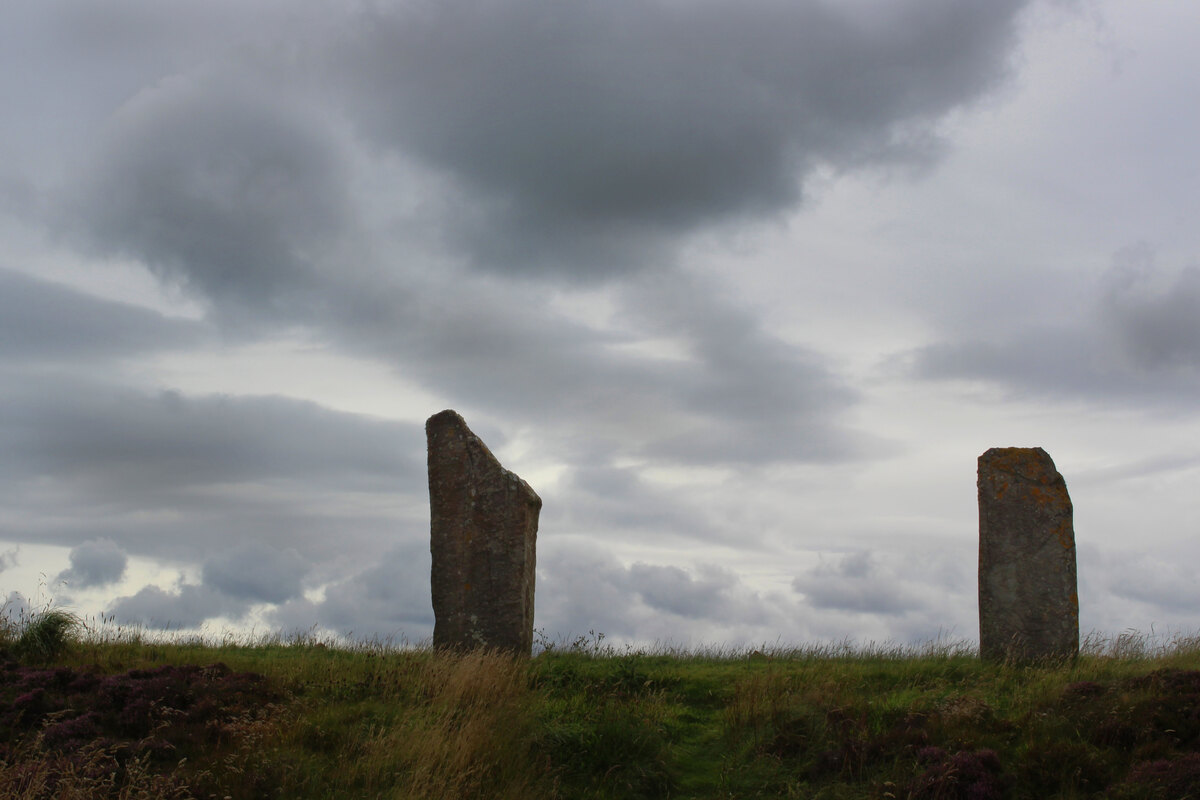
These four sites, the village of Skara Brae, the Maeshowe tomb, the Standing Stones of Stenness and the Ring of Brodgar, combine the domestic, the funerary and the ceremonial. Scattered across the Mainland, the largest island, they bear witness to a cultural tradition that flourished between roughly 3000 and 2000 BC.1 This concentration of remains is matched in Britain only by the Stonehenge and Avebury region in southern England. But in Orkney the local stone, a flagstone that splits into even slabs, allowed exceptional preservation, right down to the smallest interior fittings.
Skara Brae, a village frozen in time
On the Bay of Skaill, Skara Brae is the best-preserved Neolithic village in northern Europe. Occupied from roughly 3180 to 2500 BC, it comprises eight stone houses linked by covered passages and buried in a middenmiddenA mound of accumulated domestic refuse, used in Orkney as insulating material around dwellings.→, a refuse mound that insulated the dwellings against the harsh island climateClimateThe long-term average atmospheric conditions of a region; its variations (glaciations, aridifications) shaped migrations, agriculture and the collapse of prehistoric societies.→.2
What makes Skara Brae unique is its furniture. With no trees on the islands, the inhabitants carved everything from stone: box beds, shelves, water tanks and, above all, the "dressers" set facing each entrance, probably meant to display prized objects. Each house had a single room of about forty square metres, warmed by a central hearth. Because stone survived where wood would have vanished, we have here a snapshot of domestic intimacy five thousand years old, something extremely rare in the archaeological record.2
The site itself was only revealed in 1850, when a violent storm tore away the blanket of sand that had sealed it for millennia. Later excavation showed that the village had gone through several phases of building and a long occupation. An old track, the "low road," also linked Skara Brae to the Maeshowe tomb, passing close to Stenness and Brodgar. What emerges is a genuinely organised ritual landscape, in which the homes of the living, the sanctuaries and the houses of the dead answered one another across the Mainland.2
Stenness and Brodgar, the oldest stone circles
A few kilometres away, on a narrow neck of land between two lochs, stand two of the oldest stone circlesStone circleA Neolithic or Bronze AgeBronze AgeA protohistoric period following the Neolithic, defined by bronze metallurgy (a copper-tin alloy) and the rise of the first cities and states; in Egypt it corresponds to the age of the first pyramids.→ monument of standing stones set in a ring, often ritual or astronomical in purpose.→ in Britain. The Standing Stones of Stenness may be the earliest hengehengeA Neolithic circular enclosure bounded by a ditch and bank, often associated with standing stones.→ monument in the British Isles: radiocarbon dating of bones found in the ditch gives a range around 3100 to 2900 BC.3
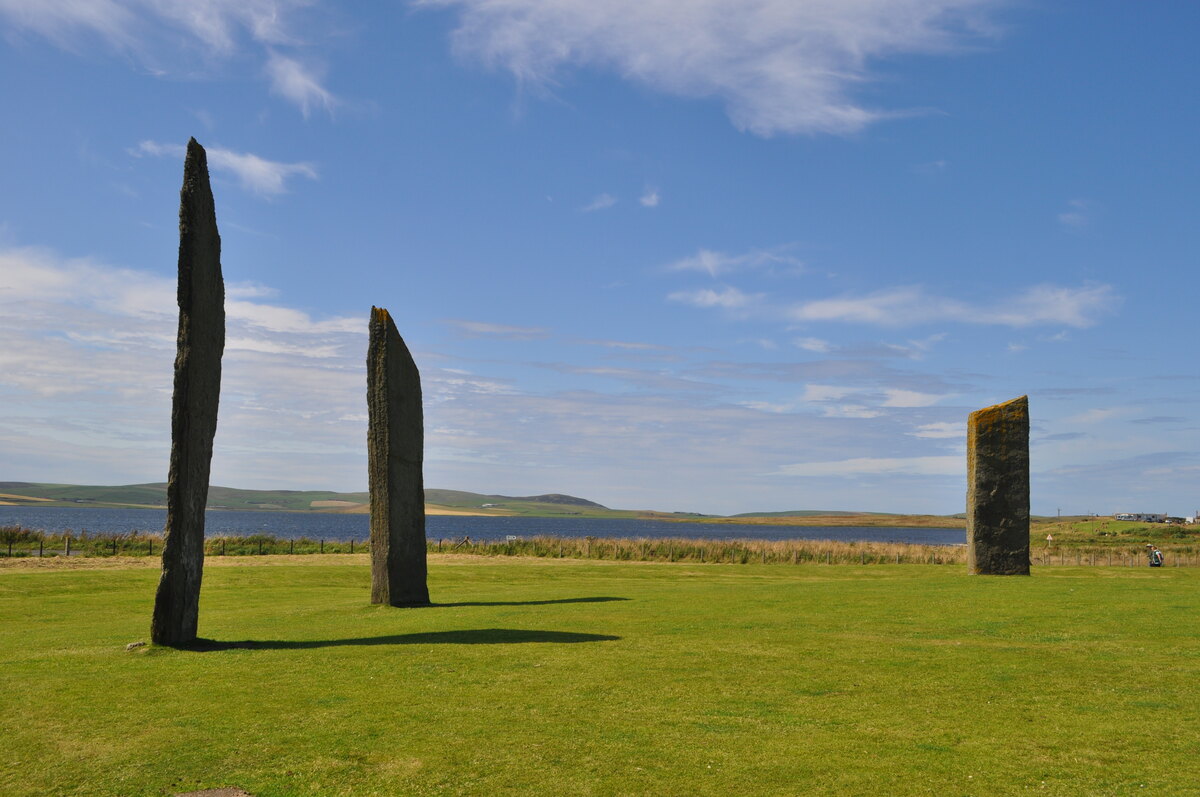
The Ring of Brodgar was raised about five centuries later, between 2600 and 2400 BC. This colossal megalithMegalithA large stone raised or assembled by humans (menhirMenhirA stone erected vertically by humans, standing alone or in rows (alignments), emblem of the Breton Neolithic megalithic tradition. From Breton men (stone) and hir (long).→, dolmenDolmenA megalithic funerary structure made of one or more capstones resting on vertical uprights, often topped by an earth tumulus. From Breton dol (table) and men (stone).→, stone circle), typical of the Neolithic and Bronze Age.→, 104 metres across, originally held around sixty standing stones set within a ditch cut into the bedrock. Its construction is estimated to have taken on the order of 80,000 hours of labour.4 The crucial point lies elsewhere: only the earliest phases of Stonehenge rival these Orcadian circles in age. The very idea of the henge, that circular sanctuary bounded by a ditch, may well have originated here in the north before spreading to the rest of the island.3
Maeshowe and the solstice light
A short distance from the circles rises Maeshowe, one of the largest passage tombs in Orkney. Built between 3000 and 2800 BC, some two centuries before the great pyramids of Giza, it consists of a grassy mound 35 metres across capping a stone chamber reached by an eleven-metre passage. Some of the slabs used weigh up to thirty tonnes, and construction is thought to have demanded around 100,000 hours of labour.2
Maeshowe's genius lies in its orientation. For the three weeks on either side of the winter solstice, the rays of the setting sun pour down the passage and strike the rear wall of the chamber. This staging of light, at the darkest moment of the year, reveals a fine command of astronomy and an elaborate symbolic mind. Centuries later, Vikings broke into the tomb and carved on its walls one of the richest collections of runic inscriptions in the world, giving this ancient monument a second life.2
The Ness of Brodgar, the discovery that changes everything
Everything shifted in 2003. A carved slab turned up by a plough, then a geophysical surveyGeophysical surveyTechniques (magnetometry, radar) detecting buried structures underground without digging, by measuring physical anomalies.→ revealing enormous anomalies beneath the fields, led to the start of excavation in 2004. Under the direction of Nick Card, work at the Ness of Brodgar would reveal, season after season until 2024, a complex of monumental buildings of unexpected scale, wedged precisely between the Ring of Brodgar and the Stones of Stenness.5
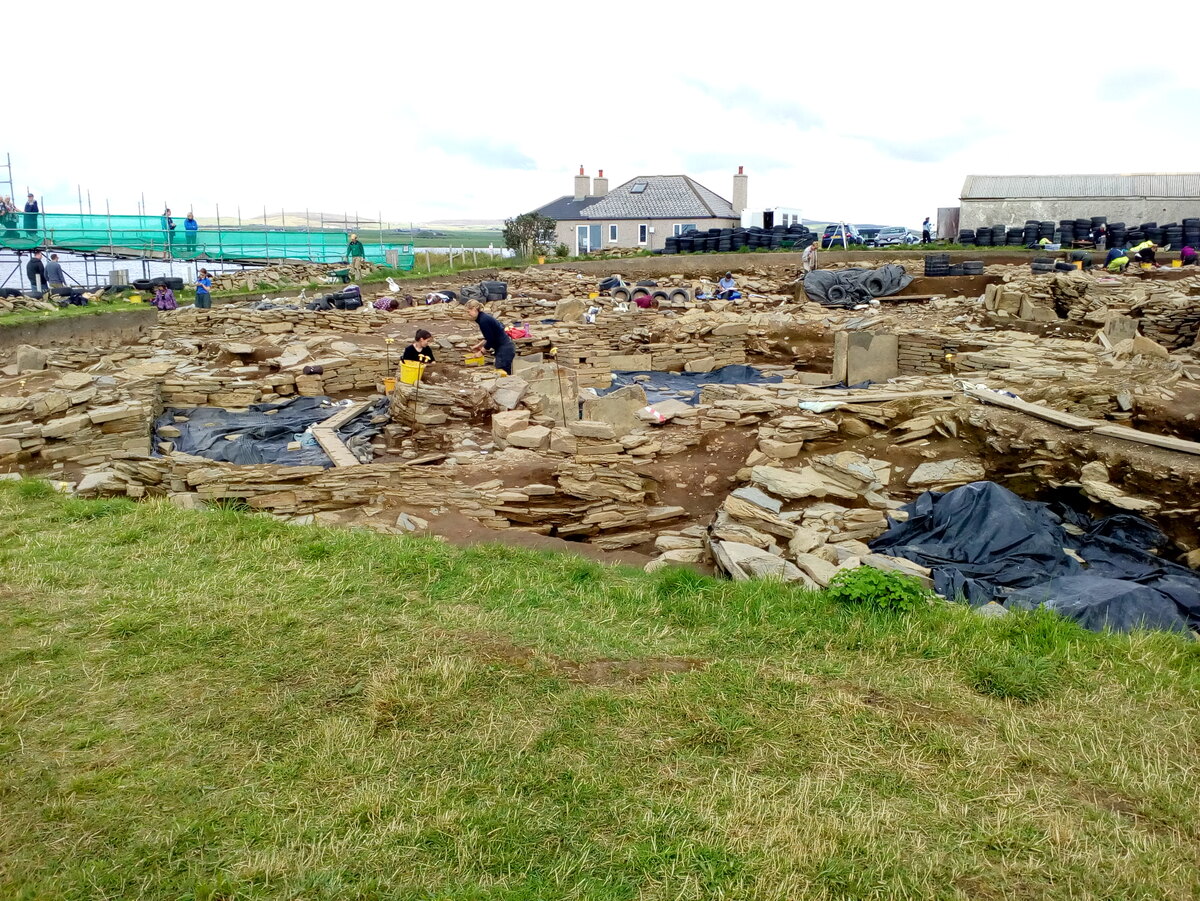
Occupied mainly between 3500 and 2400 BC, with peak activity around 3100 to 2500, the site covers roughly 2.5 to 3 hectares. It holds a sequence of large, architecturally sophisticated stone buildings ringed by a massive enclosing wall. Nothing here is domestic: everything points to a place apart, ceremonial and communal, which some now do not hesitate to call the "true heart" of Neolithic Orkney.5 The Ness has also yielded the largest assemblage of incised Neolithic art in the country, with more than a thousand decorated stones bearing incised motifs, cup marks and designs such as the celebrated "Brodgar butterfly." Remarkably, some stones still carry traces of red and yellow pigment: the walls were painted, tangible proof of Neolithic mural decoration.6
The dig has also refreshed our material picture of these buildings. Their walls, thick and carefully coursed, framed spacious interiors; the roofs, long assumed to be thatch, may have been partly covered with stone slabs, a real technical feat for the period. The bones recovered in their thousands, chiefly cattle brought from across Britain, speak of repeated communal feasts. In 2024, after twenty seasons, the team ran one final campaign before covering the site to protect the exposed structures from decay. The Ness went back underground, but transformed into an inexhaustible scientific archive.5
Grooved Ware, an invention that reaches the south
The most consequential revelation lies not in stone but in clay. The Ness of Brodgar has produced nearly 80,000 sherds of Grooved WareGrooved WareNeolithic flat-based, straight-walled pottery decorated with incised grooves and geometric patterns, first appearing in Orkney and later spreading across Britain.→, that flat-based, straight-walled pottery decorated with incised grooves and geometric patterns.5 Unlike the later Beaker vessels, this style is not an import from the continent. It appears to have originated in Orkney, most likely in the 32nd century BC, before spreading across the whole of Britain and Ireland.7
The diffusion was spectacular. Grooved Ware became a pan-British phenomenon and turns up among the builders of the first phases of Stonehenge, as well as at Durrington Walls and Marden in Wiltshire. On these southern sites, just as in Orkney, we find the traces of great communal feasts mingling animal bone and broken vessels. Whether the pottery itself travelled or only the idea of the style, the conclusion is the same: an Orcadian innovation spread more than a thousand kilometres to the south.7
Grooved Ware, moreover, is not monolithic. Archaeologists distinguish several regional variants: the Rinyo style with its elaborate incised motifs, peculiar to Orkney, the Durrington Walls style with broader grooves in southern England, and the Clacton-type forms among the earliest examples of the south-east. This diversity, grafted onto a single repertoire of northern origin, shows how an idea from the north was reinterpreted locally as it gained ground.7
A spectacular farewell, and a reversal of perspective
The story of the Ness ends with a striking piece of theatre. Around 2400 to 2200 BC, the great building known as Structure Ten was deliberately dismantled after a unique event: the slaughter of several hundred cattle. Archaeologists counted the remains of at least 400 head of cattle, whose shin bones had been cracked open to extract the marrow, the sign of a colossal feast. Whole deer carcasses were then laid over this heap of bones before the structure was destroyed.8
Why Orkney? Several factors seem to have converged. Settled life was possible here very early, the local stone offered an abundant and durable building material, and above all the sea routes linked the archipelago to the rest of the British Isles, carrying goods, people and ideas. Far from isolating these communities, the sea connected them. The chronological reversal is striking: when the first Orcadian circles were already standing, Stonehenge did not yet exist in its monumental form. The traditional sequence, which placed southern England at the vanguard of the island Neolithic, is thus turned around for a whole swathe of material culture.5
This great closing feast marks the abandonment of the site, but also the end of an era. Beyond its spectacle, it distils everything the Ness teaches us: a society able to marshal vast resources, orchestrate large-scale ritual and stage even its own ending. Taken together, the Orkney discoveries, the precocity of the Stenness and Brodgar henges, the northern origin of Grooved Ware, the architectural ambition of the Ness, sketch the portrait of a hub of innovation. The islands were not a periphery receiving fashions from the south; in part, they were their source. Twenty years of excavation at the Ness of Brodgar have thus turned our mental map of the British Neolithic on its head, placing a windswept archipelago at the centre of the story.5
Ce site me permet de donner de la profondeur historique à mes parties. Vraiment précieux.
Depuis ce site, j'ai arrêté les documentaires sensationnalistes. Bien plus fiable et bien plus intéressant.
Merci pour la qualité de l'écriture. On voit que les auteurs respectent leurs lecteurs.