In October 2000, in Kenya's Tugen Hills, a Franco-Kenyan team led by Brigitte Senut and Martin Pickford excavated fossils dating to approximately 6 million years, belonging to a species they named Orrorin tugenensis — "Original Man from the Tugen Hills." Nicknamed the "Millennium Man," it instantly became one of the most debated species in human paleontology.
The Tugen Hills Discovery
The Lukeino Formation, dated to approximately 6 million years by argon-argon, yielded over twenty specimens across four sites: teeth, jaw fragments, arm bones, a finger bone, and crucially, femoral fragments1. Published in Nature in 2001, the description came with a bold claim: Orrorin was already walking upright, with femoral morphology closer to Homo sapiensHomo sapiensThe present-day human species, which emerged in Africa around 300,000 years ago, the only surviving human lineage after the extinction of Neanderthals and Denisovans.→ than to australopiths.
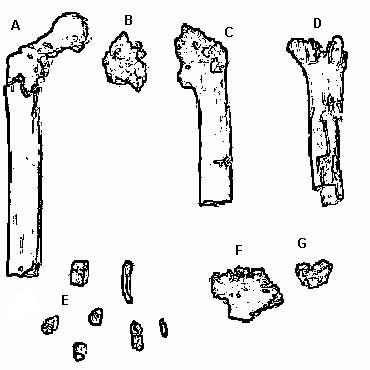
The BAR 1000'00 Femur: The Central Evidence
Specimen BAR 1000'00, a proximal left femur fragment, is the most critical Orrorin fossil. Senut and Pickford argue its large spherical femoral head, long neck, and teres fossa placement indicate habitual bipedalismBipedalismA mode of locomotion on two hind limbs, the defining trait of the human lineage, appearing over 7 million years ago. Visible in the anatomy of the pelvis, femur and foramen magnum.→ more modern than australopiths2. Richmond and Jungers counter that while the femur does indicate some bipedalism, its features are consistent with primitive rather than fully modern-like bipedal locomotion3.
Evolutionary Position
Orrorin tugenensis lived contemporaneously with Sahelanthropus tchadensis (6-7 Ma, Chad) and Ardipithecus kadabba (5.5-5.8 Ma, Ethiopia), three species that together document the earliest known hominins, close to the chimpanzee-human divergence estimated at 5-8 Ma. Whether Orrorin is directly ancestral to Homo (bypassing australopiths) or simply one of many early bipedal experiments remains unresolved. Its mosaic forest-edge habitat challenges the classic "savanna hypothesis" for bipedal origins.
No comments yet. Be the first.